As Police and Government are urging more caution on the roads, we look back at how this has been a lingering problem for Bermuda…
Police issued 75 tickets to road users from 4pm Friday through 7am Saturday – 60 of them for speeding. One person was clocked traveling 92 kilometers per hour.
The British lender said on Monday that Joo, most recently co-head of global investment banking at Bank of America, will join in early 2027 and become co-CEO of Barclays Investment Bank from February of that year, subject to regulatory approval
International News via Reuters:
Barclays has hired former Bank of America executive Mike Joo as co-chief executive of its investment bank alongside incumbent Adeel Khan, in the latest reshuffle of its senior ranks as CEO C.S. Venkatakrishnan seeks to improve revenues at the unit.
The British lender said on Monday that Joo, most recently co-head of global investment banking at Bank of America, will join in early 2027 and become co-CEO of Barclays Investment Bank from February of that year, subject to regulatory approval.
Khan, who currently leads Global Markets and has been co-head of the investment bank since 2021, will continue in the role. Both executives will sit on Barclays’ Group Executive Committee, its top decision-making body.
Joo spent nearly two decades at Bank of America, joining in 2006 and holding a series of senior leadership positions in its corporate and investment banking and markets businesses.
The appointment comes as the Barclays CEO known internally as Venkat tries to improve returns while preserving Barclays’ position as one of the few European banks with a sizeable U.S. investment banking operation.
Under the strategy unveiled in 2024, Barclays pledged to become a “simpler, better and more balanced” bank, while retaining its status as the leading non-U.S. global investment bank.
Reporting by Lawrence White; Editing by Alexandra Hudson
The rapid adoption of drugs made by Novo Nordisk and Eli Lilly has fuelled investor concerns that appetite-suppressing medicines could permanently reduce demand for packaged foods, snacks and beverages
International News via Reuters:
Nestle is seeking to turn the rise of GLP-1 weight-loss drugs from a threat into a business opportunity, using artificial intelligence and nutritional science to develop products aimed at millions of consumers taking medicines such as Ozempic and Wegovy.
The rapid adoption of drugs made by Novo Nordisk and Eli Lilly has fuelled investor concerns that appetite-suppressing medicines could permanently reduce demand for packaged foods, snacks and beverages.
Nestle believes the drugs are also creating a new market for products designed to address the side effects of rapid weight loss.
Chief Technology Officer Stefan Palzer told Reuters that Nestle was using AI and other technology to analyse clinical research, identify nutrient combinations and develop products tailored to GLP-1 users.
“We are well positioned with the portfolio. It’s a huge opportunity for our company,” he said.
Presentation materials shown to Reuters detailed side effects associated with rapid weight loss, including muscle loss and the loss of facial fat often referred to as “Ozempic face”, and outlined areas where Nestle believes its products can help address them.
The GLP-1 market is dominated by Eli Lilly’s Mounjaro and Zepbound and Novo Nordisk’s Wegovy and Ozempic.
Around 16 million Americans are taking GLP-1 medicines, according to Boston Consulting Group, a figure expected to rise sharply by the end of the decade.
Nestle’s response has been to develop products tailored to the needs of weight-loss drug users while using AI to accelerate research, product development and consumer analysis.
TACKLING SIDE EFFECTS
Palzer said Nestle’s scientists have been studying the consequences of rapid weight loss and developing products designed to help consumers manage them.
The company is using AI tools to process large volumes of clinical research and identify combinations of nutrients that may help support muscle health, hydration and nutritional intake.
Nestle has begun adding collagen protein to products under its Vital Proteins brand to address concerns around skin, hair and nail health linked to rapid weight loss.
“A big part of weight loss is that people lose lean muscle mass,” Palzer said.
“We found a combination of two micronutrients which we industrialized that stimulate the growth of muscle tissue. On one hand you provide protein, on the other hand you stimulate the muscle tissue to grow back faster.”
Palzer said Nestle had also patented combinations of proprietary ingredients designed to reduce appetite among consumers who often experience increased hunger after discontinuing GLP-1 treatments.
The company has already launched products aimed at GLP-1 users.
Nestle’s U.S. business created Boost Advanced Nutrition Shake, marketed as containing 35 grams of protein to support muscle health during weight loss. In Asia and Australia, Nestle has introduced a higher-protein version of its Milo malt drink called Milo PRO High Protein.
Rival ice cream makers are also wrestling with the same issues, turning to higher-protein products, smaller portions and simpler ingredient lists.
AI RECIPE BOOK
AI is playing a growing role throughout that process.
Nestle has developed internal systems to analyse scientific literature, simulate consumer behaviour, identify emerging trends and help product developers navigate a database of roughly 120,000 recipes.
Among those tools is an internal platform called Food Genie, which Palzer said helps scientists and product developers predict how recipes might perform and identify opportunities for reformulation.
“You can imagine if you’re a small company you have only a thousand recipes. It’s very difficult to model and predict recipes using AI,” he said.
“AI needs data.”
Nestle is also testing AI-driven consumer simulations designed to predict how shoppers will respond to new products and health claims before they reach shelves.
The company is also using AI to monitor social media and identify emerging consumer trends.
“You see noise around certain topics and then you can conclude whether that’s a lasting trend or not,” Palzer said.
“Increasingly AI will get into this field.”
NOT EVERYONE IS CONVINCED
Some nutrition experts question whether specialised products offer significant advantages over conventional foods.
“It’s quite sad that we turn to new products all the time that are more expensive than whole, fresh food that also contain the same protein and nutrients,” said Amanda Avery, associate professor in nutrition and dietetics at the University of Nottingham in central England.
She noted that meat, fish, eggs, dairy products, beans, nuts and pulses remain relatively inexpensive sources of protein and nutrients.
Still, Avery said products specifically marketed to GLP-1 users were likely to find buyers.
“Sadly, we are quite influenced by marketing,” she said. “Nestle will have done their research.”
Reporting by Richa Naidu; Editing by Adam Jourdan, Matt Scuffham and Keith Weir
Owners will receive an over-the-air radio software update via a prompt on the vehicle’s media screen when the update is available
International News via Reuters:
Chrysler-parent Stellantis said on Monday it is recalling 955,000 vehicles worldwide because radio software may prevent rear-view cameras from operating properly.
The recall includes 848,000 vehicles in the United States including various 2026 and 2027 model year Chrysler Pacifica, Pacifica Plug-in Hybrid and Voyager, Dodge Charger, Jeep Cherokee, Compass, Gladiator, Grand Cherokee, Grand Wagoneer, Wrangler and Ram 1500, 2500 and ProMaster vehicles. About 107,000 vehicles are being recalled in Canada, Mexico and other markets.
Owners will receive an over-the-air radio software update via a prompt on the vehicle’s media screen when the update is available.
Stellantis said it is unaware of any accidents or injuries related to the recall.
If the rear-view camera image does not appear, drivers should use their rear-view and side mirrors when reversing, the automaker said.
The National Highway Traffic Safety Administration in 2014 mandated rear-view cameras in all light-duty vehicles by 2018, saying on average the United States had 210 deaths and 15,000 injuries per year caused by backover crashes. About 30% of the deaths were children 5 or younger.
Reporting by David Shepardson; Editing by Sanjeev Miglani
The bus, which also had two drivers on board, was returning to Poland from a shrine to the Virgin Mary at Medjugorje in southwestern Bosnia and Herzegovina
International News via Reuters:
A dozen people were killed and at least 10 seriously injured after a Polish bus carrying 57 pilgrims veered off a motorway in eastern Hungary, in an accident that a survivor described as “unimaginable”.
Hungarian Prime Minister Peter Magyar said on Sunday in a Facebook post that the bus had run into a ditch and tipped over, at around 1 a.m..
The bus, which also had two drivers on board, was returning to Poland from a shrine to the Virgin Mary at Medjugorje in southwestern Bosnia and Herzegovina.
The injured were taken to hospitals in four nearby cities.
Crash survivor Helena Tluczek, from Lubenia, told Reuters from her hospital bed that she was on the phone with a friend back in Poland when the bus suddenly tipped over, and rolled. She suffered broken ribs and injuries to her shoulder and spine, and also hit her head, but remembered some of what had happened.
“All the seats were ripped out. People were under the seats; everyone was screaming for help,” she said. She pulled two people out from under the wreckage and then “clawed my way out of that vehicle with my hands”.
Tluczek managed to pull her sister out of the bus before collapsing.
“When I looked back, it was like … Mother of Jesus… It is not possible; it is unimaginable to see what it looked like inside that bus,” she added.
The accident happened near the town of Mezokeresztes in eastern Hungary, police said, on the way towards the city of Nyiregyhaza.
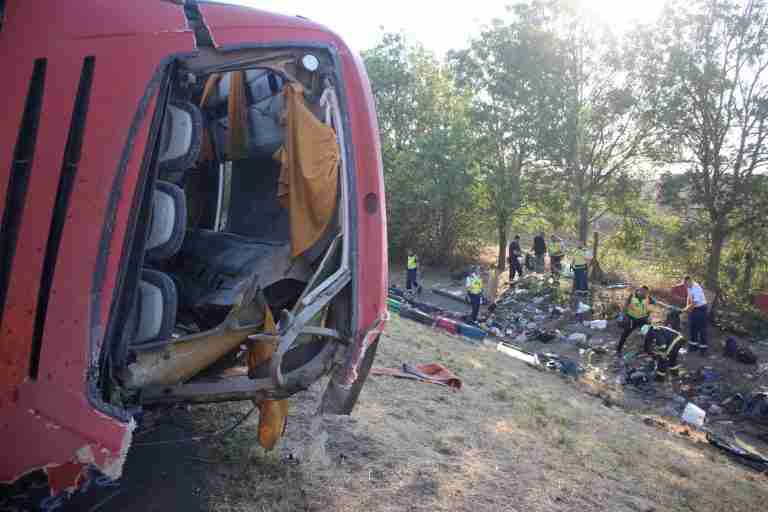
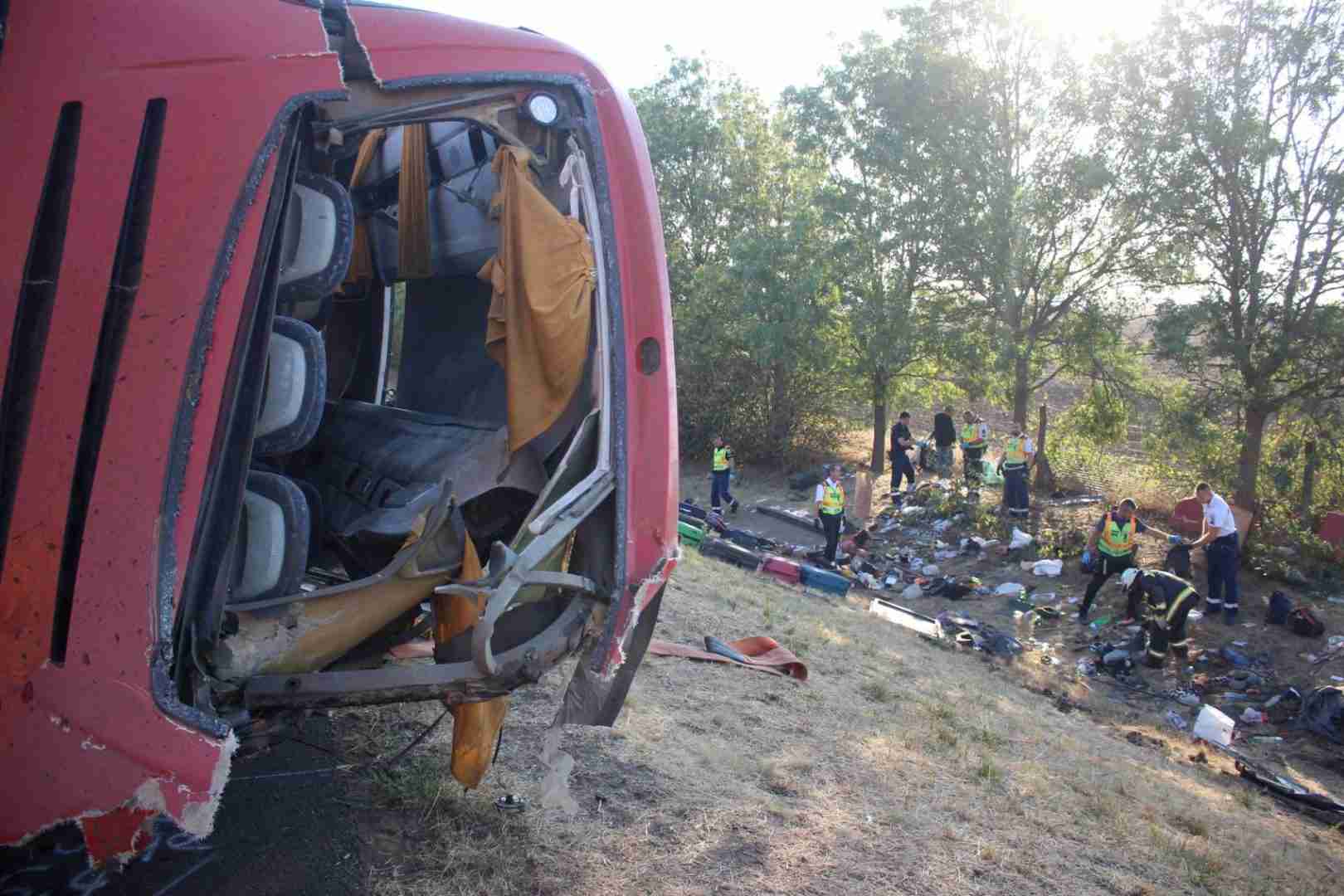
Pictures from the scene showed a badly damaged red bus lying on its side in a ditch by the motorway with windows smashed and belongings and suitcases scattered around.
“A Polish-registered bus … veered off the straight stretch of road into a ditch and overturned. Preliminary information suggests the driver likely fell asleep,” police said on their website, adding that the driver was being taken into custody.
Polish President Karol Nawrocki said on X: “It is with deep sorrow that I received the tragic news of the Polish bus accident in Hungary, in which so many of our compatriots died.”
In July 2002, a tourist bus carrying Polish pilgrims flipped over at a roundabout near Lake Balaton in western Hungary, killing 20 people.
Reporting by Balazs Kristof, Krisztina Than and Anita Komuves, additional reporting by Anna Koper in WarsawEditing by David Goodman, Kirsten Donovan
The survey was published a day before official data is also expected to paint a weak picture of the labour market
International News via Reuters:
British employers remain reluctant to hire and confidence has stayed near its weakest levels outside the COVID-19 pandemic, according to a survey published by the Chartered Institute of Personnel and Development (CIPD) on Monday.
The survey was published a day before official data is also expected to paint a weak picture of the labour market, something the Bank of England is watching as it considers its next moves on interest rates which have been on hold since December 2025.
• The CIPD’s net employment balance held at +9, close to its lowest level outside the pandemic
• Private-sector hiring intentions remained at +11, matching a record low outside the pandemic
• 57% of private-sector employers plan to recruit in the next three months, also a joint post-pandemic low
• Redundancy levels have not rise and CIPD sees “low-hire, low-fire” labour market
• Median expected pay rises remained at 3%, their level for more than two years
• 31% of employers had hard-to-fill vacancies and 14% expect significant recruitment difficulties in the next six months
• CIPD called for lower hiring costs and more support for youth employment
• The survey was based on responses from 2,017 employers between June 24 and July 24.
Writing by William Schomberg, editing by Andy Bruce
Progress towards peace talks and a resumption of oil tanker traffic through the strategic Strait of Hormuz has ground to a halt
International News via Reuters:
Iran has decided to shift its policy from defensive to “fully offensive” due to the deadlock in efforts to agree a permanent end to its war with the United States, a senior Iranian official told Reuters on Monday.
Progress towards peace talks and a resumption of oil tanker traffic through the strategic Strait of Hormuz has ground to a halt, with no sign that the warring parties are moving towards ending the conflict that the U.S. and Israel launched on February 28.
“Iranian entities must be prepared to escalate tensions in the Strait of Hormuz and wider region, as Iran will be ready to make decisions and take action on difficult decisions,” the Iranian official said, adding that Tehran would conduct a “timely and precise” military attack to break the U.S. naval blockade if diplomacy failed.
There was no immediate response to those comments from Washington, but U.S. President Donald Trump said in a phone interview with Fox News on Monday that Iran “should put up the white flag of surrender”.
Throughout the conflict, Trump has alternated between threats of escalation and assertions that a peace deal is imminent.
TRUMP THREATENS TO BOMB OMAN
Monday marked the day by which Iran and the United States were expected to reach a final deal under a memorandum of understanding agreed in June and aimed at ending the war.
Signed on June 17, the MoU set out a 60-day timeframe, extendable by mutual consent, by which Washington and Tehran should reach a broader agreement on issues including limiting Tehran’s nuclear programme and lifting U.S. sanctions.
That interim deal, which declared the “immediate and permanent termination of military operations on all fronts”, quickly unravelled, however, due to a dispute over control of the Strait of Hormuz, the narrow waterway through which a fifth of global oil and liquefied natural gas flowed before the war.
Tehran said point 5 of the MoU gave it the right to manage the strait, which it shares with Oman, while Washington rejected that interpretation. Hostilities resumed as Tehran began firing on vessels it said were trying to sail through the waterway on an unapproved route.
Trump said on July 7 that the pact was “over”. Tehran has repeatedly accused Washington of consistently violating its commitments.
“Within the short period of a few weeks set by Iran, all the agreement’s provisions must be implemented by the U.S. This is a precondition for further negotiations with the U.S.,” the Iranian official told Reuters, adding that mediators would share Tehran’s deadline with Washington and regional states.
Tehran has separately been negotiating an agreement with Oman over management of the strait, seen as a key component of a wider deal, and says they are close to agreement, although progress has been slow.
“If Oman gets in the way, we’ll bomb the shit out of them,” Trump told Fox.
There was no immediate comment from Oman.
HOUTHI ATTACKS RAISE FEARS OF WIDER WAR
Thousands of people have been killed in the conflict, mainly in Iran and Lebanon, since the U.S. and Israel launched attacks on Iran at the end of February. Iran has struck U.S. assets and infrastructure in countries including Oman, Jordan, Kuwait, Israel, the United Arab Emirates and Saudi Arabia.
Both Iran and the United States have stepped up rhetoric over the past week.
Trump warned Americans in a speech at a rally on Friday to prepare for continued high fuel prices as a result of the war, while also saying that “after we finish defeating Iran … pretty soon I’ll be declaring the Hormuz Strait a territory of the United States”.
Earlier on Monday, Trump posted on his Truth Social platform: “The number one Goal is, and always will be, that Iran cannot have, in any way, shape, or form, a Nuclear Weapon”, repeating one of his stated rationales for the war.
Benchmark Brent crude oil futures have surged since the start of the war in February, hitting a peak of $126 a barrel, roughly 75% above pre-war levels, with choppy trade reflecting concerns over disruptions to Gulf oil supplies and shifting signals on peace talks.
Brent crude rose slightly on Monday, to around $89 a barrel.
Attacks by Iran-backed Houthis in Yemen have also renewed concerns about a widening regional war and the economic fallout it could bring.
In the latest incident, the Houthis attacked what they called a Saudi military ship and four escort vessels in the Bab el-Mandeb Strait with missiles, according to the group’s military spokesperson Yahya Saree on Telegram on Monday. The strait is a strategic chokepoint connecting the Red Sea with the Gulf of Aden and an important international shipping route.
There was no immediate confirmation from Saudi authorities.
Reporting by Parisa Hafezi and Katharine Jackson; Writing by Alex Richardson; Editing by Hugh Lawson
An interim deal agreed to in June declared an “immediate and permanent termination of military operations on all fronts”, but quickly unraveled
International News via Reuters:
U.S. President Donald Trump said on Monday that Iran should surrender to end a war with the U.S. as talks between the countries remained stalled.
“They should put up the white flag of surrender,” Trump told a Fox News reporter during a phone interview.
An interim deal agreed to in June declared an “immediate and permanent termination of military operations on all fronts”, but quickly unraveled, with Trump saying it was “over” on July 7 and Iran’s foreign ministry declaring it “suspended” a week later.
Under that memorandum of understanding, Iran and the U.S. committed to negotiating a final deal — covering broader issues such as the fate of Iran’s nuclear programme — in a maximum of 60 days, extendable by mutual consent. Monday marks 60 days since the MOU was signed.
Separately, Oman and Iran have been in talks to try to reach an agreement to restore commercial shipping in the Strait of Hormuz, which carried 20% of the world’s oil and liquefied natural gas supplies before the U.S.-Israeli attacks on Iran began in late February.
“If Oman gets in the way, we’ll bomb the shit out of them,” Trump told Fox.
The dispute over control of the Strait of Hormuz has driven up fuel prices and put pressure on Trump to end a war that is unpopular at home ahead of the November midterm elections that will decide control of the U.S. Congress.
Trump told Fox News that the midterms were not impacting his strategy on Iran.
“Midterms have nothing to do with my thinking,” he said.
Earlier on Monday, Trump posted on his Truth Social platform: “The number one Goal is, and always will be, that Iran cannot have, in any way, shape, or form, a Nuclear Weapon,” repeating one of his stated rationales for the war.
Reporting by Katharine Jackson; editing by Michelle Nichols and Mark Porter
Wildfires have ripped through Europe this summer, with successive heatwaves fuelled by climate change intensifying drought and leaving vegetation tinder-dry
International News via Reuters:
Rain over eastern Belgium on Monday brought some relief to firefighters battling to contain the country’s biggest wildfire on record, which had threatened to reach the German border.
Wildfires have ripped through Europe this summer, with successive heatwaves fuelled by climate change intensifying drought and leaving vegetation tinder-dry.
From France and Spain to Greece, fires have killed more than 20 people, forced hundreds of thousands to flee their homes and burned 576,000 hectares (2,225 square miles) across Europe this year, data from the European Forest Fire Information System shows – an area twice the size of Luxembourg.
ARMY, FARMERS BATTLE BELGIUM’S BIGGEST FIRE
In Greece, an elderly couple died at the weekend as fires swept through the island of Salamina, where 500 people were evacuated by ferry after wind pushed the flames into residential areas.
Spanish firefighters stabilised a massive wildfire in Andalusia in the south that has burned nearly 40,000 hectares (98,842 acres)since August 6, while a fire in the tourist town of Omis, Croatia, forced 1,000 people to flee.
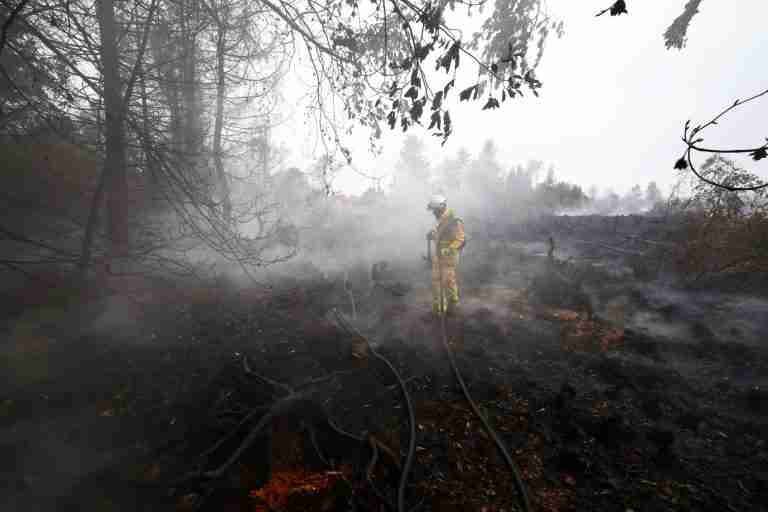
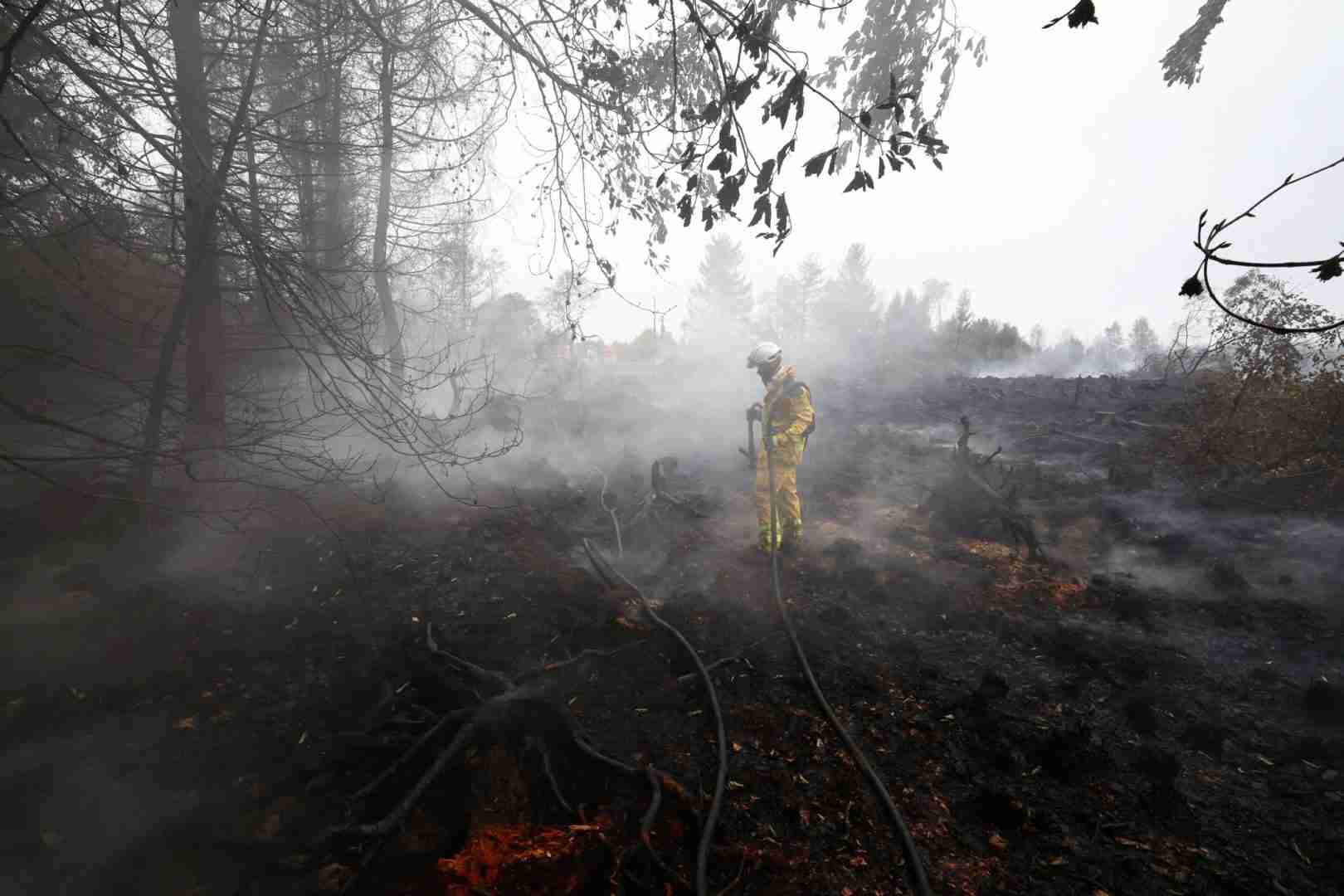
In Belgium, firefighters aided by rain and lower temperatures early on Monday had contained parts of the blaze in the High Fens, a nature reserve in the east of Belgium which has been burning since Friday – following a heatwave that saw thermometers in parts of Belgium hit 37 degrees Celsius (98.6 degrees Fahrenheit).
“This is the biggest ecological disaster in terms of forest fires, that’s clear, for Belgium,” said Nicolas Yernaux, a spokesperson for the administration of the Wallonia region.
“We can’t say that the fire is contained. It flares up all the time,” he told Reuters.
Some 500 firefighters from across Belgium, neighbouring Germany and Luxembourg, as well as farmers, soldiers and reinforcement aircraft from the European Union’s emergency reserve, have been battling the blaze.
Having burned 3,000 hectares (7,400 acres), the wildfire is Belgium’s biggest on record, far surpassing a blaze in 2011 which burned close to 1,400 hectares. Evacuated residents have not yet been allowed to return home.
The fire has penetrated the nature reserve’s metres-deep peat bogs – meaning it could take months to fully extinguish. Peat fires can smoulder underground, without flames, for long periods.
EUROPE’S FIRE SEASON FAR FROM OVER
Extreme fire risk has become a regular part of European summers in recent years, as hotter, drier weather caused by climate change has combined with other factors – including rural abandonment, which has left land untended and allowed flammable, dry vegetation to build up in forests – to fuel fast-spreading fires.
Fires were also raging on Monday in northeastern Spain, where a firefighter died on Sunday, and in northern Portugal’s Braganca district.
About 90% of wildfires are ignited by human activities, such as campfires or discarded cigarettes. Prosecutors in Belgium have opened an investigation into the cause of the blaze.
German firefighters were also working to contain a fire front 1.5 km (0.9 miles) away from buildings in the evacuated German village of Ruitzhof, close to the Belgian border. A local fire department spokesperson said the situation was “static”.
Europe had already suffered its worst fire season on record last year, with more than a million hectares of land burned. Some countries, including France, have smashed through their annual records this year, with the traditional June-September fire season far from over.
Dozens of people in the village Le Porge, in southwestern France, where hundreds of homes were destroyed by a megafire last month, booed French Prime Minister Sebastien Lecornu as he visited on Monday. Residents have criticised the government’s response and accused authorities of prioritising richer areas.
Reporting by Bart Biesemans, Yves Herman, Inti Landauro, Kate Abnett, Andreas Kranz, Petra Wischgoll, Ivana Sekularac, Andrey Khalip; Editing by Toby Chopra, Alex Richardson and Helen Popper
Lester Nelson, the Chief Executive Officer of the Bermuda Airport Authority for the past 9 years will retire 1 October 2026
The Bermuda Airport Authority has announced that Chief Executive Officer Lester Nelson will retire effective 1 October 2026, after more than nine years of leadership.
According to the Authority, Mr Nelson joined in March 2017 as its first employee. The Authority replaced the Department of Airport Operations, where he previously worked as Manager of Air Operations for eight years.
As the Authority’s first CEO, he led its establishment during a significant period of change in Bermuda’s aviation sector.
Airport Authority Chairman Lawrence Scott thanked Mr Nelson for his contribution to the organisation and Bermuda’s aviation sector.
Mr Scott said: “Lester led Bermuda Airport Authority through its start-up and formative years during a significant period of growth and development. On behalf of the Board, I thank him for his leadership and service and wish him a very well-deserved retirement.”
During his time in the role, Mr Nelson oversaw the Authority’s participation in the 30-year public-private partnership with Bermuda Skyport Corporation Limited and the $400 million redevelopment of L.F. Wade International Airport.
He also led the insourcing of air navigation and weather services, and oversaw the installation of strategic assets including the Instrument Landing System, Automated Weather Observation System and Doppler Weather Radar.
The Authority said Mr Nelson led the organisation through the operational challenges of the COVID-19 pandemic.
Reflecting on his tenure, Mr Nelson said: “I am fortunate to have had the opportunity to lead Bermuda Airport Authority from its earliest days and to see how much the organisation has developed. I thank our strategic partners for their support and, most importantly, our team whose commitment to safety and operational excellence has made that progress possible.”
The Authority said its Board will complete its search for a substantive CEO. It remains focused on the safe, efficient and resilient delivery of Bermuda’s aviation and weather services.
Media release supplied by the Bermuda Airport Authority.
The Government has unveiled a new accessible chair lift at the National Sports Centre Aquatic Centre, aimed at making the pool more inclusive for persons with disabilities, older adults and others who require assistance entering or exiting the water.
Minister of Youth, Social Development and Seniors Tinee Furbert said the equipment represents a practical step towards removing barriers that can prevent people from participating in recreation and aquatic programmes.
“Accessibility is not an added convenience,” Minister Furbert said, stressing that equal access can determine whether someone is able to participate or is left on the sidelines.
The Minister said the initiative supports Bermuda’s commitments under the United Nations Convention on the Rights of Persons with Disabilities, which calls for equal access to public facilities and participation in sport, recreation and leisure activities.
She added that accessibility should not be treated as a one-off project or an afterthought, but incorporated into the design of government policies, programmes, facilities and services.
The new lift was demonstrated by Cornell Bailey Jr., a client of the K. Margaret Carter Centre, showing how the equipment will assist users in safely accessing the pool.
Minister Furbert acknowledged that more work remains to improve accessibility across Bermuda, adding: “Today, the water is open to more of us than it was yesterday.”
To provide the best experiences, we use technologies like cookies to store and/or access device information. Consenting to these technologies will allow us to process data such as browsing behavior or unique IDs on this site. Not consenting or withdrawing consent, may adversely affect certain features and functions.
Functional
Always active
The technical storage or access is strictly necessary for the legitimate purpose of enabling the use of a specific service explicitly requested by the subscriber or user, or for the sole purpose of carrying out the transmission of a communication over an electronic communications network.
Preferences
The technical storage or access is necessary for the legitimate purpose of storing preferences that are not requested by the subscriber or user.
Statistics
The technical storage or access that is used exclusively for statistical purposes.The technical storage or access that is used exclusively for anonymous statistical purposes. Without a subpoena, voluntary compliance on the part of your Internet Service Provider, or additional records from a third party, information stored or retrieved for this purpose alone cannot usually be used to identify you.
Marketing
The technical storage or access is required to create user profiles to send advertising, or to track the user on a website or across several websites for similar marketing purposes.