The over 50s event takes place on Friday at the Flora Duffy Stadium
The Ministry of Health is reminding individuals aged 50 and above to register now for the Move More Bermuda Games 2026, taking place on Friday, June 19th, from 6 pm to 8 pm at the Flora Duffy Stadium. Registration ends on Wednesday, June 17, 2026, and is open to anyone aged 50 and older at trackie.com/event/movemorebda. The fee is $10, and the first 100 registrants receive a free swag bag.
This year’s Games promise an exciting evening of friendly competition, movement, and community spirit. Participants can take part in the 100m, 200m dash, 400m race walk, long jump, shot put, and 4x100m relay. Multi-event consisting of 60m, standing long jump, and Turbo javelin.
The event is free for spectators and will feature food vendors, live entertainment with DJ iBreeze, fun castles, health and wellness displays, and giveaways. The evening will be hosted by Powergirl, Patrina O’Connor‑Paynter, bringing her signature energy and encouragement to the Games.
Minister of Health, Kim Wilson, JP, MP, shared: “We are truly excited for this year’s Move More Bermuda Games. The energy, the activities, and the spirit of friendly competition make this one of our most enjoyable community events. We look forward to seeing participants on the track and hope that families, friends, and supporters will come out to watch, cheer, and enjoy the evening together.”
Presented by the Department of Health, in partnership with the Bermuda National Athletics Association (BNAA) and other government and private sector organisations, the Move More Bermuda Games offers a welcoming space for friendly competition, community connection, and fun.
Media release supplied by the Government of Bermuda.
Businesses and government bodies that were testing AI tools a year ago are now using them to run more complex processes and improve productivity
International News via Reuters:
Adoption of artificial intelligence has reached a “tipping point” in Britain, as companies move from experimentation to large-scale deployment and start seeing returns, a Google Cloud executive said on Wednesday.
Businesses and government bodies that were testing AI tools a year ago are now using them to run more complex processes and improve productivity, Maureen Costello, Google Cloud’s vice president for the United Kingdom, Ireland and Sub-Saharan Africa, told Reuters in an interview.
“Industry is on the cusp of a tipping point where AI adoption is accelerating quickly,” Costello said. “A year ago the focus was on experimentation, but now we’re seeing organisations put AI into production and begin to realise real returns.”
The shift is evident across sectors from retail to government, she said, citing examples such as AI-powered shopping tools from British e-commerce firm THG that have boosted customer spending, and public-sector systems helping to speed up planning decisions.
London, home to Europe’s largest concentration of tech talent, is seeking to cement its position as a global AI hub, with Prime Minister Keir Starmer pushing to position Britain as an AI “superpower”.
Costello said Britain was “leading in this space”, pointing to a strong research base and institutions such as Google DeepMind in London.
Broader adoption could deliver significant gains for smaller firms, she added, with Google research suggesting that AI could boost productivity by about 20%, effectively giving business owners “a day back” each week.
However, the pace of AI adoption will depend on investment in skills, leadership engagement and trust, particularly around security and data sovereignty.
“Technology is only half of the answer — people are the other half,” Costello said. “Leaders can’t sleep at the wheel, they need to get hands-on and understand how to apply this in their organisations.”
Reporting by Sam Tabahriti, editing by Milla Nissi-Prussak
Google must rank organic search results using objective criteria, increase transparency around rankings, introduce clearer complaint processes, and allow users to transfer their search data to authorised third parties
International News via Reuters:
Britain’s competition watchdog ordered Google to provide greater transparency on how its search rankings work, part of new rules aimed at securing a “fairer deal” for businesses and addressing concerns over the U.S. tech giant’s dominance in the sector.
Google must rank organic search results using objective criteria, increase transparency around rankings, introduce clearer complaint processes, and allow users to transfer their search data to authorised third parties, the Competition and Markets Authority said on Wednesday.
A Google spokesperson said it was committed to protecting the integrity of its systems and would work with the CMA, adding the company’s ranking systems were “fair, transparent and show the most relevant, highest quality results”.
Google faces increasing regulatory scrutiny across the world, including in the United States and the European Union. The company in March said it was developing new search controls to address British competition concerns.
REGULATOR WARNS OF FURTHER ACTION
The CMA had assigned “strategic market status” to Google, allowing it to set targeted rules to increase transparency. The company accounts for more than 90% of UK search queries.
“Step by step, we’re ensuring that Google’s search services work better for businesses and consumers across the UK,” CMA Executive Director Will Hayter said.
The new measures build on existing requirements announced by the regulator earlier this month which enable publishers to stop their content being used to power Google’s AI features.
UK businesses told the regulator that Google’s current ranking practices were neither fair nor transparent, with changes made without sufficient notice, and that the uncertainty was holding them back from investing in their own companies, according to the CMA.
The regulator said it may introduce further measures if necessary.
Google has six months to implement the fair ranking requirement, and three months for the data portability requirement, the CMA said.
Reporting by Muvija M; editing by Sarah Young; Editing by Kirsten Donovan
Sterling weakened a little against the U.S. dollar after the data, British government bond yields fell to a new two-month low and investors slightly trimmed their expectations for a rate increase later this year
International News via Reuters:
British inflation held at 2.8% in May, unchanged from April’s 13-month low and below forecasts from both economists and the Bank of England, official figures showed on Wednesday, a day before the central bank’s next interest rate decision.
Sterling weakened a little against the U.S. dollar after the data, British government bond yields fell to a new two-month low and investors slightly trimmed their expectations for a rate increase later this year.
Economists polled by Reuters had forecast a rise to 3.0% for May, and the BoE in April predicted an increase to 3.3% as the U.S.-Israeli war on Iran kept British inflation almost a percentage point higher than the central bank had forecast in February.
Lower prices than in April for meat, vegetables, dairy products and domestic heating oil helped offset a jump in airfares and petrol prices, the Office for National Statistics said on Wednesday.
UK INFLATION HAS LONG BEEN ABOVE TARGET
Inflation has been above the BoE’s 2% target for most of the past five years. In April, the BoE said it was likely to rise above 3.5% by the end of the year and potentially exceed 6% early next year under the most adverse of three scenarios.
However, financial markets this week have drawn comfort from an interim agreement between the U.S. and Iran which promises to reopen the Strait of Hormuz, a major corridor for oil exports, and is due to be signed in Switzerland on Friday.
“Today’s data strengthens the case for a continued cautious approach from the Bank of England,” Yael Selfin, chief economist at KPMG, said.
“Underlying inflationary pressures have yet to show clear signs of strengthening, which is likely to underpin a majority decision within the Monetary Policy Committee to hold interest rates at Thursday’s meeting,” she said.
Economists polled by Reuters expect the BoE’s Monetary Policy Committee to vote 7-2 to keep rates on hold at 3.75%.
While Governor Andrew Bailey says the BoE has time to wait to assess the impact of the conflict, some policymakers worry businesses will use it to raise prices more broadly, or that it could dent households’ confidence in the BoE inflation target.
A quarterly BoE survey released last week showed the public’s expectations for inflation in five years’ time were the highest since the series began in 2009 at 3.9%.
VOLATILE AIRFARES
Britain has been more affected than most Western countries by the conflict due to its reliance on imported natural gas, and manufacturers reported an 8.7% annual rise in their raw material costs for May, the biggest since February 2023.
“A chunk of inflation is locked in the system now,” Rob Wood, chief economist at Pantheon Macroeconomics, said. He now predicts inflation will peak at 3.4% in November, down from his previous forecast of 3.6% before the Iran deal, and he no longer expects the BoE to raise rates this year.
Services price inflation – which the BoE views as a guide to underlying price pressures – rose to 3.7% in May from 3.2% in April, in line with economists’ forecasts.
The rise in services inflation partly reflected a 10.3% monthly jump in airfares, which are volatile. High Easter prices were not captured in April 2026 data but were in 2025.
Core inflation, which excludes food, energy, alcohol and tobacco prices, rose slightly less than expected to 2.6% from 2.5%.
Reporting by David Milliken and Suban Abdulla; Editing by Alison Williams and Hugh Lawson
The ECB fears workers will demand compensation for rapid inflation, much like in 2022, triggering a self-reinforcing cycle that can only be tamed through higher borrowing costs
International News via Reuters:
Euro zone negotiated wage growth appears to be slowing as predicted, European Central Bank data showed on Wednesday, offering policymakers relief that the Iran-war-induced inflation surge has not set off a fresh round of pay demands.
The ECB fears workers will demand compensation for rapid inflation, much like in 2022, triggering a self-reinforcing cycle that can only be tamed through higher borrowing costs.
However, the ECB’s own wage tracker, which includes data up to the end of May, was unrevised and indicates negotiated wage growth at around 2.6% by end-2026, below the 3.2% last year.
The data series with unsmoothed one-off payments shows wage growth for the whole of 2026 at 2.6%, down from 3% a year earlier, said the ECB, which has long argued that wage growth between 2% and 3% is consistent with its 2% inflation target.
Though just one piece in the inflation puzzle, the data may take pressure off policymakers to quickly raise rates again.
The ECB lifted its benchmark rate to 2.25% last week after inflation exceeded 3%, mostly to prevent expectations from rising, and policymakers are now debating whether a follow-up move in July is needed.
Markets expect between one and two more rate hikes over the coming year and the next move is fully priced in by October.
Reporting by Balazs Koranyi; Editing by Alex Richardson and Alexander Smith
The leaders met for a summit in the French town of Evian-les-Bains on Lake Geneva, while details of the U.S.-Iran ceasefire agreement trickled out of Washington and Tehran ahead of its formal unveiling, expected on Friday across the nearby Swiss border
International News via Reuters:
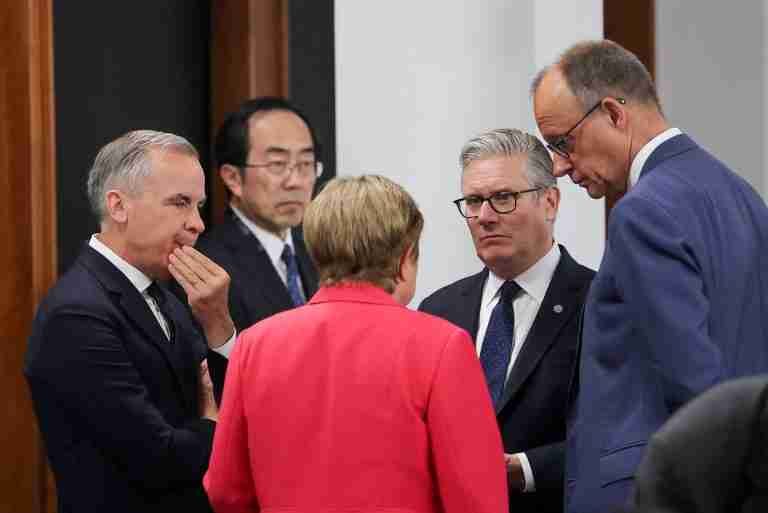
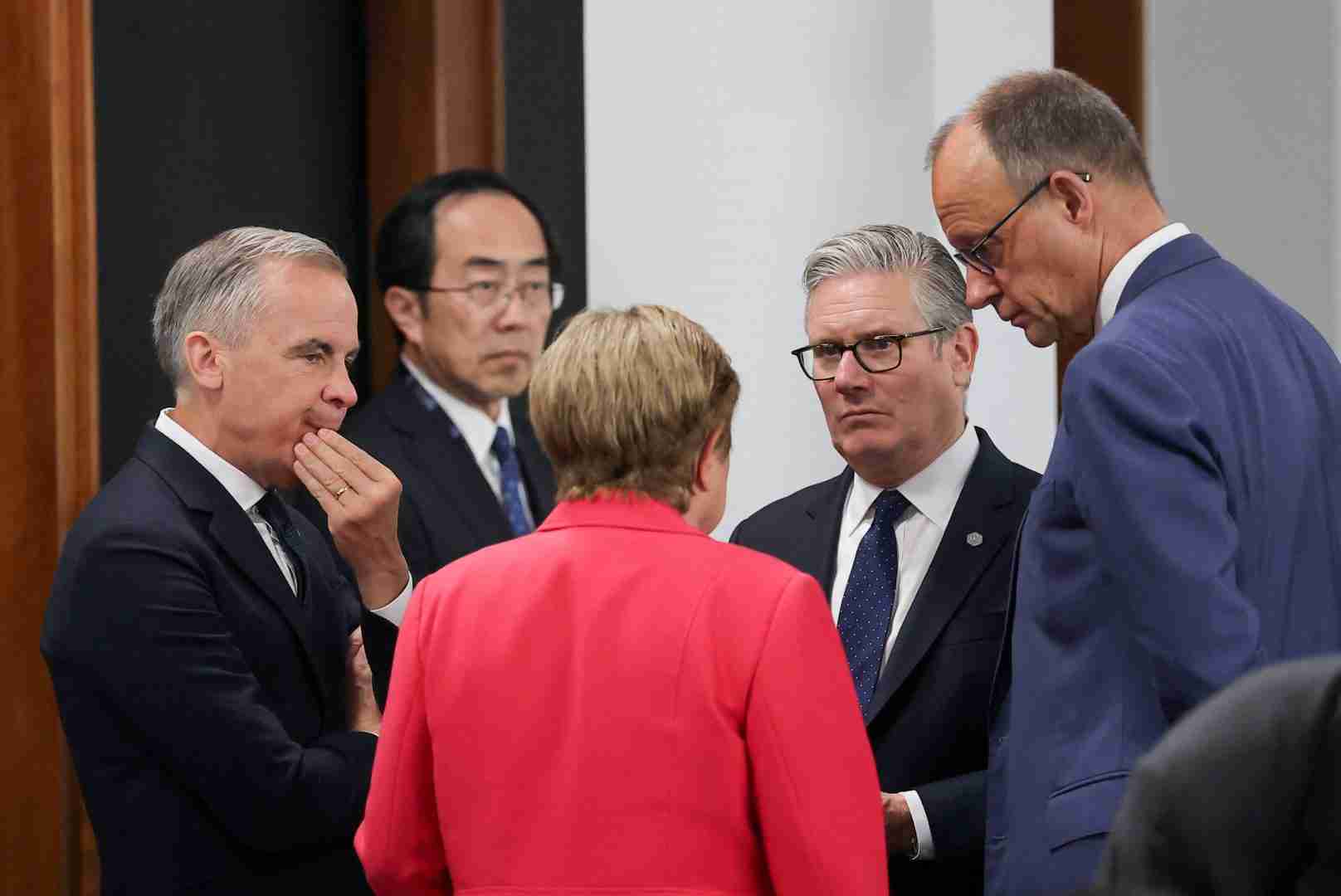
Leaders of the G7 countries demanded a ceasefire in Lebanon on Wednesday and said they will diversify energy supply routes to reduce dependence on the Strait of Hormuz in response to the war in Iran, as they welcomed an interim deal to end the conflict.
The leaders met for a summit in the French town of Evian-les-Bains on Lake Geneva, while details of the U.S.-Iran ceasefire agreement trickled out of Washington and Tehran ahead of its formal unveiling, expected on Friday across the nearby Swiss border.
The U.S.-Iran agreement is expected to launch negotiations towards a final settlement to end the war, which has killed more than 7,000 people, mostly in Iran and Lebanon.
“We underline the need for the negotiation … to address the threats posed by Iran in the region and beyond and ensure that they never obtain a nuclear weapon,” the leaders said in a statement.
The summit gave U.S. President Donald Trump a chance to present his deal with Iran to major allies Britain, Canada, France, Germany, Italy and Japan.
They mostly share Washington’s concerns about Iran’s nuclear programme and other issues, but never endorsed his decision to go to war and worry that Tehran gained leverage by withstanding the superpower onslaught and asserting control over the strait.
The leaders said they were ready to contribute to the implementation of the accord, with a coalition led by Britain and France set to help secure shipping once the Strait of Hormuz reopens as expected on Friday.
The memorandum of understanding signed by Washington and Tehran this week, though yet to be made public, extends a ceasefire announced in April by another 60 days to allow the warring countries to negotiate a permanent truce.
The U.S. president appears to have achieved little of what he said he wanted at the outset of the war. Iran’s theocratic government remains in place, its stockpile of highly enriched uranium has not been surrendered, its ballistic missile capabilities have not been destroyed and it has not ended its support for anti-Israel militias like Hezbollah in Lebanon.
Trump said the agreement states that Iran will not have a nuclear weapon – a restatement of Iran’s official position since the 1970s – and U.S. officials say further discussions will lead to the removal or destruction of its enriched uranium stockpile.
But ending the war on such terms could still expose Trump to criticism, including from hawks within his own Republican party, ahead of midterm elections in November.
TRUCE IN LEBANON?
One of the biggest questions still hanging over the truce is the fate of Lebanon, which Israel invaded in March to root out Hezbollah after the militant group fired across the border in solidarity with Tehran following U.S.-Israeli strikes on Iran.
Israeli forces still occupy a swathe of southern Lebanon, where more than a million people have been driven from their homes, while Hezbollah remains undefeated.
Iran says the ceasefire must also end hostilities in Lebanon, and that a permanent deal must lead to an Israeli withdrawal. Israel, which was excluded from the U.S.-Iran peace negotiations, says it will not withdraw and reserves the right to use military force.
That has opened up a rift between Israel and the United States, with Trump publicly berating his wartime ally Israeli Prime Minister Benjamin Netanyahu. On Tuesday Trump said at the summit that he was “not happy” with the way Israel had handled itself.
“Without us, without the United States, there would be no Israel. Without me, there would be no Israel, because no other president was willing to do what I did,” Trump said.
In their statement, the G7 leaders called for an “immediate robust ceasefire” in Lebanon and the disarmament of Hezbollah.
A Hezbollah spokesperson told Reuters the group believed Iran would not agree to a permanent truce if the Israeli occupation did not end.
After decades of U.S. and international financial sanctions that pushed Iran’s economy to the brink, a peace deal could deliver economic benefits. The memorandum includes a $300 billion reconstruction fund, paid for by neighbouring Gulf states, if Iran complies with other terms.
In the coming 60 days, negotiators will return to difficult issues such as the future of Iran’s nuclear programme. But Iran’s support for regional militia groups and its missile arsenal do not appear to be on the agenda, in what would amount to major U.S. concessions.
Oil prices fell again on Wednesday on prospects for the reopening of the Strait of Hormuz, with Brent crude futures below $80, at their lowest level since the opening salvos of the U.S.-Iran conflict.
A senior U.S. official said the U.S. will waive sanctions on Iranian oil under the deal to end the war, raising the prospect of millions of additional barrels of supply, though industry officials say Middle East oil and gas output will take months to fully recover.
The G7 leaders said they had committed to “accelerate the diversification of energy supply routes in order to reduce global vulnerability to the Strait of Hormuz and to increase our energy stocks.”
Reporting by Reuters bureaus; Writing by Stephen Coates; Editing by Peter Graff
The ONS said this marked the biggest annual rise in house prices since March 2025, before Stamp Duty Land Tax changes that came into force in April 2025
International News via Reuters:
British house prices rose by 3.8% in the year to April, after showing no growth in the year to March, the Office for National Statistics said on Wednesday.
The ONS said this marked the biggest annual rise in house prices since March 2025, before Stamp Duty Land Tax changes that came into force in April 2025.
Average UK monthly private rents increased by 3.3% in the year to May, compared with 3.5% the 12 months to April, the ONS said, marking the smallest rise since March 2022.
Reporting by Suban Abdulla; editing by David Milliken
Ribera’s comments echoed those of EU policymakers who have recently renewed calls for cross-border bank mergers to address the multi-trillion-euro investments needed to finance the bloc’s green and digital transformation
International News via Reuters:
Europe’s antitrust chief Teresa Ribera on Wednesday urged EU countries to back cross-border bank mergers to help complete the single market, a day after Germany rejected Italian bank UniCredit’s offer for German rival Commerzbank.
Ribera’s comments echoed those of EU policymakers who have recently renewed calls for cross-border bank mergers to address the multi-trillion-euro investments needed to finance the bloc’s green and digital transformation.
A plan for a fully-fledged banking union has stalled, with bankers and supervisors pointing to the absence of a joint guarantee system for euro zone depositors as the biggest impediment to its progress.
“Completing the Single Market remains one of Europe’s most urgent competitiveness priorities. Cross border mergers of our large European banks would help in that direction. It is urgently needed,” Ribera told a conference.
“Member States should applaud these deals for the overall good,” she said.
Germany on Tuesday officially rejected UniCredit’s offer for German rival Commerzbank shares, citing a low price and concerns about what it called the Italian bank’s aggressive approach.
Ribera criticised countries which call for pan-European champions but refuse to take the necessary measures to support such goals.
“Europe cannot simultaneously argue that it needs globally competitive firms and refuse to examine whether its analytical frameworks properly reflect the realities of global competition, technological transformation and investment needs,” she said.
Reporting by Foo Yun Chee, Editing by Louise HeavensEditing by Tomasz Janowski
The blue-chip FTSE 100 index fell 0.14% to 10,479.77 points by 0936 GMT, while the midcap FTSE 250 slipped 0.4%
International News via Reuters:
UK stocks edged lower on Wednesday, with consumer staples and energy shares weighing, as investors assessed steady inflation ahead of the Bank of England’s rate decision.
The blue-chip FTSE 100 index fell 0.14% to 10,479.77 points by 0936 GMT, while the midcap FTSE 250 slipped 0.4%.
• British inflation unexpectedly held at 2.8% for May, compared with a 3% rise economists polled by Reuters had expected, prompting traders to slightly trim their expectations for a rate hike later this year.
• “For the investor it is a dilemma; good news for the economy’s resilience is bad news as it justifies a rate hike,” said Nick Saunders, CEO of online investment platform Webull UK.
• Consumer staple stocks declined with British American Tobacco falling 1.7%.
• Utilities shares fell the most among sectors, slipping 1.1%.
• Oil prices were steady, trading below $80 a barrel. Oil giants BP and ShellL> were down 0.7% each.
• Among heavyweight banks, Barclays rose 2% after BofA Global Research raised its price target, while peer Standard Chartered gained 1.3%.
• British house prices rose in the year to April, data showed on Wednesday, sending homebuilders up 1.5%.
• Hays rose 1.5% after the recruiter sold its businesses in six European countries.
Reporting by Utkarsh Hathi in Bengaluru; Editing by Tasim Zahid
A blaze broke out in Dockyard early this evening, sending plumes of thick smoke into the air. It might have emanated from the Sally Port Dump facility, but no one at the fire service has been available for official comment. Bermuda Broadcasting understands that the fire has been contained, with no reports of injuries at this hour. We will update this story if and when we receive more information.
BELCO President Wayne Caines says Government’s amendments to the Electricity Act introduce the potential for ministerial interference
Government’s electricity amendment is not in the best interests of Bermuda, according to BELCO.
BELCO President Wayne Caines says that “the decisions that will shape Bermuda’s energy future belong in the Integrated Resource Plan – an independent, evidence-based process that draws on comprehensive data, public opinion and the oversight of the Regulatory Authority…
“The RA is an independent body whose purpose is to represent the people of Bermuda. Governments and their priorities change over time. The RA does not, and that consistency is part of what protects customers…
“As part of our transmission, distribution, and retail licence, BELCO is tasked with planning, constructing, operating, and maintaining Bermuda’s electricity system…
“Every day, work is carried out by BELCO’s highly trained engineers and technically skilled energy professionals who do it for a living. This is exactly the expertise the IRP is designed to draw on to reach the best outcome for Bermuda. Changing that process is not in the best interest of Bermuda…
Mr Caines adds that BELCO shares Government’s goals of affordability, reliability and sustainability, but the suggested changes are not necessary, and introduce the potential for ministerial interference.
Meanwhile, the Regulatory Authority itself has also responded to the legislative changes. An RA spokesperson said, “The Regulatory Authority of Bermuda (RA) acknowledges the passage of the Electricity Amendment Act 2026…
“As the independent regulator of Bermuda’s electricity sector, The RA remains focused on its statutory responsibilities, including supporting long-term investment in critical energy infrastructure, protecting consumers and ensuring the delivery of resilient, reliable and fairly priced electricity for the island.”
BELCO Press Release:
Bermuda Electric Light Company Limited (BELCO) today responded to the Electricity Amendment Act 2026, which was passed in the House of Assembly on Friday, June 12.
BELCO President Wayne Caines said: “For almost 120 years, BELCO has been committed to serving our customers, the 36,000 homes and businesses that rely on the electricity we generate and distribute across our grid. A utility exists to serve those customers, and our mandate is to deliver power that is reliable and affordable. Serving Bermuda has never been separate from running a sound business. It is our business, and that means the best interests of the island and its people are front of mind in everything we do.
The decisions that will shape Bermuda’s energy future belong in the Integrated Resource Plan (IRP), an independent, evidence-based process that draws on comprehensive data, public opinion and the oversight of the Regulatory Authority (RA). The RA is an independent body whose purpose is to represent the people of Bermuda. Governments and their priorities change over time. The RA does not, and that consistency is part of what protects customers.
As part of our transmission, distribution, and retail licence, BELCO is tasked with planning, constructing, operating, and maintaining Bermuda’s electricity system. Every day, work is carried out by BELCO’s highly trained engineers and technically skilled energy professionals who do it for a living. This is exactly the expertise the IRP is designed to draw on to reach the best outcome for Bermuda. Changing that process is not in the best interest of Bermuda.
Interrupting the very process designed to protect customers puts the affordability and reliability that Bermuda requires at risk. The surest path to lower bills is a complete, evidence-based plan, not one cut short before the analysis is done. For that reason, BELCO does not agree with the changes introduced by the Electricity Amendment Act. The suggested changes are not necessary, and they introduce the potential for ministerial interference into a process that is meant to stay independent. Within the IRP there is already a clearly defined process, and giving a minister the power to direct the IRP removes the independence of the Regulatory Authority that protects customers.”
Mr. Caines added: “BELCO shares the Government’s goals of affordability, reliability and sustainability. These are the very principles BELCO already plans around. Regulatory certainty is what keeps Bermuda an attractive place to invest in the infrastructure our customers depend on. BELCO remains committed to participating fully and transparently in the IRP planning process, and we will remain steadfast in our advocacy for the valued customers who rely on our service.”
To provide the best experiences, we use technologies like cookies to store and/or access device information. Consenting to these technologies will allow us to process data such as browsing behavior or unique IDs on this site. Not consenting or withdrawing consent, may adversely affect certain features and functions.
Functional
Always active
The technical storage or access is strictly necessary for the legitimate purpose of enabling the use of a specific service explicitly requested by the subscriber or user, or for the sole purpose of carrying out the transmission of a communication over an electronic communications network.
Preferences
The technical storage or access is necessary for the legitimate purpose of storing preferences that are not requested by the subscriber or user.
Statistics
The technical storage or access that is used exclusively for statistical purposes.The technical storage or access that is used exclusively for anonymous statistical purposes. Without a subpoena, voluntary compliance on the part of your Internet Service Provider, or additional records from a third party, information stored or retrieved for this purpose alone cannot usually be used to identify you.
Marketing
The technical storage or access is required to create user profiles to send advertising, or to track the user on a website or across several websites for similar marketing purposes.