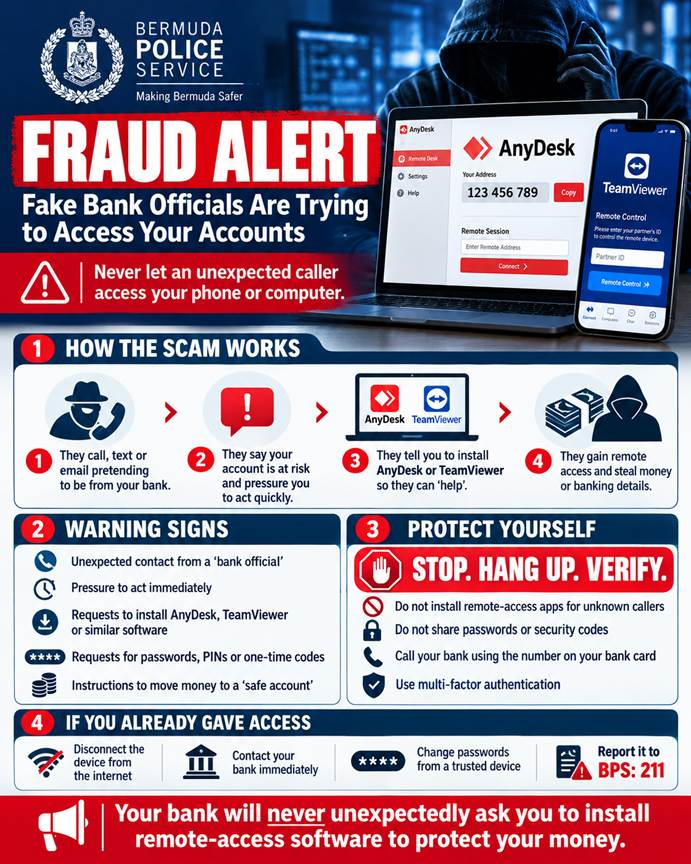
The Bermuda Police Service (BPS) is urging residents and businesses to ignore requests from fake bank agents, via persuasive calls or messages, to download and install AnyDesk remote desktop software on their devices. The BPS is aware that fraudsters are abusing AnyDesk to steal money from local bank accounts.
An actual bank representative would never insist that any resident or business download and install remote access apps, like AnyDesk or TeamViewer, to their computers or mobile phones, for technical support purposes.
The Approach
Unknown con artists, posing as bank fraud investigators, call or message, claiming they are investigating suspicious transactions. Part of this scam involves the installation of remote access software, including AnyDesk, often through malicious websites. The criminals then gain remote access and initiate unauthorised bank transfers.
Residents & Businesses: Stay Alert
Never follow instructions to transfer money to a “safe account.” Any request to do this should be refused.
Exercise caution with urgent payment requests. Businesses should ensure that employees responsible for initiating or approving payments take the time to verify unusual requests, particularly those involving international transfers.
Report suspected fraud promptly. If personal information has already been shared, remote access to devices granted or funds transferred, contact your bank immediately using the number on your bank card and report the matter to the Bermuda Police Service.
Once again, don’t take any call, text message, or e-mail, with instructions to act urgently, at face value.
Slow down. Independently verify any claims through the relevant bank, via their official contact information and take extra precautions by activating additional security measures, like multi-factor authentication, to avoid unapproved account activity.
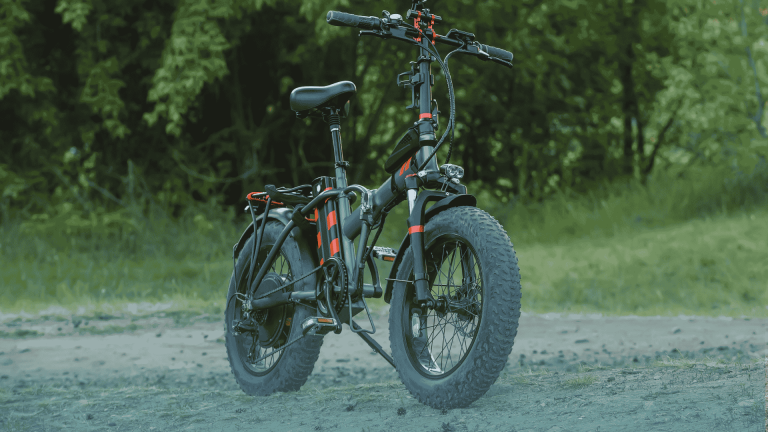
The Transport Control Department (TCD) has examined 195 bicycles over five Saturday sessions. 22 were classified as auxiliary cycles and a further 22 as motorcycles. Owners have cooperated by licensing and insuring their cycles. However, several of the bicycles examined did not meet the threshold specifications for either auxiliary or motorcycles. Legislation must be amended to address these cycles that do not meet this threshold, thereby ensuring that individuals operating them are not penalized as if they are operating an auxiliary or motorcycle contrary to law.
Minister of Tourism & Transport, Culture & Sport, the Hon. Owen Darrell, JP, MP, said: “E-bikes offer important transportation, health, and environmental benefits for the people of Bermuda, and we want to ensure those benefits can be enjoyed safely and responsibly. The testing programme has provided valuable information to help guide our approach to regulating these vehicles. Our focus remains on establishing a clear, fair, and practical framework that protects all road users while providing greater certainty for e-bike owners, prospective purchasers, and businesses.”
As part of their ongoing roads policing initiative, the Bermuda Police Service will use a consistent and proportionate framework to assess observable characteristics, including a bicycle’s apparent power, and its apparent capabilities while work continues on the required legislative changes.
TCD is continuing to examine e-bikes during its normal weekday working hours, from 8:30 am to 4:30 pm, Monday to Friday, at its Hamilton facility. This service is available to owners who were unable to attend the special sessions and to prospective purchasers who wish to have a bicycle assessed before buying. The Ministry thanks TCD staff for their diligence throughout the programme and the Bermuda Police Service for its collaboration in supporting a fair and practical approach to road safety. Riders are encouraged to take advantage of the examination service and to wear helmets for their safety.
With Halloween 2026, set for tomorrow, Saturday, October 31, the Bermuda Police Service (BPS) wants you to enjoy the festivities, but urge you to do so safely and responsibly.
To help that happen, officers will be out across the island, maintaining a visible presence and ready to assist wherever needed
Trick-or-treaters will be out in numbers visiting neighbourhood gathering their goodies, particularly after dark. Motorists are urged to exercise extra caution. Parents and guardians, please make sure you accompany your young ones. We recommend taking along a flash light in order that you can see and also be easily seen.
Young children should always be accompanied by a parent or guardian. Older children heading out in groups, should be supervised by a trusted adult or responsible older sibling. Let’s work together to keep the night fun and incident-free.
While we want you to have fun as you celebrate we remind you to be respectful and courteous. Antisocial behaviour, including vandalism will not be tolerated. Fun, not foolishness.
If you notice anything suspicious, or concerning, please contact us right away. Dial 211 for non-emergencies or 911 if it’s urgent. Your vigilance helps in making Bermuda safer.
We appreciate the continued support from our community and wish everyone a safe, and enjoyable Halloween.
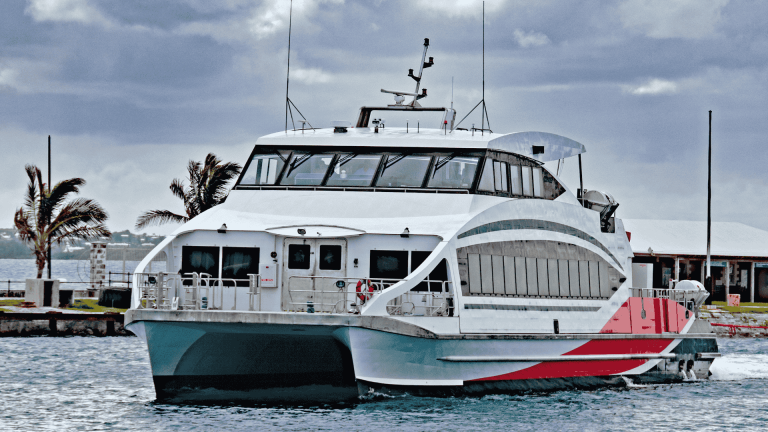
The Department of Marine & Ports Services would like to advise the public that due to current adverse weather conditions, both the Blue and Orange Route ferry services have been suspended until conditions improve.
Please also note that the Department will commence its Winter Ferry Schedule on Monday, November 2, 2026. As part of the winter schedule, the Orange Route will cease operations and is scheduled to resume with the commencement of the Summer Ferry Schedule in 2027.
The Department apologizes for any inconvenience and appreciates the public’s patience and understanding.
Futures trading pointed to falls on Wall Street later in the session, including a more than 2.5% drop in the tech-heavy Nasdaq 100
A trader works on the floor at the New York Stock Exchange (NYSE) in New York City, US, October 28, 2026. REUTERS/Jeenah Moon
International News via Reuters:
Tech shares slumped on Friday and US bonds surged toward their biggest monthly gain in nearly three years, as investors scurried to safety due to worries that huge and rising AI spending may not deliver sufficient returns.
Futures trading pointed to falls on Wall Street later in the session, including a more than 2.5% drop in the tech-heavy Nasdaq 100. That came alongside an out-of-hours plunge of 25% in Intel shares and a drop of 6% in Amazon as their results showed they burned through cash.
Shares in Google parent Alphabet fell 12.6% on Wall Street on Thursday and slid a little further after hours, to wipe out a stunning $500 billion in market value, as massive AI spending turned the company’s cash flow negative.
European stocks were last down 0.3% on Friday, as the relative lack of big tech stocks helped limit losses. There were falls earlier in Asia led by chipmakers.
Investors are worried about the returns they can expect to make on the massive capital spending needed for the AI buildout and what effect it could have on consumers if price hikes squeeze global demand for devices like smartphones and PCs. Anthropic’s potentially record-breaking IPO could prove the next big test of sentiment.
“The next key milestone will be the Anthropic IPO, to see how that lands. If it’s a poor listing, I think that could signal a bit of weakness going forward,” said Jason Da Silva, co-chief investment officer at Arbuthnot Latham.
Nerves were also frayed by a potentially record-breaking hack at Binance, the world’s biggest cryptocurrency exchange, which drove down bitcoin and other cryptocurrency prices.
The world’s biggest cryptocurrency, bitcoin, hit a six-week low before cutting losses to trade 1.7% lower at $77,471.
“I suspect the negative price action still has some way to go,” said Geoffrey Kendrick, head of digital assets research at Standard Chartered. “Only after assets are unfrozen and more detail of the hack emerges will we find a new base.”
In commodities, oil prices rose more than 2% on Friday and were poised for a fourth monthly gain, as an attack on a tanker in the Strait of Hormuz waterway highlighted continuing supply risks from the US-Israeli war on Iran. [O/R]
Gold prices fell to their lowest since mid-July and were last at $3,970, headed for a second straight monthly decline, as rising crude oil prices and persistent inflation worries reinforced expectations of US interest rate hikes.
NO SURPRISE FROM BOJ
The Bank of Japan left interest rates on hold, which was expected and did not trigger major currency or bond moves, although in a surprise development the central bank unveiled plans to sharply accelerate exchange-traded fund sales next year.
“While this may initially spook markets, I actually think this is a positive development since the BOJ feels confident enough with the economy and market,” said David Chao, global market strategist for Asia-Pacific at Invesco.
The central bank declared victory in a nearly 14-year battle to hit its price target and signalled vigilance against inflation risks, suggesting the next rate hike could come as soon as December.
Tech sector jitters have helped push a rush to bonds, further spurred by the Federal Reserve’s decision on Wednesday to keep US interest rates on hold, with no firm projection of when it might hike next.
Benchmark 10-year US Treasury yields fell around 8 basis points on Friday to 4.91% and were on track for their largest one-month drop since December 2023. Yields fall when bond prices rise.
The risk-averse mood strengthened haven currencies such as the yen and Swiss franc, with the yen slightly higher at 157.05 per dollar and the franc at 0.821 to the dollar and not far from a one-month high.
The euro inched up 0.1% to $1.1193 but was set for a drop of over 1% in October, its second straight monthly decline.
The euro zone economy grew faster than predicted last quarter, data showed, with the economies of the 21 nations sharing the euro growing by 0.4% in the third quarter.
Reporting by Iain Withers in London and Tom Westbrook and Ankur Banerjee in Singapore; Editing by Tom Hogue, Clarence Fernandez, Stephen Coates, William Maclean and Chizu Nomiyama
The ECB debated a hike on Thursday, but ultimately unanimously decided against the move on the premise that an energy price-driven inflation surge is not yet generating dangerous second-round effects
Governor of the Bank of Italy Fabio Panetta poses for a photo ahead of a G7 finance ministers and central bank governors meeting in Paris, France, May 18, 2026. REUTERS/Tom Nicholson
International News via Reuters:
The European Central Bank may need to raise interest rates further to counter high inflation and prevent it from spiralling into wages, ECB policymakers said on Friday, hours after the bank left rates unchanged.
The ECB debated a hike on Thursday, but ultimately unanimously decided against the move on the premise that an energy price-driven inflation surge is not yet generating dangerous second-round effects.
But commentary on Friday suggested that a hike may have only been delayed and such a move in December was on the cards.
“Monetary policy … can and should prevent (price increases) from becoming entrenched in the expectations and behaviour of households and firms, triggering a wage-price spiral that would be costly to stop,” Bank of Italy Governor Fabio Panetta said.
“With inflation set to remain above target for an extended period and risks skewed to the upside, further increases in the policy rates could prove necessary,” he said in Rome.
Investors see a two-in-three chance of a hike in December, and expect almost three rate increases in the coming year on top of the two hikes earlier this year, according to LSEG data.
Martin Kocher, Austria’s central bank chief, echoed Panetta’s comments.
“If the situation does not improve in the near future, the monetary policy environment suggests a response will be necessary,” Kocher said in a blog post published on Friday.
“The inflation risks have clearly increased. But neither acting prematurely nor waiting and doing nothing will ensure price stability,” Kocher added.
Euro zone inflation hit 3.8% last month, nearly twice the ECB’s target, and could accelerate further in the coming months on a renewed surge in energy costs and rising food prices.
An ECB survey published on Friday suggests that inflation may accelerate this year and next by more than earlier predicted, and may not return to target until 2028.
“The risk that price increases will be faster and more sustained than projected remains significant,” Estonian central bank chief Ülo Kaasik said.
“It is therefore understandable why financial markets are counting on further interest rate hikes from the European Central Bank,” he said.
In a note of caution, Panetta added that the ECB should take into account the recent surge in bond yields, which is already making borrowing more expensive, when “gradually calibrating monetary policy.”
Reporting by Francesco Canepa, Francois Murphy and Balazs Koranyi; Editing by Tomasz Janowski and Xevi Fontdegloria
The ECB, which kept interest rates steady on Thursday but hinted at a hike at its next meeting, is on the lookout for any sign that the recent, energy-fuelled rise in inflation is spreading to salaries
A view shows the European Central Bank (ECB) flag and the flag of the European Union in front of the ECB Building, on the day of the monthly news conference following the ECB’s monetary policy meeting in Frankfurt, Germany, September 14, 2023. REUTERS/Wolfgang Rattay
International News via Reuters:
Euro zone companies are bracing for higher wage demands from their workers after a surge in the cost of living caused by the Iran war, a European Central Bank survey showed on Friday.
The ECB, which kept interest rates steady on Thursday but hinted at a hike at its next meeting, is on the lookout for any sign that the recent, energy-fuelled rise in inflation is spreading to salaries.
Its quarterly survey of large euro zone companies showed that 40% of respondents were either expecting or seeing the risk of higher wage demands, up from 20% in the previous poll published in July.
Overall, wage growth was still expected to slow — from 3.2% last year to 3.0% this year and 2.9% the next — but more gradually than in the previous survey round.
Like in July, companies were struggling to pass on higher costs to consumers, who were increasingly looking for cheaper options.
Around 90% of respondents from consumer-facing firms said that the pass-through to selling prices was only partial or limited, compared to less than half among companies that sell to other businesses.
Accordingly, selling price growth was expected to moderate somewhat in the coming months, even if many companies expected cost pressures to continue into next year as hedges expire, agricultural prices rise and past price increases continue to feed through.
Investment was increasingly concentrated in AI, cloud computing, data centres, defence and electrification, with strong demand from public-sector and healthcare clients boosting software, engineering and renewable-energy firms.
Outside these growth areas, industry remained subdued. Trade protections aided steelmakers, but chemicals, food and textiles companies cut investment amid high costs, weak demand, foreign competition and rising political uncertainty.
Reporting by Francesco Canepa;Editing by Aidan Lewis
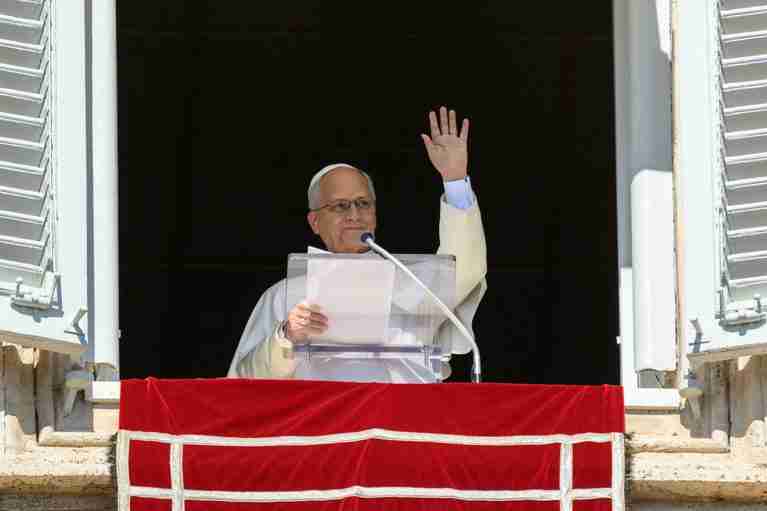
Leo, 71, was born in Chicago and is the first American-born pope
Pope Leo leads the Angelus prayer from the window of the Apostolic Palace at the Vatican, October 11, 2026. Vatican Media/Elisabetta Trevisan/Handout via REUTERS
International News via Reuters:
Pope Leo XIV cast a ballot by mail in the US midterm elections, the Vatican press office said on Friday, a historic first for the American-born pontiff.
“In keeping with this long-standing practice of civic participation, he has submitted his mail-in ballot in Chicago,” the Vatican said. “The Holy Father expresses his belief in the right and the duty of citizens to participate in democratic processes.”
The Vatican did not say which candidates Leo had voted for.
Leo, 71, was born in Chicago and is the first American-born pope. He registered to vote in Illinois under his birth name Robert Francis Prevost and requested a ballot on October 3, the Chicago Sun-Times reported on Thursday, citing the Will County Clerk’s office.
President Donald Trump’s sagging popularity is hurting his fellow Republicans’ chances of holding onto their majorities in both chambers of Congress in the November 3 election, with the public unhappy about the high cost of living and the Iran war.
Trump repeatedly criticized Leo early in the new pope’s tenure, calling him “weak” and “terrible” on crime.
The pope said in March that God rejects the prayers of those who start wars and have “hands full of blood.” In April, he termed Trump’s threat to destroy the Iranian civilization as unacceptable and previously declined to join the US president’s so-called “Board of Peace” initiative for Gaza.
Leo has also urged a “deep reflection” on the way migrants are treated in the US.
Voters in the solidly Democratic state of Illinois will select a successor for retiring US Senator Dick Durbin and choose whether to re-elect Governor JB Pritzker.
Leo was elected to lead the 1.4-billion-member Church by the world’s cardinals in May 2025.
The pope had the lower lobe of his right lung removed in surgery on October 13 and was diagnosed with lung adenocarcinoma, the most common form of lung cancer. Doctors say he will not need further therapy.
He is set to travel to South America next week.
Reporting by Katharine Jackson; editing by Scott Malone
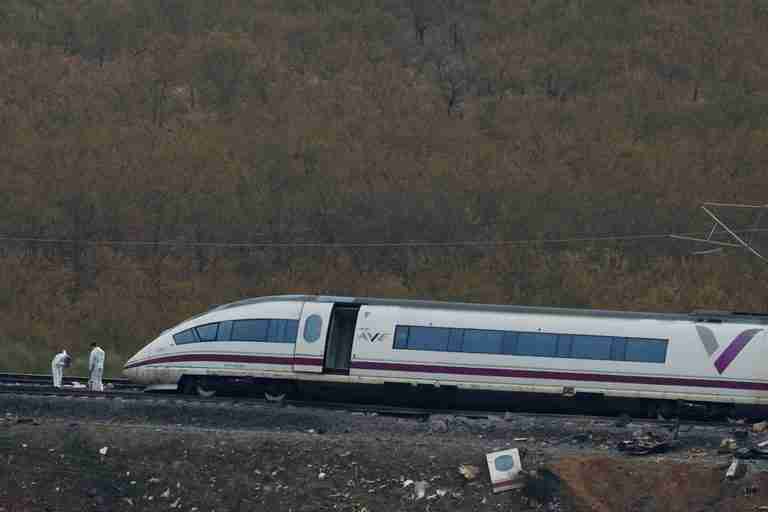
The crash, which happened near the town of Urda in central Spain, followed another accident involving the same rail companies on the same line that killed 46 people in January
Investigators work at the site of the collision where two high-speed trains crashed between the towns of Mora and Orgaz, in Urda, near Toledo, Spain, October 30, 2026. REUTERS/Susana Vera
International News via Reuters:
Spain’s transport minister on Friday rejected calls for his resignation over the second train accident on his watch to cause mass casualties this year, as authorities worked to identify the victims from a crash that killed at least 69 people.
Lawmakers from across the political spectrum this week condemned Transport Minister Oscar Puente for attributing Wednesday’s crash to a break in protocol by control centre operators rather than accepting responsibility, with rail workers’ unions calling for his immediate dismissal.
The crash, which happened near the town of Urda in central Spain, followed another accident involving the same rail companies on the same line that killed 46 people in January.
It has reopened a debate about safety and maintenance on Spain’s high-speed rail network, the most extensive in Europe, as the country prepares for an election that left-leaning Prime Minister Pedro Sanchez has called for November 29.
“My duty now is not to focus on discussing whether I will remain in office, but on solving the problem, determining exactly what happened and providing clear explanations,” Puente said at a press conference on Friday.
At the scene of the crash, large cranes were lifting the mangled wreckage as the Civil Guard listed 64 people as missing in what is already Spain’s deadliest train accident since 2013. It was unclear if all those missing were accounted for in the death toll.
Authorities have carried out 49 autopsies so far and formally identified five people, three women and two men, Esther Padilla, spokesperson for the Castilla-La Mancha regional government, said on state television network TVE.
AUTHORITIES CAN’T RULE OUT MORE FATALITIES
No additional bodies were found when rescue teams overturned a train carriage on Thursday, Castilla-La Mancha regional leader Emiliano Garcia-Page said on TVE.
Identifying the bodies was proving difficult because many were in pieces, he said. On Thursday, rescue teams had placed partial remains in 31 bags.
“We cannot rule out the possibility of more fatalities,” Garcia-Page said.
The collision occurred after several trains were automatically stopped due to the failure of a signalling system, after which the central control centre in Madrid took over. A train operated by state-owned Renfe was authorised to proceed, even though there was a stationary Iryo-operated train ahead, according to Puente.
Audio of communications between the control centre and the train drivers obtained by El Pais showed how a controller authorised the Renfe train to continue on its journey at a normal speed, which Puente said disregarded a protocol to travel at no more than 40 kph in such circumstances.
CONTROLLERS SAY FOCUS SHOULD BE ON FAILED SIGNAL SYSTEM
The debate about who was at fault intensified, with unions saying it was unfair to lay the blame on human error.
Raquel Ayllon, a union leader at state-owned infrastructure operator Adif, said controllers were having to operate under difficult working conditions.
“Human error is being criticized and questioned very quickly, while people are not really focusing on the central issue: the failure of the safety system,” Ayllon said on TVE.
Puente said the number of staff working at the control centre in Madrid had almost doubled since 2012 and that the controller who made the call had been working for two hours when the crash occurred.
“I have never used the term ‘human error’, although that is not to say that there was no human error,” he said.
He said the LZB train control system that failed on Wednesday had an average of 170 failures per year, which was about the same as the rest of Europe.
The system was behind schedule for an upgrade, public documents show.
The European Rail Traffic Management System (ERTMS) has been installed across most of Spanish high-speed rail, according to a factsheet by European rail association UNIFE, which developed the new standard.
Thales España, the Spanish arm of the French equipment maker, won a 2021 contract to install the ERTMS on the Madrid-Seville line, site of the two fatal crashes, by early 2026, but the work fell behind and passed to Hitachi Rail in 2024, according to Thales.
Thales declined to comment on the delay of the rollout.
Puente said the ERTMS system on the Madrid-Seville line was expected to begin working in early 2027, adding that the delay was due to the complexity of installing the system while keeping the line in operation.
($1 = 0.8930 euros)
Reporting by Charlie Devereux, Mireia Merinao, Corina Pons, Emma Pinedo and David Latona; Editing by Sharon Singleton, Aidan Lewis and Xevi Fontdegloria
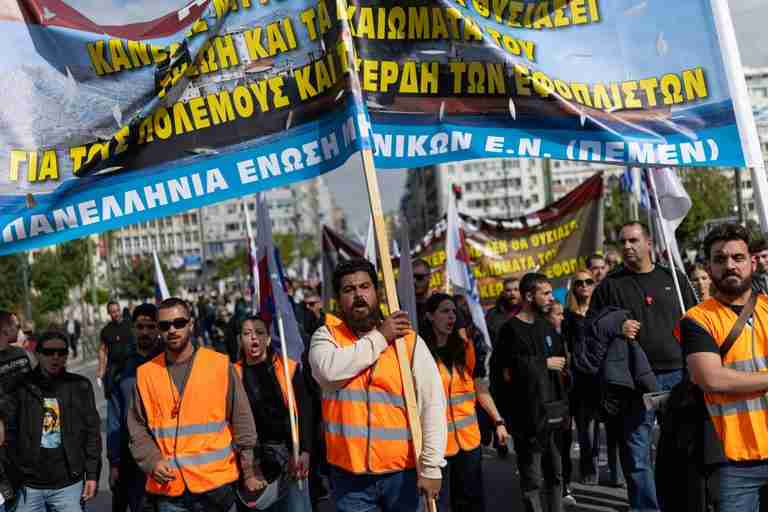
Strikers across 113 ports in 22 countries also called for pay rises, better working conditions and the right to have doctors on board vessels crossing war zones
Protesters chant slogans at an anti-war rally during a 24-hour strike by seafarers, in Piraeus, Greece, October 30, 2026. REUTERS/Stelios Misinas
International News via Reuters:
Dockworkers went on strike across Europe and beyond on Friday, disrupting shipping and ferries as they protested against the use of their ports for arms shipments and the number of seafarers killed in wars from the Gulf to the Black Sea.
Strikers across 113 ports in 22 countries also called for pay rises, better working conditions and the right to have doctors on board vessels crossing war zones.
“We will not work for their wars, and we will not become food for their cannons,” Apostolos Kypraios, head of the Greek union of merchant marine engineers, told Reuters during a rally at the Greek port of Piraeus.
‘SEAFARERS HAVE SUFFERED MANY CASUALTIES’
“We have felt it first hand, and our families have felt it too, living with the anxiety of whether a colleague will get back home,” he added.
More than 25 unions have now backed the strike originally called in Italy, France, Greece, Spain’s Basque Country, Turkey and Morocco.
On Friday, it covered major shipping hubs in Piraeus, Valencia, Le Havre, Algeciras and Genoa, as well as Morocco’s Tangier Med and India’s Nhava Sheva.
“Seafarers have suffered many casualties — numbering in the hundreds — including both the dead and the severely injured,” the Greek seafarers’ union PENEN said in a statement.
It said there had been 28 attacks on vessels in the Gulf in the first 21 days of October, a record since the start of the Iran war.
It said there had been 570 attacks confirmed in the Black Sea so far this year, leaving 40 seafarers dead and hundreds wounded.
A series of strikes in the western Black Sea has raised concerns about the widening scope of Russia’s war in Ukraine.
Cargo operations were disrupted in Piraeus and ferry services to Greek islands were suspended, as about 3,000 dockworkers and seafarers joined the walkout.
Representatives of India’s WTWFI union said about 15 Indian seafarers had died as a result of the Iran war, with many more stranded at sea as waterways were blocked.
A group of dockworkers and other activists, called ‘No Harbour for Genocide’ and campaigning to stop military cargo from reaching Israeli ports, said on Friday the protest would halt some 52,000 containers and snarl cargo worth $2.8 billion.
Reuters was not able to independently verify the impact.
In May 2026, dockworkers’ unions from over 35 European countries published the so-called Istanbul Declaration demanding that port facilities not be used to transport weapons destined for war zones.
Dockworkers said they were also worried about the rising cost of essential goods and energy, stemming from the ongoing conflicts.
“We can’t even afford to fill the car with fuel to get to the supermarket,” George Gogos, head of the Piraeus port dockworkers’ union, said.
Reporting by Valentini Anagnostopoulou in Athens, Sybille de La Hamaide in Paris; Writing by Angeliki Koutantou; Editing by Andrew Heavens
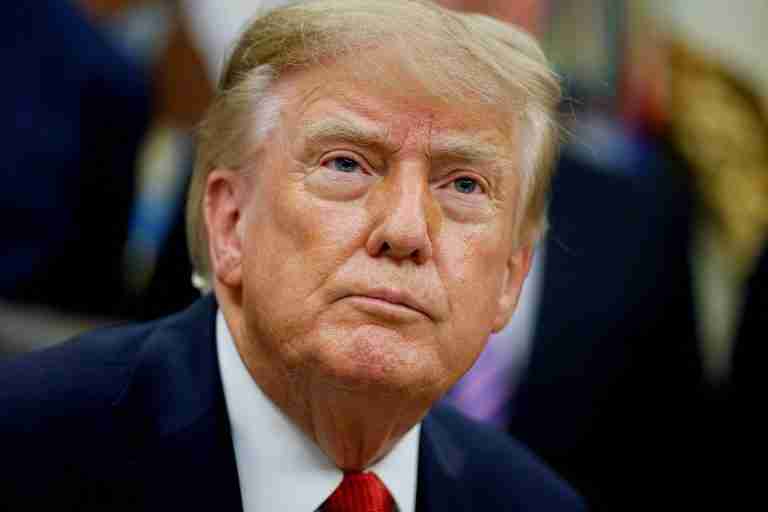
“It’s going to get wrapped up soon,” Trump said in an interview with Kansas City radio station KCMO
FILE PHOTO: US President Donald J. Trump looks on as he makes an announcement on healthcare in the Oval Office at the White House in Washington, D.C., US, September 18, 2026. REUTERS/Evan Vucci/File Photo
International News via Reuters:
US President Donald Trump, speaking ahead of November 3 midterm congressional elections, said on Friday he believed the war with Iran will end soon, but did not say how that would happen.
“It’s going to get wrapped up soon,” Trump said in an interview with Kansas City radio station KCMO. “We need a guarantee there’ll never be a nuclear weapon.”
Trump has said the US would not strike Iran before the elections.
Reporting by Susan Heavey and Doina Chiacu; Editing by Michelle Nichols
The blue-chip FTSE 100 index was 0.1% higher at 10,732.58 points by 0941 GMT, adding to the month’s gains at 1.3%
FILE PHOTO: A worker walks near an LSEG (London Stock Exchange Group) branded cube inside the LSEG headquarters in Paternoster Square, London, Britain, September 8, 2026. REUTERS/Toby Melville/File Photo
International News via Reuters:
London’s FTSE 100 looked on track to log its first monthly gain in three months, edging up on Friday as AstraZeneca rose, with investors welcoming a budget that was softer than expected on taxes.
The blue-chip FTSE 100 index was 0.1% higher at 10,732.58 points by 0941 GMT, adding to the month’s gains at 1.3%. The midcap FTSE 250 slipped 0.6%.
Here are more details:
• On the day, AstraZeneca rose 3.6%, after the Anglo-Swedish drug-maker announced a restructuring drive that will likely save $1.5 billion and help achieve long-term ambitions, including investing in new drug pipelines
• The broader pharma sector gained 3%, setting it up for its biggest monthly gain since February
• Banks weighed most on the index on the day, after NatWest lost 7.9% following disappointing third-quarter profit
• Precious and industrial metal miners lost 3.4% and 1.3%, respectively, tracking declines in gold and copper [GOL/] [MET/L]
• Oil prices rose about 2% on Friday, set for a fourth monthly gain, with Brent crude futures trading at over $117 a barrel [O/R]
• Energy rose 0.2%. BP was up marginally after it posted a record quarterly net profit
• Finance Minister John Healey’s first budget raised taxes on banks and gambling firms, which were less severe than expected, sparking a rally in the stocks on Wednesday
• Defence firms also rallied after Healey said that ‘reprioritisation’ in other departments would fund the government’s defence plan. Aerospace and defence firms are among the best performers this week
• Consumer staples stocks rose on the day, with British American Tobacco and Unilever up about 2%
• Earlier this month, data showed inflation rose more than expected in September, cementing the case for an interest rate hike by the Bank of England in November
Reporting by Darshan Kumar and Purvi Agarwal in Bengaluru; Editing by Harikrishnan Nair
To provide the best experiences, we use technologies like cookies to store and/or access device information. Consenting to these technologies will allow us to process data such as browsing behavior or unique IDs on this site. Not consenting or withdrawing consent, may adversely affect certain features and functions.
Functional
Always active
The technical storage or access is strictly necessary for the legitimate purpose of enabling the use of a specific service explicitly requested by the subscriber or user, or for the sole purpose of carrying out the transmission of a communication over an electronic communications network.
Preferences
The technical storage or access is necessary for the legitimate purpose of storing preferences that are not requested by the subscriber or user.
Statistics
The technical storage or access that is used exclusively for statistical purposes.The technical storage or access that is used exclusively for anonymous statistical purposes. Without a subpoena, voluntary compliance on the part of your Internet Service Provider, or additional records from a third party, information stored or retrieved for this purpose alone cannot usually be used to identify you.
Marketing
The technical storage or access is required to create user profiles to send advertising, or to track the user on a website or across several websites for similar marketing purposes.