The protests occurred outside the Bell Hotel in Epping, about 20 miles north of London, that has been used to house asylum seekers
International News via Reuters:
British police will have hundreds of officers on duty this weekend to deal with protests linked to immigration, a regional police chief said on Wednesday, amid worries over possible rioting.
Ben-Julian Harrington said he was aware demonstrations were being advertised for Saturday and Sunday in Epping, in the county of Essex to London’s northeast, after protests over the last week which resulted in violent disorder offences.
“We’ll have a robust policing operation. Essex is safe. You will have hundreds of officers on duty,” Harrington, the Essex chief constable, told a press conference.
The protests occurred outside the Bell Hotel in Epping, about 20 miles north of London, that has been used to house asylum seekers.
Five men have been charged with incidents of violent disorder in recent days, after police made 10 arrests following damage to vehicles and protesters throwing projectiles that injured eight officers.
The police alert follows nationwide rioting last summer when racist unrest involving far-right supporters broke out after false reports on social media that a suspect in the murder of three girls was a radical Islamist migrant.
The anniversary of those murders in Southport is July 29.
Essex Police’s focus is on protecting communities while allowing peaceful protest to take place, Harrington said.
The Epping hotel has become the focal point for some anti-immigration protesters and pro-immigration groups after an Ethiopian asylum seeker living there was charged with sexual assault, harassment and inciting a girl to engage in sexual activity. He denies the charges, according to a BBC report.
The man had arrived in Britain by boat from northern Europe eight days before the alleged incident on July 7, the BBC said, adding he had been remanded in custody.
Prime Minister Keir Starmer has pledged to stop thousands of migrants arriving in Britain via small boats, but is struggling to do so. Official data published earlier this month showed nearly 20,000 asylum seekers arrived on small boats in the first six months of the year, marking a record high for the period.
Reporting by Sarah Young; editing by Mark Heinrich
Health Ministry has launched a survey that aims to improve care
Press release: The Ministry of Health invites the participation of residents and parents of children who have received care for respiratory illnesses such as Asthma and Chronic Obstructive Pulmonary Disease (COPD) in completing the corresponding Respiratory Illness Patient Care Surveys.
The Respiratory Illness Patient Care Surveys for Asthma and COPD will launch on Wednesday, 23 July 2025. All responses must be submitted by Friday, 22 August 2025. Each Survey will take approximately 10 minutes to complete, and all feedback will remain anonymous. The individual surveys can be accessed through the following links:
As part of the implementation of the 2022 – 2027 Health Strategy and Universal Health Coverage (UHC), the Ministry is working to better understand the journey of both adults and children living with the specific respiratory illnesses of Asthma and COPD. The two surveys will be collecting perspectives from residents on experiences accessing and using health services related to these illnesses and will be used to strengthen patients’ overall care experience.
The two surveys are a part of the Ministry’s current Respiratory Illness Integrated Care Pathway initiative and is being led by a multidisciplinary working group that is Chaired by Debbie Barboza, Asthma and COPD Nurse Educator at Bermuda Hospitals Board, and supported by the Ministry’s UHC Project Management Office.
Integrated Care Pathways take a multidisciplinary, collaborative approach to managing care for individuals with specific needs, in this case, individuals with Asthma and COPD. They outline a patient’s entire care journey, specifying what happens, when, and who is responsible at each stage. This process includes working group sessions and one-on-one interviews with both patients and health service providers.
To date, patient and service provider interviews have been conducted and two workshops have been scheduled and will include patient representatives and health service providers specialising in pediatrics, respiratory physiology, GPs, and public health.
“Asthma and COPD were identified as two of the priority diseases in the 2023 Joint Strategic Needs Assessment requiring the development of a priority disease control plan,” shares the Minister of Health, the Hon. Kim Wilson, JP, MP.
“Asthma was also one of the leading five reasons for pediatric insurance claims in 2021 and on a global level is the most common long-term condition in children. The results of these surveys will inform the creation and implementation of the Respiratory Illness Integrated Care Pathway, ensuring patient needs can be effectively addressed.”
“As Chair of the Working Group, I strongly encourage everyone impacted by these health conditions to participate in the patient surveys on respiratory illness,” invites Debbie Barboza. “Your feedback is essential in helping us understand the real-world challenges faced by patients and in developing a comprehensive and integrated care pathway that improves outcomes for all those affected by respiratory conditions.”
Minister Wilson concluded, “I would like to extend my heartfelt gratitude to all health system stakeholders and respiratory illness patients who have contributed to this initiative so far, and to those who will continue to do so in the future. Your ongoing involvement is not only vital to this project, but also to all health system strengthening initiatives. Together, we are laying the foundation for a healthier and brighter future for all of Bermuda.”
ABOUT THE BERMUDA HEALTH STRATEGY AND UNIVERSAL HEALTH COVERAGE:
The Bermuda Health Strategy 2022 – 2027 (“The Health Strategy”) was developed as the next phase of work for the Ministry of Health as it works to achieve the vision of “healthy people in healthy communities”. The Health Strategy provides the frame to shift Bermuda’s health system as it works to implement Universal Health Coverage (“UHC”) and shift to a more people-centred approach to healthcare that focuses on delivering better care that meets the needs of individuals and families today and into the future. Bermuda’s UHC programme is a multi-year, multi-phased initiative that seeks to ensure “all people have equitable access to needed informative, preventive, curative, rehabilitative and palliative essential health services, of sufficient quality to be effective, while also ensuring that people do not suffer financial hardship when paying for these services and critical medicines.”
Kaleidoscope Arts Foundation has been at 27 Jubilee Road, for almost 20 years. Many of you know this glorious building as the Old Elliot School or Saint Mattais Hall. Their teachers know it as family. Their students know it as freedom. Their parents have voted them as the Best Arts Programme for many years now. They have heard that we are the mosh pit of the arts organisations on our island.
They all call it home.
Kaleidoscope is the place for climbing trees, mud kitchens, hot glue guns, hand saws, drills and hammers, of painting the paper and painting themselves and let us not forget three dimensional art!
Sadly, they have come to the end of their relationship with this wonderful property as this space does not belong to Kaleidoscope. They have been given notice by their landlords to leave/vacate the property by March 31st, 2026, three months shy of finishing their last school year, and five months shy of having just one more summer camp, as they will be starting major renovations with an unknown finish date and changes in the layout that will no longer work for their programs.
With less than eight months to secure a new home they need your help.
They want to continue to grow and have children flourish. They will need a huge amount of support from our community and they are sharing their needs with everyone they can think of.
They need the community’s help in finding them the right space, for now and forever.
Mrs Rodriguez-Roberts told us, “Ideally this space would allow us to continue our current programs and have the space to expand. To keep our programmes as they are our forever space would need to stay centrally located, with access to a play/garden space, and indoor space of at least 2,500 sq ft. To grow it would have more than four classrooms, lots more storage space and over an acre of land.”
“We are all extremely hopeful but also realistic that we will have to find a place in the interim, but we would really love to not have to move everything twice.”
They are looking for our partners and supporters to help us build connections to rent a space/co-located with a property where we can host at least 40 students for camps and classes.
Kaleidoscope is full of passionate and creative individuals. They know they can make a new space just as magical. Kaleidoscope did that in 2006 when they moved into the shell of the building at 27 Jubilee Road. A shell both inside and outside. They can do it again.
They have to find a new space.
Kaleidoscope has used their current space to empower children through art, nature & play. Over 10,000 students have come through their programs. Kaleidoscope currently runs programs for all the public pre schools, public primary classes from P3-P5, Dame Marjory Bean as well as ASL classes from West Pembroke. Our enchantment programs give students the opportunity to create and build their self confidence through choice.
95% of our public school teachers stated – My students built their creative thinking while with Kaleidoscope.
One teacher shared, “Thank you for all that you do for our students. The arts are very important and their first more structured art experience has been a pleasurable one.”
Kalediscope believes it is important to share about our public school programs, which are unknown to much of the community. Many also do not know that they have programs for younger students. They have a licensed nursery class for 2-5 yr olds and child and guardian classes for 18 months to 3 yr olds. These two programmes work as building blocks for children to connect children to textures, play, nature, and early literacy skills.
“The evidence indicates that expressive arts and design play an important role in supporting children’s learning across a range of areas, and PSED (Personal, Social and Emotional Development).’ Pascal, C., Bertram, T., & Rouse, L. (2019). Getting it right in the Early Years Foundation Stage: a review of the evidence. Centre for Research in Early Childhood
Kaleidoscope offers many programs to reach its mission of empowering children through art. They serve over 1,000 students a year in the programmes above and as well as after school classes, one day camps and week long camps.
They are looking for at least 2500 square feet of classroom space, with multiple rooms as well as outside garden space for our natural play space.
Will you join them in finding and funding this new location?
To find out how your voice, your connections, and your advocacy can help Kaleidoscope contact them at 542-9000 or email info@kaf.bm, they would love your help!
For further information, or if you’re in need of high-resolution images, please get in touch with Dani Frith, Kaleidoscope’s Operations Manager, via email at dani@kaf.bm or by phone at 542.9000.
Von der Leyen said the EU and Japan would seek to strengthen economic security
International News via Reuters:
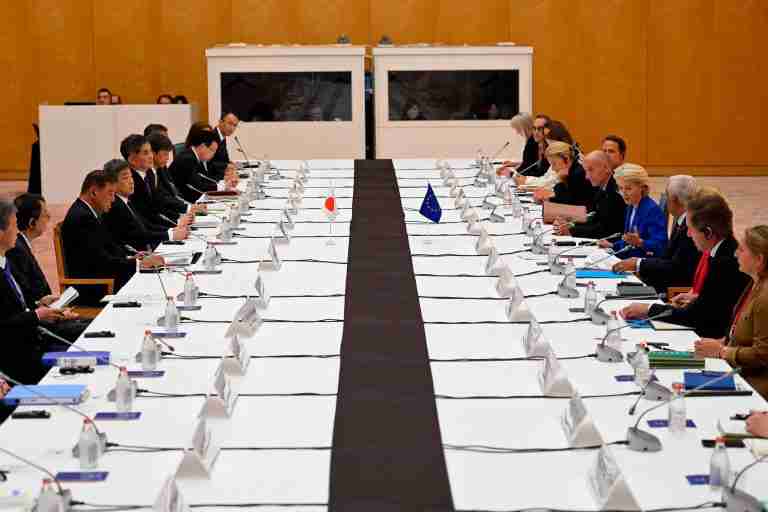
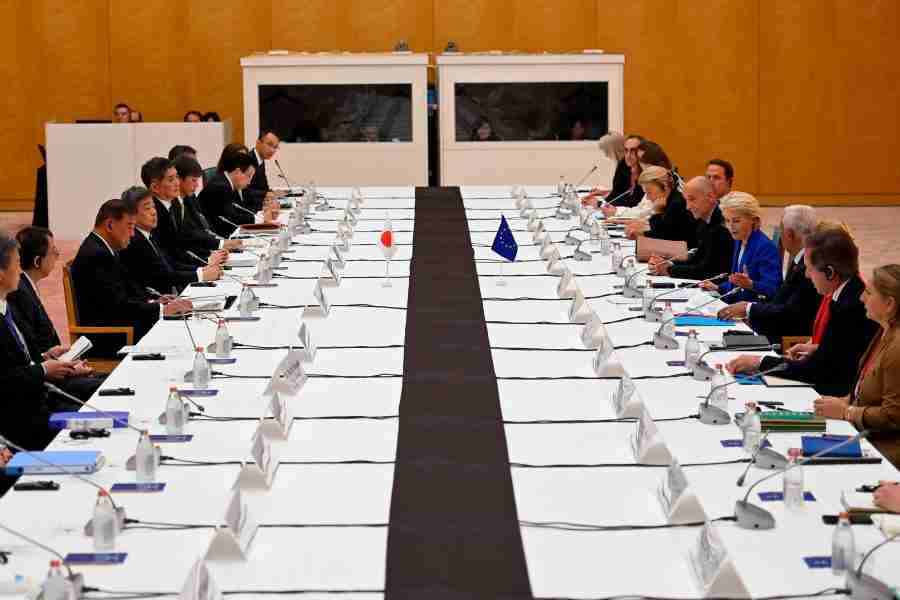
The European Union and Japan will work more closely to counter economic coercion and address unfair trade practices, European Commission President Ursula von der Leyen told reporters on Wednesday.
Von der Leyen’s comments came after an EU-Japan summit with Japanese Prime Minister Shigeru Ishiba as the EU struggles to conclude a trade deal with the United States and a day before potentially tough meetings with Chinese leaders.
Japan struck a trade deal with the United States on Tuesday that lowered tariffs on auto imports in exchange for U.S.-bound investment and loans.
Von der Leyen said the EU and Japan would seek to strengthen economic security.
“We will also work more closely together to counter economic coercion and to address unfair trade practices,” she said, adding later: “We believe in global competitiveness and it should benefit everyone.”
Ishiba told reporters that the EU and Japan would work to maintain and strengthen a rules-based, free and fair economic order.
Ishiba added that the EU and Japan had agreed to work to strengthen the defence industry and to start talks for an information security agreement.
“In the field of security, we agreed to cooperate to launch a defense industry dialogue to strengthen the defense industrial base, which is a priority for both sides, and to begin official negotiations on a Japan-EU information security agreement,” Ishiba said.
Reporting by Charlotte Van Campenhout, Makini Brice and Kiyoshi Takenaka in Tokyo; Editing by Philip Blenkinsop and Kim Coghill
The challenges facing the sector have exposed its initial ambitions as unrealistic
International News via Reuters:
Green hydrogen developers are cancelling projects and trimming investments around the world, raising the prospect of longer than targeted reliance on fossil fuels.
The challenges facing the sector have exposed its initial ambitions as unrealistic.
Hard-to-electrify industries that were seen as ideal candidates for green hydrogen, such as steelmaking and long-distance transportation, have found that transition to the low-carbon fuel looks prohibitively expensive.
The gap between ambition and reality in Europe shows the extent of the reset happening within the industry, said Jun Sasamura, hydrogen manager at research company Westwood Global Energy.
Only about a fifth of planned hydrogen projects across the European Union are likely to come online by the end of the decade, he said. That equates to roughly 12 GW of production capacity against an EU target of 40 GW, Westwood Global Energy data shows.
“In the current state, I really don’t see the EU 2030 (hydrogen production) target being reached,” he added.
INFLATED EXPECTATIONS
Companies say that high costs and a lack of demand for green hydrogen have rendered many plans unprofitable.
“Green hydrogen was an inflated expectation that has turned into a valley of disillusionment,” said Miguel Stilwell d’Andrade, chief executive of Portuguese power company EDP.
“What’s missing is the demand. There are 400 million euros ($464.2 million) of subsidies for hydrogen in Spain and Portugal, but we need someone to buy the hydrogen.”
The company has several projects in advanced stages but cannot move forward because of a lack of buyers, said Ana Quelhas, EDP’s hydrogen chief and co-chair of the European Renewable Hydrogen Coalition.
Across the border, Spain’s Iberdrola has shelved plans to increase capacity at a green hydrogen plant with electrolyser capacity of 20 MW until it finds buyers for additional output, company executive Iban Molina said at an energy event in Madrid.
They are among more than a dozen large companies that have trimmed spending or shelved projects across Europe, Asia, Australia and elsewhere in recent years.
Companies had scrapped or delayed more than a fifth of all European projects by the end of last year, Westwood Global Energy says.
At Aurora Energy Research, Emma Woodward said: “In 2020-2021 we had this view of hydrogen and the fact it was going to be used in almost every sector that hadn’t been electrified.
“I think we’ve realised now that there are other, probably more commercially viable, alternatives for lots of sectors. Maybe we don’t need as much hydrogen as initially expected.”
TOO EXPENSIVE
Many governments have long supported development of green hydrogen – produced through electrolysis that splits water into hydrogen and oxygen using electricity from renewables – to help to decarbonise energy, transport and industry.
Countries including Australia, Britain, Germany and Japan announced ambitious investment strategies they hoped would bring down costs and eventually create a profitable green hydrogen sector that would no longer need support.
Production, however, remains more expensive than for natural gas and other fossil fuel-based alternatives, said Minh Khoi Le, Rystad Energy’s head of hydrogen research.
It is at least three times more expensive than natural gas as a fuel for power generation, for example, and twice as expensive as grey hydrogen. The latter is produced from natural gas and coal and is already used in industries such as oil refining and production of ammonia and methanol.
Costs could fall by 30-40% in 10-15 years if equipment prices decline and the broader supply chain scales up, he added, while Aurora’s Woodward and Westwood Global Energy’s Sasamura said that green hydrogen is unlikely to become competitive before then.
Only 6 million metric tons per annum (mtpa) of low-carbon hydrogen capacity – including green and blue hydrogen, which is made from gas – is either operational or under construction globally, consultancy Wood Mackenzie says.
This is well below the 450 mtpa the consultancy says is needed as part of the global push for net zero greenhouse gas emissions by 2050. The EU has committed to reducing emissions by 55% from 1990 levels by 2030, en route to the 2050 target.
BUYERS PRICED OUT THE MARKET
The industry had counted on sectors such as steel, oil refining, cement and transport to be among the first buyers, but the expected demand has failed to materialise.
German die forging company Dirostahl, which makes components for wind turbines, ships and oil and gas drill pipes, is dependent on furnaces fired by natural gas and is looking for a replacement.
However, green hydrogen is still too expensive. Offers for the fuel do not come below 150 euros per megawatt hour (MWh) while natural gas can be bought for 30-35 euros/MWh, said Chief Executive Roman Diederichs.
“It simply doesn’t work. You might not want to call it economic suicide, but in practice it would be just that. We’d be completely uncompetitive,” he said.
Prices remain elevated because of the high cost of electrolysers needed for large-scale production, infrastructure bottlenecks and increased energy costs resulting from rules on what constitutes green hydrogen.
Some European countries have scaled back their ambitions. Italy has recently shifted more than 600 million euros in post-pandemic funds from hydrogen to biomethane. France lowered its 2030 hydrogen electrolysis capacity target by more than 30% in April and Portugal has cut its electrolysis capacity ambitions by 45%.
The Dutch government last year made sharp cuts to funds it had originally reserved for green hydrogen projects and battery development, shifting the focus of its climate fund toward the planned construction of two new nuclear plants.
Several players in Australia, meanwhile, have scaled back or withdrawn from projects despite more than A$8 billion ($5.2 billion) of pledged government support.
Projects that are going ahead also face delays. Rystad Energy analysts estimate that 99% of A$100 billion of projects announced for the next five years have failed to progress beyond the concept or approval stage.
INFRASTRUCTURE DIFFICULTIES
Another problem is that hydrogen is difficult to store because it requires high-pressure tanks, extremely low temperatures and tends to leak, making for risky transportation through old gas pipelines while awaiting new infrastructure.
Spain hopes to build a 2,600 km (1,615 mile) hydrogen network and connect it to another project – the trans-European H2Med link – from the Iberian region to northwest Europe.
The Spanish network should be operational around 2030, but delays of two or three years are likely for broader European infrastructure, said Arturo Gonzalo, CEO of Spanish gas grid operator Enagas.
“Infrastructure is not something that happens when the market has already taken off; it is something that has to happen for the market to take off,” he said.
($1 = 0.8617 euros)
($1 = 1.5340 Australian dollars)
Reporting by Pietro Lombardi in Madrid, Nina Chestney in London and Riham Alkousaa in BerlinAdditional reporting by Sergio Goncalves in Lisbon, Vera Eckert in Frankfurt, Bart Meijer in Amsterdam, Christine Chen in Canberra and Sam Li in BeijingEditing by David Goodman
High energy costs and competition from Chinese producers have struck Europe’s steel industry in recent years
International News via Reuters:
SSAB’s earnings fell more than expected in the second quarter, hit by lower steel prices and a weakening European market due to tariff-driven uncertainty, the Swedish steelmaker said on Wednesday, sending its shares more than 7% lower.
High energy costs and competition from Chinese producers have struck Europe’s steel industry in recent years, while President Donald Trump’s tariffs have brought on fresh challenges.
“The turbulence of tariffs and trade barriers resulted in increased uncertainty,” CEO Johnny Sjostrom said in a statement, with the largest impact seen in the weakening European steel market.
The biggest issue is that more shipments are redirected from the U.S. to Europe, Sjostrom told Reuters. “We have a balance between supply and demand normally, but if there’s a lot of cheap material coming into Europe, then the prices on the European market will go down fast.”
Steel and aluminium tariffs were among the earliest put into effect by Trump. Duties of 25% on most steel and aluminium imported to the U.S. went into effect in March, and they were ratcheted up to 50% for most countries in June.
The direct impact of tariffs on SSAB’s Americas business is limited, as it produces roughly 2.4 million tons of steel in its two U.S. production facilities in Montpelier, Iowa, and Mobile, Alabama.
However, the Special Steels division, which produces specialized high-strength steels for customers around the world, is very much dependent on export, Sjostrom said. Therefore, any escalation in the trade war would impact SSAB on a global scale.
SSAB expects third-quarter shipments by the Special Steels unit to be lower than in the previous quarter, along with somewhat lower shipments for the Americas and significantly lower for the European business.
Its operating earnings fell 28% to 2.14 billion Swedish crowns ($224.93 million) in the second quarter, while analysts were expecting 2.29 billion on average.
“The bulk of the miss is Steel Europe which is (around) 30% below consensus … which has negative read-across to other European Steel names after Salzgitter’s profit warning last week,” J.P.Morgan analysts said in a note.
($1 = 9.5140 Swedish crowns)
Reporting by Marta Frąckowiak in Gdańsk; Editing by Milla Nissi-Prussak
Russia played down expectations of any breakthrough at the meeting
International News via Reuters:
Russian negotiators flew to Turkey to hold peace talks with Ukraine on Wednesday, the Kremlin said, before what will be the first direct discussions between the warring sides in more than seven weeks.
Russia played down expectations of any breakthrough at the meeting, which Ukrainian President Volodymyr Zelenskiy said this week should focus in part on preparing a summit between himself and President Vladimir Putin.
“Naturally, no one expects an easy road. Naturally, this will be a very difficult conversation. The projects (of the two sides) are diametrically opposed,” Kremlin spokesman Dmitry Peskov told reporters.
Previous talks in Istanbul on May 16 and June 2 led to the exchange of thousands of prisoners of war and the remains of dead soldiers. But those meetings lasted less than three hours in total and made no breakthrough towards a ceasefire or a settlement to end almost three and a half years of war.
U.S. President Donald Trump last week threatened heavy new sanctions on Russia and countries that buy its exports unless a peace deal was reached within 50 days.
But three sources close to the Kremlin told Reuters that Putin, unfazed by Trump’s ultimatum, would keep on fighting in Ukraine until the West engaged on his terms for peace, and that his territorial demands may widen as Russian forces advance.
On Wednesday, Russia said its forces had captured the settlement of Varachyne in Ukraine’s Sumy region, where Putin has ordered his troops to create a buffer zone after Ukraine mounted a shock incursion into Russia last year and held onto a chunk of its territory for months. Reuters could not independently confirm the battlefield report.
In recent weeks, Russian forces have launched some of their heaviest air attacks of the war, focusing especially on the Ukrainian capital Kyiv.
Ukraine has hit back with attacks of its own, and last month inflicted serious damage on Russia’s nuclear-capable strategic bomber fleet by smuggling drones close to air bases deep inside the country.
CONFLICTING DEMANDS
Zelenskiy said earlier this week that the agenda for talks was clear: the return of prisoners of war and of children abducted by Russia, and the preparation of a meeting between himself and Putin.
Putin turned down a previous challenge from Zelenskiy to meet him in person and has said he does not see him as a legitimate leader because Ukraine, which is under martial law, did not hold new elections when Zelenskiy’s five-year mandate expired last year. Russia also denies abducting children.
The Kremlin said this week it was unrealistic to expect “miracles” from the talks.
At the last meeting on June 2, Russia handed Ukraine a memorandum setting out its key demands, including: full withdrawal of Ukrainian forces from four regions of the country that Russia has claimed as its own; limits on the size of Ukraine’s military; enhanced rights for Russian-speakers in Ukraine; and acceptance by Kyiv of neutral status, outside NATO or any other alliance.
Ukraine sees those terms as tantamount to surrender, and Zelenskiy described the Russian stance as an ultimatum.
Ukraine wants an immediate ceasefire, reparations, international security guarantees and no restrictions on its military strength.
Reporting by Dmitry Antonov in Moscow and Mark Trevelyan in London; Editing by Toby Chopra
The storied chipmaker, once synonymous with America’s chipmaking heft, has lagged due to years of strategic missteps
International News via Reuters:
Faced with slumping quarterly sales and a burgeoning loss, Intel shareholders will want to know new CEO Lip Bu-Tan’s plans for the chipmaker’s nascent contract manufacturing business.
Intel is set to report its sixth consecutive net loss on Thursday, while revenue is expected to drop for a fifth straight quarter, according to estimates from LSEG data.
The storied chipmaker, once synonymous with America’s chipmaking heft, has lagged due to years of strategic missteps.
Rival Nvidia <NVDA,O> has leaped ahead in the booming artificial intelligence chip industry, while rival AMD has been gaining share in Intel’s mainstay personal computer and server semiconductor markets.
CEO Tan has been focusing on a next-generation chipmaking process called 14A to win big external customers, shifting away from 18A, a technology that his predecessor Pat Gelsinger had spent billions of dollars to develop.
Such a move could lead to a big writedown, an expense that would surely displease investors even as Intel has signaled that the new technology will help it be more competitive against Taiwan’s TSMC, the world’s biggest chipmaking factory.
Longer-term commentary on the company’s plans for the 14A technology “will hold more weight this earnings call than anything else”, Stifel analysts wrote ahead of the earnings.
Intel is expected to report a net loss of about $1.25 billion for the April-June quarter, while its sales are expected to drop more than 7% to $11.92 billion. Last year was Intel’s first unprofitable year since 1986.
Writedowns could amount to hundreds of millions, if not billions, of dollars, according to analysts, and might impact the timeline for the foundry to break even.
Intel’s finance boss David Zinsner said in May he expected the unit to break even in 2027 and that would require external customers to generate low- to mid-single-digit billions in revenue.
Intel’s foundry unit is expected to generate $4.49 billion in sales in the second quarter, though a majority of this would come from chips Intel produces for itself, analysts said.
STREAMLINING
Since taking over as CEO in March, Tan has focused on shedding non-core assets. In April, Intel agreed to sell a 51% stake in its Altera programmable chip business for $4.46 billion. The company has also considered divesting its network and edge businesses as well.
Intel’s stock has risen 16% so far this year, compared with a 13.23% rise in the broader chip index.
Investors will watch if Tan sells more assets, further flattens out the management structure, or expands the global layoffs the company announced last year.
Intel, as with other chipmakers, is facing customers who are dragging their feet on their spending, due to uncertainty from U.S. President Donald Trump’s trade war.
Revenue at Intel’s personal computer unit is expected to dip some 2% to $7.25 billion in the second quarter after customers pulled forward orders to the first three months of the year due to the threat of tariffs.
Analog chipmaker Texas Instrument flagged similar troubles on Tuesday, sending its shares down 11% after hours. Chip-equipment maker ASML and TSMC have also warned tariff-related uncertainty has muddied the outlook for them.
Revenue in Intel’s data center unit, however, is expected to jump about 20% to $3.66 billion, signaling improving demand for traditional server chips after several quarters of poor sales.
Reporting by Arsheeya Bajwa in Bengaluru; Editing by Sayantani Ghosh and Arun Koyyur
The planned investment represents a 75% increase over the previous six years
International News via Reuters:
Europe’s largest utility Iberdrola launched a five billion euro ($5.87 billion) capital increase on Wednesday to help pay for a big increase in investments in power grids in Britain and the United States.
The company plans to increase its annual investments to around 15 billion euros from around 12 billion euros, building on its shift towards upgrading and expanding power grids in countries where returns are steady and healthy, such as the U.S. and Britain.
In the next six years, it will invest some 55 billion euros in power grids, more than 80% in these two countries as they offer “an unprecedented investment opportunity,” Executive Chairman Ignacio Sanchez Galan said in a call with analysts.
The planned investment represents a 75% increase over the previous six years.
As a result, the value of its grid assets, whose returns are regulated and guaranteed, will top 90 billion euros by 2031 – 75% of which will be in Britain and the U.S. – from 55 billion euros this year and just 30 billion euros at the beginning of the decade.
The weight of its Spanish home market in the network business is set to decline significantly, as a share of both investments and regulated assets.
Spanish utilities have recently warned that the country risked losing critical investments in grids to other countries as the remuneration on grid assets proposed by regulators was set below what they expect.
“The draft proposal, in my opinion, is providing a clear negative signal to the market,” Galan said.
The cash raised by Iberdrola’s capital increase, along with debt, operating cash flow, asset sales and partnerships will help fund the new strategy to be set out in September. No further equity raises are expected until at least the end of the decade, Galan said.
The shares offered through a process of accelerated book-building were set to be priced at 15.10 euros and investor interest covered the entire amount, one of the bookrunners said. Iberdrola’s share price closed at 15.895 euros on Tuesday.
Spain’s stock market regulator suspended trading of Iberdrola’s shares on Wednesday morning.
The issue, though unexpected, was of a scale expected to be digested by the market, Citi analysts said in a note.
Iberdrola also said first-half net profit declined 14% from a year earlier to 3.56 billion euros, when results were boosted by the inclusion of the sale of gas assets in Mexico.
($1 = 0.8523 euros)
Reporting by Pietro Lombardi, editing by Inti Landauro, Louise Heavens and Elaine Hardcastle
Known as an advisory opinion, the deliberation of the 15 judges of the International Court of Justice in The Hague is legally non-binding
International News via Reuters:
The United Nations’ highest court will deliver an opinion on Wednesday that is likely to determine the course of future climate action across the world.
Known as an advisory opinion, the deliberation of the 15 judges of the International Court of Justice in The Hague is legally non-binding. It nevertheless carries legal and political weight and future climate cases would be unable to ignore it, legal experts say.
“The advisory opinion is probably the most consequential in the history of the court because it clarifies international law obligations to avoid catastrophic harm that would imperil the survival of humankind,” said Payam Akhavan, an international law professor.
In two weeks of hearings last December at the ICJ, also known as the World Court, Akhavan represented low-lying, small island states that face an existential threat from rising sea levels.
In all, over a hundred states and international organisations gave their views on the two questions the U.N. General Assembly had asked the judges to consider.
They were: what are countries’ obligations under international law to protect the climate from greenhouse gas emissions; and what are the legal consequences for countries that harm the climate system?
Wealthy countries of the Global North told the judges that existing climate treaties, including the 2015 Paris Agreement, which are largely non-binding, should be the basis for deciding their responsibilities.
Developing nations and small island states argued for stronger measures, in some cases legally binding, to curb emissions and for the biggest emitters of climate-warming greenhouse gases to provide financial aid.
PARIS AGREEMENT AND AN UPSURGE IN LITIGATION
In 2015, at the conclusion of U.N. talks in Paris, more than 190 countries committed to pursue efforts to limit global warming to 1.5 degrees Celsius (2.7 degrees Fahrenheit).
The agreement has failed to curb the growth of global greenhouse gas emissions.
Late last year, in the most recent “Emissions Gap Report,” which takes stock of countries’ promises to tackle climate change compared with what is needed, the U.N said that current climate policies will result in global warming of more than 3 C (5.4 F) above pre-industrial levels by 2100.
As campaigners seek to hold companies and governments to account, climate‑related litigation has intensified, with nearly 3,000 cases filed across almost 60 countries, according to June figures from London’s Grantham Research Institute on Climate Change and the Environment.
So far, the results have been mixed.
A German court in May threw out a case between a Peruvian farmer and German energy giant RWE, but his lawyers and environmentalists said the case, which dragged on for a decade, was a still victory for climate cases that could spur similar lawsuits.
Earlier this month, the Inter-American Court of Human Rights, which holds jurisdiction over 20 Latin American and Caribbean countries, said in another advisory opinion its members must cooperate to tackle climate change.
Campaigners say Wednesday’s court opinion should be a turning point and that, even if the ruling itself is advisory, it should provide for the determination that U.N. member states have broken the international law they have signed up to uphold.
“The court can affirm that climate inaction, especially by major emitters, is not merely a policy failure but a breach of international law,” said Fijian Vishal Prasad, one of the law students that lobbied the government of Vanuatu in the South Pacific Ocean to bring the case to the ICJ.
Although it is theoretically possible to ignore an ICJ ruling, lawyers say countries are typically reluctant to do so.
“This opinion is applying binding international law, which countries have already committed to. National and regional courts will be looking to this opinion as a persuasive authority and this will inform judgments with binding consequences under their own legal systems,” Joie Chowdhury, senior attorney at the Center for International Environmental Law, said.
The court will start reading out its opinion at 3 p.m. (1300 GMT).
Reporting by Stephanie van den Berg, additional reporting by Ali Withers in Copenhagen; editing by Barbara Lewis
U.S. President Donald Trump struck a trade deal with Japan, lowering tariffs on auto imports and sparing Tokyo from punishing new levies on other goods
International News via Reuters:
London’s main stock indexes hit a fresh record high on Wednesday, helped by positive corporate updates, while a U.S.-Japan trade deal also boosted global sentiment.
The benchmark FTSE 100 was last up 0.5% by 0936 GMT. The domestically oriented midcap FTSE 250 gained 0.3%.
U.S. President Donald Trump struck a trade deal with Japan, lowering tariffs on auto imports and sparing Tokyo from punishing new levies on other goods in exchange for a $550 billion package of U.S.-bound investment and loans.
The UK’s automobiles and parts index rose 1.7%, tracking strength in Asian rivals. Aston Martin rose 7.1%.
Media stocks led sectoral gains, up 2.4%, boosted by Informa’s 5.4% rise after the events and academic publishing group raised its annual underlying revenue growth forecast.
Healthcare stocks rose 2.2%, with AstraZeneca extending its yesterday’s gain, up 2.7%, following the announcement of a $50 billion investment to expand U.S. manufacturing.
Conversely, construction and materials stocks lost 0.9%, with Breedon Group down 10.8%, after the company forecast annual results at the low end of market expectations.
In company news, J D Wetherspoon gained 3% after the pub group reported a rise in sales in recent weeks since May.
Shares of precious metals company Hochschild Mining rose 7.1% on stronger-than-expected quarterly silver output.
British stocks have rallied this year, pushing the FTSE 100 to all-time highs in recent weeks, as hopes of interest rate cuts, optimism over the UK-US trade deal and a surge in commodity prices lifted sentiment.
Traders are currently pricing an 87.9% chance of a 25-basis-point BoE cut next month, as per data compiled by LSEG.
This week, attention is on the UK flash Purchasing Managers’ Index for July and retail sales data for June.
Meanwhile, India and Britain will sign a free trade agreement on Thursday during Indian Prime Minister Narendra Modi’s UK visit, officials said.
Reporting by Sukriti Gupta; Editing by Vijay Kishore
Enforcement evolves alongside gangs, with police citing greater use of search powers and strategic targeting of offenders
Internal conflict, younger recruits, and growing female involvement – these are among the latest trends in gang activity, according to Acting Deputy Commissioner of Police Antoine Daniels.
He says gang dynamics are shifting, and the police are adapting their response.
To provide the best experiences, we use technologies like cookies to store and/or access device information. Consenting to these technologies will allow us to process data such as browsing behavior or unique IDs on this site. Not consenting or withdrawing consent, may adversely affect certain features and functions.
Functional
Always active
The technical storage or access is strictly necessary for the legitimate purpose of enabling the use of a specific service explicitly requested by the subscriber or user, or for the sole purpose of carrying out the transmission of a communication over an electronic communications network.
Preferences
The technical storage or access is necessary for the legitimate purpose of storing preferences that are not requested by the subscriber or user.
Statistics
The technical storage or access that is used exclusively for statistical purposes.The technical storage or access that is used exclusively for anonymous statistical purposes. Without a subpoena, voluntary compliance on the part of your Internet Service Provider, or additional records from a third party, information stored or retrieved for this purpose alone cannot usually be used to identify you.
Marketing
The technical storage or access is required to create user profiles to send advertising, or to track the user on a website or across several websites for similar marketing purposes.