One year after the fatal shooting of Razi Garland and Amon Robinson, police renew appeal for information; grieving mother urges community to speak up
A grieving mother has made a heartfelt plea to the community – urging anyone with information to come forward and help find justice for her son and godson, who were both fatally shot near Fort Scaur nearly one year ago.
Chyrstal-Lynn El spoke to the media today, as police renewed their appeal for answers in the double murder of 18-year-old Razi Garland and 19-year-old Amon Robinson.
She described the two as ambitious young men who had just started a landscaping business, saying they had “hopes, plans, and so much to give.”
Mr Garland and Mr Robinson were fatally shot just after 6 am on Wednesday, July 10th last year in the Scaur Hill area of Sandys.
To date, two individuals have been arrested in connection with the case who remain under investigation and are currently out on police bail.
Meanwhile, Acting Detective Chief Inspector Kenten Trott renewed an appeal for information, emphasizing the importance of community involvement in helping to bring about justice.
Eight members of the group are scheduled to meet online on Saturday to decide their oil output policy for August
International News via Reuters:
OPEC+ may make an increase in oil output for August at its meeting on Saturday that is larger than the 411,000 barrels per day (bpd) hikes it made for May, June and July, three sources familiar with OPEC+ talks told Reuters.
Eight members of the group – Saudi Arabia, Russia, the UAE, Kuwait, Oman, Iraq, Kazakhstan and Algeria – are scheduled to meet online on Saturday to decide their oil output policy for August.
OPEC+ made a radical change in policy this year when the eight members started to unwind their most recent output cut of 2.2 million bpd starting in April. They then accelerated the hikes in May, June and July to 411,000 bpd for each month, despite the extra supply weighing on crude prices.
Earlier on Friday, other sources told Reuters the group was expected to agree to an increase of 411,000 bpd for August, which remains a possible outcome of Saturday’s meeting. All sources declined to be identified by name due to the sensitivity of the matter.
The acceleration of the output hikes came after some OPEC+ members, such as Kazakhstan, produced way over their targets, angering other members that were sticking more closely to agreed cuts.
Kazakh output returned to growth last month and matched an all-time high, as the Chevron-led Tengiz field ramped up, a source familiar with the data told Reuters this week.
OPEC+, which groups the Organization of the Petroleum Exporting Countries and allies led by Russia, is looking to expand its market share against the backdrop of growing supplies from other producers like the United States.
The group pumps about half of the world’s oil. As of their decision for July output, the OPEC+ eight have made or announced production increases of 1.37 million bpd. This is 62% of the production cut of 2.2 million bpd that they are unwinding.
Reporting by Ahmad Ghaddar and Olesya Astakhova. Editing by David Goodman, Mark Potter and Chizu Nomiyama
Impressions Artistry is hosting its first free workshop for salon professionals this Sunday and Monday at Impressions Artistry on Queen Street, featuring two celebrity guests from the beauty industry.
The workshop is part of the company’s mission to educate and inspire hairstylists and salon professionals.
Owner Vivian Millings says this is just the beginning and encourages everyone in the industry to come out and take part.
China’s commitment to the fund could pave the way for emerging economies to contribute to climate change mitigation
International News via Reuters:
China has signaled to the Brazilian government that it will invest in the Tropical Forests Forever Facility, a multilateral mechanism funding conservation of endangered forests around the world, two people with knowledge of negotiations told Reuters.
An investment by China in the fund, which Brazil first proposed in 2023, would signal an important shift in climate finance, which has relied on funding from wealthy nations most responsible for global warming to date.
China’s commitment to the fund could pave the way for emerging economies to contribute financially to climate change mitigation, moving beyond the mandatory requirements imposed on developed nations by the 2015 Paris Agreement.
The new approach comes as wealthy nations such as the United States retreat from ambitious pledges to fund projects curbing climate change, despite growing pressure from poorer nations struggling to cope with the impacts of a warmer climate.
At last year’s United Nations climate summit, leaders of developing countries lambasted wealthy nations over their annual $300 billion global finance target, covering just a fraction of the $1.3 trillion that economists say is necessary.
Chinese Finance Minister Lan Fo’an expressed the intention to contribute to the forests fund, known as TFFF, in a meeting with his Brazilian counterpart Fernando Haddad on Thursday, sources said. They spoke on the sidelines of a meeting of finance ministers in the run-up to the BRICS summit of major developing nations that starts in Rio de Janeiro on Sunday.
“(Lan) told (Haddad) that he considered the fund idea important and that China would collaborate,” said one source, who witnessed the conversation, adding that the discussion did not involve specific values.
The Brazilian government has taken the message from China’s finance minister as a signal that Beijing will contribute funds, the sources said, although a public announcement is not expected until the U.N. climate summit, COP30, in November.
China’s embassy in Brasilia and Brazil’s Finance Ministry did not immediately reply to a request for comment.
Brazilian President Luiz Inacio Lula da Silva had previously discussed the fund with Chinese President Xi Jinping during his visit to China in May, according to sources.
Brazil also aims to attract other resource-rich developing nations to the fund, particularly from the Middle East, the sources said.
The Brazilian government sees potential for the TFFF to be its main new deliverable at COP30, which it will host in the Amazonian city of Belem.
Policymakers have envisioned TFFF as a $125 billion fund, combining sovereign and private-sector contributions, to be managed like an endowment paying countries annual stipends based on how much of their tropical forests remain standing.
While sources do not expect the fund to launch at that scale, the idea received initial signs of support from the U.K., France, Germany, Norway, Singapore and the United Arab Emirates.
Early backing from the United States evaporated after President Donald Trump exited the Paris Agreement.
The interest in the TFFF underscores growing international attention on the preservation of tropical forests, rich in planet-warming carbon, as a powerful tool to combat climate change and stave off biodiversity loss.
Reporting by Lisandra Paraguassu in Rio de JaneiroWriting by Manuela AndreoniEditing by Brad Haynes and Chizu Nomiyama
The pound was flat and last fetched $1.36, while against the euro it inched 0.1% lower and was last at 86.26 pence
International News via Reuters:
Sterling was poised for a weekly loss on Friday, marking a lacklustre end to a week that saw fiscal and political uncertainties rattle investor appetite for UK assets.
The pound was flat and last fetched $1.36, while against the euro it inched 0.1% lower and was last at 86.26 pence. Gilt yields were broadly steady in late morning trading.
However, on a weekly basis, cable was down 0.4% against the greenback, while it had fallen about 1% against the euro, marking its biggest one-week drop against the currency since U.S. tariffs on world economies took effect in early April.
UK stocks, bonds and cable witnessed a selloff earlier in the week, after the government’s welfare reforms were not well received by ruling Labour Party members and stirred speculation about the future of finance minister Rachel Reeves.
Some analysts even drew parallels between this week’s market reaction and the rout during former Prime Minister Liz Truss’ premiership in 2022.
With the Keir Starmer-led government completing one year in power, uncertainties prevail over the options it has to balance public accounts.
“There is speculation that given the difficulties the government has faced in finding savings from welfare budgets, tax rises are likely in the Autumn Budget,” said Susannah Streeter, head of money and markets at Hargreaves Lansdown.
“Bets are rising that the Bank of England will cut interest rates more quickly with a reduction in August increasingly on the cards. So, that’s kept a bit more downwards pressure on sterling.”
Traders expect the Bank of England to lower borrowing costs by 25 basis points next in September and are anticipating another interest rate cut by the same amount before the year ends, data compiled by LSEG showed.
Further, top ratings agency S&P said the inability of Britain’s government to make modest cuts to welfare spending this week underscores that it has very limited budgetary room to manoeuvre.
Despite the week’s developments, the pound is at a near four-year high against the dollar and is up about 9% so far this year, having benefited from broader dollar weakness and as a U.S.-UK trade deal offered some relief on the tariff front.
Reporting by Johann M Cherian, Editing by William Maclean
Malaysia-based AirAsia is one of Asia’s largest low-cost carriers and one of Airbus’ largest customers
International News via Reuters:
AirAsia on Friday signed a memorandum of understanding with Airbus to buy 50 long-range A321XLR planes with conversion rights for another 20 of the single-aisle jets, as the budget airline nears the end of a restructuring process.
Reuters reported last month that Tony Fernandes, CEO of AirAsia owner Capital A Group, was in talks to buy 50 to 70 of the latest Airbus narrow-body model, which would include the ability to convert some of the airline’s large, existing Airbus order book into A321XLR orders.
Malaysia-based AirAsia is one of Asia’s largest low-cost carriers and one of Airbus’ largest customers, with around 360 planes on order.
Fernandes said the airline intends to order another 150 jets within a month, which would complete the carrier’s fleet strategy for the time being.
Fernandes did not say which models would be ordered, but confirmed that AirAsia remains in previously reported talks for a potentially large order of smaller planes, either the Airbus A220 or Embraer E2 regional jet.
Capital A, hard hit by pandemic travel restrictions, was classified by Malaysia’s stock exchange as financially distressed in 2022. Fernandes hopes to exit this so-called PN17 status soon, he said.
Capital A is in the process of selling its AirAsia aviation business to long-haul unit AirAsia X to consolidate long and short-haul operations under a single AirAsia brand.
After this disposal takes place, Capital A should exit PN17 status, Fernandes said.
The expanded and standalone AirAsia, which will remain listed in Malaysia, intends to issue its first bond in October and two credit agencies are looking to rate the company, he said.
LOW-COST NETWORK CARRIER
AirAsia, which has a current fleet of 255, has been restructuring its plane order book after it faced financial difficulties during COVID-19.
Like most budget airlines it mostly operates economy-only narrow-body planes. Fernandes said he was negotiating with Airbus about what to do with an historical order for 15 A330 wide-bodies but that he had not yet cancelled any.
Fernandes wants to expand AirAsia flights to North America and Europe, but still at budget prices. Airbus’ long-range narrow-body models are key to that vision, he says.
But single-aisle planes can only fly so far, so AirAsia wants to establish hub airports in the Middle East, Europe and Asia-Pacific.
AirAsia is in talks with four cities in the Gulf, including in Saudi Arabia and the Emirate of Ras Al Khaimah, Fernandes told Dubai Eye radio this week. Bahrain is also a potential candidate, a company presentation showed on Friday.
Reporting by Lisa Barrington; additional reporting by Makini Brice and Dominique Vidalon; Editing by Susan Fenton and Hugh Lawson
National Security Minister urges community cooperation at CCTV town hall, Travel clinic reports high demand for vaccinations and living cost surveys to remain open until July 8th plus all the latest sports news
Health Minister Kim Wilson said notice was given to all retailers of the government enforcement of the Pharmacy and Poisons Act 1979
Retailers and convenience store owners could be liable for a $10,000 fine if found to be selling nicotine-based products including vapes to customers.
Only registered pharmacies are permitted to dispense nicotine containing products as part of a Government clamp down to deter youngsters from picking up the habit.
According to the Health Ministry, “it is acknowledged that the emergence of newer product formats, such as nicotine pouches and lozenges, created uncertainty in how the law was interpreted and applied by some retailers.
“Importantly, the legal framework itself has not changed. However, it is evident that a number of retailers exploited this ambiguity, knowingly selling these products outside the scope of the law.
“At the same time, others appear to have been genuinely unaware of the existing regulatory restrictions, highlighting the need for enhanced education and consistent enforcement.”
As Bermuda marks this year’s PRIDE parade on July 5th, I find myself reflecting not just on the strength and vibrancy of our LGBTQ+ community, but also on how far we still have to go.
The road to marriage equity in Bermuda is one of the clearest examples of how party politics can obstruct, not accelerate, progress. It is also a sobering reminder of the power elected officials wield when legislation is guided by partisanship rather than principle.
From the outset, let me be clear: I stand on the side of human rights for all people. That is what I have told constituents who’ve asked me where I stand on marriage equity, and it is a position I hold with conviction. I have considered all sides of this issue, and each time I come to the same conclusion: equality is equality.
Over time, and especially through my work in advocacy, I’ve come to understand something fundamental: true advocacy must be inclusive. It must extend to the people and injustices that don’t directly impact me. Otherwise, it is not advocacy, it’s simply convenience.
Our legislators are meant to be advocates. Not only for their supporters. Not only for the people who look like them or love like them. But for all Bermudians.
And yet, the story of marriage equity in Bermuda tells a different tale.
A Timeline of Political Obstruction
As a student of history, I know the value of looking back to understand how we got here. So, if you’ll indulge me, allow me to briefly recap the timeline of events as it relates to marriage equity here in Bermuda.
In 2013, Bermuda took a critical first step by amending the Human Rights Act to include “sexual orientation” as a protected ground, an addition often referred to as “two words and a comma.” Though modest in language, this legislative change was monumental in its impact, making it illegal to discriminate against someone based on their sexual orientation.
In 2015, Bermuda’s Supreme Court ruled in favour of same-sex couples’ right to adopt. A year later, the Government held a referendum on same-sex marriage and civil unions. It failed to reach the required 50 percent voter turnout, rendering it non-binding. Still, a majority of those who did vote said no to both.
Despite this, in 2017, the Supreme Court once again acted in defence of rights, ruling in Godwin v Registrar General that same-sex couples could legally marry under the protections of the Human Rights Act. It was a moment of justice, and many believed it marked a turning point.
But that moment proved to be fleeting as politics soon intervened.
In July 2017, the Progressive Labour Party won the general election with a strong majority. Sadly, one of their early moves was to introduce the Domestic Partnership Bill, legislation that sought to replace marriage equality with a separate legal framework. The bill created a new category of “domestic partnership” available to both same-sex and heterosexual couples, but crucially, it revoked the right of same-sex couples to marry.
By February 2018, the bill became law, effectively stripping away marriage rights that had been affirmed by the courts just months earlier. Bermuda made global headlines as the first jurisdiction to legalise same-sex marriage, only to repeal it.
It’s important to highlight that the vote on the Domestic Partnership Bill in the House of Assembly was not a conscience vote. It was a whipped vote, with PLP Members expected to follow the party line. The bill passed 24 to 10, demonstrating how party politics, not personal conviction or public consultation, drove this regressive legislation.
Activists pushed back. The courts again ruled the ban unconstitutional in June 2018, affirming that the Domestic Partnership Act violated fundamental rights. The Government chose to appeal the decision, and in November, the Court of Appeal upheld the ruling that same-sex marriage must be allowed. For a brief moment, equality was restored.
But the legal battle didn’t end there. The Government pursued a final appeal to the Privy Council, the highest court of appeal for Bermuda, at the public’s expense. In March 2022, the Privy Council overturned the previous ruling, declaring that the Domestic Partnership Act did not violate Bermuda’s Constitution. And just like that, after years of legal wrangling that cost not just dignity and time, but taxpayer dollars too, marriage equity in Bermuda no longer existed.
OUTBermuda, the island’s only LGBTQ+ charity, has called this repeal a grave injustice and urged the Government to restore marriage equality and repair Bermuda’s international human rights reputation. Their recent Policy Manifesto outlines not just the need for full equality under the law but tangible steps for how the Government can support and protect LGBTQ+ Bermudians today.
People Over Politics
This back-and-forth legal history is not just about legislation. It’s about people. About Bermudians whose lives, loves, and families have been treated like political footballs. This reflection has shown clearly how partisan agendas can delay and derail fundamental rights – rights that should never have been up for debate.
What this tells us, painfully and clearly, is that party politics is not always aligned with the people’s wellbeing. And when that happens, we all lose.
If we are to truly become a society that values justice and inclusion, we must start with leadership that puts human rights, dignity, and fairness above political calculations. Leadership that reflects the full diversity of Bermuda and governs in service of all its people.
A Call for Courage
I know that embracing inclusive leadership can be uncomfortable. I’ve had to confront long-held beliefs of my own. Beliefs that were shaped by culture, community, and faith instead of the lived realities of others. That process wasn’t easy, but it was necessary. Because if we are serious about equality, we must lead with courage, even – or perhaps especially – when our decisions challenge the status quo. That is what leadership requires: doing what is right, even when it’s hard.
Marriage equity is not an LGBTQ+ issue. It is a human rights issue. And Bermuda’s treatment of it is a cautionary tale about what happens when our leaders are more loyal to their party than to the rights of their people.
May this PRIDE weekend serve as a call to action, because PRIDE is, and always has been, a form of protest. And because every one of us deserves to be represented, respected, and protected under the law.
S&P has a “stable” outlook on its AA UK credit rating
International News via Reuters:
The inability of Britain’s government to make cuts to welfare spending this week underscores the extent of the challenges it faces in repairing its finances, credit rating agency S&P Global said on Friday.
UK Prime Minister Keir Starmer was forced to scrap 5 billion pounds ($6.83 billion) worth of benefits cuts due to opposition from within his own government, reducing the already razor-thin margin it relies on to meet its self-imposed fiscal rules.
“We consider the inability to make modest cuts to welfare spending, which has ballooned in the UK since the 2020 pandemic, underscores the UK government’s very limited budgetary room for manoeuvre,” S&P said in an analysis.
S&P has a “stable” outlook on its AA UK credit rating and though it sees the fiscal position as “vulnerable” it said the direct effect of this week’s last-minute policy reversal was small in the context of the country’s “existing fiscal challenges”.
The now-cancelled 5 billion-pound-a-year of mainly disability allowance cuts would have amounted to 0.2% of 2025 GDP, by 2029. That compares with last year’s headline government deficit of 5.9% of GDP – equivalent to almost 170 billion pounds.
“Getting the deficit down to the pre-pandemic five-year average of 3% of GDP would require a roughly 70 billion pound consolidation effort,” said S&P, which is next due to review Britain’s rating on October 10.
“We expect that the UK’s fiscal consolidation will remain a slow process,” it added.
($1 = 0.7321 pounds)
Reporting by Marc Jones; Editing by Amanda Cooper and Barbara Lewis
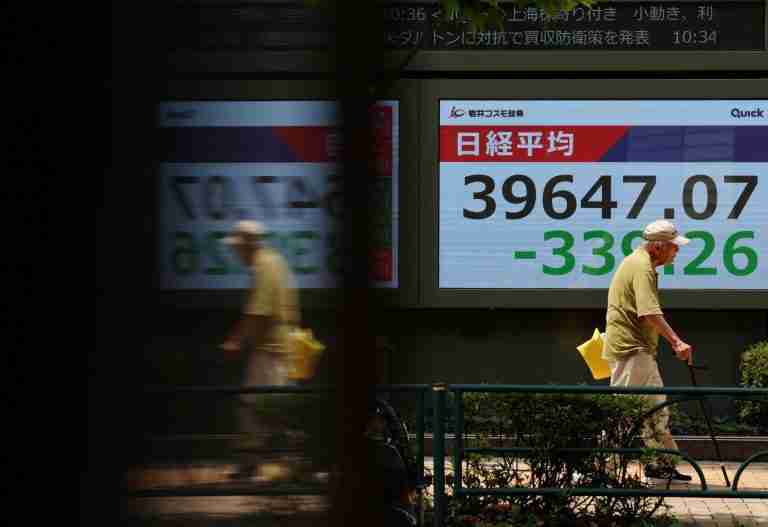
Stocks slipped on Friday as U.S. President Donald Trump got his signature tax cut bill over the line and attention turned to his July 9 deadline for countries to secure trade deals with the world’s biggest economy.
The dollar also fell against major currencies, with U.S. markets already shut for the holiday-shortened week, as traders considered the impact of Trump’s sweeping spending bill that is expected to add an estimated $3.4 trillion to the national debt.
The pan-European STOXX 600 index fell 0.5%, with banks, mining-related stocks and retailers among the top laggards.
U.S. S&P 500 futures edged down 0.6%, following a 0.8% overnight advance for the cash index to an all-time closing peak. Wall Street was closed on Friday for the Independence Day holiday.
Trump said Washington would start sending letters to countries on Friday specifying what tariff rates they would face on exports to the United States, a clear shift from earlier pledges to strike scores of individual deals before a July 9 deadline when tariffs could rise sharply.
Investors are “now just waiting for July 9”, said Tony Sycamore, an analyst at IG, with the market’s lack of optimism for trade deals responsible for some of the equity weakness in export-reliant Asia, particularly Japan and South Korea.
At the same time, investors cheered a surprisingly robust U.S. jobs report on Thursday, sending all three of the main U.S. equity indexes climbing in a shortened session.
“The U.S. economy is holding together better than most people expected, which suggests to me that markets can easily continue to do better (from here),” Sycamore said.
Following Thursday’s close, the House narrowly approved Trump’s signature, 869-page bill, which averts the near-term prospect of a U.S. government default but adds trillions to the national debt to fuel spending on border security and the military.
TRADE THE KEY FOCUS IN ASIA
Trump said he expected “a couple” more trade agreements, after announcing a deal with Vietnam on Wednesday to add to framework agreements with China and Britain as the only successes so far.
U.S. Treasury Secretary Scott Bessent said earlier this week that a deal with India was close. However, progress on agreements with Japan and South Korea, once touted by the White House as likely to be among the earliest to be announced, appears to have broken down.
The U.S. dollar index had its worst first half since 1973 as Trump’s chaotic roll-out of sweeping tariffs heightened concerns about the U.S. economy and the safety of Treasuries, but had rallied 0.4% on Thursday before retracing some of those gains on Friday.
As of 1430 GMT it was down 0.1% at 96.94.
The euro added 0.2% to $1.1778, while sterling held steady at $1.3662 as British assets steadied following investor fright over the last two days at a tearful appearance by Finance Minister Rachel Reeves in parliament on Wednesday.
The U.S. Treasury bond market was closed on Friday for the holiday, but 10-year yields rose 4.7 basis points (bps) to 4.34%, while the 2-year yield jumped 9.3 bps to 3.882%.
Gold firmed 0.4% to $3,336 per ounce, on track for a weekly gain as investors again sought refuge in safe-haven assets due to concerns over the U.S.’s fiscal position and tariffs.
Brent crude futures fell 57 cents to $68.23 a barrel, while U.S. West Texas Intermediate crude dropped 66 cents to $66.34, as Iran reaffirmed its commitment to nuclear non-proliferation.
Reporting by Lawrence White in London and Kevin Buckland in Tokyo; Editing by Stephen Coates, Kim Coghill, Alexandra Hudson, Joe Bavier and Alex Richardson
To provide the best experiences, we use technologies like cookies to store and/or access device information. Consenting to these technologies will allow us to process data such as browsing behavior or unique IDs on this site. Not consenting or withdrawing consent, may adversely affect certain features and functions.
Functional
Always active
The technical storage or access is strictly necessary for the legitimate purpose of enabling the use of a specific service explicitly requested by the subscriber or user, or for the sole purpose of carrying out the transmission of a communication over an electronic communications network.
Preferences
The technical storage or access is necessary for the legitimate purpose of storing preferences that are not requested by the subscriber or user.
Statistics
The technical storage or access that is used exclusively for statistical purposes.The technical storage or access that is used exclusively for anonymous statistical purposes. Without a subpoena, voluntary compliance on the part of your Internet Service Provider, or additional records from a third party, information stored or retrieved for this purpose alone cannot usually be used to identify you.
Marketing
The technical storage or access is required to create user profiles to send advertising, or to track the user on a website or across several websites for similar marketing purposes.