Enlargement has risen up the EU agenda due to Russia’s war against Ukraine
International News via Reuters:
The European Union must show it is willing and able to take in new members, German Chancellor Friedrich Merz said on Friday as the bloc’s leaders gathered with Western Balkan counterparts hoping to join in the coming years.
Enlargement has risen up the EU agenda due to Russia’s war against Ukraine, with Kyiv keen to join the bloc to anchor itself in Europe’s political mainstream and EU officials declaring that the union should expand to reduce the influence of foreign powers in its neighbourhood.
But the process of joining is usually long and complex, involving years of negotiations and legal reforms, with approval of all 27 current EU members required to complete each step.
“The European Union has to show that it is capable of enlarging and willing to enlarge and we want to discuss that here,” Merz told reporters at the summit in the Montenegrin coastal town of Tivat.
“There are, of course, a whole range of questions that we must answer, that we must answer together, but above all else, it must be clear that this part of Europe belongs within the European Union’s future,” Merz added.
“The fact that we have not admitted any new members for 13 years now shows that there have also been shortcomings on the part of the European Union.”
Six Western Balkan countries want to join the EU – Albania, Bosnia, Serbia, Montenegro, North Macedonia and Kosovo – but are at different stages of the accession process.
Montenegro, with a population of just 630,000, is widely considered the frontrunner and would be relatively easy to absorb into the EU, a bloc of 450 million people.
But even Montenegro faces obstacles, including related to justice and corruption, and many see its goal of joining by 2028 as very ambitious.
On the eve of the summit, Germany and France proposed giving aspiring EU members more opportunities to join EU programmes and access the single market before joining the bloc.
Merz last month also suggested Ukraine could be granted a new status of “associate member” that would allow Ukrainian officials to take part in EU summits and ministerial meetings – but not vote in them – as an interim step towards full membership.
Reporting by Ivana Sekularac and Andreas Rinke; Writing by Andrew Gray; Editing by Kirsten Donovan
Prime Minister Peter Magyar’s Tisza party, which ended right-wing leader Viktor Orban’s 16-year rule in an April 12 election landslide, has said it would stop issuing visas to workers from outside the European Union from June
International News via Reuters:
Hungary’s government will stop issuing worker visas to employees from the Philippines, Georgia and Armenia from Friday, a government spokeswoman said, calling the move a first step towards regulating the inflow of guest workers.
• Prime Minister Peter Magyar’s Tisza party, which ended right-wing leader Viktor Orban’s 16-year rule in an April 12 election landslide, has said it would stop issuing visas to workers from outside the European Union from June.
• Government to tighten employment opportunities for guest workers over what it says are concerns they are pushing down local salaries, spokeswoman Vanda Szondi told a media briefing.
• Foreign workers account for just 2% of Hungary’s workforce based on official statistics, but some sectors, like services and manufacturing, are heavily reliant on foreign workers.
• Government to change decree allowing manpower companies to import workers in a simplified procedure from the Philippines, Georgia and Armenia as of Friday.
• Employees already present can still apply for an extension, while requests already submitted would be assessed.
• Government calls reforms a first step in a planned long-term solution.
• Some of Hungary’s largest foreign investors have said a complete halt to the inflow of guest workers would hit companies and the wider economy.
Reporting by Gergely Szakacs, Editing by William Maclean
A Romanian Navy official’s hand was caught in a V-BAT propeller on May 12 during a Shield AI training exercise on a boat off the Texas coast – severing two of her fingers and fracturing a third
International News via Reuters:
A year ago, Ryan Tseng, the head of U.S. defense tech startup Shield AI, announced his company had turned a new page.
After a gory incident that partially severed a U.S. Navy official’s fingers during a test of its V-BAT drone, Shield AI had addressed safety concerns with new landing gear and warning stickers near the propeller. “(The) aircraft is, tip to tail, just a radically better airplane,” Tseng told Forbes last year.
Now it’s happened again.
A Romanian Navy official’s hand was caught in a V-BAT propeller on May 12 during a Shield AI training exercise on a boat off the Texas coast – severing two of her fingers and fracturing a third, a spokesperson for Romania’s Ministry of National Defence told Reuters.
The incident, which has not previously been reported, comes as Shield AI struggles to overcome years of technical hitches and safety concerns with its V-BAT, according to interviews with 21 former employees, industry executives and investors, and a Reuters review of a whistleblower complaint, a lawsuit related to hostile work environments and company presentations.
Reuters found that the V-BAT has crashed more than 50 times over the past 18 months, that several staff who raised safety concerns were dismissed and that a Cessna plane with a Shield AI employee and his child aboard had to take evasive action to avoid a mid-air collision with a V-BAT.
Shield AI also allegedly obscured technical flaws with its V-BAT, which costs about $1 million, to help land military sales, according to a previously unreported whistleblower complaint filed in May to the Department of Labor’s Office of Administrative Law Judges and reviewed by Reuters.
Shield AI acquired the V-BAT, a vertical takeoff and landing (VTOL) unmanned aircraft designed for military uses, when it bought Martin UAV in 2021.
The company didn’t make Tseng, or Gary Steele, who replaced Tseng as CEO last year, available for an interview. In a statement to Reuters, Shield AI said it had a strong safety record and defended the performance of its drones, saying “operational mishaps are common” for a drone like V-BAT.
“V-BAT remains one of the most operationally proven VTOL aircraft in service today,” the company said, adding that the drone had accumulated 18,000 flight hours since 2019.
Shield AI said the May 12 incident was caused by “a violation of established safety procedures, not from a product defect”, without disclosing the specific violation.
Romania’s defence ministry said it was investigating the incident and that it would be premature to draw conclusions regarding fault or whether the incident could have been prevented.
The Romanian official, whose identity hasn’t been disclosed, had operations to reattach her fingers on May 12 and May 16 at the University Medical Center New Orleans. Her condition deteriorated and she was sent to the Walter Reed National Military Medical Center in Maryland, where she remained as of May 25, the ministry said in a statement, without providing further medical details.
Romania’s Naval Forces, which signed a $30 million agreement with Shield AI last year for the V-BAT, said the contract remained in effect.
SHIELD AI VALUED AT $12.7 BILLION
Shield AI, which was valued at $12.7 billion in a March funding round co-led by JPMorgan, has emerged as one of Silicon Valley’s largest defense tech bets, positioning itself as a key provider of drones and autonomous software to rearm the Pentagon as wars rage in Ukraine and the Middle East, and as tensions grow with China over Taiwan.
In February, U.S. Vice President JD Vance was touring Armenia when he was shown the latest V-BAT model, which had just been sold under Washington’s first arms sales to the country.
“Holy shit. Look at this thing!” Vance said in a video posted on LinkedIn, circling the drone in a gilded hall. “It’s going to do great things for you guys.”
Other drone startups have faced setbacks as they race to deliver nascent technology to the battlefield. Reuters has previously reported that other drone companies have suffered after crashes, and a series of U.S. Navy autonomous vessel tests went awry when unmanned boats smashed into one another.
But Shield AI had a “Silicon Valley mindset, that ‘fake it ’til you make it’,” said Jacob Miller, a former product manager who filed the whistleblower complaint in which he alleged he was fired after raising air-safety concerns. That philosophy, he said, is “being applied to equipment that can cause severe immediate harm to people and war fighters”.
Miller also filed a lawsuit against Shield AI and senior director Trey Lindsey in May alleging he was fired after raising safety concerns.
Responding to Miller’s allegations, the Shield AI spokesperson said the company could not comment on ongoing litigation: “We believe these claims lack merit, and we intend to vigorously defend ourselves against this attack on Shield AI and its mission.”
Lindsey didn’t respond to a comment request.
DRONE CRASHES MOUNT UP
Shield AI was founded in 2015 by Ryan Tseng – a tech entrepreneur who sold a phone-charging company to Qualcomm – and his brother Brandon, a former Navy SEAL. The firm was among the first venture-backed startups seeking to loosen the grip on major Pentagon contracts long held by so-called prime contractors such as Lockheed Martin and RTX.
But alongside its meteoric growth, including V-BAT sales to more than half a dozen foreign militaries, Shield AI’s drone has struggled with persistent behind-the-scenes failures.
In the past 18 months, more than 50 of about 200 upgraded V-BATs managed by Shield AI as part of its internal fleet have been destroyed in crashes during testing or training, a high failure rate, according to two people with knowledge of the matter.
During a NATO-led event in Portugal in September showcasing unmanned military systems, a V-BAT crash-landed on a runway, according to a person familiar with the event and two videos seen by Reuters.
In February, Shield AI announced it was pausing flights for several weeks to determine the causes of a particularly bad spate of crashes – including one that ignited a grass fire in Texas that burned more than 40 acres before it was extinguished, according to fire records, interviews with emergency crews and two people familiar with the matter.
Shield AI did not comment on Reuters reporting on the crashes involving its internal fleet but said that its customers had experienced only 10 “operational mishaps” since early 2025, when it upgraded the V-BAT. The company did not elaborate on the incidents.
WHISTLEBLOWER: SHIELD AI HID MISHAPS FROM CUSTOMERS
When technical shortfalls emerged, the company took steps to obscure them from military customers, according to Miller’s whistleblower complaint. During one test, Shield AI told the Greek military that a V-BAT was flying autonomously when in fact it was being piloted manually, the complaint alleged.
In addition, Miller said Shield AI falsified or scrubbed data in mishap reports, which are generated and reviewed internally after each crash, to “create a falsely favorable narrative” about V-BAT performance, according to his complaint.
He alleged the revised data was used to help secure contracts with Naval Air Systems Command as well as Greece, Japan, Norway, Taiwan and Ukraine. Ukraine declined to comment. The other militaries and NAVAIR did not respond to inquiries.
At times, some Shield AI employees were concerned by the company’s approach to safety.
In July, Shield AI employees were testing a new capability allowing V-BAT drones to detect and avoid other aircraft. Two employees flew near the drone in a Cessna as part of the test – but had to steer the propeller plane out of the way to avoid a potential crash after realizing the drone had failed to detect the small aircraft, according to two people with knowledge of the incident. The young son of one of the employees was also in the Cessna at the time, the people said.
At least three employees who raised safety concerns in the past 18 months were fired, or have left the company, according to people with knowledge of the matter.
Last year, law firm Littler Mendelson was hired by Shield AI to investigate claims of a hostile work environment and concerns raised about air safety, according to a person with knowledge of the matter and Miller. Reuters could not determine the findings of the investigation.
Littler Mendelson did not respond to a comment request.
X-BAT PENTAGON CONTRACT
Shield AI is now marketing its X-BAT, a newer, larger drone which is expected to cost about $30 million and is designed to fly alongside fighter jets as a “loyal wingman”.
The company was recently awarded a contract by the Pentagon’s Defense Innovation Unit for the X-BAT, a Pentagon spokesperson said. The award has not previously been reported.
In an April pitch deck seen by Reuters, Shield AI had requested $500 million from the Pentagon to help develop four X-BAT prototypes by 2029, along with company investment to cover the total cost of $1.3 billion. Reuters could not determine the ultimate value of the contract. The Pentagon spokesperson declined to provide further details.
The X-BAT is expected to use the same flight controls as the V-BAT, according to a presentation to the Indian government in April last year reviewed by Reuters.
Asked whether the Pentagon was concerned about X-BAT’s reliance on V-BAT technology, the spokesperson said: “We recognize that risk is inherent to technology development and innovation, viewing it as a critical learning process essential to fulfilling our Department’s mandate to embrace risk, break things, and deliver capabilities at speed and scale.”
Reporting by David Jeans; Editing by Joe Brock and David Clarke
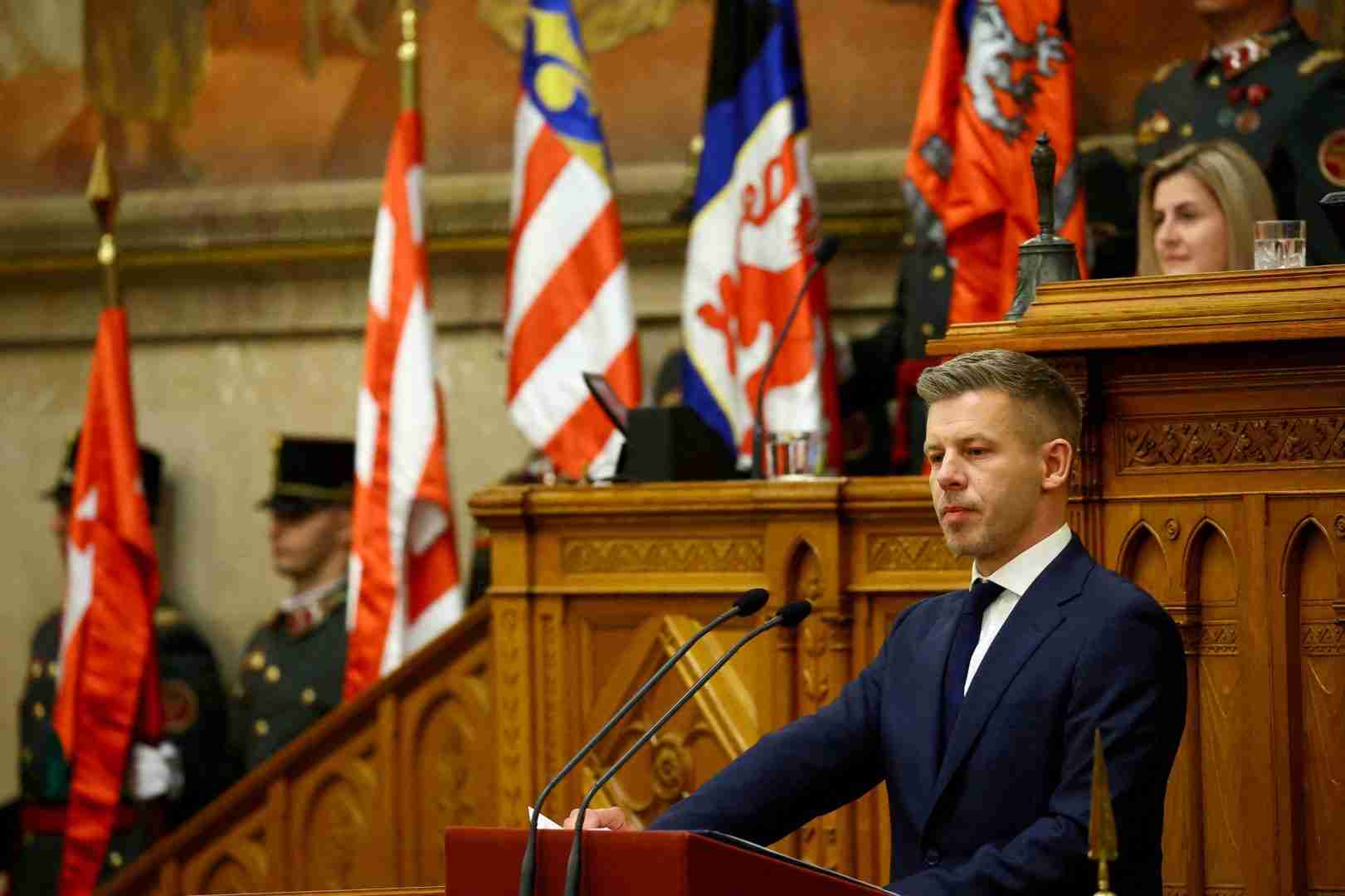
Prime Minister Peter Magyar, who ousted veteran nationalist leader Viktor Orban in an April election, secured the release of 16.4 billion euros ($19.1 billion) last month on promises to scrap Orban reforms deemed by the EU to have harmed democracy
International News via Reuters:
Hungary’s government will submit to parliament next week anti-corruption legislation needed to release billions of euros worth of suspended European Union funding, Transport and Investment Minister David Vitezy said on Friday.
Prime Minister Peter Magyar, who ousted veteran nationalist leader Viktor Orban in an April election, secured the release of 16.4 billion euros ($19.1 billion) last month on promises to scrap Orban reforms deemed by the EU to have harmed democracy.
Hungary’s forint currency and bond markets have rallied strongly on Magyar’s pro-EU pivot and his pledge to prepare the country for adoption of the euro by the end of this decade.
“This will be a comprehensive anti-corruption bill that also improves the transparency of Hungarian public life,” Vitezy told reporters. “This represents the rule-of-law criteria that will allow us to bring the EU funds home.”
He said the legislation would enable Hungary to tap up to 10 billion euros from the EU’s pandemic recovery fund to finance transport and renewable energy projects, as well as funds to support small businesses and rental housing construction.
TRANSPARENCY
The reforms will boost the powers of Hungary’s Integrity Authority, an anti-graft watchdog, and create more transparency in the asset declarations of public officials, with any omissions punishable by up to two years in jail, Vitezy said.
He said the government would inject some 3.5 billion euros of EU recovery funds into the state development bank MFB to help finance some of these projects and avoid any loss of funding ahead of an end-August cut-off date.
Hungary will also be able to offset 2.6 billion euros worth of investments previously drawn from its own resources with EU funding, Vitezy said, boosting the government’s room for manoeuvre with the budget following a surge in the deficit driven by heavy pre-election spending under Orban.
Vitezy said some 4.2 billion euros of EU cohesion money would be used to finance investments in railways and transport infrastructure, while another 2.2 billion suspended over an erosion of academic freedoms would be spent on higher education.
($1 = 0.8593 euros)
Reporting by Gergely Szakacs and Paweł FlorkiewiczEditing by Gareth Jones
The current Ebola outbreak in the Democratic Republic of Congo has resulted in 344 confirmed cases of the disease and 60 deaths, according to the World Health Organization
International News via Reuters:
Most of the 13 U.S. treatment centers in a government-funded hospital network for severe infectious diseases are ready to handle patients, including those with Ebola if needed, representatives from the hospitals said this week.
The current Ebola outbreak in the Democratic Republic of Congo has resulted in 344 confirmed cases of the disease and 60 deaths, according to the World Health Organization. So far, one American confirmed to have Ebola has been treated in Germany.
The U.S. State Department has said that U.S. citizens exposed to the virus but with no symptoms would be quarantined in Kenya at a facility it’s building and vowed to keep the U.S. free of travelers with Ebola.
The U.S. Department of Health and Human Services told Reuters on Wednesday the U.S. network is ready if needed for outbreak response.
Public health experts have increased calls for the government to bring any sick Americans home for treatment, with protests at the Kenya site leading to at least two deaths. A Kenyan court has also ordered a block to the construction.
The U.S. has spent hundreds of millions of dollars on preparing its health system to be able to handle Ebola patients since the 2014 Ebola outbreak in West Africa, including funding the network of 13 treatment centers.
AT LEAST 9 OF 13 CENTERS READY TO GO
Reuters reached out to the 13 hospitals and universities around the country that are part of the program called the National Emerging Special Pathogens Training and Education Center, nine of which confirmed they are able to receive patients who have been exposed to Ebola.
The network includes well-known sites such as the University of Nebraska and Emory University in Atlanta, which recently housed Americans exposed to hantavirus on a cruise, as well as others like Bellevue Hospital in New York and Cedars-Sinai Medical Center in Los Angeles.
Emory and three other hospitals did not respond to requests for comment.
“The United States’ investment in preparedness… remains a critical component of national health security,” Emily Hilliard, a spokesperson for HHS, said.
Hospitals “stand ready to safely evaluate, isolate, and treat patients with high-consequence infectious diseases while supporting ongoing response efforts,” she said.
INVESTMENT AFTER 2014 OUTBREAK
In the 2014 West Africa outbreak, the U.S. brought several Ebola patients back to be treated domestically. The following year, HHS received around $260 million in funding for Ebola preparedness and response activities in support of the regional treatment network.
Recently, HHS has provided $21 million a year in funding to the group, which has continued in 2026.
The facilities are required to be able to take care of at least two patients with exposure to a contagious viral hemorrhagic fever like Ebola. The facilities are required to train their personnel quarterly, and have lab testing capabilities and personal protective equipment on hand.
The U.S. CDC has dozens of employees in the DRC and has said it plans to send members of the Public Health Service Corps to staff the Kenya site. Americans also volunteer there for international relief organizations.
Healthcare officials in the U.S., including former Centers for Disease Control and Prevention officials, argued in an open letter earlier this week that building the new facility in Kenya would raise serious health risks compared with medical repatriation to fully staffed and prepared U.S. facilities.
One former CDC official who is familiar with the response effort said the Kenya quarantine plan could hinder recruiting Americans to help with the outbreak.
“People are concerned they will be abandoned by their government, and many see it as a slap in the face to have taken an oath to serve the American public and get repaid that way,” the former official said.
Reporting by Michael Erman in New Jersey; Additional reporting by Ahmed Aboulenein in Washington; Editing by Caroline Humer and Bill Berkrot
The Defence Investment Plan will lay out the funding for military equipment and services to ensure the armed forces move to a state of “warfighting readiness”, but reports say it has been held up since last year by budget rows within government
International News via Reuters:
Britain is running out of time to boost its defences in response to the threat posed by recent Russian actions, the country’s military chief said on Friday, after months of delays to the country’s Defence Investment Plan.
“Russia is definitely raising the stakes and risks crossing a line,” Chief of the Defence Staff Richard Knighton told BBC Radio. “We need to spend more on defence and do it faster.”
The Defence Investment Plan will lay out the funding for military equipment and services to ensure the armed forces move to a state of “warfighting readiness”, but reports say it has been held up since last year by budget rows within government.
Prime Minister Keir Starmer confirmed on a visit to a drone factory on Friday that the plan would be published before a July 7 NATO summit, following a period of close work between government and military leaders.
“It is no exaggeration to say that we’re living in more dangerous and volatile times than at any time in my life,” Starmer said.
U.S. President Donald Trump, who has repeatedly called on Starmer and other European leaders to spend more on defence and become less reliant on Washington for the continent’s security, is due to attend the summit.
THREATS GREATEST SINCE COLD WAR
Knighton said the risks and threats to Britain were greater than at any time since the Cold War, and the government needed to spend on defence accordingly.
“The challenge for ministers is to make those difficult trade-off decisions,” he said.
Media reports say military chiefs have warned Starmer that there is a £28 billion shortfall in funding over the next four years, and say that is behind the delay to the investment plan.
Starmer has pledged the largest sustained increase in defence spending since the Cold War, aiming to lift it to 3% of national output in the next parliament, but he has been criticised for not following through on his promises.
George Robertson, who served in the 1990s as Britain’s defence secretary and then as chief of NATO, said in April that there was a gap between Starmer’s rhetoric and action and he was “not willing to make the necessary investment” in defence.
Knighton said Russia was stepping up its threat, with more incursions into British airspace and through regular “probing, challenging, testing” of defences, as well as being behind cyberattacks, sabotage and attempts to steal technology.
“We do need to step up and enhance our capability as the threats from potential adversaries grow,” he said.
Reporting by Sarah Young; Editing by Alex Richardson, William Maclean
The FAO Food Price Index, which measures changes in a basket of globally traded food commodities, averaged 130.8 points in May, 0.2% down from its revised April level of 131.0, but up 2.9% from a year earlier
International News via Reuters:
World food prices slipped in May from a revised April level, with vegetable oil prices falling for the first time this year while cereals and sugar jumped, the United Nations Food and Agriculture Organization said on Friday.
The FAO Food Price Index, which measures changes in a basket of globally traded food commodities, averaged 130.8 points in May, 0.2% down from its revised April level of 131.0, but up 2.9% from a year earlier.
Despite the small downward correction for the April data, the index remained near its highest level since January 2023 and 18.4% below its March 2022 peak.
Cereal prices rose more than 2.6% on the month, with wheat up for a fourth straight month on smaller export harvest prospects, including in the United States, and higher fuel and fertiliser costs linked to the Iran conflict.
Maize prices were also supported by stronger import demand and tighter supplies in Brazil and the U.S., the agency said.
By contrast, vegetable oil prices fell 4.6% from last month, their first monthly decline this year, as lower palm and soy oil prices outweighed gains in rapeseed and sunflower oil. After rising for five consecutive months, international palm oil prices declined, reflecting expectations of weaker global import demand and uncertainty in crude oil markets.
Vegetable oil prices on average were still more than 20% above last year, as elevated energy costs following the effective closure of the Strait of Hormuz raised demand for biofuels made using organic materials, such as oil-rich plants.
Sugar prices jumped 7.5% from last month to 95.1 points, but remained 13.1% below their level a year ago. The increase was mainly driven by concerns over an anticipated tightening of global sugar supplies in the coming months.
In a separate cereal supply report, the FAO said it expected world cereal production – including rice in milled equivalent – to shrink 2% in 2026/27 to 2.98 billion tons.
Production of all major cereals is anticipated to decline, albeit for many from record levels reached in 2025, with the largest year-on-year decrease in percentage terms forecast for wheat and the smallest for maize and barley.
Reporting by Sybille de La Hamaide; Editing by Emelia Sithole-Matarise
The Iran-backed Hezbollah militia rejected a new ceasefire in Lebanon on Thursday and Israel said it would not withdraw troops from the country, undermining U.S. President Donald Trump’s efforts to halt fighting there and reach a peace deal with Tehran
International News via Reuters:
Shares slid on Friday as investors turned defensive ahead of the weekend, wary of the flare-up in Middle East hostilities with U.S.-Iran peace talks in limbo.
The Iran-backed Hezbollah militia rejected a new ceasefire in Lebanon on Thursday and Israel said it would not withdraw troops from the country, undermining U.S. President Donald Trump’s efforts to halt fighting there and reach a peace deal with Tehran.
Meanwhile, an AI-driven selloff after chipmaker Broadcom reported underwhelming results on Wednesday continued into a second day, as investors took profits following a blistering recent rally.
The pan-European STOXX 600 index slipped 0.2%, led by declines in tech stocks which have risen 33% in the past two months, the most among sectors in the broader index.
MSCI’s broadest index of Asia-Pacific shares outside Japan fell 2.23% in Asian trade, with South Korea’s tech-heavy Kospi plunging as much as 7%.
“(It) seems like quite a risk-off today,” said Charu Chanana, chief investment strategist at Saxo.
“Korea has been one of the biggest beneficiaries of the AI memory supercycle, so when Broadcom disappointed on AI expectations, investors quickly de-risked the whole semiconductor chain,” she said.
“The issue is not that AI demand has disappeared – it is that expectations had become extremely high, and even good numbers are no longer enough unless guidance keeps moving higher.”
Nasdaq futures fell 1.2% and S&P 500 futures eased 0.6%, after a mixed session on Wall Street overnight.
Cryptocurrencies extended recent declines, with bitcoin shedding 1.4% to $62,725.54 and heading for a weekly decline of 15%, its biggest since the week FTX collapsed in November 2022, while ether was down 2.3% at $1,732.09.
OIL SET FOR WEEKLY GAIN
Oil prices eased slightly after Oman said operations at Mina al Fahal port were proceeding normally following an earlier Reuters report that oil loadings had been suspended after an explosion.
Brent crude futures fell 24 cents to $94.79 a barrel and U.S. crude edged down 0.6% to $92.48 per barrel, with both contracts set to post their first weekly gain in three weeks.
Kristian Kerr, head of macro strategy at LPL Financial, said markets were underestimating the complexities involved in restoring shipping through the Strait of Hormuz to pre-war levels, even if Washington and Tehran reach a memorandum of understanding.
“Any early increase in barrels is likely to come from already produced crude, including crude sitting on stranded or floating vessels and Iranian cargoes in storage, rather than a sustained restart in production or exports,” he said.
“In other words, this is more about clearing existing bottlenecks than reflating the supply base.”
EYES ON US NONFARM PAYROLLS
In currencies, the dollar was on track for a 0.5% weekly rise supported by the Middle East conflict.
The yen languished near the 160 per dollar level and was last 0.1% stronger at 159.95, as Japanese officials ramped up warnings on the ailing currency, keeping traders on alert for further intervention from Tokyo.
Data on Friday showed Japan’s foreign reserves fell by $77 billion in May.
Focus now turns to the closely watched U.S. nonfarm payrolls data due later in the day.
Market forecasts are for a solid rise of 85,000 in employment, keeping the jobless rate steady at 4.3%. Anything stronger would likely see the odds of a Federal Reserve rate hike narrow further.
Reporting by Lawrence White and Rae Wee; Editing by Kate Mayberry
The party expresses sympathy to the family and honours Sir John Swan’s public service
Statement from Opposition Leader, the Hon Ben Smith, JP, MP
On behalf of the One Bermuda Alliance, I would like to extend my sincerest condolences to the family of the late Sir John Swan, who is also my godfather.
Sir John was undoubtedly a unique character who will forever hold a place in Bermuda’s history as our longest serving Premier. He was affable, and admired by many, regardless of where they sat on the political spectrum. He treated everyone with high regard—he was truly a man of the people.
Sir John, thank you for your service to the people of Bermuda throughout the years. May you rest in eternal peace.
Sir John Swan was a real estate developer, philanthropist, and the longest-serving Premier of Bermuda. He was widely respected for his keen political and business insight, matched by his humility and gentlemanly demeanour.
As a child, Sir John was visually impaired and had dyslexia. His parents instilled in him the importance of discipline and sacrifice, which he embraced fully. He learned to overcome obstacles through determination and a belief in his ability to succeed, principles that have guided his life’s work.
In 1962, he founded the John W. Swan Agency, a real estate development and savings and loan company offering services in architecture, construction, land development, rentals, and property management. Between 1968 and 1978, the company developed 40% of Bermuda’s residential homes. His mission was to help ordinary Bermudians achieve home ownership and provide them with the financial tools to do so. The company also employed over 20 young Bermudian contractors, many of whom went on to launch successful businesses of their own. The firm celebrated its 50th anniversary in 2012.
Sir John helped modernize the City of Hamilton through numerous building projects, including Bermuda’s first condominium complex and the island’s first 10-storey development at 141 Front Street, an environmentally sustainable and energy-efficient landmark.
Before entering politics, he played a key role in national development as a founding member of the Bermuda Monetary Authority, a Director of the Bermuda Chamber of Commerce, and a Director of the Bermuda Employers Council.
He was elected to Parliament in 1972 and simultaneously became Chairman of the Bermuda Hospitals Board. Over his 25-year political career, he held several important Cabinet posts, including Minister of Marine and Air Services, and Minister of Immigration and Labour, where he introduced progressive policies that supported Bermuda’s economic and social growth. In 1982, Sir John became Premier of Bermuda, a position he held for 13½ years until 1995.
His most lasting political achievement was leading the negotiations for the 1985 USA – Bermuda Tax Convention. These high-level discussions included meetings with the President, Vice-President, Secretary of the Treasury, Secretary of State, National Security Advisor, and members of Congress. The resulting agreement helped establish Bermuda’s reinsurance and insurance sectors and secured the island’s reputation as a major offshore financial centre, laying the groundwork for the strong, regulated economy Bermuda has today.
Sir John has been honoured numerous times for his service. In 1990, he was knighted by Her Majesty Queen Elizabeth II as a Knight Commander of the Order of the British Empire (KBE) and appointed a Justice of the Peace. He has received awards from the Bermuda Jaycees, the International Association of Lions Clubs, the Poor Richard Club of Philadelphia, and St. Paul’s AME Church. He was also admitted to the Freedom of the City of London, made an Honorary Member of the Hamilton Rotary Club, appointed a Senator of the Junior Chamber of Commerce, and inducted into the Company of Honorary Fellows of Bermuda College. In 2010, he was one of the first four inductees into the Bermuda Business Hall of Fame.
He earned a Bachelor of Arts from West Virginia Wesleyan College, which also awarded him an Honorary Doctorate. He received additional honorary doctorates from Atlantic Union College, the University of Tampa, and Morris Brown College.
Sir John served as Chairman of the Swan Group of Companies and remained actively involved in international business, public policy, and real estate development, including his long-time advocacy for the revitalization of the Hamilton Waterfront. He passionately supported local charitable causes and was a patron of Bermudian theatre for more than three decades.
The Premier, the Hon. David Burt, JP, MP, today expressed his sincere condolences to the family of former Premier, the late Sir. John Swan.
“Sir John dominated Bermuda’s politics for a generation and for over a decade served as Premier of Bermuda. His tenure was historic and those of us who have followed him in this office still feel the shadow of his larger-than-life presence,” the Premier said.
Premier Burt continued, “Our politics often saw us on opposing sides, but we were united in a love of this Island, and her people. Sir John’s “common touch” remains a hallmark of his life and legacy. Whether in the White House or at Cup Match, he was the same man…true to his beliefs and ideals and always ready to greet people with his characteristic warmth. He certainly “walked with kings but never lost the common touch.
“On behalf of the Government and People of Bermuda I express our heartfelt prayers for the comfort of his children and his family. The legacy of this patriarch is a story of humble beginnings, dogged determination, business and political skill and success, founded in a genuine heart for service.”
The Cabinet Office confirmed that flags on Government buildings will be flown at half mast starting tomorrow, Friday, 5th June.
Bermuda’s longest-serving Premier, Sir John Swan, has passed away at the age of 90
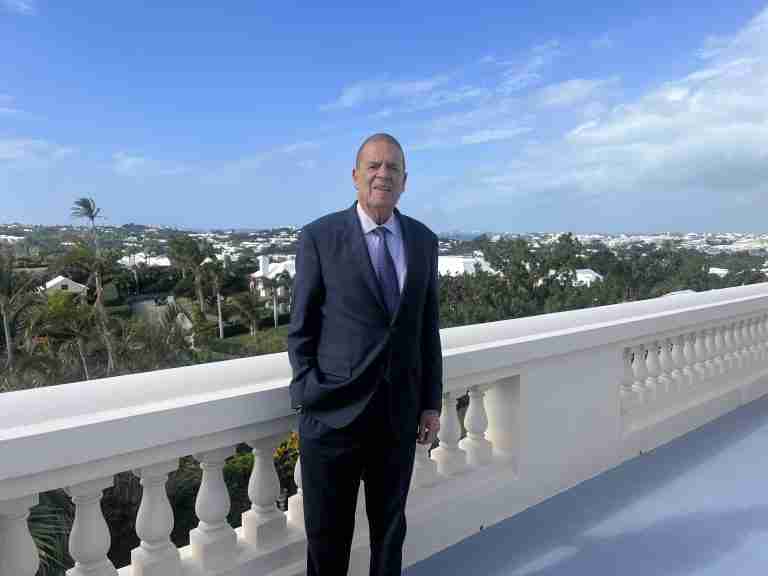
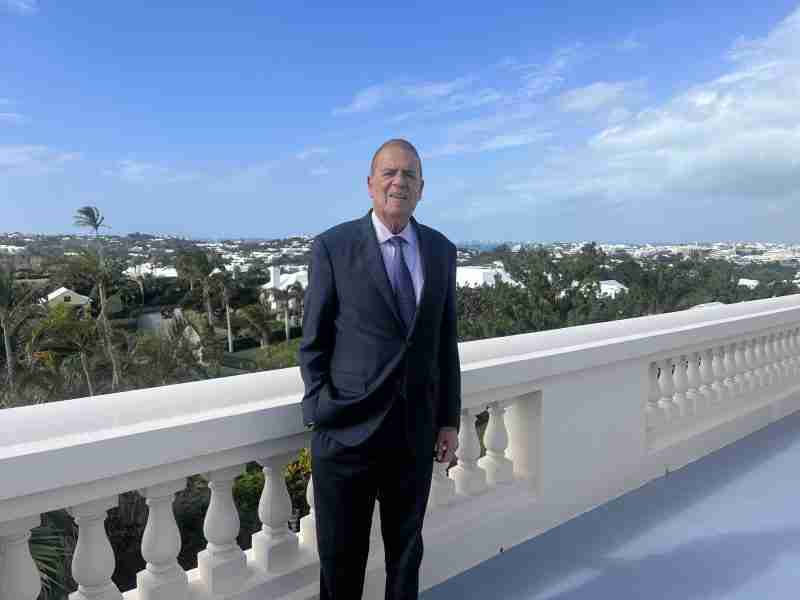
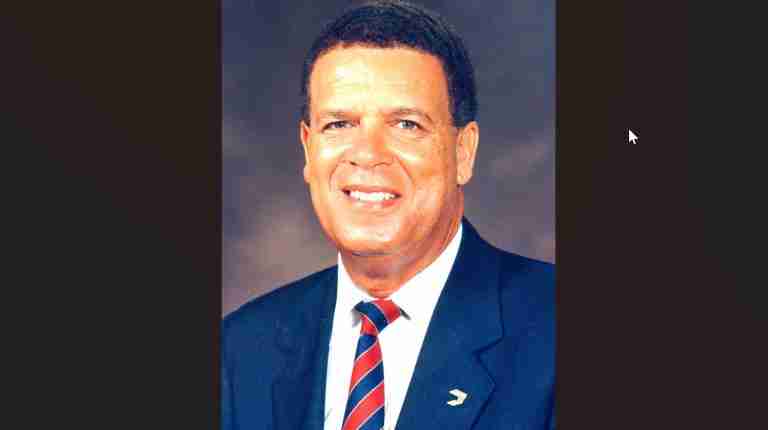
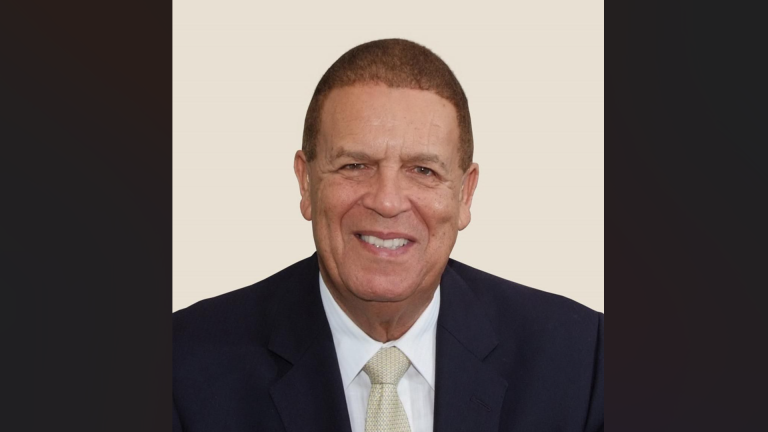
Former Premier Sir John Swan in 2025, right; As Premier in the 1980s, Sir John Swan stands with Queen Elizabeth II
Sir John Swan, Bermuda’s longest-serving and arguably most famous Premier, has died aged 90, a month away from his 91st birthday.
Bermuda Broadcasting has been told that he passed on Thursday afternoon, surrounded by family and friends.
Sir John, as he was often called, led the United Bermuda Party and served as Premier from 1982 until 1995, and his tenure is associated with a period of significant expansion in Bermuda’s financial services sector.
The 1986 US–Bermuda Tax Convention, signed in 1986 and entered into force in 1988, is seen as the foundation of Bermuda’s subsequent success as a global insurance and reinsurance centre.
A successful businessman and property owner, his 10-storey office complex at 141 Front Street is a City of Hamilton landmark.
He was recognised as a National Hero in 2016, and until today had been Bemruda’s only living National Hero.
Sir John had a political renaissance in May 2024, coming second to the OBA’s Robert King in the Smith’s North by-election.
He went on to spearhead a movement of independent candidates who ran in the February 2025 General Election. Ultimately, none of the independents, including Sir John, managed to claim a seat. Some of those candidates went on to form The People’s Independent Coalition (PIC).
In Bermuda Broadcasting’s final interview with Sir John Swan in May 2025, he was reflecting on the passing of U.S. Congressman Charles Rangel, who he says helped him in the 1980s as he advocated for the tax treaty that underpinned the growth of international business in Bermuda.
Speaking on the success of that treaty, he said “thus you see Bermuda as you see it today – a country that is probably one of the most successful countries in the world.”
“We went from being great competitors in the tourist business. Now we’re great competitors in the international business.”
Bermuda Broadcasting offers its sincere condolences to the family of Sir John Swan.
To provide the best experiences, we use technologies like cookies to store and/or access device information. Consenting to these technologies will allow us to process data such as browsing behavior or unique IDs on this site. Not consenting or withdrawing consent, may adversely affect certain features and functions.
Functional
Always active
The technical storage or access is strictly necessary for the legitimate purpose of enabling the use of a specific service explicitly requested by the subscriber or user, or for the sole purpose of carrying out the transmission of a communication over an electronic communications network.
Preferences
The technical storage or access is necessary for the legitimate purpose of storing preferences that are not requested by the subscriber or user.
Statistics
The technical storage or access that is used exclusively for statistical purposes.The technical storage or access that is used exclusively for anonymous statistical purposes. Without a subpoena, voluntary compliance on the part of your Internet Service Provider, or additional records from a third party, information stored or retrieved for this purpose alone cannot usually be used to identify you.
Marketing
The technical storage or access is required to create user profiles to send advertising, or to track the user on a website or across several websites for similar marketing purposes.