In the Southern League Premier Central Division, midfielder Milan Butterfield was the hero for Halesowen Town. He was named man of the match after scoring the winning goal in their 1-0 victory over Stratford Town FC at The Grove. His 51st-minute header was the decisive strike in what was a much-improved second-half performance from his team.
There was also cup success for Bermudian trio Reece Jones Jr., Qur’an Raynor, and their Binfield teammates. The side secured a 2-1 victory over Hartley FC in the Velocity Cup at Hill Farm Lane, with Malachi Henry as an unused substitute.
Elsewhere, Willie Clemons and his Leiston FC teammates played out a 2-2 draw with St Ives Town at the Watson & Hillhouse Stadium in their Southern League Premier Central Division match.
Meanwhile, Jutorre Burgess and his Harborough Town FC teammates were victorious, defeating Redditch United at the Valley Stadium in the same division.
Justin Donawa’s Brackley Town secured all three points at home, with a first-half strike from Connor Hall proving the difference in their match against Truro City FC at St James Park.
In the National League, Kane Crichlow and his Sutton United teammates battled to a 1-1 draw in their shortest away day of the season against Woking.
However, it was a tough night for Reggie Lambe and his Needham Market teammates, who fell to a heavy 4-0 defeat at the hands of Bishop’s Stortford FC at the Bloomfields Stadium.
The loan, aimed at helping Kyiv fund its war effort, would be repaid by Ukraine only once it receives reparations from Russia in a peace accord
International News via Reuters:
The European Union’s “reparations loan” for Ukraine could be up to 130 billion euros, EU officials close to the talks said, with the size to be finalised after the International Monetary Fund’s assessment of Ukraine’s financing needs in 2026 and 2027.
The idea of a reparations loan to Kyiv, based on cash balances of Russian assets immobilised in the West after Moscow invaded Ukraine in 2022, was floated by European Commission President Ursula von der Leyen on September 10.
The loan, aimed at helping Kyiv fund its war effort, would be repaid by Ukraine only once it receives reparations from Russia in a peace accord. The risk would be carried collectively by European and possibly also some other G7 countries, she said.
Most of the roughly 210 billion euros worth of Russian assets held in Europe are in Belgian central securities depository Euroclear. Officials said 175 billion euros of the assets in Euroclear have now matured and become cash that could be the basis of the new loan.
But officials said that before the EU would move ahead with the reparations loan, it would want to repay the 45 billion euro ($50 billion) G7 loan agreed last year.
That would leave some 130 billion euros from the cash balance available for the new instrument, three officials close to the discussions said.
USING RUSSIAN ASSETS WITHOUT CONFISCATING THEM
EU Economic Commissioner Valdis Dombrovskis said on Friday that the Commission would only decide on the size of the loan after receiving an IMF assessment of Ukraine’s financing needs over the next two years.
No concrete details have been agreed, senior EU finance ministry officials have said. The Commission is working out a mechanism to allow it to use the frozen Russian assets without confiscating them — a red line for many EU governments and the European Central Bank.
The reparations loan mechanism is likely to include a Special Purpose Vehicle to which the immobilised Russian cash from Euroclear could be transferred in exchange for zero-coupon bonds issued by the European Commission with the guarantees of EU and possibly G7 governments.
($1 = 0.8518 euros)
Reporting by Jan Strupczewski; editing by Richard Lough and Ros Russell
The Trinity Western Spartans started strong, but it was the Pacific Pride who finished with a flourish, overcoming a first-half deficit to secure a 46-22 victory in Coastal Cup Rugby action at Yorkson Community Park. The win was fueled by a dominant second-half performance, which saw the Pride shut out the Spartans in a 29-0 scoring run.
Jamin Hodgkins was a key contributor to the comeback, accounting for nine of his team’s points with a penalty kick and three conversions.
The Spartans looked to be in control early on, building a comfortable lead in the first half with some impressive attacking play. However, the Pacific Pride showed their resilience and determination after the break. They began to chip away at the deficit, with their relentless pressure and defensive intensity paying off.
The second half was all one-way traffic, with the Pride’s attack finding another gear and their defence holding firm. The comeback was complete with a late scoring blitz, as Hodgkins and his teammates sealed a memorable victory.
As of September 21, a total of 57 cases, including 10 probable cases and 35 deaths were reported in Congo’s Kasai Province
International News via Reuters:
Eleven new confirmed cases of Ebola were reported in Democratic Republic of Congo since the World Health Organization’s last update on September 15, showing a decreasing trend of cases in the recent week, the UN health agency said on Wednesday.
As of September 21, a total of 57 cases, including 10 probable cases and 35 deaths were reported in Congo’s Kasai Province, the WHO added. The total deaths included 10 probable deaths.
“The outbreak shows a decreasing trend of cases in the recent week, nevertheless the attention remains high”, the agency said.
Reporting by Chandni Shah in Bengaluru; Editing by Joe Bavier
Tourism is the beating heart of Bermuda’s economy, and the measures introduced in the Honourable House this past week represent more than just legislation—they represent vision. For years, Bermudians have called for a tourism strategy that supports both large-scale investment and homegrown entrepreneurs. With the new Tourism Investment Bills and Orders, that call is finally being answered.
What makes this moment so significant is not only the scale of the projects but their inclusivity. Too often, the benefits of government relief were seen as the preserve of foreign developers with deep pockets. That perception is being shattered. By extending relief to local businesses the government is proving that Bermudian entrepreneurs are just as vital to our tourism future as international investors. This recognition is long overdue, and it deserves praise.
Equally important is the modernization of the Tourism Investment Act. The world does not wait for outdated bureaucracy, and neither should Bermuda. Allowing ministers to respond to real-time market conditions is not only pragmatic, it is essential. Our competitors in the region are agile and aggressive in attracting investors. Bermuda can no longer afford to move at yesterday’s pace. By introducing flexibility into the law, the government is signaling that we are ready to meet today’s challenges head-on.
Of course, major projects still carry enormous weight in our tourism landscape. The decision to support the developers of The Loren in their acquisition and revitalization of the former Elbow Beach site is a case in point. For years, that property has stood as a symbol of lost opportunity. Now, with the promise of renewal, it has the chance to become a symbol of hope. Jobs will be created, hotel capacity will expand, and Bermuda will once again have a world-class asset that strengthens our competitive edge.
Critics may argue that government incentives come at too high a price. But the true cost lies in inaction. Every shuttered site, every missed opportunity, every Bermudian without work is a reminder that bold steps are needed. These legislative measures are not handouts—they are investments in our people, our economy, and our future.
We must focus on the next generation of repeat visitors by deepening ties with our key markets to boost winter air arrivals.
With sports and cultural tourism re-emerging as fall and winter drivers, we encourage sporting bodies, entrepreneurs and event organizers to work with the BTA to receive organizational and marketing support.
Never underestimate love for sport, culture and the arts – we have seen passion-driven initiatives have the best chance to thrive long term.
Bermuda’s tourism story is being rewritten. This chapter is about confidence, inclusion, and growth. And if we stay the course, it will be remembered as the moment we chose progress over stagnation.
The Department of Culture hosted its annual Cultural Connect event on Thursday, 18 September 2025, at the Blue Diamond, Young Men’s Social Club. The evening gathered artists, tradition-bearers, cultural workers, and community leaders for a panel discussion, live music, and networking centred on Bermuda’s National Cultural Heritage Policy. The event highlighted the importance of collaboration in strengthening Bermuda’s cultural landscape and ensuring it thrives for future generations.
Minister of Tourism & Transport, Culture & Sport, the Hon. Owen Darrell, JP, MP, said in his opening remarks, “This gathering is about building relationships, sparking ideas, and creating the connections that allow culture to grow in Bermuda. I want to thank the Department of Culture for bringing us together this evening. But it is you, our artists, tradition-bearers, cultural workers, and community leaders, who bring the National Cultural Heritage Policy to life. Your creativity, your stories, and your dedication are what ensure Bermuda’s culture remains strong and relevant.”
The Minister’s address highlighted the value of cultural participation and the role of the community in shaping Bermuda’s evolving identity. From the rhythms of the Gombeys to the words of local storytellers, culture was celebrated as both heritage and innovation. Attendees were encouraged to contribute their voices and ideas through discussions and feedback, reaffirming the Government’s commitment to inclusive cultural development.
Cultural Connect continues to serve as a vital forum for dialogue, creativity, and exchange, offering a space for Bermudians to engage in shaping the future of cultural policy and practice. The Department of Culture remains dedicated to supporting the arts, uplifting tradition, and investing in new generations of creators, ensuring that Bermuda’s unique cultural identity is celebrated at home and shared with the wider world.
Bermudian tennis player Trey Mallory’s run at the M15 Kayseri International Tennis tournament has come to an end after a straight sets defeat in the Main Draw. Mallory, who had successfully navigated the pre-qualifying rounds to earn his spot, was unable to overcome the experience of his opponent, Aldin Setkic of Bosnia and Herzegovina.
Mallory put up a strong fight in the opening set. The match went to a tiebreak, but Setkic ultimately clinched the set 7-6.
Setkic, a veteran on the professional circuit with a career-high singles ranking of 165, proved too consistent for Mallory in the second set. He broke the Bermudian’s serve to take control and closed out the match with a 6-3 victory.
Despite the early exit, Mallory’s appearance in the Main Draw is a significant step in his developing professional career, giving him valuable experience against a seasoned international opponent. It’s a positive start to his campaign on the professional circuit as he works towards a higher international ranking.
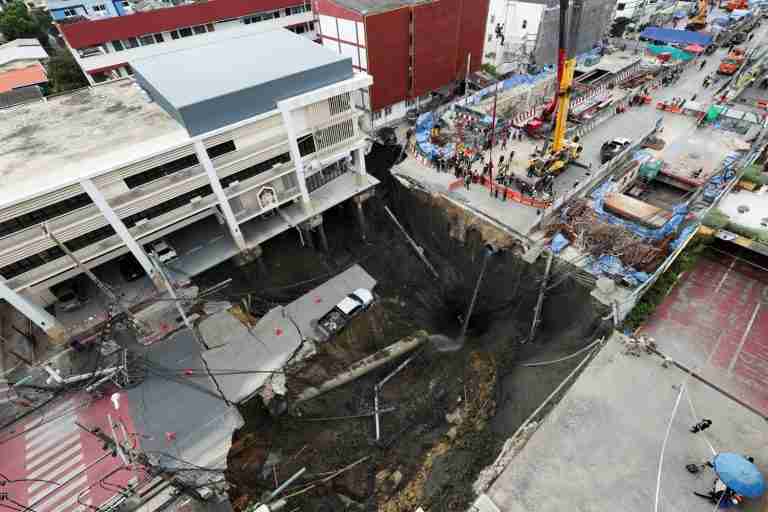
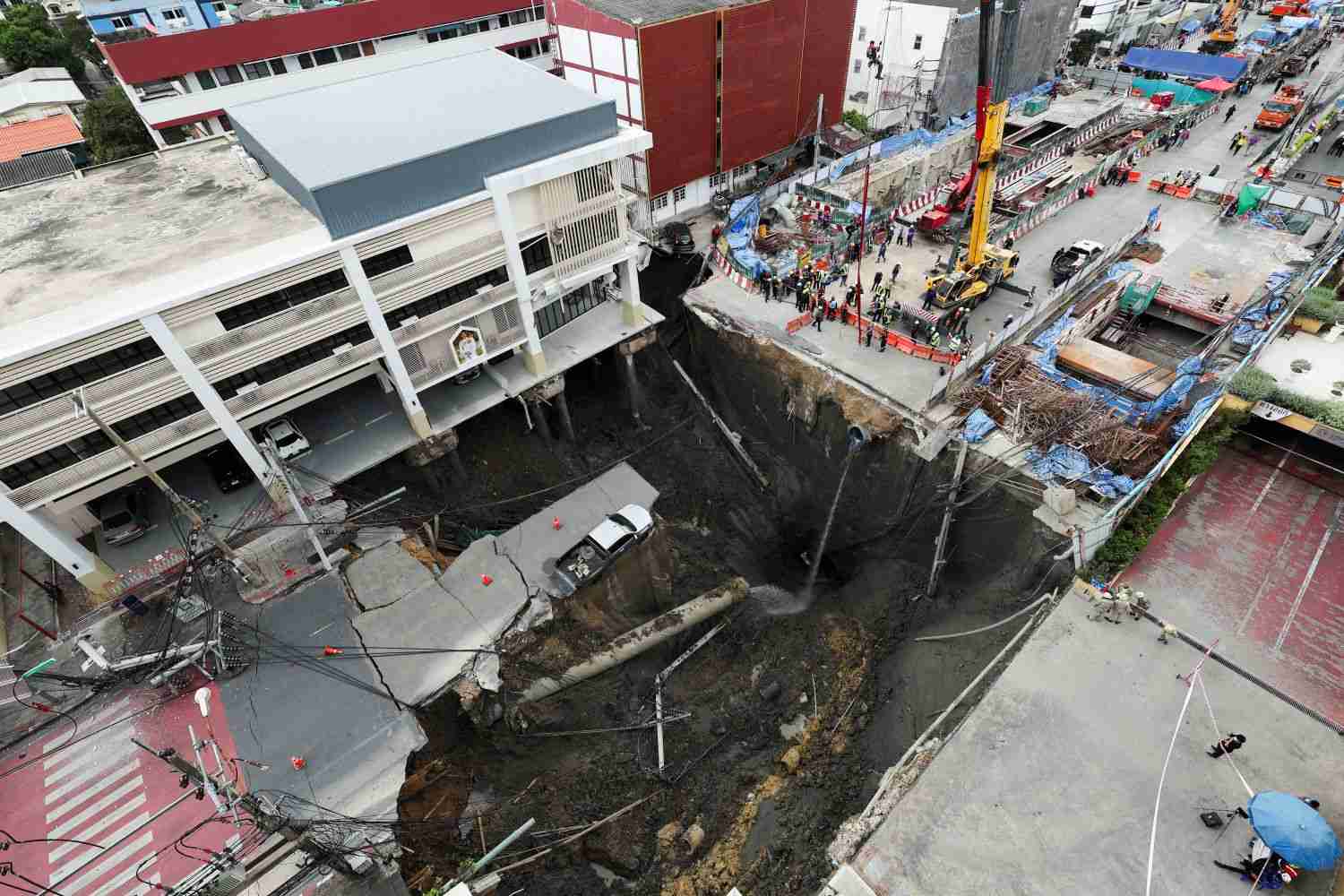
The 50-metre deep (164 feet) sinkhole extended about 900 square metres in front of the Vajira Hospital, halting traffic
International News via Reuters:
Thai authorities rushed to contain a massive sinkhole near a hospital in central Bangkok that disrupted utilities and traffic, officials said on Wednesday.
The 50-metre deep (164 feet) sinkhole extended about 900 square metres in front of the Vajira Hospital, halting traffic.
Footage on social media showed the road slowly sinking as water poured out from a drainage pipe, dragging down electricity poles. The hospital announced that it would not take on patients during the incident.
“Dirt from an underground train construction was sliding in,” Prime Minister Anutin Charnvirakul told reporters. “Luckily there are no deaths or injuries.”
Bangkok Governor Chadchart Sittipunt said a pipe had burst so water and power lines have also been cut.
“The hospital has no problems, but we are worried about the police station: that’s still dangerous and the public has been evacuated,” he said.
By noon, authorities said they had halted further ground movement and were monitoring the site closely.
Reporting by Panarat Thepgumpanat, Chayut Setboonsarng, Editing by David Stanway
Berlin is one of several airports across Europe impacted by the disruptions, attributed to a ransomware attack on software provider Collins Aerospace
International News via Reuters:
Berlin airport is battling to restore its check-in and baggage handling systems after a cyberattack at the weekend, with further delays and cancellations possible on Wednesday, the airport operator said in a statement.
Berlin is one of several airports across Europe impacted by the disruptions, attributed to a ransomware attack on software provider Collins Aerospace, which have affected dozens of flights and thousands of passengers since Friday.
It may take several more days before the German capital’s airport has functional and secure software again, with staff working flat out to process passengers manually in the meantime, the BER operator said in a statement.
The software provider “has called in other experts and is working urgently to find a solution,” it added.
Passengers should be prepared for long delays, and the airport encouraged people to check with their airlines in advance whether their flight was still planned.
Collins Aerospace said on Monday that it was working with the affected airports, which also include Brussels and London Heathrow, Europe’s busiest.
Berlin airport was particularly busy after a marathon took place in the city over the weekend, with many runners struggling to return home.
Reporting by Rachel More, editing by Thomas Seythal
Sub-tropical Taiwan, frequently hit by typhoons, normally has a well-oiled disaster mechanism that averts mass casualties by moving people out of potential danger zones quickly
International News via Reuters:
Residents in a Taiwan town where flooding from a typhoon killed 17 people sought shelter on Wednesday fearing further disaster after a lake burst its banks, as Premier Cho Jung-tai called for an inquiry into what went wrong with evacuation orders.
Sub-tropical Taiwan, frequently hit by typhoons, normally has a well-oiled disaster mechanism that averts mass casualties by moving people out of potential danger zones quickly.
But many residents in Guangfu, an eastern town in the beauty spot of Hualien, thronged by tourists, said there was insufficient warning when a lake overflowed during Tuesday’s torrential rains brought by Super Typhoon Ragasa.
The barrier lake, formed by landslides triggered by earlier heavy rain in the island’s sparsely populated east, burst and sent a wall of water into Guangfu.
NUMBER OF MISSING REVISED DOWN
Cho said the immediate priority was to find those missing. The original number of 152 was revised down to just 17 after many people were located alive.
“For the 14 who have tragically passed away, we must investigate why evacuation orders were not carried out in the designated areas,” he told reporters in Guangfu, before the death toll was adjusted up in the afternoon, to 17.
“This is not about assigning blame, but about uncovering the truth.”
Fire officials said all the dead and missing were in Guangfu, where the waters destroyed a major road bridge across a river.
As heavy rain continued on and off in Hualien, police cars sounded sirens for a new flood warning in Guangfu on Wednesday, sending people scrambling for safer areas as residents and rescuers shouted: “The flood waters are coming, run fast.”
“We will not return until the overflow is finished or the risk of it bursting is reduced. It’s too dangerous,” said a woman who gave her family name as Tsai from a packed emergency shelter in an elementary school.
NO REPEAT OF MASS FLOODING EXPECTED
Deputy disaster command centre chief Huang Chao-chin said with rainfall easing and much of the water from the lake already released, he did not expect a repeat of Tuesday’s mass flooding.
Lamen Panay, a Hualien councillor, said government evacuation requests before the flood had not been mandatory.
Referring to guidance for people to head to higher floors, she said: “What we were facing wasn’t something ‘vertical evacuation’ could resolve.”
About 5,200 people, or 60% of the population, sought shelter on the higher floors of their own homes while most of the rest left to stay with families, government data showed.
But the government said the overflow of the barrier lake released about 60 million tonnes of an estimated 91 million tonnes of water, enough to fill about 36,000 Olympic-sized swimming pools.
Taiwan has been lashed since Monday by the outer rim of Typhoon Ragasa, which was downgraded from a super typhoon and is now hitting China’s southern coast and the Asian financial hub of Hong Kong.
WATER HIT LIKE A ‘TSUNAMI’
The water hit like a “tsunami”, said Guangfu postman Hsieh Chien-tung, who was able to flee to the second floor of the post office just in time. Later, he got home to find his car had been swept into the living room.
Regions across Taiwan have dispatched rescue teams to Hualien, with the military sending 340 troops to help.
In Guangfu, soldiers operating from an armoured personnel carrier to keep clear of thick mud in the streets went door-to-door handing out water and instant noodles. Wrecked cars and scooters were littered around.
China’s Taiwan Affairs Office offered condolences, in a rare sign of goodwill from Beijing, which has a deep dislike of Taipei’s government.
China views Taiwan as its own territory, despite the strong objections of the island’s democratically elected government.
Besides the wilderness beauty that makes it one of Taiwan’s top tourist draws, Hualien is also home to many members of the island’s indigenous groups, including the Amis.
The typhoon brought about 1 metre (3.2 ft) of rain to parts of Taiwan’s east, though the populous west coast, home to the crucial semiconductor industry, was not affected.
In 2009, Typhoon Morakot brought destruction to Taiwan’s south, killing about 700 and causing damage of up to $3 billion.
Reporting by Yimou Lee, Fabian Hamacher and Ann Wang; Writing by Ben Blanchard; Editing by Stephen Coates, Clarence Fernandez, Lincoln Feast and Alison Williams
While geopolitics have been a large driver for global markets this year, the focus for investors on Wednesday was firmly trained on the outlook for the U.S. economy
International News via Reuters:
Stocks slid on Wednesday, echoing losses on Wall Street overnight, while the dollar rose broadly, after Federal Reserve Chair Jerome Powell fell short of confirming investors’ expectations that U.S. interest rates will decline sharply in coming months.
In Europe, defence stocks – one of the star-performing sectors this year – jumped after U.S. President Donald Trump said he believed Ukraine could retake all its land occupied by Russia, marking a sudden shift in rhetoric in Kyiv’s favour.
“After seeing the Economic trouble (the war) is causing Russia, I think Ukraine, with the support of the European Union, is in a position to fight and WIN all of Ukraine back in its original form,” he said in a social media post on Tuesday, although there was no sign of any actual change in U.S. policy.
Defence stocks such as Rheinmetall, Hensoldt and SAAB rose between 2-4.8%, although losses in financials kept the STOXX 600 down around 0.4% on the day.
In a sometimes-meandering speech to the U.N. General Assembly, in which he rejected moves by allies to recognise a Palestinian state, Trump chastised Western nations for their approach to climate change and immigration, telling leaders “your countries are going to hell.”
While geopolitics have been a large driver for global markets this year, the focus for investors on Wednesday was firmly trained on the outlook for the U.S. economy and the likely path of U.S. interest rates.
The dollar rose broadly, leaving the euro, pound and yen in negative territory, pushing up the U.S. currency against a basket of six others by 0.35% on the day.
Powell, in remarks on Tuesday, largely stuck to the language used last week when the central bank cut its benchmark rate a quarter of a percentage point, to stress the need for policymakers to balance the competing risks of high inflation and a weaker jobs market in coming monetary policy decisions.
Given that traders are almost fully pricing in a rate cut in October, Powell offered little in the way of new direction for markets.
“There was a clear pivot at the last meeting which set the direction, but the pace (of cuts) is something we’ll have to see,” Daiwa Capital economist Chris Scicluna said.
“All markets, if you’re looking on the fixed-income side or the equity side, are taking comfort from the expectation that the Fed will be easing for the remainder of this year and again next year and take them basically moving from a restrictive stance to a neutral stance,” he said.
Traders have ramped up bets on further U.S. rate cuts, with Fed funds futures implying a 91.9% chance of a rate cut at the central bank’s October meeting, up from a 89.8% probability on Tuesday, according to the CME Group’s FedWatch tool.
Longer-dated U.S. government bonds attracted buyers, which pushed down the yield on 30-year Treasury bonds by 2.1 basis points on the day to 4.717%, while the benchmark 10-year note eased 1.4 bps to 4.106% and the rate-sensitive two-year yield held steady at 3.565%.
U.S. economic data released on Tuesday stoked growth concerns, with purchasing managers’ index (PMI) data from S&P Global showing business activity slowed for a second straight month in September.
“The S&P PMIs were softer in the September preliminary release, but both remain in expansion and are within the range of the last few months,” Citi analysts wrote in a research note. But they pointed to more weakness in the details than implied in the headline numbers.
“The composite output prices index fell to the lowest level since April with anecdotes mentioning that firms are having difficulty passing on higher costs to consumers due to weak demand and more competition,” the analysts said.
In commodities, gold shrugged off the drag from a stronger dollar to rise 0.25% on the day $3,772 an ounce, just below Tuesday’s record high of $3,790.
In oil markets, Brent crude rose 0.3% to $67.86 a barrel, after a deal to resume exports from Iraq’s Kurdistan stalled, pacifying some investor concerns that the restart might exacerbate worries about global oversupply.
Additional reporting by Gregor Stuart Hunter in Singapore; Editing by Jamie Freed, Jacqueline Wong , Sam Holmes and Sharon Singleton
To provide the best experiences, we use technologies like cookies to store and/or access device information. Consenting to these technologies will allow us to process data such as browsing behavior or unique IDs on this site. Not consenting or withdrawing consent, may adversely affect certain features and functions.
Functional
Always active
The technical storage or access is strictly necessary for the legitimate purpose of enabling the use of a specific service explicitly requested by the subscriber or user, or for the sole purpose of carrying out the transmission of a communication over an electronic communications network.
Preferences
The technical storage or access is necessary for the legitimate purpose of storing preferences that are not requested by the subscriber or user.
Statistics
The technical storage or access that is used exclusively for statistical purposes.The technical storage or access that is used exclusively for anonymous statistical purposes. Without a subpoena, voluntary compliance on the part of your Internet Service Provider, or additional records from a third party, information stored or retrieved for this purpose alone cannot usually be used to identify you.
Marketing
The technical storage or access is required to create user profiles to send advertising, or to track the user on a website or across several websites for similar marketing purposes.