The dollar index was last down 0.77% on the day at 97.85, after trading around 98.7 before Powell’s comments
An employee holds U.S. dollar bank notes at a money changer in Jakarta, Indonesia, April 9, 2025. REUTERS/Willy Kurniawan/File Photo
International News via Reuters:
The dollar fell on Friday after Federal Reserve Chair Jerome Powell pointed to a possible rate cut at the central bank’s September meeting but stopped short of committing to such a move.
The dollar index, which measures the greenback against a basket of currencies including the yen and the euro, was last down 0.77% on the day at 97.85, after trading around 98.7 before Powell’s comments.
The euro gained 0.85% to $1.1704. Against the Japanese yen, the dollar weakened 0.96% to 146.92.
“While the labor market appears to be in balance, it is a curious kind of balance that results from a marked slowing in both the supply of and demand for workers. This unusual situation suggests that downside risks to employment are rising,” Powell said.
“And if those risks materialize, they can do so quickly,” he told an audience of international economists and policymakers at the Fed’s annual conference in Jackson Hole, Wyoming.
Karl Schamotta, chief market strategist at Corpay in Toronto, said Powell’s message was far more dovish than markets had anticipated.
“The dollar is plunging, odds on a September rate cut are rising and market participants are clearly bracing for more easing to come,” he said.
Traders are now pricing in 91% odds of an interest rate cut at the Fed’s September 16-17 policy meeting, up from 72% earlier on Friday, according to the CME Group’s FedWatch Tool. They are also pricing in 56 basis points of cuts by year-end, up from 48 basis points.
Traders had been raising their expectations for a cut in September after an unexpectedly weak jobs report for July. Consumer price data showing limited inflation increases from tariffs so far added to the view.
But hotter than expected producer price inflation and some other economic releases, including a strong business activity survey for August, had led them to temper their view.
Now, labor market data is expected to be the main driver of Fed policy going forward.
“What he’s really saying there is that they are bracing for a pivot in labor market conditions and that the second half of the Fed’s mandate has suddenly become much, much more important in terms of defining policy settings,” said Schamotta.
Reporting by Karen Brettell; Editing by Chizu Nomiyama and Clelia Oziel
Bermuda’s Marli Butterfield and her Delaware State University women’s soccer teammates have broken a two-year winless streak, clinching a narrow 1-0 victory in their season opener.
The Hornets, playing in their home opener at Drass Field, defeated Southwestern Athletic Conference opponents Alabama A&M on Sunday. The win marked their first since October 9, 2022, a significant milestone for the program.
The match remained a tense, scoreless affair through a well-fought first half. The breakthrough came when Frederika Kibassa Maliba Ntumbia provided an excellent assist to Nicole Cargill, who finished coolly for what would prove to be the Hornets’ decisive goal.
While Delaware State registered 11 shots, five of which were on target, it was goalkeeper Johoanna Hornyak who was particularly busy, making seven crucial saves to deny an Alabama A&M side that managed 16 shots throughout the match.
With the victory, Delaware State now holds a 1-0-0 record and will look to build on this positive start as the season progresses.
Many animal lovers took to the streets to protest against the order
International News via Reuters:
India’s Supreme Court modified its order on stray dogs on Friday, directing that those picked up from streets in and around Delhi be released after sterilisation and immunisation, after a storm of protests from animal lovers.
Earlier this month, the court ruled that all stray dogs in Delhi and its suburbs be moved to shelters following a surge in dog bites and cases of rabies. Critics of the ruling had said it could not be implemented because there were not enough shelters.
Many animal lovers took to the streets to protest against the order. Animal rights activists signed online petitions asking the court to revoke its decision.
The court ruling also drew criticism from politicians and celebrities. India’s opposition leader Rahul Gandhi called it a “step back from decades of humane, science-backed policy”.
On Friday, the court said that dogs picked up in the past few weeks in Delhi and its suburbs would be released after sterilisation and immunisation, barring those showing aggressive behaviour or signs of rabies infection.
Former federal minister and animal rights activist Maneka Gandhi told ANI news agency that she was happy with the “scientific decision” of relocating dogs back to their area.
The court has not clarified what “an aggressive dog” is and this remains a grey area, she added.
In April, the government said nearly 430,000 cases of dog bites were reported nationwide in January, against 3.7 million cases in all of 2024.
India has 52.5 million stray dogs, a survey of homeless pets by Mars Petcare has shown, with 8 million canines in shelters.
Media reports suggest Delhi alone has 1 million stray dogs. Reuters could not independently verify the figure.
To curb public feeding of stray dogs, the court also directed the setting-up of designated zones.
A three-judge panel of the court said the scope of the case would be expanded across India and the court would formulate a uniform policy for all stray dogs soon.
“On behalf of the community dogs we serve, we thank the three-judge bench for its decision,” animal rights group PETA India said on Friday, urging people to adopt dogs and support sterilisation efforts.
Reporting by Tanvi Mehta; Editing by Sudipto Ganguly, Clarence Fernandez and Raju Gopalakrishnan
Bermuda’s young swimming talents, Thomas Cechini and Connor Hupman, were back in the pool on Day Three of the World Aquatics Junior Swimming Championships, delivering solid performances as they continued their campaigns in Romania.
In the Men’s 800m Freestyle, Cechini competed in Heat One, putting in a determined effort to finish 6th with a time of 8:52.26. His performance saw him ranked 35th overall in a highly competitive international field.
Meanwhile, Hupman took to the water in Heat 7 of the Men’s 50m Freestyle. The Bermudian sprint specialist finished 2nd in his heat, touching the wall in a respectable time of 24.25 seconds. His time placed him 57th overall among the world’s best junior swimmers.
Both athletes will be looking to build on these swims as the championships continue, gaining valuable experience on the world stage. Their participation highlights Bermuda’s continued presence in international aquatics and the promising future of the sport on the island.
Oliver Betschart was the sole Bermudian athlete in action on Day 11 of the Junior Pan American Games in Paraguay, beginning his campaign in the men’s individual golf tournament.
Betschart faced a challenging opening round at the Asunción Golf Club, finishing with a score of 7-over par 79. The young golfer struggled on the front nine, making the turn at 3-over after a round that included one birdie, four pars, and four bogeys.
His back nine was a slight improvement, as he showed resilience to find some form. Betschart carded one birdie and five pars, but a bogey and two double bogeys ultimately impacted his final score for the day.
With two more rounds of competition remaining, Betschart will be focused on a bounce-back performance as he looks to climb the leaderboard and make his mark on the tournament.
Bermuda’s squash team has begun its quest for glory at the XXVI Pan American Squash Championship in Rio de Janeiro, Brazil, with a mixed bag of results in the opening rounds of both the men’s and women’s singles competitions.
The highlight of the day came in the Women’s Singles main draw, where Sydney Wallace delivered a commanding performance. She defeated Rhea Khan of Trinidad in a hard-fought match, winning 11-8, 7-11, 11-8, 11-6 to advance to the next round. Her teammate, Abigail Brewer, also competed in the main draw but went down to Brazil’s Laura Silva 11-7, 11-2, 11-1. Meanwhile, in the parallel division, Charlotte Toogood was defeated by Antonia Vera of Chile, with a final score of 11-4, 11-3, 11-5.
On the men’s side, the results were varied. Noah Browne secured a victory in the parallel division, defeating Luca Reich of the British Virgin Islands in straight games, 11-6, 11-9, 11-3. However, his teammates faced tough challenges. In the main draw, Taylor Carrick fell to Nick Spizzirri from the United States, 11-5, 11-6, 11-9. Micah Franklin was also eliminated from the main draw by Peru’s Rafael Galvez, losing 11-6, 11-3, 11-8. In the parallel division, Anaya Smith went down to Shawn Simpson from the Bahamas, 11-8, 11-8, 7-11, 11-3.
The team will now regroup and prepare for the upcoming rounds and the doubles and team competitions later in the tournament.
Oil prices were also supported by a larger than expected drawdown from U.S. crude stockpiles in the past week
International News via Reuters:
Oil prices were little changed on Friday as hopes for an imminent peace deal between Russia and Ukraine dimmed, putting prices on track for their first weekly gain in three weeks.
Brent crude futures were down 17 cents, or 0.25%, at $67.50 a barrel by 1000 GMT. West Texas Intermediate (WTI) crude futures declined by 13 cents, or 0.2%, to $63.39.
Both contracts gained more than 1% in the previous session. Brent has risen 2.8% so far this week while WTI is up 1%.
“Everyone is waiting for President Trump’s next step,” said UBS commodity analyst Giovanni Staunovo. “Over the coming days, it seems nothing will happen.”
The three-and-a-half-year war continued unabated this week as Russia launched an air attack near Ukraine’s border with the European Union on Thursday and Ukraine said it hit a Russian oil refinery and the Unecha oil pumping station, a critical part of Russia’s Europe-bound Druzhba oil pipeline. Hungary said deliveries through the pipeline had been halted.
Trump is seeking to arrange a summit between Russian President Vladimir Putin and his Ukrainian counterpart Volodymyr Zelenskiy as part of efforts to broker a peace deal for Ukraine.
But arranging such a meeting appears challenging and discussions around potential security guarantees face obstacles, ING analysts said in a client note on Friday. The less likely a ceasefire looks, the more likely the risk of tougher U.S. sanctions on Russia, they said.
Meanwhile, U.S. and European planners have presented military options to their national security advisers after the first in-person meeting between the U.S. and Russian leaders since Russia invaded Ukraine.
Putin demanded that Ukraine give up all of the eastern Donbas region, renounce NATO ambitions and keep Western troops out of the country, sources told Reuters.
Trump pledged to protect Ukraine under any war-ending deal and Zelenskiy dismissed the idea of withdrawing from internationally recognised Ukrainian land.
LARGER THAN EXPECTED FALL IN US OIL STOCKS
Oil prices were also supported by a larger than expected drawdown from U.S. crude stockpiles in the past week, indicating strong demand. Stocks fell by 6 million barrels in the week ended August 15, the U.S. Energy Information Administration said on Wednesday. Analysts had expected a draw of 1.8 million barrels. [EIA/S]
Weak economic data from Germany on Friday partially offset the stocks draw, showing that Europe’s largest economy shrank by 0.3% in the second quarter, raising concerns over oil demand.
Investors were also looking to the Jackson Hole economic conference in Wyoming for signals of a Federal Reserve interest rate cut next month. The annual gathering of central bankers began on Thursday and Fed Chair Jerome Powell speaks on Friday.
Lower interest rates can stimulate economic growth and increase oil demand, potentially boosting prices.
Reporting by Anna HirtensteinAdditional reporting by Sudarshan VaradhanEditing by David Goodman
The OBA’s priority is to reduce the burden on consumers while tackling the pollution that comes with [energy] generation
Michael Fahy: “We can hardly host climate summits whilst in the skyline we see BELCO stacks generating soot.”
Statement by Shadow Home Affairs and Housing & Municipalities Minister, Michael Fahy:
Bermuda’s energy situation demands more than slogans, distant targets and empty promises. It demands clear, practical action that lowers bills, strengthens resilience, protects our people and addresses the local pollution caused by our current generation mix. Too many of our families and businesses continue to feel the impact of volatile fuel prices and health concerning pollution. We must confront this reality head-on and pursue solutions that deliver results now while building a cleaner, healthier future.
First, let me be clear about the problem. Bermuda’s small, isolated grid and heavy reliance on imported fossil fuels leave us exposed. Global price swings translate quickly into higher electricity bills for ordinary households. When storms come, outages become threats to safety and livelihoods. On top of that, our on-island generation has local consequences: emissions from the diesel and heavy fuel oil-fired BELCO plant contributes to air pollution that affects community health and our environment. We cannot simply hope that the status quo will carry us through. Our response must be realistic, measured, and centered on the needs of all residents.
The OBA’s priority is to reduce the burden on consumers while tackling the pollution that comes with generation. Renewable energy is an essential piece of the solution, but we must deploy it in ways that ensure vulnerable households are not left paying higher grid costs as others go off-grid. Rooftop solar, paired with battery storage, is increasingly affordable and can cut peak demand, the times when electricity is most expensive and when generators run hardest and emit the most pollutants. But we must put the right frameworks in place.
We also need to confront pollution from our current generation system directly. Area residents have legitimate concerns about emissions such as soot, particulates and other pollutants produced when diesel and heavy fuel oils are burned — and how they affect air quality and respiratory health. That means requiring transparent emissions monitoring and public reporting, stricter local emissions standards, and short-term mitigation measures while we accelerate cleaner alternatives.
The BELCO power plant is in a high-density residential area. It is a perfect storm. Despite what they consider to be best efforts, there are still obvious issues which are a clear and present danger to residents. BELCO has made it clear that they want to be part of the solution. It would therefore seem sensible to invest in cleaner-burning technologies, such as liquified natural gas and work closely with the Regulatory Authority to reduce local impacts on burning of heavy fuel oil even faster.
Consideration of incentives for efficient appliances and light bulbs would immediately reduce household bills, as would different pricing tiers for time-of-day usage like in other jurisdictions. Efficiency is often overlooked because it lacks the glamour of big projects, but it is the low-hanging fruit that benefits the most people, fastest. We should roll out targeted efficiency programs with accessible financing options so that upgrades are not only for those who can afford them up-front.
We must be mindful of pace and cost, but not at the expense of clean air. Start with projects that clearly deliver savings, resilience and pollution reductions: targeted rooftop programs, efficiency initiatives, and pilot storage projects tied to critical infrastructure. Require BELCO to publish emissions data daily and implement further short-term controls.
Finally, this is about stewardship. Bermuda’s economy depends on our environment and our reputation for stability. Investing in clean, resilient energy systems and tackling local pollution is both prudent economic management and responsible guardianship of our island. We owe it to future generations to make choices that protect them from escalating costs, poorer air quality, and a more volatile climate. We can hardly host climate summits whilst in the skyline we see BELCO stacks generating soot.
If we act now with a practical, people-centered strategy that holds BELCO accountable for their local impacts, we can reduce bills, improve reliability, clean our air, create good jobs, and build a more sustainable future. Let us move from debate to delivery for the sake of our families, our businesses, our health, and the island we call home.
The 20 biggest U.S. IPOs this year — among them software maker Figma and stablecoin issuer Circle — averaged a first-day pop of 36%
International News via Reuters:
Big first-day gains by recent high-profile U.S. listings have raised questions over whether Wall Street banks — wary of volatility and economic uncertainty from sweeping U.S. tariffs — are pricing them too cautiously, benefiting investors but causing issuers to miss out.
The 20 biggest U.S. IPOs this year — among them software maker Figma and stablecoin issuer Circle — averaged a first-day pop of 36%, a Reuters calculations using data compiled by LSEG showed.
That was much higher than the 15% to 20% rise that analysts considered the sweet spot, enough to reward investors for taking the risk without underpricing the offering.
If the 20 listings were priced closer to this range, it could have netted the companies $6.1 billion more in proceeds, a separate analysis of Dealogic data showed.
Banks are often accused of underpricing IPOs to avoid embarrassing flops. But underwriters are more cautious because IPOs on hold for years due to higher interest rates are looking to debut amid tariff worries and choppy retail demand, according to four analysts, two venture capital executives and two industry experts.
“In today’s market, conservative IPO pricing is a strategic choice designed to build positive momentum and long-term brand equity (for issuers),” said Lukas Muehlbauer, research analyst at IPO research firm IPOX.
A solid debut also makes it easier for companies to tap follow-up capital, he said.
Shares of Figma popped 250% and Circle 168% in their debuts. Crypto exchange Bullish closed its first session nearly 84% above the IPO price.
The companies and their lead underwriters either declined to comment or did not respond to requests seeking comment.
‘BROKEN’ PROCESS
Market turmoil sparked by Trump’s global trade war soured the chances of a blockbuster first quarter for deals, but optimism over his deregulatory policies and expectations of interest-rates cuts have helped the S&P 500 hit new records, reviving the IPO market.
While modest pricing may draw investors in choppy markets, critics said it would be at the expense of issuers, who may raise less capital.
“IPO pops are a reminder that the process remains broken,” said Phil Haslett, co-founder of EquityZen, one of the largest pre-IPO stock platforms.
“The traditional roadshow is designed to secure commitments from institutional investors, largely failing to account for what we see as significant levels of retail investor demand.”
That blind spot leaves banks guessing how retail buyers will respond on day one, increasing the chances of sharp trading swings.
However, some fintech brokerages such as Robinhood and SoFi Technologies are tapping retail demand by offering access to IPO shares in select companies.
“The IPO market’s basically been closed for three years. So if you’re an investment banker, you don’t know what the demand is,” said Tomasz Tunguz, founder of venture capital firm Theory Ventures.
As listings rise, startups preparing to go public may push back against conservative pricing, Tunguz said.
The fall IPO window is shaping up to be one of the busiest in years, with fintech giant Klarna, crypto exchange Gemini and medtech firm Medline leading the race to capitalize on resurgent investor demand before the end of the year.
The Renaissance IPO Index, which tracks the performance of some of the largest newly listed stocks, has risen 15% in 2025, outpacing the benchmark S&P 500.
NICHE ALTERNATIVES
For years, critics of the IPO process have promoted direct listings — where issuers go public by putting shares directly on to a stock exchange without the help of underwriters — to avoid misjudging demand.
This route was taken by streaming platform Spotify and crypto exchange Coinbase in recent years.
But it has gained limited traction in the U.S. as companies prefer the stability of the traditional IPO roadshow and the trading support provided by underwriters.
“The traditional IPO path is just more tried and tested, and more people understand it than a direct listing,” said Mike Bellin, IPO services leader at PwC U.S.
Special purpose acquisition companies or SPACs, where a listed shell merges with a private firm, were touted as an alternative to traditional IPOs, but went through a boom-and-bust cycle between 2020 and 2022.
Though the route is regaining ground this year, mainly among high-growth crypto and tech stocks, it remains constrained by regulatory hurdles, redemption risks and stock volatility.
“If I were IPO-ing my company right now, I probably would do it the way that people have been doing it, even if I know there’s a mispricing risk,” said Maria Palma, general partner at Freestyle Capital.
Reporting by Manya Saini and Niket Nishant in Bengaluru; Editing by Michelle Price and Arun Koyyur
Local media showed videos of barber shops with lines out the door as students chopped off their locks
International News via Reuters:
Oscar Melara, the director of a technical school in El Salvador, stations himself at the front gate every day to inspect dress code compliance as students file in.
Melara checks for infractions such as shirts missing a monogram or name tag, dirty shoes and long haircuts. He is following a directive issued by the nation’s new education minister, military captain Karla Trigueros.
While dress codes have long existed throughout the nation’s public schools, Trigueros’ directive gives administrators the power to ding students’ grades or require community service if they do not comply.
“We thank the minister, because this allows us to correct and better our students,” Melara said.
Local media showed videos of barber shops with lines out the door as students chopped off their locks, with some offering specials to take advantage of the new order.
Salvadoran President Nayib Bukele reposted a message on X cheering the new guidelines, which no longer allow hairstyles such as the mohawk or the so-called “Edgar cut,” a bowl cut-like style popularized in recent years by young Latinos, particularly in the U.S.
Trigueros herself has toured schools in recent days, often with a slicked-back bun and dressed in military fatigues.
Teachers’ groups have opposed her naming. The Salvadoran Teachers’ Front, in a statement last week, said putting a military official in charge of education was “absurd” and that it harkened back to the nation’s decades under military dictatorship.
Bukele, sharing the memorandum on X, argued that complete educational overhaul was needed in the Central American nation.
The leader is popular in El Salvador after launching a widespread gang crackdown that has slashed crime rates, though rights groups say innocent people have been caught up in the dragnet.
His party recently passed a constitutional reform scrapping presidential term limits, which critics say opens the door to Bukele staying in power indefinitely.
Reporting by Nelson Renteria; Writing by Kylie Madry; Editing by Sandra Maler
Storm passes northwest of the island with squalls and outages affecting hundreds of homes
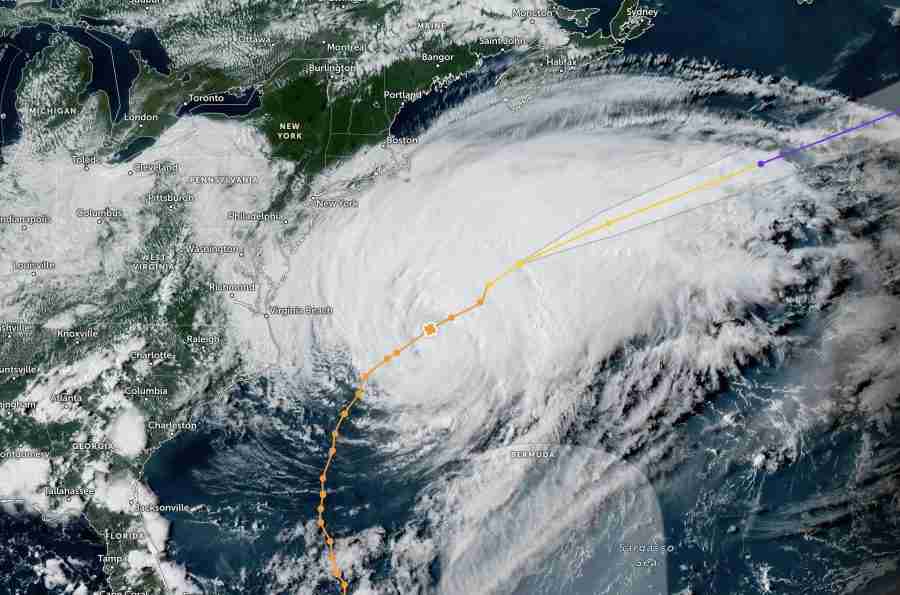
Credit: Zoom.Earth
Hurricane Erin brushed past Bermuda overnight, delivering thunderstorms, squalls and leaving pockets of the island without power.
The large Category 2 system passed about 323 nautical miles to the island’s northwest at 7 pm.
Michelle Pitcher, former Director at the Bermuda Weather Service, said the island briefly experienced tropical storm-force winds.
Preliminary figures from the BWS, shared with Bermuda Broadcasting, show that the strongest wind gust recorded at the airport was about 34 knots sustained, with gusts up to 50 knots. Meanwhile, at the National Museum in Dockyard, sustained winds reached 41 knots, with gusts up to 51 knots.
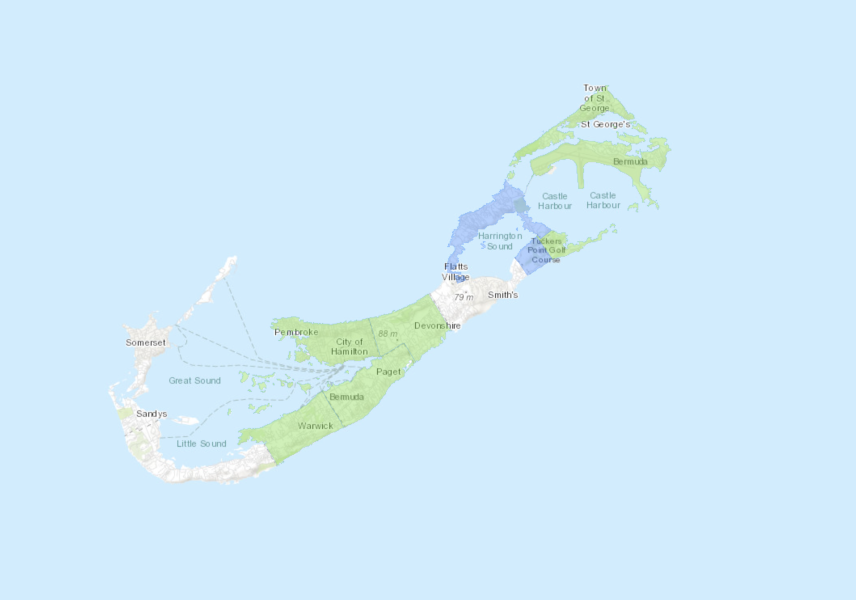
BELCO Outage Map
Shortly after midnight, around 1,300 homes were without power, mainly in St. George’s and Warwick. There was also an outage earlier in the evening in Pembroke, where utility equipment came down in the Happy Valley area. Another large outage in the White Sands area of Paget was attributed to lightning strikes, according to BELCO.
As of 8 am, the number of homes without power had fallen to 295.
In a post to social media, the utility company said crews had begun restoring power “as quickly and safely as possible,” adding: “Please exercise extreme caution when driving, walking or riding near our working crews. The safety of you, our crew, the public and all road users is paramount.”
Ms Pitcher explained: “Erin was a quite large hurricane, so we already started to see clouds from around it Wednesday morning and then Wednesday and Thursday and even early this morning, all of the heavier showers and isolated thunderstorms that have been moving through our area are associated with rain bands from Erin.”
She added that conditions are expected to settle quickly today but urged residents to keep a watchful eye on the tropics.
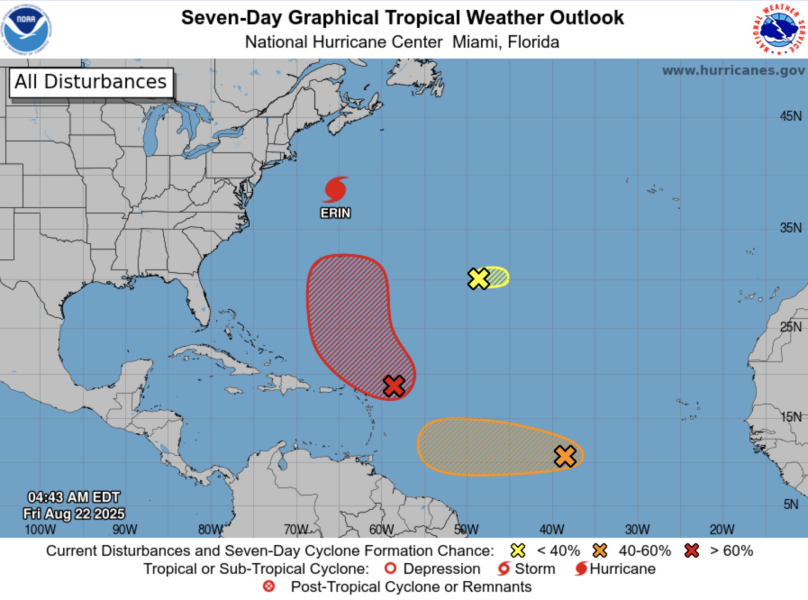
“There is a development area that the National Hurricane Centre is watching to our south so it has an 80% chance of developing into a tropical depression so we expect to see that after today or tomorrow.”
Listen to Ms Pitcher’s morning update, in full, below:
To provide the best experiences, we use technologies like cookies to store and/or access device information. Consenting to these technologies will allow us to process data such as browsing behavior or unique IDs on this site. Not consenting or withdrawing consent, may adversely affect certain features and functions.
Functional
Always active
The technical storage or access is strictly necessary for the legitimate purpose of enabling the use of a specific service explicitly requested by the subscriber or user, or for the sole purpose of carrying out the transmission of a communication over an electronic communications network.
Preferences
The technical storage or access is necessary for the legitimate purpose of storing preferences that are not requested by the subscriber or user.
Statistics
The technical storage or access that is used exclusively for statistical purposes.The technical storage or access that is used exclusively for anonymous statistical purposes. Without a subpoena, voluntary compliance on the part of your Internet Service Provider, or additional records from a third party, information stored or retrieved for this purpose alone cannot usually be used to identify you.
Marketing
The technical storage or access is required to create user profiles to send advertising, or to track the user on a website or across several websites for similar marketing purposes.