The UK stock market has lost out on major initial public offerings in recent months
FILE PHOTO: Branding is seen inside the LSEG (London Stock Exchange Group) headquarters in Paternoster Square, London, Britain, April 25, 2025. REUTERS/Toby Melville/File Photo
International News via Reuters:
London’s blue-chip stock index edged higher and the midcap index fell on Wednesday as investors assessed a mixed bag of corporate news, including a media report that AstraZeneca is moving its listing to the U.S.
The blue-chip FTSE 100 added 0.2% while the domestically focussed midcap index fell 0.5% by 0930 GMT.
FTSE’s most valuable company AstraZeneca is considering moving its listing to the U.S., the Times reported on Thursday, citing multiple sources.
“The CEO seems frustrated at the lack of financial support to open new laboratories and manufacturing facilities in Europe and might see a full U.S. stock listing as a stepping stone to receiving better treatment Stateside,” said Dan Coatsworth, investment analyst at AJ Bell.
The UK stock market has lost out on major initial public offerings in recent months including money transfer firm Wise and online fast fashion retailer Shein, with Brexit-related challenges pressuring UK market valuations.
Gains on Wednesday were led by industrial metals and mining stocks tracking higher metal prices. Glencore rose 3.2% and Ferrexpo and Antofagasta were both up 2.3%.
Oil and gas companies gained 1.6%, with heavyweights BP and Shell adding 2.2% and 1% each.
Among individual stocks, Spectris gained 4.6% after the firm agreed to a debt-inclusive 4.7 billion pounds ($6.46 billion) offer from KKR over Advent’s rival offer.
Bytes Technology slumped 26% to the bottom of the midcap after warning of lower operating profit for the first half of 2026.
British fast food chain Greggs fell 14.1% on saying its annual operating profit could dip as a heatwave in the UK discouraged customers from eating out.
Restaurant chain operator SSP Group climbed to the top of the midcap index, rising almost 8% after filing for Indian IPO of airport lounge operator Travel Food Services.
Reporting by Twesha Dikshit; Editing by Sahal Muhammed
The dollar index hovered near its lowest since early 2022 and was last at 96.705
International News via Reuters:
Global stocks edged higher and the dollar was pinned near a three-year low on Wednesday as investors pondered the prospect of U.S. interest rate cuts and the scramble for trade deals ahead of President Donald Trump’s July 9 deadline for tariffs.
Trump said he was not considering extending the deadline for countries to negotiate trade deals with the United States, and cast doubts again that an agreement could be reached with Japan, although he expects a deal with India.
The European Union’s trade chief is also expected to hold negotiations this week in Washington to avert higher U.S. tariffs.
Europe’s STOXX 600 edged up 0.1%, and Germany’s DAX climbed 0.3% in early trading. Across the Atlantic, futures tracking the S&P 500 pointed to a higher open after the benchmark index eased from its record high in the previous session.
MSCI’s broadest index of Asia-Pacific shares outside Japan witnessed a choppy session earlier in the day and was last up 0.1%. However, trade ambiguities weighed on Japanese stocks that lost 0.5%.
“You’ve seen it with other trade negotiations that they take years if you want to do them properly,” said Matthias Scheiber, senior portfolio manager and the head of the multi-asset solutions team at Allspring Global Investments.
“It’s not something you negotiate within a week. I think that’s also what the U.S. is realizing now. If the tariffs get ramped up again and the situation sours, short-term, we can definitely see some volatility.”
Data on Tuesday showed the U.S. labour market remained resilient with a rise in job openings for May, sharpening the focus on the payrolls report due on Thursday as investors try to gauge when the Federal Reserve is likely to cut rates next.
Fed Chair Jerome Powell, under fire from Trump to cut rates immediately, reiterated that the U.S. central bank plans to “wait and learn more” about the impact of tariffs on inflation before lowering interest rates.
Traders are pricing in about 64 basis points of cuts this year from the Fed, with the odds of a move in July at 21%.
The dollar index, which measures the U.S. currency against six rivals, hovered near its lowest since early 2022 and was last at 96.705. Analysts have said that any signs of labour market weakness could further weigh on the greenback.
TRUMP’S BILL
Investor focus over the last few days has pivoted to the progress of Trump’s massive tax-and-spending bill, which is expected to add $3.3 trillion to the national debt, slash taxes and reduce social safety net programmes.
The legislation heads to the House of Representatives for possible final approval after U.S. Senate Republicans passed it by the narrowest of margins.
The bill has stoked fiscal worries, but the reaction was relatively muted in bond markets after it passed the Senate.
Aninda Mitra, head of Asia macro strategy at BNY Investment Institute, said the legislation solidifies a steady deterioration of the fiscal position and the debt trajectory of the U.S. government.
“The near-term impact is mostly in the price, but the uncertainty factor could keep term premia elevated. We don’t think long-term yields will fall back materially in the 6-12 month horizon.”
Uncertainties about the outlook on public finances, trade and interest rates have caused investors to flee U.S. assets and look for alternatives. This was evident in the U.S. dollar’s 10% loss, its worst first-half performance since the 1970s.
In commodities, spot gold slipped 0.2% to $3,331 per ounce, after surging 1% in the previous session. The yellow metal is up 27% this year on safe-haven flows. [GOL/]
Reporting by Ankur Banerjee and Johann M Cherian; Editing by Shri Navaratnam, Jamie Freed and Saad Sayeed
The initiative pushes for the systematic inclusion of clauses in new public and commercial lending
International News via Reuters:
A number of wealthy creditor nations and multilateral lenders have launched an initiative that aims to give sovereign borrowers breathing space on debt payments in the event of a climate or humanitarian crisis, Spain said on Tuesday.
The Debt Suspension Clause Alliance was launched during a U.N. conference in Seville – a once in a decade meeting aimed at furthering development finance goals and guidelines.
The initiative pushes for the systematic inclusion of clauses in new public and commercial lending that allow for a temporary suspension of debt payments in the face of extraordinary events, such as natural disasters, food crises or health emergencies.
“The logic behind these clauses is simple but powerful: to create immediate fiscal space in times of greatest need, allowing countries to focus their resources on response and recovery without risking their solvency or ability to meet social spending,” said economy minister Carlos Cuerpo.
Speaking on the sidelines of the conference, Spain’s Foreign Minister Jose Manuel Albares told Reuters that the suspension clause for debt repayments could also cover war.
The governments of Canada, France and Britain were among the co-leaders of the initiative together with multilateral banks, including the Inter-American Development Bank, the European Investment Bank, the African Development Bank, the Development Bank of Latin America and the Caribbean and the Asian Development Bank.
Deutsche Bank has become the first private institution to join the initiative, Cuerpo later told a press conference in Seville, without giving details on what this would mean in practice for Germany’s largest bank.
“What we want is to… advance in standardizing the different concepts within these clauses, expand their application, and also be able to broaden their ability to open up more fiscal space when it would be needed going forward,” Cuerpo said.
Deutsche Bank declined to provide additional details.
A number of multilateral lenders have already added such clauses in their lending – including inserting them retroactively in some existing loans.
The Inter-American Development Bank said in the statement on Tuesday that adding climate-resilient debt clauses in sovereign loans had extended $3.2 billion in protection across several countries. It said it would expand this to more nations and broaden its scope.
The European Investment Bank last year made climate-resilient debt clauses available to 70 developing countries.
The World Bank – one of the biggest multilateral development lenders – has also broadened the scope of its Climate Resilient Debt Clauses for the most vulnerable countries in recent years.
Reporting by David Latona in Seville and Karin Strohecker in London, additional reporting by Virginia Furness in London and Tom Sims in Frankfurt, editing by Ros Russell
The move is part of a phased relief plan to ease living costs
The Government of Bermuda issued the following media release.
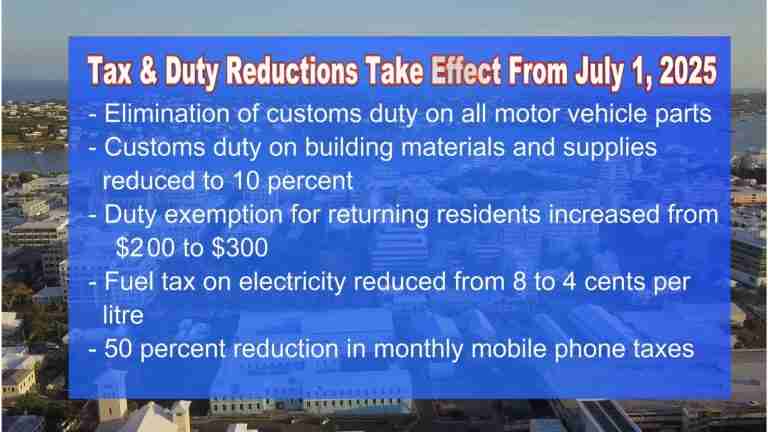
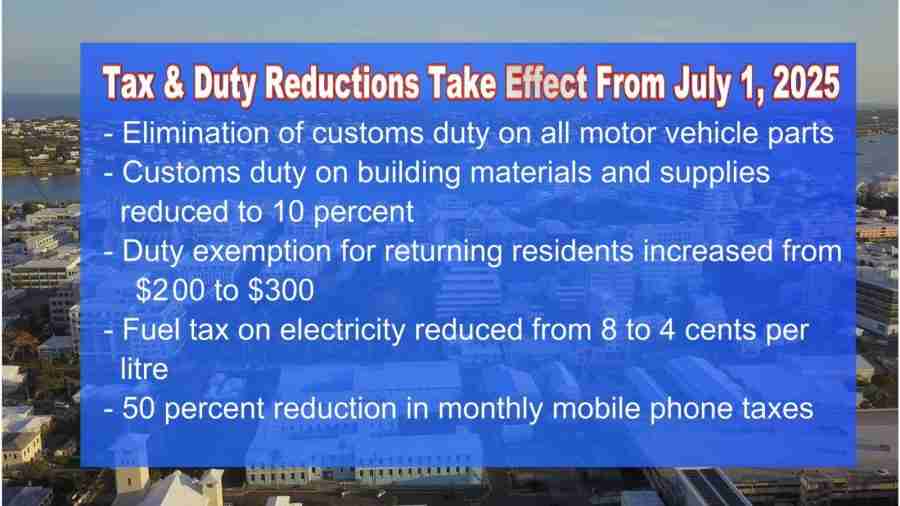
The Ministry of Finance advises that the first phase of the tax and duty reductions announced in the 2025 Budget Statement takes effect today, July 1.
Premier and Minister of Finance, the Hon. E. David Burt, JP, MP, stated, “This year’s Budget contained a series of tax reductions that will come into effect over the next nine months. The Government will do all that it can to reduce the cost of living and cost of doing business in Bermuda, and these tax and duty reductions will have a positive impact. The first stage of these reductions takes effect from today, and it is important that residents are aware of these changes.”
Elimination of customs duty on all motor vehicle parts
Customs duty on building materials and supplies reduced to 10 percent
Duty exemption for returning residents increased from $200 to $300
Fuel tax on electricity reduced from 8 to 4 cents per litre
50 percent reduction in monthly mobile phone taxes
The Ministry of Finance also wishes to advise that further tax and fee reductions will come into effect over the next nine months. On January 1, 2026, the base rate of land tax will be reduced by 50% from $300 to $150 a year. Further, on April 1, 2026, vehicle licensing fees for private cars will be reduced by a further 10%.
Premier Burt concluded, “Our mission is clear: to build a Bermuda that is fairer, more stable, and more affordable for all. These tax reductions are part of a broader strategy to return savings to the people, reduce financial burdens, and stimulate inclusive economic growth. We are delivering on our promise to make everyday life more affordable for working families, seniors, and small businesses.”
Below is an excerpt from the 2025 Budget Statement showing examples and fiscal context for the impact of these tax and duty reductions.
“Investors are looking at options” in a climate characterised by uncertainty and unpredictability
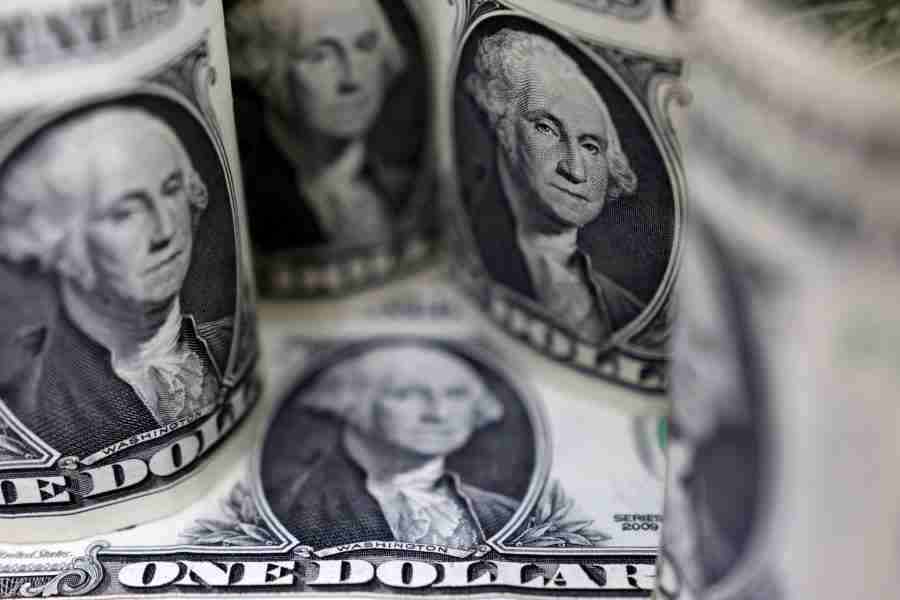
FILE PHOTO: U.S. Dollar banknotes are seen in this illustration taken July 17, 2022. REUTERS/Dado Ruvic/Illustration/File Photo
International News via Reuters:
There is no prospect of a major challenge to the dollar’s status as the world’s reserve currency of choice any time soon, central bankers gathered for an annual conference in the Portuguese resort of Sintra said on Tuesday.
U.S. President Donald Trump’s unpredictable economic, trade and security policies have spurred questions over whether the U.S. currency, which accounts for 58% of the world’s reserves, can remain at the centre of the global monetary system.
European Central Bank President Christine Lagarde, who has argued the euro could over time become an alternative to the dollar if Europe’s currency zone enacted necessary reforms, said 2025 could in future be viewed as “pivotal” in this respect.
“(But) for a major change to occur it will take a lot of time and a lot of effort,” she told a panel with her U.S., British, Japanese and Korean counterparts.
She noted that “investors are looking at options” in a climate characterised by uncertainty and unpredictability and that there was evidence that the euro was benefiting from that.
“It’s not going to happen just like that overnight. It never did historically,” she said. “But there is clearly something that has been broken. Whether it is fixable, or whether it is going to continue to be broken – I think the jury’s out.”
Bank of Japan Governor Kazuo Ueda also noted that any significant change would depend on structural reforms.
“It’s to a certain extent up to what areas like Europe or China will do in terms of improving the efficiency or convenience of their currencies,” he said, citing as an example the efforts at capital market integration in the euro zone.
Bank of England Governor Andrew Bailey said any change to the dollar’s status was a long way off.
“I don’t see … a sort of a major shift at the moment,” he said, arguing that any reserve currency had to offer a supply of safe assets into the market that can be used for purposes of collateral and security.
Bank of Korea Governor Rhee Chang-yong said the prospect of a long-term shift of the dollar sentiment was a subject of discussion for some even as they retained their dollar holdings.
“It looks like people are talking about it. But at this moment they keep the dollar share while increasing their hedging ratio,” he told the panel.
Lagarde told a recent audience in Berlin that there was an opening for a “global euro moment”, if it earned it.
She said Europe would need to build a deeper, more liquid capital market, bolster its legal foundations and underpin its commitment to open trade with security capabilities.
While the dollar’s current share of international reserves is the lowest it has been in decades, its 58% tally is still well above the euro’s 20% share.
The slowdown comes after a record number of corporate agitators made demands
International News via Reuters:
Activist investors who push companies for operational changes and management shake-ups waged fewer campaigns during the first half of 2025 as tariffs, wars and U.S. President Donald Trump’s unpredictable policies made them more cautious, new data show.
The pace of investor demands, aimed at pushing up a company’s share price, fell 12% to 129 campaigns launched during the first six months of 2025, compared with 147 a year ago, according to numbers compiled by investment bank Barclays.
“The environment was shaped by mixed economic signals, fears about wars and geopolitical tensions and the instability created by future tariffs and trade wars,” said Jim Rossman, global head of shareholder advisory at Barclays. “And taken together that is creating an environment of caution.”
The slowdown comes after a record number of corporate agitators made demands last year and the pace of campaigns jumped by 17% in the first three months of this year.
Elliott Investment Management, among the world’s most powerful corporate activists, pressed for changes at six companies, including BP and Hewlett Packard Enterprise, roughly half the number of campaigns it launched a year ago. But it deployed $8.8 billion in assets, the most of any activist this year.
Also so-called first-timers who were becoming more comfortable employing activist tactics last year stepped to the sidelines late in the first half.
During the second quarter when stock markets gyrated as Trump threatened harsher tariffs only to reverse course before suggesting them again, campaigns launched by first-timers dropped 27% from the first quarter of this year, the data show.
But the slowdown does not hint at a pause in activity or suggest activist investors are going soft, Rossman said.
Corporate agitators, including Mantle Ridge, Ancora Holdings and Jana Partners have, as a group, forced bigger changes at companies in the first half of this year than a year ago, the data show.
Settlements between activist investors and companies jumped 32% to 37 in the first half of 2025 and left activists with 86 board seats, marking a 16% increase. They won seats, often a measure of success for activists, at companies ranging from industrial gases maker Air Products and Chemicals to food processing company Lamb Weston.
“As a group activists are having a strong year, winning settlements and board seats and managing to engage with a number of companies privately,” Rossman said.
Most activists continue to focus their attention on companies in the United States with 60 campaigns launched, down from 61 a year earlier. There were 37 campaigns in Japan, down from 51 a year ago. Activity in Europe declined by 17% to 24 campaigns launched in the first half compared with a year ago.
Reporting by Svea Herbst-Bayliss; Editing by Stephen Coates
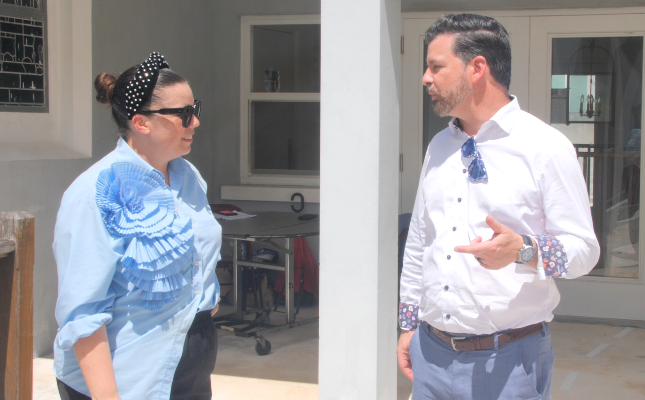
Retailer Mia Chambray and tech consultant Michael Branco have today been contesting a city councillor position for the Corporation of Hamilton.
They were busy greeting voters at the municipal election polling site at St. Paul’s AME church Centennial Hall on Victoria Street this afternoon.
The seat was left vacant by the death of the lawyer and councillor Larry Scott in early June.
City retailer Mia Chambray, owner of Cassine on Reid Street, is looking to take the next step up into public service.
Mrs. Chambray, who is carrying the family torch as a Hamilton based entrepreneur, says the City needs more boutiques, cafes, more opportunities for vendors markets especially around Christmas plus greater collaboration between city businesses.
She said, “I’ve really appreciated everybody’s time to come [spend] 2 to 5 minutes to speak with me. Tell me their concerns, tell me positive and negative things they love about the city or would like to see improved.
“The general consensus is people want more parking always – more parking. More draw to offices; people renting office space – bring people in.
More residents in the City and generally more vibrancy in the City…”
Business owner and tech consultant Michael Branco is returning a second time to run for a seat having lost by five votes to Mr. Scott in the last city council general election in 2019.
“I’m actually quite happy to see that between my efforts and Mia’s efforts that we’ve had a steady stream of voters come out. So it may not be low voter turnout and I’m up against a really good candidate. So, I think it could go either way.
Mr. Branco is seeking to continue the work of addressing homelessness in the city and finding ways to help business grow.
He added, “On one hand, if I’m successful then the city gets a techy and finance person with a lot of business experience. And if I’m not successful, they get Mia who has retail and small business experience and she’s a fresh face; a fresh voice.
“Either way I think its good for the City.”
Around 378 business ratepayers are registered to vote in today’s by-election.
Community leaders reflect on a turning point in Bermuda’s history, with celebratory events to follow
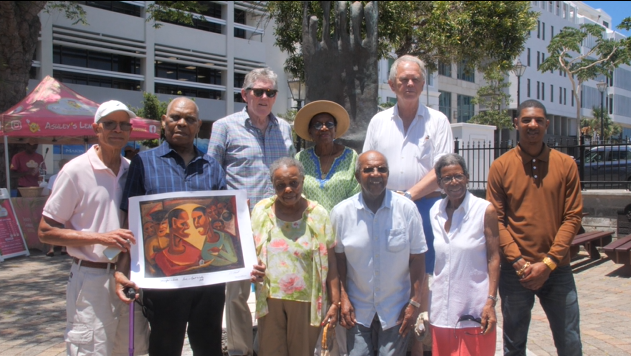
A group of community members, including the Mayor of Hamilton and a former politician, gathered yesterday to reflect on the impact of the Theatre Boycott, more than six decades after the historic event.
A media release issued by Glenn Fubler stated:
“We are here formally launching the celebration of the 66th Anniversary of the Success of the Boycott. The mindful actions of ordinary people opened movie theatres, restaurants and hotels in the first instance. That same momentum eventually ended formal segregation/apartheid and was key in establishing the right to vote.
“The effective strategy developed by the Progressive Group set the stage. Those that rallied around Church, Wesley & Queen streets sustained the flame of that peaceful protest, effectively opening Bermuda.
“The success of the Boycott demonstrated the potential of collaboration occurring across generations. The 1940’s campaigning of the Bermuda Workers Association provided a foundation for progress in later decades. Efforts by activist in the early 1950’s – such as the protest at the Bermudiana Hotel Theatre proved to be exemplary. Other groups helped to ‘till the soil’, which allowed us – as the collective Bermuda – to grow towards our better selves.
“Thus, the theme: “Open Hearts, Open Minds” offers us encouragement to reflect in appreciation for ‘those on whose shoulders we stand’. As we respond by reaching out to others in our families, neighbourhoods, island and world, we enhance both ourselves and our community.”
Below is the full press conference featuring remarks from John Barritt, former United Bermuda Party government minister; Charles Gosling, Mayor of Hamilton; and 99 year-old Izola Harvey, a member of the group that led the boycott.
Upcoming events to mark the anniversary:
Wednesday, July 2 12:30 PM – 1:30 PM Interactive Gathering at Cathedral Hall Special guest Rev. Kingsley Tweed will share “nutshell” recollections of his role as the ‘Voice’ of the Boycott Rally. He will also perform piano and song.
Facilitation Team for the Interactive Dialogue: Nekesha Holdipp, Sandy Butterfield, Darius Richardson, and Glenn Fubler
7:00 PM – 7:30 PM Harbour Night Celebration Music Presentations: Ed Christopher and Willard Burch Theatre Boycott Skit: Ensemble includes Kathy Kawaley, Michelle Cooper, Nikita Robinson, Leighton Rochester, Richie Latham; coordinated by Rotimi Martins
Bermudian creator and writer Hafiz Shakur is known for his popular local series Hustlerz Paradise, which debuted as a web series in March 2019.
Mr. Shakur recently wrapped his second feature film, Blood on the Crown, which is inspired by the historical events of the 1970s that led to the 1977 riots.
With an all-Bermudian production team, Mr. Shakur emphasizes the opportunities this creates for local talent. The premiere of Blood on the Crown will take place on July 26th.
Tibetan tradition holds that the soul of a senior Buddhist monk is reincarnated after his death
International News via Reuters:
The choice of a successor to the Dalai Lama, the spiritual head of Tibetan Buddhists, is a matter of riveting interest not only for followers of his religion, but also China, India, and the United States, for strategic reasons.
The Nobel peace laureate, who turns 90 on Sunday, is regarded as one of the world’s most influential figures, with a following extending well beyond Buddhism.
HOW WAS HE CHOSEN?
Tibetan tradition holds that the soul of a senior Buddhist monk is reincarnated after his death.
The 14th Dalai Lama, born as Lhamo Dhondup on July 6, 1935, to a farming family in what is now Qinghai province, was identified as such a reincarnation when he was just two years old.
A search party sent by the Tibetan government made the decision on the basis of several signs, such as a vision revealed to a senior monk, the Dalai Lama’s website says. The searchers were convinced when the toddler identified belongings of the 13th Dalai Lama with the phrase, “It’s mine, it’s mine”.
In the winter of 1940, Lhamo Thondup was taken to the Potala Palace in Lhasa, the capital of today’s Tibet Autonomous Region, and officially installed as the spiritual leader of Tibetans.
HOW WILL HIS SUCCESSOR BE CHOSEN?
In his book “Voice for the Voiceless”, released in March 2025, the Dalai Lama said his successor would be born outside China.
The Dalai Lama has lived in exile in northern India since 1959, after fleeing a failed uprising against the rule of Mao Zedong’s Communists.
He wrote that he would release details about his succession around the time of his 90th birthday. On Monday, addressing a gathering in Dharamshala, he said: “There will be some kind of a framework within which we can talk about the continuation of the institution of the Dalai Lamas”. He did not elaborate.
In a speech in 2011, the Dalai Lama also mentioned how highly enlightened Buddhists can “manifest an emanation before death”. Some experts have speculated that it might mean the Dalai Lama possibly suggesting he could train a successor in his lifetime, but Tibetan officials say that is unlikely.
“He has said this institution will carry on, which means his incarnation will be born,” said Dolma Tsering Teykhang, the deputy speaker of the Tibetan parliament-in-exile.
“Our Dalai Lama will be reborn, and the institution will carry on.”
The parliament-in-exile, based in the Himalayan town of Dharamshala, like the Dalai Lama, says a system has been established for the exiled government to continue its work while officers of the Gaden Phodrang Foundation will be charged with finding and recognising his successor.
The current Dalai Lama set up the foundation in 2015 to “maintain and support the tradition and institution of the Dalai Lama” with regard to his religious and spiritual duties, it says on its website. Its senior officers include several of his aides.
WHAT DOES CHINA SAY?
China says its leaders have the right to approve the Dalai Lama’s successor, as a legacy from imperial times. A selection ritual, in which the names of possible reincarnations are drawn from a golden urn, dates to 1793, during the Qing dynasty.
Chinese officials have repeatedly said the reincarnation of the Dalai Lama should be decided by following national laws that decree use of the golden urn and the birth of reincarnations within China’s borders.
But many Tibetans suspect any Chinese role in the selection as being a ploy to exert influence on the community.
It is inappropriate for Chinese Communists, who reject religion, “to meddle in the system of reincarnation of lamas, let alone that of the Dalai Lama,” the Buddhist leader has said.
In his book, he asked Tibetans not to accept “a candidate chosen for political ends by anyone, including those in the People’s Republic of China,” referring to the country by its official name.
Beijing brands the Dalai Lama, who won the Nobel Peace Prize in 1989 for keeping alive the Tibetan cause, as a “separatist” and prohibits displays of his picture or any public show of devotion towards him.
In March 2025, a Chinese foreign ministry spokesperson said the Dalai Lama was a political exile with “no right to represent the Tibetan people at all”.
China denies suppressing the rights of the Tibetan people, and says its rule ended serfdom in, and brought prosperity to, a backward region.
WHAT ROLE COULD INDIA AND THE U.S. PLAY?
Apart from the Dalai Lama, India is estimated to be home to more than 100,000 Tibetan Buddhists who are free to study and work there.
Many Indians revere him, and international relations experts say his presence in India gives New Delhi some kind of leverage with rival China.
The United States, which faces rising competition from China for global dominance, has repeatedly said it is committed to advancing the human rights of Tibetans.
U.S. lawmakers have previously said they would not allow China to influence the choice of the Dalai Lama’s successor.
In 2024, then U.S. President Joe Biden signed a law that presses Beijing to resolve a dispute over Tibet’s demands for greater autonomy.
Reporting by Krishna N. Das in New Delhi; Additional reporting by Laurie Chen in Beijing; Editing by Clarence Fernandez and Raju Gopalakrishnan
To provide the best experiences, we use technologies like cookies to store and/or access device information. Consenting to these technologies will allow us to process data such as browsing behavior or unique IDs on this site. Not consenting or withdrawing consent, may adversely affect certain features and functions.
Functional
Always active
The technical storage or access is strictly necessary for the legitimate purpose of enabling the use of a specific service explicitly requested by the subscriber or user, or for the sole purpose of carrying out the transmission of a communication over an electronic communications network.
Preferences
The technical storage or access is necessary for the legitimate purpose of storing preferences that are not requested by the subscriber or user.
Statistics
The technical storage or access that is used exclusively for statistical purposes.The technical storage or access that is used exclusively for anonymous statistical purposes. Without a subpoena, voluntary compliance on the part of your Internet Service Provider, or additional records from a third party, information stored or retrieved for this purpose alone cannot usually be used to identify you.
Marketing
The technical storage or access is required to create user profiles to send advertising, or to track the user on a website or across several websites for similar marketing purposes.