Brent crude futures for October delivery rose $1.20, or 1.3%, to $92.82 a barrel by 0813 GMT, while U.S. West Texas Intermediate crude futures for September added 92 cents to $86.75 a barrel
International News via Reuters:
Oil prices climbed to three-week highs on Thursday, driven by concerns that the impasse in the Iran war will continue to disrupt supply from the key Middle Eastern producing region.
Brent crude futures for October delivery rose $1.20, or 1.3%, to $92.82 a barrel by 0813 GMT, while U.S. West Texas Intermediate crude futures for September added 92 cents to $86.75 a barrel. The more-active October WTI contract was up $1.13, or 1.3%, to $85.52.
Both Brent and WTI benchmarks hit their highest since late July during the session, gaining for a fifth straight session and having settled on Wednesday at their highest since July 24. The September WTI contract expires later on Thursday.
“Tensions in the Middle East remain high, leaving room for further supply disruptions,” said UBS analyst Giovanni Staunovo. “Lower oil exports from the Middle East are once again tightening the oil market.”
The UAE’s decision to suspend all financial and economic transactions with Iran until further notice has refocused the spotlight on fraught ties between the major Gulf Arab oil producer and Iran.
“Oil prices remained elevated as the market is supported by sporadic attacks in the Middle East but lacks fresh momentum without a major escalation,” said Hiroyuki Kikukawa, chief strategist of Nissan Securities Investment.
“The market is likely to maintain a gradual upward trend given uncertainty over peace talks and tensions involving the United Arab Emirates, Oman and Iran,” he added.
On Tuesday, U.S. President Donald Trump said no talks were taking place with Iran and that the Strait of Hormuz was open. Iran, however, said the waterway remained shut.
Trump on Wednesday warned of economic consequences against any country that provided “any type of lifeline to Iran”.
Shipping traffic through the strait on Wednesday was unchanged from the day before as discussions to end the conflict remained deadlocked, according to the latest shipping data.
Prior to the war that began with U.S. and Israeli strikes on Iran on February 28, shipments equal to about one-fifth of global consumption moved through the waterway. Current flows are far below pre-war levels.
The war has also impacted the supply of refined fuels and drawn down inventories with less crude available to refiners.
U.S. stockpiles of distillate fuel, including diesel and heating oil, fell last week for a third week, the Energy Information Administration said on Wednesday. However, crude inventories unexpectedly rose by 4.4 million barrels. [EIA/S]
Reporting by Stephanie Kelly in London, Yuka Obayashi in Tokyo and Siyi Liu in Singapore; Editing by Tom Hogue, Christian Schmollinger and Alexander Smith
The dollar index, which measures the dollar against six other currencies, was at 98.723, its lowest level since May 14
International News via Reuters:
The U.S. dollar was pinned near a three-month low on Thursday after the Treasury Department moved to calm a bond market selloff that had pushed long-end yields to their highest since 2007, lifting risk sentiment and undercutting the currency.
The dollar index, which measures the dollar against six other currencies, was at 98.723, its lowest level since May 14. The euro was at $1.1692, perched at the highest level since mid-May.
ING global head of markets Chris Turner said the Treasury’s move to increase buybacks of Treasury securities with maturities between 10 and 30 years should reassure markets that longer-dated bonds are unlikely to face a disorderly selloff.
“It reduces one of those left-field risks out there which is good for risk, good for the investment environment and slightly dollar negative,” Turner said.
Investors have been grappling this week with a sharp selloff in the global bond market on mounting concern about soaring government debt and the spectre of higher oil prices due to the lack of progress in ending the U.S.-Israeli war with Iran.
The 30-year Treasury yield rose to a 19-year high of 5.337% earlier this week. It was last at 5.198% after dropping 9 basis points following the move by the Treasury that effectively shifts more of the government’s borrowing toward short-term bills.
EYES ON YEN
The broad dollar weakness provided some relief to the Japanese yen as the fragile currency pulled away from the closely watched 160 level. It traded at 158.41 per dollar, surrendering part of its advance from the previous session.
The yen has been in the spotlight since a rare coordinated intervention by U.S. and Japanese authorities at the end of July sought to arrest its slide after it weakened to a 40-year trough near 164 per dollar.
Sterling rose to $1.3631, its highest in three months, while the Swiss franc was slightly weaker at 0.7986 per U.S. dollar, after rising by almost 2% in the previous session.
FED MINUTES
Concern about inflation deepened at the Fed’s meeting last month, with several policymakers ready to raise interest rates and many saying a hike in borrowing costs would be needed if inflation did not decline to the U.S. central bank’s 2% target, the minutes of the session showed.
“The minutes of the Fed’s July meeting confirmed that the rate-setting committee had become more hawkish since the June meeting but, with the inflation, labour market and activity data since then all on the soft side, there is little to suggest that interest rate hikes are imminent,” said Ariane Curtis, senior North America economist at Capital Economics.
Reporting by Ankur Banerjee in Singapore; Editing by Kate Mayberry, Stephen Coates and Shri Navaratnam
Motorists urged to avoid area as overturned propane truck forces diversions
Media Release:
Shortly before 5:30 am on Thursday, 20th August 2026, police and other first responders were dispatched to a report of a road traffic collision involving a motorcar and a propane gas truck on Somerset Road, just west of Beacon Hill.
Initial information suggests that the vehicles were travelling in opposite directions when they collided on the bend near the Mangrove Bay Post Office, resulting in the propane gas truck overturning onto its side.
Neither driver, both of whom are male, was reported to be injured.
The Bermuda Fire and Rescue Service has carried out an assessment of the gas truck as a precaution.
The roadway is currently completely blocked and traffic diversions are in effect at Beacon Hill Road and Mangrove Bay Road. Motorists are advised to avoid the area and use alternative routes until the collision scene has been cleared.
Final order due this year to hit 110-bus target by 2027
The Department of Public Transportation (DPT) welcomed 10 new electric buses on August 18, as the vehicles were driven off the docks, marking another important step in Bermuda’s transition to a fully electric public transportation fleet.
Minister of Tourism & Transport, Culture & Sport, the Hon. Owen Darrell, JP, MP, said, “The arrival of these buses is another important milestone in our commitment to a modern, reliable and sustainable public transportation system. We remain focused on achieving 100 per cent fleet electrification by 2030, while ensuring that the travelling public benefits from improved service and reliability.”
This is DPT’s third order of electric buses from Golden Dragon Bus Company. The first order of 30 buses was placed in 2022, followed by 40 buses in 2023 and the latest 20 buses in 2026. Of the latest 20-bus order, 10 buses arrived on August 18, with the remaining 10 expected to arrive next week. Once all 20 buses have arrived, the electric fleet will total 90 buses.
The final 20 buses will be ordered later this year and are expected to enter service in early 2027, completing the electrification project with a total fleet of 110 buses.
Once the final buses are commissioned, DPT will retire older diesel buses that have reached the end of their service life. The additional buses will help improve service reliability and capacity for the public while reducing operating costs and supporting the Government’s goal of a cleaner, fully electrified bus fleet.
Minister Perinchief commended the class for their commitment and readiness to serve the community
Media Release:
Nine firefighter recruits were recognised today for reaching an important milestone in their journey to becoming fully trained members of the Bermuda Fire & Rescue Service (BFRS).
The Minister of National Security, Senator the Hon. Ryan Robinson Perinchief, JP, joined Acting Chief Fire Officer Troy Furbert, senior BFRS officers, instructors, family members and other guests at the Milestone Awards Ceremony held at Hamilton Fire Station.
The ceremony marked the completion of two of the three phases required for the recruits to become fully trained firefighters.
In addition to presentations of certificates and awards, the ceremony included an impressive display by the recruits on responding to a simulated building fire, as well as the extraction of a person trapped in a vehicle after a collision.
The recruit class comprised eight Bermudians and one spouse of a Bermudian. They are Jaylon Bather, E. Camren Caines, Jayorie Fox, Erik Frederick, Cole Hepburn, Stefan Maybury, Kobie Reid, Jonah Robinson and Keion Smith. Firefighter Cole Hepburn was presented with the award of Outstanding Recruit, as well as the Highest Academic Award.
The recruits have completed extensive training locally and overseas. This rigorous training includes certification in Aircraft Rescue Fire Fighting, aligned with International Civil Aviation Organization requirements, and the Skills for Justice Level 3 Certificate in Operational Firefighting.
Minister Perinchief said he was particularly encouraged to see young Bermudians pursuing careers in the fire service, noting that most of the recruits were under 30, including one who was just 18 years old.
“I am particularly encouraged to see young Bermudian men stepping forward, accepting demanding training and preparing themselves for careers built on responsibility, teamwork and service to others,” the Minister stated.
He added: “When our firefighters arrive at an accident, a fire or another emergency, people depend on their dedication, discipline, work ethic and competence to effectively and calmly handle the situation.
“The men and women in this service consistently demonstrate all those qualities and you are blessed to be accepted into their fold.”
The Minister also reminded the recruits of the significance of the profession they are entering.
He stated: “This is a calling for those who accept the opportunity to serve our people. At times, that service may not be fully appreciated by the wider community, and there will be moments when the demands of the job feel challenging or the circumstances under which you must operate feel constrained.
“However, those realities must not dissuade you from giving your very best for the benefit and betterment of our Country.”
Acting Chief Fire Officer Troy Furbert said the ceremony was an opportunity to recognise the work and perseverance that had brought the recruits to this stage.
“This occasion is about far more than certificates, assessments, or completed training modules. It is about recognising the commitment, sacrifice, resilience, and character that have brought you to this point.”
Mr Furbert said the milestone should also serve as a reminder that the standards developed during training must continue throughout the recruits’ careers.
“For our recruits, today’s award is not the finish line. It is a milestone. It marks the completion of one stage of development and the beginning of another.
“The standards you have demonstrated throughout recruit training are not temporary. They are now ongoing expectations.”
The latest recruit class forms part of the BFRS’s continuing effort to attract and develop local firefighters. Since 2022, the Service has recruited and trained 50 local firefighters, with 23 recruited in 2022, 11 in 2023, nine in 2024 and seven in 2025.
The Minister also acknowledged the instructors, training partners and family members who have supported the recruits throughout their training.
“To those on parade today, I say ‘well done’. You have earned the right to be here today. I expect you now to conduct yourselves with honour, discipline, dignity and pride as you go about performing your duties, and to uphold the Department’s core values,” Minister Robinson Perinchief added.
Bermuda’s National Events & Entertainment Committee is aiming to shape the future of major events across the island.
Kendal Trott sat down with Minister of Tourism, Transport, Culture & Sport, the Hon. Owen Darrell, who shared insight into why the committee was created, how its members were selected, and the experience and perspectives he wanted represented.
He also discussed why having a dedicated body for Bermuda’s events industry is important.
Here’s a preview of the conversation, with the full extended interview available this Friday on BBC.bm.
The blue-chip FTSE 100 index edged up 0.1% to 10,743.35 points, while the midcap FTSE 250 climbed 0.3% to 24,643.52 points
International News via Reuters:
London shares edged higher on Wednesday after an in-line inflation report did little to alter interest rate expectations, while surging gold prices lifted mining stocks.
The blue-chip FTSE 100 index edged up 0.1% to 10,743.35 points, while the midcap FTSE 250 climbed 0.3% to 24,643.52 points.
• British inflation rose to 2.9% in July from a 15-month low of 2.6% in June, according to the Office for National Statistics, though the rise was in line with economists’ forecasts in a Reuters poll.
• The data, coming a day after a soft labour market report, supported bets that the Bank of England will keep borrowing costs unchanged in September.
• Meanwhile, a rout in global bonds eased after the U.S. Treasury said it would double some liquidity support operations. British government bond prices headed for their biggest daily gain in two weeks, as U.S. bond yields fell from near their highest levels since 2007.
• Gold miners Fresnillo, Endeavour Mining and Pan African Resources all rose more than 7% as gold surged 3% against a softer dollar. [GOL/]
• Oil prices climbed for a fourth straight day as investors weighed conflicting messages from Tehran and Washington on whether the Strait of Hormuz is open to ships. Energy majors Shell and BP rose about 1% each. [O/R]
• Smith+Nephew fell 3.8% after it said its finance chief John Rogers would step down after a roughly two-and-a-half-year tenure with the medical products company.
• Trainline shares fell 14% after Britain’s competition regulator said it was investigating whether the rail and coach ticketing operator, Virgin Atlantic and RED Driving School were transparent in disclosing total pricing when customers made bookings.
• Biotech firm Oxford Nanopore Technologies rose 14.3% after posting upbeat half-year results.
Reporting by Anand Gopal and Medha Singh in Bengaluru; Editing by Shilpi Majumdar and Gareth Jones
The departure follows Smith+Nephew’s decision weeks ago to cut its annual revenue growth forecast after second-quarter sales missed expectations due to weak U.S. knee and hip implant demand and pressure on skin substitute pricing
International News via Reuters:
Smith+Nephew said on Wednesday its finance chief John Rogers would step down at the end of September to take up an external position in the United States, ending his roughly two-and-a-half-year tenure with the medical products company.
Here are some more details:
• The departure follows Smith+Nephew’s decision weeks ago to cut its annual revenue growth forecast after second-quarter sales missed expectations due to weak U.S. knee and hip implant demand and pressure on skin substitute pricing.
• Smith+Nephew said it had appointed Senior Vice President Finance and Group Controller Pierre Palassian as interim chief financial officer until a permanent replacement was appointed.
• Palassian, who joined Smith+Nephew in 2017, previously held senior roles at AbbVie and Abbott Laboratories.
• Rogers, who took up the CFO role in early 2024, had relocated to the United States in 2025 for operational efficiencies.
• Shares in the FTSE 100 company have gained nearly 14% during Rogers’ tenure as CFO.
• Smith+Nephew said Rogers would receive no severance payment, and that his outstanding incentive and share awards would lapse on September 30 under leaver rules.
Reporting by Neeshita Beura in Bengaluru; Editing by Subhranshu Sahu
The median pay award by employers fell to 3.2% in the three months to the end of July, down from 3.3% in the previous three rolling quarters, figures from human resources data firm Brightmine showed
International News via Reuters:
Pay settlements by British employers inched down in the three months to June to a 10-month low, adding to signs of a softening labour market, a survey showed on Wednesday.
The median pay award by employers fell to 3.2% in the three months to the end of July, down from 3.3% in the previous three rolling quarters, figures from human resources data firm Brightmine showed.
“The fact that more than a third of matched pay awards are now lower than last year does suggest some employers are becoming more cautious,” said Sheila Attwood, Brightmine’s HR insights and data lead.
Below are details from the survey and related context:
• 71% of settlements awarded were between 2% and 3.99%, while 3% was the single most common award value
• 35% of settlements delivered a lower award than the previous year, for the same employee group, while another 35% remained unchanged and 30% were higher
• Data based on 36 pay awards implemented between May 1 and July 31, representing pay settlements for approximately 762,000 UK employees
• Official data on Tuesday showed the jobs market again weakened slightly in the second quarter
Reporting by Andy Bruce; editing by David Milliken
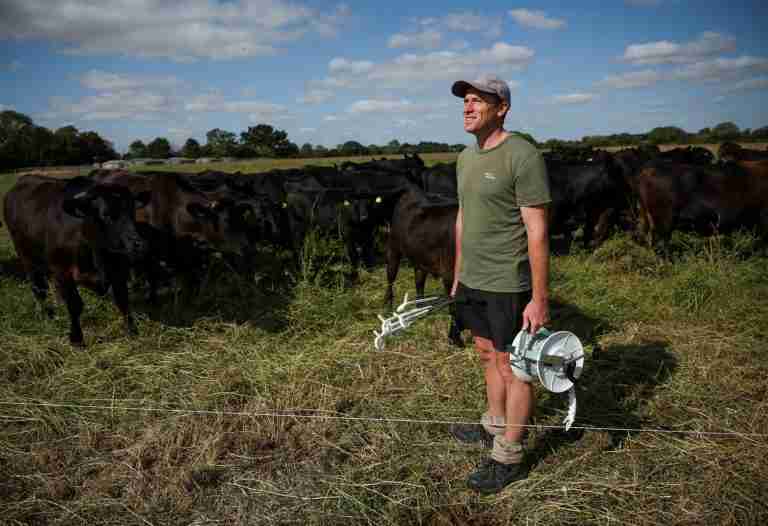
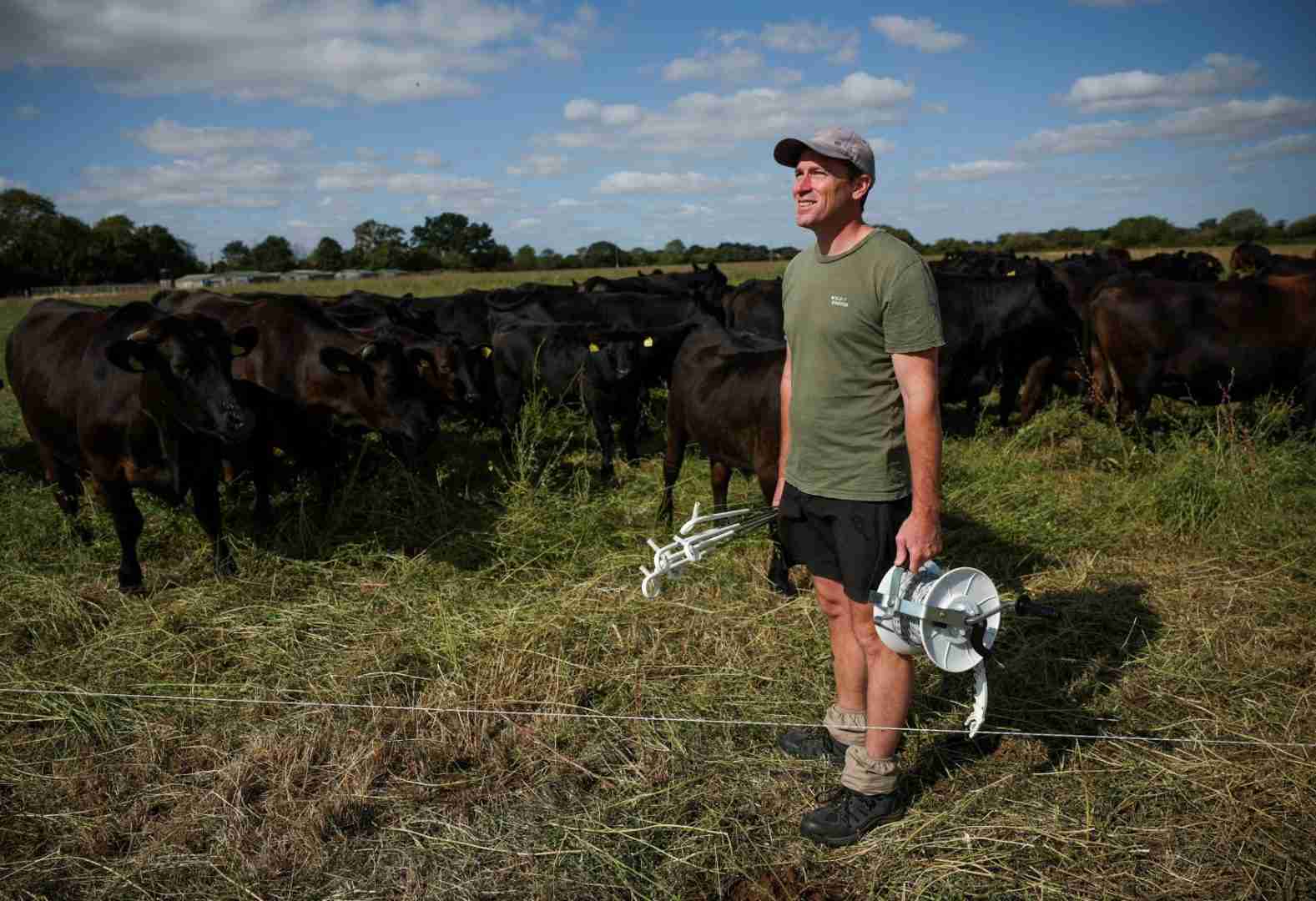
As neighbouring farmers have resorted to using winter feed, Squier’s herd of Aberdeen Angus feeds on dense pasture maintained by planting that has retained water and improved soil quality
International News via Reuters:
With Britain about to record its hottest summer yet, Sam Squier’s nearly 200-acre beef farm in south east England stands out as a lush, green oasis surrounded by scorched brown fields.
As neighbouring farmers have resorted to using winter feed, Squier’s herd of Aberdeen Angus feeds on dense pasture maintained by planting that has retained water and improved soil quality.
“This year is a testament to what you can do in a dry year,” Squier told Reuters.
“Our vision was to improve the soil structure and build resilience within our business, mitigating against both prolonged periods of dry hot weather and prolonged periods of wet weather,” he said.
His cattle, which carry genetic traits from Japanese Wagyu that are renowned for producing tender beef, graze on a mix of grasses, deep-rooting herbs and legumes, known as herbal leys.
The method is inspired by ancient practices and reflects decades-long efforts to introduce climate-resilient farming as governments and regulators across the world have sought to make supply chains less vulnerable.
After years of intensive agriculture that was designed to feed the maximum number of people most cost-effectively, this year’s extreme weather has added urgency to the debate over whether climate change has transformed the economics.
According to Reuters’ interviews for this story with more than 25 people engaged on the issue, banks, insurance groups, water companies, governments and major food groups such as McDonald’s are funding a shift in farming practices.
FINANCIAL LOSSES FROM EXTREME WEATHER
Meteorologists have said they expect to declare Britain’s summer, which officially ends on August 31, the hottest yet and Europe as a whole has this year experienced more extreme warming than any other continent with five heatwaves and far below average rainfall.
After its hottest June and driest July on record, almost three-quarters of England is officially in drought.
Livestock and dairy farmers have reported poor grass growth, the UK’s cereal harvest is set to be the worst since comparable records began in 1984, and fruit and vegetable growers have said production will be reduced, echoing warnings from across Europe.
The losses for farmers in the European Union and Britain from failed crops in the June heatwave could be up to €2.3 billion ($2.7 billion), according to the Energy and Climate Intelligence Unit. There are knock-on effects for inflation, which has already been driven higher by the increased energy and fertiliser costs linked to war in the Middle East.
NUTRIENT-ENHANCING AND ENERGY-RICH
By contrast with the arid land all around, the herbal leys in some of Squier’s fields, near Chelmsford, stand over knee height even after two months without rain, and without the use of irrigation.
The grasses provide energy-rich feed, the nutrient-enhancing herbs help to control parasites and reduce the need for medication, while the legumes fix nitrogen in the soil, removing the need for artificial fertilisers.
The cows are concentrated in a small area where they graze and trample the vegetation and are moved twice a day. They create a protective layer over the soil and their manure helps return seed to the ground, boosting soil health and water retention. Squier has not needed to buy winter feed for eight years.
He estimates the soil holds around 400,000 litres (105,700 U.S. gallons) more water per acre than before he adopted regenerative farming. In the first six years after the switch, estimated earthworm numbers rose from 80 million to 680 million.
BIG COMPANIES HELP FARMS TO SWITCH TECHNIQUES
Government environmental grants helped Squier make the transition. Without giving precise detail, he said his farm would struggle to remain viable without that support.
He also said ownership and tenancy arrangements, financial constraints and resistance to change were a problem for others.
An increasingly popular solution is to work with companies from across a range of sectors including insurers and banks, which have an interest in protecting themselves from the consequences of extreme weather, and as evidence mounts that it is worth investing in different farming methods.
“Farms adopting … regenerative practices are consistently outperforming more conventional holdings during drought stress in terms of both yield and profitability,” Andrew Voysey, Chief Impact Officer at agriculture consultancy Soil Capital, said.
He cited a study for the organisation that found farms that adopted regenerative practices reduced drought-related yield losses by at least 10% in around 85% of cases.
In Britain, Lloyds Bank has joined forces with regenerative food business Wildfarmed to create the Food & Nature Resilience Fund, alongside water companies Severn Trent and Affinity Water and insurance group AXA XL. Pooled funds go to farmers to improve soil health.
Ben Makowiecki, Lloyds’ Agriculture Sustainability Director, said water companies could reduce the amount of money spent on removing farm chemicals from river systems, saving £4 ($5) to £6 of upstream costs for every pound they invest in farms, while insurers can access data to better understand how regenerative agriculture can mitigate flood risk.
“We can’t do this on an individual farm-by-farm basis,” he said, adding collaboration was needed to get “systemic industry change”.
Another scheme is the Routes to Regen initiative, involving companies including McCain and McDonald’s, UK supermarket Waitrose, banks such as Lloyds, Barclays and NatWest and insurers including Aon and Tokio Marine Kiln.
Rather than creating a pooled fund, it aims to give farmers a choice of support. The options include preferential lending terms, technical advice, food-company incentives, peer learning and insurance products.
After launching last year with 100 farmers the initiative aims to grow to at least 200 farmers this year, and expand from the original six counties to six more, a spokesperson said.
MAJOR FOOD GROUPS ARE INCREASINGLY INVOLVED
“Building a more resilient food system is bigger than any one company,” said Jon Banner, global chief impact officer at McDonald’s, which aims to spend at least $1 billion over the next decade in supply-chain resilience.
For McCain Foods, the Canadian frozen potato company, almost 50% of its farmer base is eligible for some form of transition-support programme, including financing, guarantees, incentives and longer-term contracts.
Vice President Global External Affairs and Sustainability Charlie Angelakos said supply concerns drove its decision to target regenerative farming, adding: “This isn’t just a climate change play for us. We really look at this as an assured supply initiative.”
For some, the support of the insurance industry has been the catalyst for change.
At Nestle, the world’s largest food and beverages company by market capitalisation, the work to bolster supply chains has been aided by insurers offering lower fees for insurance against yield decline or natural disasters when applied to regenerative agriculture practices.
Insurer Generali Italia also this year launched a pilot involving 500 farms that links sustainable farming practices to higher indemnity limits for climate-related events, with future phases potentially including lower premiums.
In Britain farming officials said they could not specify how many farms use regenerative techniques as it can mean different things to different people.
Andy Gray, however, is another English farmer who has made the switch.
On one of the hottest days of the year he pointed a temperature gun at two patches of ground on his farm.
Beneath a cover crop of clover, the soil registered 32 degrees Celsius (89.6 degrees Fahrenheit). On a nearby bare patch, it reached 51 C (123.8 F), a temperature that kills much of the soil biology crops need, he said.
“If I can maintain soil moisture for a fortnight going into the drought, then that gives me an extra fortnight’s growing compared to everybody else,” said Gray, who farms 150 acres of maize in the southwestern county of Devon.
“If it’s green for longer, it’s producing for longer.”
The agreement marks an incremental win for the eSafety Commissioner as it seeks to use its enforcement powers to make online platforms comply with Australia’s sweeping child-safety rules
International News via Reuters:
Australia’s internet regulator secured a court-enforceable undertaking from Roblox to improve protections against grooming and sexual exploitation, after tests found adult strangers could still contact children despite safety measures introduced by the world’s biggest gaming platform.
The agreement marks an incremental win for the eSafety Commissioner as it seeks to use its enforcement powers to make online platforms comply with Australia’s sweeping child-safety rules, including a landmark ban on social media for children under 16.
eSafety said on Thursday its testing found adults could send connection requests to young Australian children on Roblox without parental consent, while children and adults could interact on forums outside games without parental approval. Children’s connections, profiles and other information were also visible to other users.
The regulator gave Roblox three months to roll out measures including stopping adults from contacting unknown children without parental consent, making children’s accounts private by default and improving systems for reporting complaints and notifying users of outcomes.
The San Mateo, California-headquartered company must also hire an independent third-party auditor to assess the effectiveness of its safety measures, including its age-estimation technology. eSafety said this was the first time it required an external safety audit by a tech firm.
“Roblox cannot mark their own homework,” eSafety Commissioner Julie Inman Grant said in a statement.
If Roblox breaches the undertaking, eSafety can apply to the Federal Court for an order requiring the company to comply, as well as seek other orders, the regulator added.
A Roblox spokesperson said the platform had “delivered on the commitments we made to eSafety over the last 12 months and (we) will continue to work towards our shared goal of keeping Australian children safe online”.
Reporting by Byron Kaye; Editing by Christian Schmollinger
To provide the best experiences, we use technologies like cookies to store and/or access device information. Consenting to these technologies will allow us to process data such as browsing behavior or unique IDs on this site. Not consenting or withdrawing consent, may adversely affect certain features and functions.
Functional
Always active
The technical storage or access is strictly necessary for the legitimate purpose of enabling the use of a specific service explicitly requested by the subscriber or user, or for the sole purpose of carrying out the transmission of a communication over an electronic communications network.
Preferences
The technical storage or access is necessary for the legitimate purpose of storing preferences that are not requested by the subscriber or user.
Statistics
The technical storage or access that is used exclusively for statistical purposes.The technical storage or access that is used exclusively for anonymous statistical purposes. Without a subpoena, voluntary compliance on the part of your Internet Service Provider, or additional records from a third party, information stored or retrieved for this purpose alone cannot usually be used to identify you.
Marketing
The technical storage or access is required to create user profiles to send advertising, or to track the user on a website or across several websites for similar marketing purposes.