
If approved, plan will implement a fee on ships that don’t meet CO2 targets
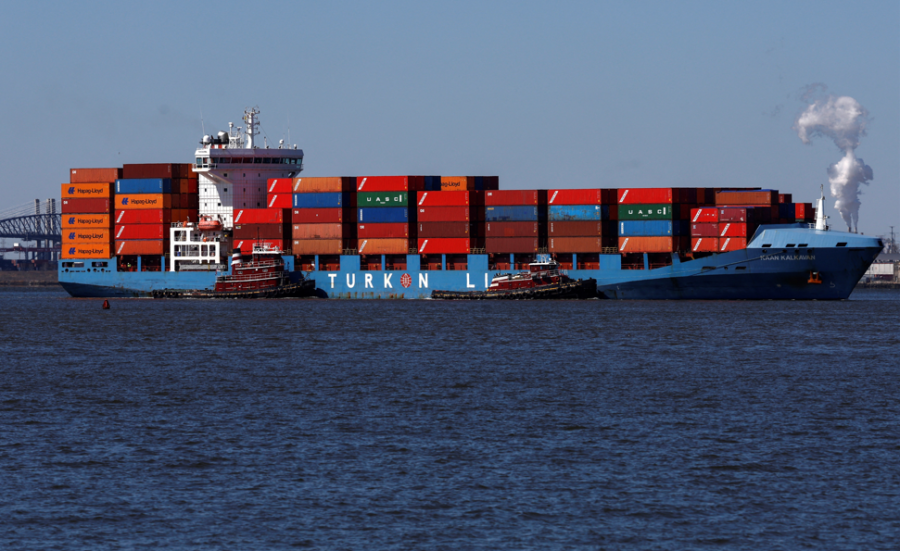
Photo: A cargo ship is brought into the Port of Elizabeth marine terminal, New Jersey, U.S. (REUTERS/Shannon Stapleton)
Efforts to reduce CO2 emissions across the global shipping industry are sailing forward – but the U.S. is not on board.
Reuters reports that the International Maritime Organization, a United Nations agency, approved a scheme to charge ships a penalty if CO2 emissions are above a fixed threshold.
These measures are to help meet the IMO’s target to cut net emissions from international shipping by 20% by 2030, and eliminate them by 2050.
It’s not clear how the cargo ships serving Bermuda might be affected, but we have reached out to local agents for comment.
The U.S., however, pulled out of this week’s IMO climate talks in London, threatening to impose “reciprocal measures” against any fees charged on U.S. Ships.
The shipping industry news site gCaptain received comment from a spokesperson for the U.S. State Department:
“The U.S. will not be engaging in negotiations at the IMO’s 83rd Marine Environment Protection Committee.”
“Consistent with President Trump’s Executive Orders on International Environmental Agreements and on Energy Dominance, it is the Administration’s policy to put the interests of the United States and the American people first in the development and negotiation of any international agreements.”
Despite the U.S. withdrawing from the talks, Reuters reports that a majority of countries approved a charge of $380 per metric ton on every extra ton of CO2 equivalent they emit above the main emissions threshold.
If ships get below the main limit, there will still be a $100 penalty until they can get below the stricter, ideal limit.
The target will move, with ships required to cut emissions by 8% compared with a 2008 baseline, with a stricter standard of a 21% reduction. By 2035, the main standard will be 30%, the stricter standard will be 43%.
Ships that manage to get below the stricter standard will receive credits they can sell to non-compliant vessels.
From 2030, up to $40 billion in fees is expected to be generated, Reuters reports, some of which may be used to make expensive zero-emission fuels more affordable.
An International Chamber of Shipping response reads, “We are pleased that governments have understood the need to catalyze and support investment in zero emission fuels”.
Countries will still need to give final approval to the scheme at an IMO meeting in October.