Friday, November 6, 2026
Home Blog Page 1006

‘Want population growth? Private sector must house them’

Responding to the Chamber, MP Chris Famous says banks must make it easier to finance rental investment

The housing crisis threatens to be a knockout punch for Bermuda’s economic goals.

Chamber of Commerce President Marico Thomas, in boxing regalia, told attendees at their AGM last week that, to reach a utopia population of 70,000 people, we need to provide about 2,500 additonal homes.

Increasing the working population by thousands is something Government has also lauded as being vital to Bermuda’s future.

Chris Famous, PLP MP and chair of the Bermuda Housing Corporation, suggests it can’t happen without a serious commitment from those outside of Government.

“The reality is that the Housing Corporation has built in the last year 70 units”, Mr Famous says. “This year, we’re targeted to build/renovate 100 new units.”

“The majority of land on this island is owned by private entities, whether they be families or they be companies.”

“In order to accommodate the goal that the Bermuda Chamber of Commerce is speaking about, logistically, it’s going to be the private sector that has to build these houses.”

As of April 2025, the BHC has worked with 25 private property owners in a scheme to renovate their rental units. Following this, Government and the owner/s will share the rental income for a seven year period.

Many more properties will be needed in the future, Mr Famous affirmed.

“We have the Southampton Princess which will be coming online in the next two years. Elbow beach will be coming online in next 2 or 3 years.”

“They’re going to need five, six, seven hundred staff each… where are they going to live? We have to build more for them.”

An online commenter suggested Government could provide duty relief on construction materials for private housing investors. The Fairmont Southampton, the Hamilton Princess and other hotels have all received years of tax and duty concessions, including construction materials.

Could a much smaller version of this work for the private sector?

“There was some relief on aggregate”, Mr Famous says, “which helps to bring down the cost of the actual building materials… cement and cement block… I’m sure there’s other things that can be considered.”

“But, the biggest hindrance in building for many Bermudians is bank rates.”

“You’ve got to come up with 20% down payment… depending on the bank, you could be dealing with up to 10% mortgage rates.”

“If we want population increase, then there has to be some give and take, not just on government. There has to be give and take on private sector business entities that would aid Bermudians to purchase homes, or build on to their homes.”

Gary Foster Skelton asked Chris Famous whether Government may support such investments…

GFS – “The PLP government has worked with the private sector, worked with banking, to create an avenue for first time home buyers… do you think government needs to take another collaborative role with banks to try and encourage [private investment in housing]?”

Chris Famous – “So what you’re talking about is the mortgage guarantee program through the Bermuda Commercial Bank… which gets to the point that when the down payment is going from 20% down to 10%, and the interest rates are fixed at 5%, it means more Bermudians are able to purchase their home.”

GFS – “Bermuda commercial Bank wasn’t going to do that themselves… they needed some help from government. So is do you think government, in the same way, should try and work with the banks to… create an environment where it’s easier for private individuals to put more housing on the market?”

Chris Famous – “All options are open. I’m simply saying… it’s well and fine for the Chamber of Commerce and others to say we need a population increase, and we need 2,500 more houses. But, what also needs to be said is that one of the biggest cost factors is Bermudians being able to get on that housing ladder. Bermudians being been able to afford to renovate the houses. And what does it all come back to? Financing.”
“The government – your tax dollars, my tax dollars – cannot be used for every single thing.”
“We as a government are doing our part… the private sector, whether it be individuals, whether it be companies, has to do more.”


‘Serious’ two-vehicle crash on North Street

It happened near TCD

Credit: Bermuda Police Service

Police are warning drivers of a ‘serious’ crash involving two motor cars that occurred on the edge of the City of Hamilton this afternoon.

A spokesperson for the Bermuda Police Service said the collision took place on North Street near the Transport Control Department.

As of 5 pm, they advised, “The roadway is currently closed and motorists are being diverted over Till’s Hill and along Dutton Avenue.”

Update, 5:50 pm: The road has been reopened.

Museum celebrates roof wetting of Casemates Barracks

The ceremony marked the completion of essential restoration work on the historic site

Images supplied.

The National Museum of Bermuda issued the following media release.

The National Museum of Bermuda (NMB) marked a significant milestone on Thursday, April 24, with the roof wetting ceremony of the Casemates Barracks. The event, attended by distinguished guests including His Excellency, Deputy Premier De Silva, Minister Tyrell, and former Deputy Premier Roban, celebrated the completion of the essential restoration work on the historic site.

NMB Executive Director Elena Strong opened the ceremony with remarks, reflecting on the journey to secure the Casemates Barracks. “It is deeply meaningful to be standing here – on the roof – marking a milestone that once felt impossibly far away,” she said. Strong highlighted the challenges faced, including invasive plants, water damage, failing roof and praised the collective efforts that led to the restoration. “Thanks to your support and The Future of History campaign, we are gathered on a secure, water-tight surface,” she added.

Strong emphasised the importance of honouring the complex history of Casemates, which includes military discipline and forced confinement. “Engaging with this place requires care, respect, and a clear vision for the future,” she noted. Pre-restoration work, began over 20 years ago, involved museum volunteers and private and corporate partners but it was not until 2024 thanks to The Future of History Campaign that major roof work could begin.

“Our long-term vision is to transform Casemates into an international hub for Atlantic World Studies,” Strong stated. She detailed the extensive restoration efforts over the past year, including removing invasive growth, abating asbestos, documentation of the historic roof structure and installing modern protective systems. “This is just Phase 1: to stabalise the buildings. We haven’t yet brought Casemates Barracks and the Upper Ordnance Yard Buildings fully back to life, but we’ve secured them.” she concluded.

Board Chair Jennifer Davidson echoed Strong’s sentiments, expressing gratitude to all involved in the restoration. “Tonight is a celebration of what happens when people come together – when volunteers, donors, contractors, foundations, corporations, and government partners align around a shared purpose,” Davidson said. She thanked key partners, including Bermuda Project Management Limited, Crisson Construction, Gray Co Roofing, SAL, Island Construction, and the Government of Bermuda.

Davidson also invited attendees to leave their mark on history by placing their fingerprints on the cement. “With your fingerprint, you become a part of the next chapter of Casemates’ story,” she said. The ceremony concluded with His Excellency pouring Gosling’s Rum for the roof wetting.

The National Museum of Bermuda extends its deepest gratitude to all who contributed to this significant achievement. Having watertight roofs on Casemates Barracks and the Upper Ordnance Yard Buildings are major step in a longer journey, and the Museum looks forward to continuing its work to preserve Bermuda’s history and heritage.

Domestic Violence Court nearing official launch

The court, set to be operational in the coming months, will prioritize swift justice and survivor support

 
Recently, Minister Wilkerson met with Juanae Crockwell, Executive Director of the Women’s Resource Centre (WRC) and Laurie Shiell, Executive Director of the Centre Against Abuse (CAA), to discuss the Domestic Violence Court. Image Supplied.

The Government of Bermuda issued the following media release.

“The establishment of the Domestic Violence Court is a landmark moment for our justice system,” said Attorney General and Minister of Justice, Sen. The Hon. Kim Wilkerson, JP.

The Government of Bermuda is preparing to take a watershed step in its commitment to protecting victims of domestic abuse with the upcoming launch of the Domestic Violence Court.

This initiative, a key component of the Government’s broader justice reform efforts, is set to be fully operational in the coming months and will provide a focused, responsive, and supportive legal framework for survivors of domestic violence.

Minister Wilkerson reaffirmed the Government’s dedication to this initiative, adding: “Domestic violence affects individuals, families, and our wider community, particularly our young people who may witness abuse in their formative years.

“This new court will provide swift access to legal protection, ensure urgent cases are handled, and prioritise support for survivors while holding perpetrators accountable.”

Although the court is not officially in operation, steps have already been taken to implement its principles. Some domestic violence cases in the Magistrates’ Court have been heard with the same urgency and victim-centred approach that will define the new court.

The Government has also laid the groundwork for a smooth transition by developing training programmes for judicial officers, law enforcement personnel, and support service providers.

These efforts will ensure that all involved parties are fully equipped to work within the specialised framework when the court begins hearing cases. The selection process for vendors to deliver perpetrator training programmes has now been completed.

The Domestic Violence Court will emphasise timely intervention, with a focus on accelerating access to protection orders and support services for victims.

It will also incorporate rehabilitative measures to address the root causes of abusive behaviour, including treatment programmes designed to prevent reoffending.

The demand for domestic violence-related legal assistance and intervention continues to grow. Between April and December 2024, the Women’s Resource Centre (WRC) received:

  • 50 reports of abuse
  • 5 cases of harassment
  • 205 requests for legal assistance

During the same period, WRC issued 29 warning letters and referred 48 clients seeking protection orders or domestic violence assistance to the Centre Against Abuse (CAA).

The Centre Against Abuse (CAA) has expressed strong support and enthusiasm for the establishment of a Specialist Domestic Abuse Court in Bermuda. Laurie Shiell, the executive director of CAA, stated: “Having advocated for this initiative for over a decade, CAA extends its gratitude to all involved in making this long-awaited development a reality.”

In 2024, CAA served 157 clients—150 women and seven men—providing vital safety and support to 173 children connected to those clients. CAA also delivered 297 legal advocacy services, including assisting 51 clients in obtaining Domestic Violence Protection Orders (DVPOs), a critical measure in ensuring survivor safety.

Clients in need of DVPOs or other legal advocacy services are encouraged to contact the CAA directly. Last year, the CAA provided 26 safe housing and resettlement services, further ensuring stability and security for those fleeing abusive situations.

Mrs Shiell added: “The introduction of a Specialist Domestic Abuse Court will provide crucial benefits, including:

  • Trained domestic abuse personnel, including magistrates and court staff
  • Consistent standards for domestic abuse cases
  • Increased safety for victims within the courtroom setting
  • A unified court for both criminal and civil domestic abuse matters
  • Improved monitoring of offenders
  • Court-ordered programs for offenders
  • Expedited criminal court trials
  • Enhanced data collection
  • Greater public confidence in the justice system”

Mrs Shiell acknowledges that the effectiveness of the Specialist Domestic Abuse Court will depend on amendments to existing laws and policies and that CAA remains committed to working with the Government and other stakeholders to support the implementation of a Domestic Abuse Act and a National Domestic Abuse Awareness and Prevention Plan.

“Such measures would serve as a blueprint for addressing domestic abuse in Bermuda and ensuring clear repercussions for offenders,” Ms Shiell further stated.

“CAA continues to advocate for comprehensive measures to combat domestic abuse and stands ready to assist in the court’s development and implementation.”

These numbers highlight the urgent need for a more streamlined legal process to protect victims, hold offenders accountable, and ensure that survivors receive the support they need in a timely manner.

The establishment of the Domestic Violence Court directly addresses this need.

Minister Wilkerson highlighted the long-term benefits of this initiative, noting: “This is more than just a court—it is a commitment to ending the cycle of domestic violence in Bermuda.

“It will serve as a critical resource in protecting victims, preventing future harm, and promoting a compassionate and effective justice system.”

Domestic violence remains a significant challenge in Bermuda, affecting not only direct victims but also young people who may be exposed to violent home environments.

Research has shown that children who grow up in abusive households are at a greater risk of experiencing long-term emotional and psychological distress, impacting their academic performance, mental well-being, and future relationships.

The Ministry of Justice will continue to provide updates on the progress of the Domestic Violence Court as it nears its official launch.

(L-R): Juanae Crockwell, Minister Wilkerson and Laurie Shiell. Image supplied.
 

Trump to reduce impact of auto tariffs, commerce secretary says

A coalition of U.S. auto industry groups urged Trump not to impose 25% tariffs on imported auto parts

FILE PHOTO: Cars to be exported sit at a port in Lianyungang, Jiangsu province, China August 8, 2018. REUTERS/Stringer/File Photo

International news via Reuters:

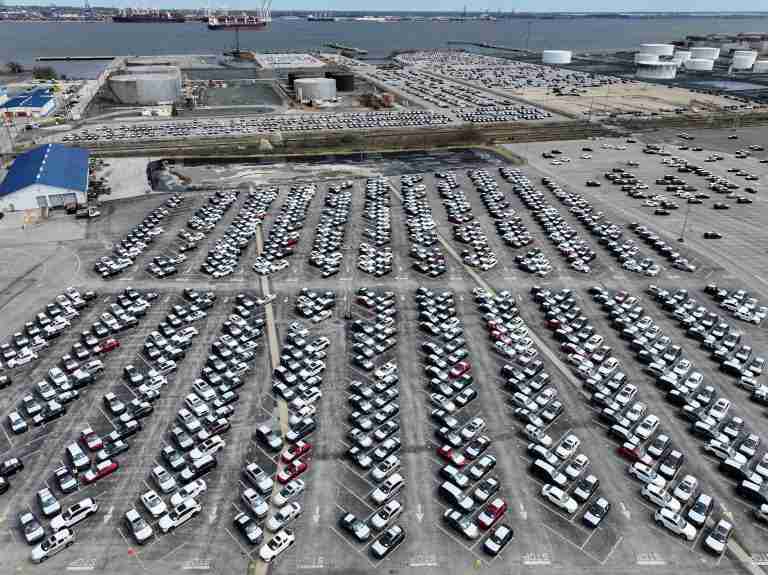
President Donald Trump’s administration will move to reduce the impact of his automotive tariffs on Tuesday by alleviating some duties imposed on foreign parts in domestically manufactured cars and keeping tariffs on cars made abroad from piling on top of other ones, officials said.

“President Trump is building an important partnership with both the domestic automakers and our great American workers,” Commerce Secretary Howard Lutnick said in a statement provided by the White House.

“This deal is a major victory for the President’s trade policy by rewarding companies who manufacture domestically, while providing runway to manufacturers who have expressed their commitment to invest in America and expand their domestic manufacturing.”

The Wall Street Journal, which first reported the development, said the move meant car companies paying tariffs would not be charged other levies, such as those on steel and aluminum, and that reimbursements would be given for such tariffs that were already paid.

A White House official confirmed the report and indicated the move would be made official on Tuesday.

Trump is traveling to Michigan on Tuesday to commemorate his first 100 days in office, a period that the Republican president has used to upend the global economic order.

The move to soften the effects of auto levies is the latest by his administration to show some flexibility on tariffs, which have sown turmoil in financial markets, created uncertainty for businesses and sparked fears of a sharp economic slowdown.

Automakers said earlier on Monday they were expecting Trump to issue relief from the auto tariffs ahead of his trip to Michigan, which is home to the Detroit Three automakers and more than 1,000 major auto suppliers.

General Motors, CEO Mary Barra and Ford CEO Jim Farley praised the planned changes. “We believe the president’s leadership is helping level the playing field for companies like GM and allowing us to invest even more in the U.S. economy,” Barra said.

Farley said the changes “will help mitigate the impact of tariffs on automakers, suppliers and consumers.”

Last week, a coalition of U.S. auto industry groups urged Trump not to impose 25% tariffs on imported auto parts, warning they would cut vehicle sales and raise prices.

Trump had said earlier he planned to impose tariffs of 25% on auto parts no later than May 3.

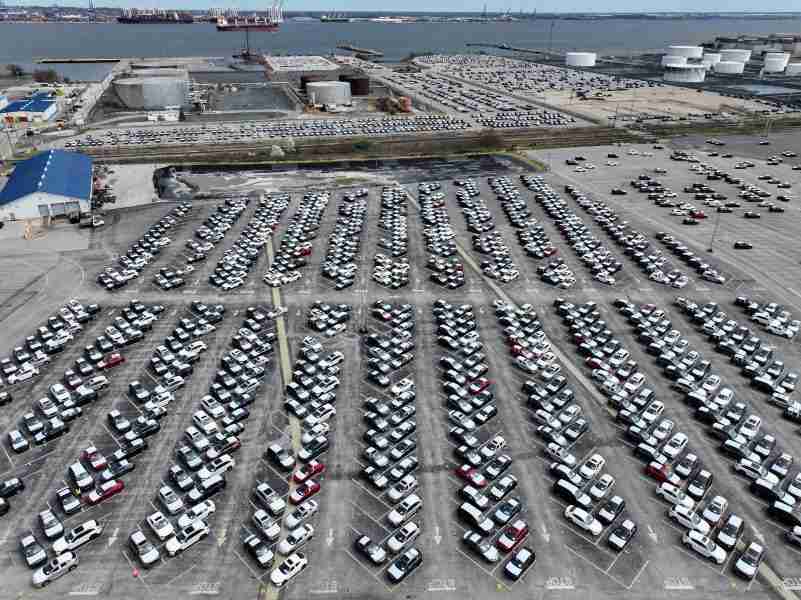
FILE PHOTO: A drone view shows cars on the day U.S. President Donald Trump is set to announce new tariffs, at the Port of Baltimore, Maryland, U.S., April 2, 2025. REUTERS/Evelyn Hockstein/File Photo

“Tariffs on auto parts will scramble the global automotive supply chain and set off a domino effect that will lead to higher auto prices for consumers, lower sales at dealerships and will make servicing and repairing vehicles both more expensive and less predictable,” the industry groups said in the letter.

The letter from the groups representing GM, Toyota Motor, Volkswagen, Hyundai and others, was sent to U.S. Trade Representative Jamieson Greer, Treasury Secretary Scott Bessent and Commerce’s Lutnick.

“Most auto suppliers are not capitalized for an abrupt tariff induced disruption. Many are already in distress and will face production stoppages, layoffs and bankruptcy,” the letter added, noting “it only takes the failure of one supplier to lead to a shutdown of an automaker’s production line.”

Reporting by Jeff Mason and David Shepardson; Editing by Leslie Adler, Shri Navaratnam and Kim Coghill

Surge in attacks signals jihadist comeback in Nigeria’s northeast

0

Attributed to resurgence in fighting between Boko Haram and Islamic West Africa Province

FILE PHOTO: An armored vehicle of Nigerian Security Forces drives by newly built homes, ahead of the community re-opening ceremony which was destroyed by Boko Haram armed militants in 2015, in Ngarannam, Borno State, Nigeria, October 21, 2022. REUTERS/Christophe Van Der Perre/File Photo

International news via Reuters:

A surge in attacks in Nigeria’s northeast by Boko Haram and its splinter rival ISWAP has raised fears of a major comeback by jihadists, whose tactics now include armed drones and explosive devices planted on major roads, security experts said.

At least 22 people were killed in weekend raids by militants in Adamawa and Borno states, while 26 others died on Monday after an explosive device ripped into two vehicles in Borno.

Dozens more have been killed by a string of jihadist attacks since January.

In Borno state, the heartland of the insurgency for over 15 years, governor Babagana Zulum has warned that insurgents were making gains, with little push back from the military.

Security experts attributed the resurgence to a lull in fighting between Boko Haram and Islamic West Africa Province (ISWAP) and the adoption of aerial technology by the groups.

“Both groups have become a bit bolder and showed they have some sophisticated technology,” said James Barnett, a Hudson Institute research fellow who conducts fieldwork on insecurity in Nigeria.

The use of armed drones also suggested ISWAP was receiving more funding from Islamic State, analysts said.

Last month, insurgents used drones to attack a military outpost near the Cameroonian border, killing several soldiers.

Vincent Foucher, a research fellow at the French National Centre for Scientific Research who has interviewed former fighters, said there were reports that Islamic State advisers had been sent in to help ISWAP fighters on the ground.

“They can improve the tactics and we have seen the use of drones and explosives and large-scale attacks. This could be taken as impact of the advice from the Islamic State,” Foucher said.

Boko Haram and ISWAP had fought bitterly for supremacy since splitting in 2016.

But Foucher said “they are less busy fighting each other and have more time to carry out attacks.”

Last Friday, Zulum told reporters that militants were regrouping in the Lake Chad area and Sambisa hills in Borno, near the Cameroonian border.

The Nigerian military did not respond to a request for comment.

Malik Samuel, a senior researcher at security think-tank Good Governance Africa, said jihadists had shown to be resilient and adaptive to strategies deployed by the military.

“Their current resurgence mirrors previous periods when they took the fight to the military, instead of waiting for the military to attack before repelling them,” he said.

Reporting by Ope Adetayo, Editing by MacDonald Dzirutwe and Aidan Lewis

Canada’s Liberals win minority government; Carney says old relationship with US ‘is over’

0

Teaser Paragraph here…,

Canada’s Prime Minister Mark Carney speaks at the Liberal Party election night headquarters in Ottawa, Ontario, Canada April 29, 2025. REUTERS/Blair Gable

International news via Reuters:

Canadian Prime Minister Mark Carney’s Liberals retained power in the country’s election on Monday, but fell short of the majority government he had wanted to help him negotiate tariffs with U.S. President Donald Trump.

The Liberals were leading or elected in 167 electoral districts, known as seats, followed by the Conservatives with 145, with votes still being counted.

Supporters of Bloc Quebecois leader Yves-Francois Blanchet look on at election night headquarters in Montreal, Quebec, Canada April 28, 2025. REUTERS/Mathieu Belanger

The Liberals had needed to win 172 of the House of Commons’ 343 seats for a majority that would allow them to govern without support from a smaller party.

“Our old relationship with the United States, a relationship based on steadily increasing integration, is over,” Carney said in a victory speech in Ottawa. “The system of open global trade anchored by the United States, a system that Canada has relied on since the Second World War, a system that, while not perfect, has helped deliver prosperity for our country for decades, is over.”

“These are tragedies, but it’s also our new reality.”

Carney said the coming months would be challenging and require sacrifices.

Shachi Kurl, president of the Angus Reid Institute, a polling firm, told Reuters the Liberal win hinged on three factors.

“It was the ‘anybody-but-Conservative’ factor, it was the Trump tariff factor, and then it was the Trudeau departure … which enabled a lot of left-of-center voters and traditional Liberal voters to come back to the party,” Kurl said, referring to the resignation of unpopular former Prime Minister Justin Trudeau.

Carney had promised a tough approach with Washington over its import tariffs and said Canada would need to spend billions to reduce its reliance on the U.S. But the right-of-center Conservatives, who called for change after more than nine years of Liberal rule, showed unexpected strength.

Minority governments in Canada rarely last longer than 2-1/2 years.

Conservative leader Pierre Poilievre conceded defeat to Carney’s Liberals and said his party would hold the government to account.

The result capped a notable comeback for the Liberals, who had been 20 percentage points behind in the polls in January before Trudeau announced he was quitting and Trump started threatening tariffs and annexation.

“America wants our land, our resources, our water, our country,” Carney said. “These are not idle threats. President Trump is trying to break us so America can own us. That will never ever happen.”

WAVE OF PATRIOTISM

Trump’s threats ignited a wave of patriotism that swelled support for Carney, a political newcomer who previously led two G7 central banks.

Trump re-emerged as a campaign factor last week, declaring that he might raise a 25% tariff on Canadian-made cars because the U.S. does not want them. He said earlier he might use “economic force” to make Canada the 51st state.

Carney has emphasized that his experience handling economic issues makes him the best leader to deal with Trump, while Poilievre tapped into concerns about the cost of living, crime and a housing crisis.

Trump, in a social media post on Monday, reiterated his call for Canada to become the 51st state.

“Good luck to the Great people of Canada,” he said. “Elect the man who has the strength and wisdom to cut your taxes in half, increase your military power, for free, to the highest level in the World, have your Car, Steel, Aluminum, Lumber, Energy, and all other businesses, QUADRUPLE in size, WITH ZERO TARIFFS OR TAXES, if Canada becomes the cherished 51st. State of the United States of America. No more artificially drawn line from many years ago.”

Tensions with the U.S. have caused supporters of two smaller parties, the left-leaning New Democratic Party and the separatist Bloc Quebecois, to shift to the Liberals. NDP leader Jagmeet Singh conceded defeat in his own district and said he planned to quit as party leader.

The Conservatives appeared on track to make gains in the seat-rich Toronto area to prevent a Liberal majority government, but Poilievre was trailing in his own Ottawa-area district, with votes still being counted.

“We didn’t quite get over the finish line yet,” Poilievre told his supporters in Ottawa. “We know that change is needed, but change is hard to come by. It takes time.”

The Liberals are the last party to win four consecutive elections in Canada, accomplishing the feat in 2004.

Poilievre focused his campaign on domestic issues and the need to fix a country that he said the Liberals had “broken.”

Reporting by Rod Nickel and Promit Mukherjee in Ottawa, Nivedita Balu in Toronto and Amanda Stephenson in Calgary; additional reporting by Susan Heavey in Washington; editing by Deepa Babington, Nick Zieminski and Paul Simao

UPS profit beats estimates, to cut 20,000 jobs on economic worries

The comnpany had in January forecast full-year revenue of $89 billion

FILE PHOTO: An United Parcel Service employee works at the new package sorting and delivery UPS hub in Corbeil-Essonnes and Evry, southern Paris, France, June 26, 2018. REUTERS/Charles Platiau/File Photo

International news via Reuters:

United Parcel Service reported a better-than-expected profit for its first quarter on Tuesday and said it will cut 20,000 jobs to control costs against a tough macroeconomic environment, sending its shares up 4% before the bell.

Trade tensions have prompted many companies to hold back on spending, which in turn has lowered the need for services between firms and hurt UPS’ performance in its domestic market.

The parcel giant said it was not providing any updates to its full-year outlook due to the economic uncertainty. Its first-quarter revenue fell to $21.5 billion from $21.7 billion a year ago.

The comnpany had in January forecast full-year revenue of $89 billion and operating margin to be about 10.8%.

Its U.S. domestic segment revenue grew 1.4% to $14.46 billion in the first quarter, driven by increase in air cargo and improving revenue per piece, even as volumes declined.

UPS postedan adjusted profit per share of $1.49 compared with expectations of $1.38, according to data compiled by LSEG.

Reporting by Lisa Baertlein in Los Angeles and Abhinav Parmar in Bengaluru; Editing by Arun Koyyur

Explainer-What could be behind the Iberian power outage?

Spain is one of Europe’s biggest producers of renewable energy

Tourists check into a hotel without electricity during a power outage which hit large parts of Spain, in Ronda, Spain April 28, 2025. REUTERS/Jon Nazca

International news via Reuters:

The hunt has begun for the cause of a massive blackout across Spain, Portugal and parts of France that halted trains, bank machines and traffic lights, in one of Europe’s biggest ever power system collapses.

CYBER ATTACK?Portugal’s Prime Minister Luis Montenegro has said there was no indication of a cyberattack, but both countries are still looking at all hypotheses.

EXPLANATIONS SO FARSpanish grid operator Red Electrica, in a statement on Monday night, pointed to a “strong oscillation in the power flow, which triggered “a very significant loss of generation.”

This loss of generation went beyond what the electrical systems are designed to handle and the Spanish grid was disconnected from the European system.

The electrical system then collapsed, leading to voltage losses in the supply points of both the Spanish and Portuguese peninsular electrical systems, Red Electrica said.

A view of a dark street in the early morning hours during a power outage, which hit large parts of Spain, in Ronda, Spain April 29, 2025. REUTERS/Jon Nazca

WHAT CAUSES POWER OUTAGES?

The most common cause of an unplanned power cut which disables electricity on a large scale is extreme weather such as storms, lightning strikes or high winds.

They can also happen when there are faults at power stations, power distribution lines, substations or other parts of the electricity transmission system or grid.

Most power cuts typically last between a few minutes to several hours.

WHAT IS THE IBERIAN POWER MIX?

Spain is one of Europe’s biggest producers of renewable energy and Monday’s shutdown has already sparked debate about whether the volatility of supply from solar or wind made its power systems more vulnerable to such an outage.

Red Electrica data shows solar photovolatic (PV) energy was providing almost 59% of Spain’s electricity at the time of the blackout, while wind power was providing nearly 12%, nuclear almost 11% and combined cycle gas plants 5%.

Red Electrica data also shows that within just five minutes on Monday, between 1230 and 1235 local time (1030-1035 GMT), solar PV generation dropped from more than 18 GW to just 8 GW.

People wait on a platform as metro operations resume partially, after power begins to return following a huge outage that hit Spain and Portugal, in Madrid, Spain April 29, 2025. REUTERS/Violeta Santos Moura

WHAT FACTORS COULD BE INVOLVED?

A source with direct knowledge of the sector said that at the time of the outage the Spanish grid was running with very little “inertia”, which is the energy moving in a large rotating mass like a generator or in some industrial motors.

Inertia helps to stabilize the grid by slowing down the rate of frequency change when there’s a sudden drop or rise in demand or generation.

“In those conditions (when there is little inertia) if there’s a drop in production for whatever reason, the grid loses (more) inertia and everything fails. And in a blackout, you need to rebuild inertia before bringing things back online, which takes a few hours,” the source said, requesting anonymity.

Victor Becerra, professor of power systems engineering, at the UK’s University of Portsmouth, said the Iberian outage showed the complexity of managing modern energy systems particularly as they integrate increasing levels of intermittent renewable energy, such as wind and solar.

Reporting by Nina Chestney, Pietro Lombardi, Susanna Twidale, Aislinn Laing, Andres Gonzalez Estebaran and Kate Abnett; editing by Susan Fenton

Bosnian centre trains dogs for Ukrainian demining efforts

Landmines laid since Russia’s 2022 invasion cost Ukraine over $11 billion in annual GDP

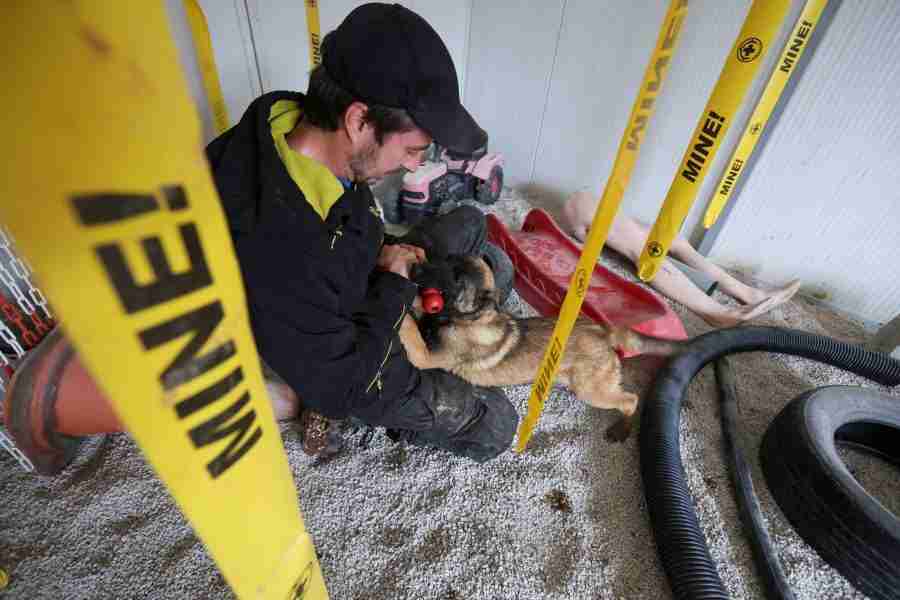
Trainer Abdulah Jukanovic trains a dog named May to detect mines and explosive devices, at the Norwegian People’s Aid Global Training Centre for Mine and Explosive Detection Dogs, in Sarajevo, Bosnia and Herzegovina April 24, 2025. REUTERS/Amel Emric

International news via Reuters:

 Mey, a Belgian shepherd, and her trainer Kenan Muftic learned how to effectively detect mines and unexploded ordnance last week, negotiating various obstacles and scenarios in a grass field in Sarajevo’s suburb of Butmir.

Mine detection dog Revka trains to detect mines and explosive devices at the Norwegian People’s Aid Global Training Centre for Mine and Explosive Detection Dogs, in Sarajevo, Bosnia and Herzegovina April 24, 2025. REUTERS/Amel Emric

Since its establishment in 2004, the Norwegian People’s Aid Global Training Centre for Mine and Explosive Detection Dogs in Sarajevo has trained more than 500 dogs. The trained dogs have been deployed to conflict zones across the globe, including Cambodia, Zimbabwe and Iraq. 

The centre has also sent 26 dogs to Ukraine, the world’s most densely mined country according to a 2024 estimate by the United Nations and Ukrainian government.

Mine detection dog Gina trains to detect mines and explosive devices at the Norwegian People’s Aid Global Training Centre for Mine and Explosive Detection Dogs, in Sarajevo, Bosnia and Herzegovina April 24, 2025. REUTERS/Amel Emric

Soon after the Russian invasion of Ukraine in 2022, Norwegian People’s Aid sent dogs to assist in the effort to clear millions of mines and unexploded ordnance devices, Muftic said. 

In Ukraine, dogs from Butmir assist deminers in clearing fields in heavily affected regions such as Kharkiv in the northeast and Mykolaiv in the south. 

Trainer Stefan Relic trains a dog named Mira to detect mines and explosive devices, at the Norwegian People’s Aid Global Training Centre for Mine and Explosive Detection Dogs, in Sarajevo, Bosnia and Herzegovina April 24, 2025. REUTERS/Amel Emric

“In some places, they are close to the front lines,” Muftic said.

Landmines laid since Russia’s 2022 invasion cost Ukraine over $11 billion in annual GDP, according to a 2024 report by Ukraine’s Economy Ministry and the Tony Blair Institute for Global Change. 

Minefields and unexploded ordnance render vast agricultural areas inaccessible, slashing Ukraine’s exports and tax revenue.

Bosnia, still grappling with the legacy of its 1990s war, faces similar challenges. 

Trainer Abdulah Jukanovic trains a dog named Maddy to detect mines and explosive devices, at the Norwegian People’s Aid Global Training Centre for Mine and Explosive Detection Dogs, in Sarajevo, Bosnia and Herzegovina April 24, 2025. REUTERS/Amel Emric

Data from Bosnia’s Mine Action Centre in 2023 shows landmines planted across the country by Serb, Bosniac and Croat troops still affect around 15% of the population. Specialised dogs are sometimes indispensable in clearing minefields.

“In demining, we say: one mine found, one family saved,” said Muftic, who over the past 27 years has helped to clear thousands of mines and unexploded ordnance devices. 

Reporting by Aleksandar Vasovic; Editing by Freya Whitworth

Central Europe must diversify to mitigate tariff hit, Moody’s Analytics

The Ukraine war and increased defence spending contributed to higher borrowing in the region

A view of sunset over skyline in Warsaw, Poland April 27, 2024. REUTERS/Kuba Stezycki

International news via Reuters:

Central Europe has limited fiscal space to offset the economic hit from tariffs given high deficit levels across much of the export-reliant region, which must find new engines for growth amid a shake-up of the world economy, Moody’s Analytics said.

Despite low direct exports to the U.S., central Europe is among the European Union’s most trade-reliant regions, with goods exports as a share of output ranging from 75.5% in Slovakia to 39.4% in Poland — all above a 34.2% EU average.

Tariffs have darkened the outlook for Europe as a whole, raising recession risks and slashing growth prospects in the Czech Republic, Romania and Hungary, Gaurav Ganguly, head of EMEA Economic Research at Moody’s Analytics told Reuters.

The analytics arm is a separate unit to the one that sets credit ratings.

“The U.S. is retreating into isolationism. That’s putting a huge pressure on the global economy, and particularly on countries that are exposed to the global trading system and that have relied on trade as an engine for growth,” he said.

“It is very important for these countries to find new export markets, to find new partners, to find new engines for growth.”

Ganguly said these could include export promotion, new trade and investment alliances, promoting new industries or attracting foreign investment from other countries.

“The policy environment and the tariff environment is such that it’s creating some very big structural problems for growth,” he said. “If countries don’t address that, they will have some medium-term issues, not just short-term issues.”

The war in Ukraine, increased defence spending and elections have contributed to higher borrowing in central Europe, with Poland and Romania, the region’s largest economies, racking up the 27-member EU’s highest budget deficits last year.

“There seems to be a lot of spending rigidity in Poland, so that’s putting huge pressure on fiscal consolidation efforts on the expenditure side,” Ganguly said, adding that Poland needs to work harder to ensure its lower deficit targets stay credible.

While debt levels in both Poland and Romania are still below the EU average, Poland’s debt servicing costs as a percentage of output have doubled since 2021, while Romania’s interest bill increased by one percentage point to 2.3% of output.

Ganguly said he was “much more concerned” about Romania, where the deficit rose to 9.3% of output last year, exceeding even its COVID-19 pandemic highs. First-quarter figures last week showed the gap widening further on an annual basis.

“Unless the government acts very urgently to increase fiscal consolidation, then particularly given this much darker growth outlook, we are going to see a worsening in the budget deficit for 2025 and 2026,” Ganguly said, projecting the shortfall at 8.4% of output this year and 7.1% in 2026.

While Hungary managed to trim its deficit last year despite running the EU’s highest interest bill, the government is pushing ahead with large-scale income tax cuts ahead of a 2026 election, even amid risks to growth and high inflation.

Writing by Gergely SzakacsAdditional reporting by Luiza IlieEditing by Sharon Singleton

US veteran remembers end of Vietnam War 50 years on

0

The Vietnam War lasted for two decades and killed nearly 60,000 Americans

Chuck Searcy, 81, a Vietnam War veteran, interacts with an installation at the War Remnants Museum in Ho Chi Minh City, Vietnam, April 25, 2025. REUTERS/Thinh Nguyen

International news via Reuters:

As a young U.S. intelligence analyst in Saigon during the Vietnam War, Chuck Searcy never thought that 50 years later he would be living in Communist Vietnam and helping its people fight a different war against unexploded mines.

The Vietnam War scarred a generation of U.S. soldiers, but like many, Searcy returned to the old battleground and has witnessed first hand the dramatic warming of relations between the two former foes.

Searcy, 81, now lives in northern Vietnam as the Communist-run nation celebrates 50 years since the end of the war on April 30, known as Reunification Day.

But he still remembers the prophetic words of a South Vietnamese soldier he met in the 1960s in Saigon, the capital of the U.S.-backed South Vietnam that spent decades fighting against Communist North Vietnam, which was renamed Ho Chi Minh City after the war.

“Until you get out of our country, we will never get peace,” Searcy recalls the man telling him.

Searcy declined to name the soldier but marvelled that while he was America’s ally, he nevertheless believed that North Vietnamese leader Ho Chi Minh was the only figure respected by the majority of the people and capable of bringing peace.

Chuck Searcy, 81, a Vietnam War veteran, stands at the War Remnants Museum in Ho Chi Minh City, April 25, 2025. REUTERS/Thinh Nguyen

The Vietnam War lasted for two decades and killed nearly 60,000 Americans, many of them young soldiers drafted by their government. Some three million Vietnamese died on both sides of what is known in Vietnam as the American War.

But fewer and fewer Vietnamese have memories of the war. Vietnam’s median age is now below 35 and youths may rather link the notion of a conflict with America to the current trade war.

Vietnamese youths crowd Starbucks cafes throughout the country, and U.S. consumers buy “Made in Vietnam” goods – contributing in the process to Vietnam’s rapid economic growth.

The former foes have now turned into close economic partners, with U.S. multinationals, such as Apple, Nike and Intel, running large manufacturing operations in Vietnam.

HEALING WAR’S WOUNDS

After having experienced first-hand such legendary wartime events as the 1968 Tet Offensive, Searcy left the military and returned home to the United States, at least for a time.

He was in Atlanta when he watched on TV the fall of Saigon on April 30, 1975 and the iconic takeoff of the last helicopter from the roof of the U.S. embassy in the centre of the city.

“I felt this overwhelming sense of relief that it was over after such a long agony,” Searcy told Reuters.

Firmly in the anti-war camp at that point, Searcy acknowledged that his elation for the end of the war “was mixed with great concern” about Vietnamese friends who had supported the U.S. army and whose lives may have been in jeopardy. Over 1 million Vietnamese left the country after the war ended.

Chuck Searcy, 81, a Vietnam War veteran, looks on at the War Remnants Museum in Ho Chi Minh City, April 25, 2025. REUTERS/Thinh Nguyen

However, expectations that things were about to change brought him back to Vietnam 20 years later with a project for the rehabilitation of children with disabilities caused by polio and other diseases. 

That was shortly after Washington had lifted its embargo on Vietnam in 1994, giving people hope that a normalisation of relations was possible, he said.

Searcy has remained in Vietnam since, having later co-founded Project Renew, which helps people gravely injured by mines and deploys teams of de-miners to clear the country from unexploded ordnance out of the 5-8 million tons the Americans dropped during the war.

He is still impressed by the resilience and pragmatism of Vietnamese people, including these days when they face the threat of crippling tariffs from the Trump administration which could undermine the country’s growth model.

“We are still making life very difficult for the Vietnamese,” said Searcy.

Reporting by Minh Nguyen in Ho Chi Minh City and Francesco Guarascio in Hanoi; Editing by Michael Perry