Friday, October 30, 2026
Home Blog Page 262

Climate change threatens global plant species as habitats shrink

Researchers modelled future ranges for numerous species of vascular plants, a category that accounts for almost all the world’s plants – those with water- and nutrient-carrying tissues

International News via Reuters:

Some of the plants that make familiar landscapes recognizable may not survive by century’s end as climate change becomes an increasingly important driver of species loss, according to scientists, reshaping and often shrinking suitable habitats that the plants need to survive.

Researchers modelled future ranges for numerous species of vascular plants, a category that accounts for almost all the world’s plants – those with water- and nutrient-carrying tissues. They looked at more than 67,000 species, meaning about 18% of the world’s known vascular plants. 

They found that 7% to 16% could lose more than 90% of their range, placing them at high risk of extinction. Examples include Catalina ironwood, or island ironwood, a rare endemic California tree, bluish spike-moss from a plant lineage dating back more than 400 million years, and roughly one third of Eucalyptus species, one of Australia’s most recognizable plant groups.

The researchers came to their estimates after examining millions of records on plant locations as well as greenhouse-gas emissions scenarios for 2081-2100.

A plant’s habitat is not simply a place on a map, but the full array of conditions it needs: temperature, rainfall, soils, land use and landscape features such as shade. 

“One way to picture this is to imagine plants trying to follow a moving ‘climate envelope.’ As temperatures warm, many species can shift northward or uphill to stay cool enough. But temperature is only part of the story,” Junna Wang, a Yale University postdoctoral researcher, and Xiaoli Dong, a professor of environmental science and policy at the University of California, Davis, said in joint comments to Reuters.

Wang and Dong helped lead the study published in the journal Science.

In many places, the study indicated, climate change is shrinking these combinations, leaving fewer areas where all the conditions that a species needs still exist together. 

For plants, movement, or dispersal, usually happens across generations, via seeds or spores carried by wind, water, animals or gravity. Yet when the researchers compared realistic movement with a scenario in which plants could reach any newly suitable habitat, extinction rates were very similar.

“If slow movement were the main problem, then allowing unlimited dispersal should dramatically reduce extinction risk. But that is not what we found,” Wang and Dong said.

That matters for conservation. 

“If dispersal limitation were the main driver, then strategies like assisted migration – physically helping species move to new areas – could solve much of the problem. But if climate change is reducing the amount of suitable habitat overall, then simply helping species move may not be enough,” they added.

The projected impacts vary by region. Cold-adapted plants in the Arctic may lose habitat as extreme cold climates shrink. Dry regions, including parts of the western United States and Mediterranean-climate regions, face risk from stronger drought, lower soil moisture and more frequent wildfires. In southern and eastern coastal Australia, coastlines may limit poleward shifts.

At the same time, local plant diversity could rise across about 28% of Earth’s land surface as species move into newly suitable areas, including parts of the tropics and subtropics where increased rainfall – rather than temperature alone – could make conditions suitable for additional species, the researchers found. 

They described this as a global reshuffling, with some species disappearing from parts of their historical range while others move into new areas, but said local gains do not mean plants are doing better overall.

These shifts could also create “novel communities” – combinations of plants that have not historically lived together but would begin encountering one another for the first time. How would these interactions play out? The researchers said they do not know.

Plants underpin most terrestrial ecosystems. They store carbon, stabilize soils, support wildlife and provide food, timber, medicines and other materials. So changes in plant diversity can have cascading effects on nature and people. 

“If climate change reduces vegetation cover, ecosystems may absorb less carbon dioxide from the atmosphere, which can further intensify warming. That creates a feedback loop in which climate change harms plants, and reduced plant cover/productivity in turn worsens climate change,” Wang and Dong said.

“Ultimately, protecting plant diversity is not only about conserving nature for its own sake – it is also about maintaining the ecological systems that support human societies,” they said.

Reporting by Marta Serafinko in Gdansk, Poland; editing by Will Dunham

Stocks rally, while oil and dollar ease on Middle East peace hopes

The nearly three-month-long conflict in the Middle East has driven energy prices sharply higher and reshaped the global rates outlook, as inflation concerns intensify following Tehran’s effective shutdown of the key strait

International News via Reuters:

Stocks surged on Monday, while the U.S. dollar and oil prices slid as the prospect of a deal to end the Iran war buoyed risk appetite, although a lack of clarity over when the Strait of Hormuz would open kept enthusiasm in check. 

The nearly three-month-long conflict in the Middle East has driven energy prices sharply higher and reshaped the global rates outlook, as inflation concerns intensify following Tehran’s effective shutdown of the key strait. 

U.S. President Donald Trump said on Sunday he had told his representatives not to rush into any deal with Iran and his administration played down hopes of an imminent breakthrough. 

Just a day earlier, Trump said Washington and Iran had “largely negotiated” a memorandum of understanding on a deal that would reopen the waterway, which carried one-fifth of global oil and liquefied natural gas shipments before the war.

Chris Weston, head of research at Pepperstone, said markets have become less focused on the timing of a resolution and instead been keeping an eye on the tone of the headlines. 

“The tone has been consistently towards some sort of resolution… We’ve become very patient for a resolution deadline,” he said.

The pan-European STOXX 600 was up 0.7% at 629.24, while Nasdaq futures were 1.4% higher and S&P futures were up 1%. Liquidity is likely to be thin, as several markets, including Britain and the United States, are closed on Monday.

Stocks did not seem to wobble, despite comments from Iran’s foreign ministry spokesperson on Monday saying that while many topics had been agreed, this did not mean Tehran is close to signing a peace deal.

OIL PRICE SETS THE TONE FOR MARKETS 

For much of the year, oil prices have steered broader markets, as investors sift often conflicting signals from Washington and Tehran, with both sides locked in talks since a fragile ceasefire took hold in April.

On Monday, oil prices hit two-week lows, with Brent crude futures down $4.81, or about 5%, to $98.73 a barrel, while U.S. West Texas Intermediate was at $91.79 a barrel, also down nearly 5%. [O/R]

Analysts expect oil prices to stay elevated even if there is a resolution in the near term, and they are unlikely to return to levels before the war as it will take time to remedy supply chain disruption from the conflict.

Last week, Barclays maintained its 2026 average Brent crude oil price forecast at $100, though it said risks are skewing higher.

The euro was up 0.3% at $1.1634, while the Japanese yen firmed to 158.96 per U.S. dollar as the safe-haven dollar gave up some of its recent gains. [FRX/] 

In Asia, Japan’s Nikkei jumped roughly 3% to roar past the 65,000 level for the first time and Taiwan stocks to 43,644, both closing at record highs.

Global stocks have mostly shrugged off war worries to focus instead on all things AI and a strong earnings season, which has pushed equities to record highs through the year.

RATE EXPECTATIONS RESET 

The increase in energy prices since the conflict began and the risk that prolonged disruptions will keep them high has prompted traders to bet on rate hikes across both developed and emerging markets.

Markets are now fully pricing in a 25-basis-point hike from the U.S. Federal Reserve in January 2027, a sharp shift from expectations before hostilities erupted in late February, when two rate cuts this year were anticipated. 

The 30-year Treasury bond’s yield, which is seen as a barometer of geopolitical and fiscal risk, briefly touched its highest level since July 2007 last week, but has pulled back from that milestone. There was no cash trading on Monday, but 30-year futures were up a full point.

Data on Friday showed U.S. consumer sentiment fell to a record low in May as surging gasoline prices linked to the Iran war intensified affordability concerns just as Kevin Warsh was sworn in as chair of the Fed.

“For the Federal Reserve, this creates a difficult balancing act,” said Bruno Schneller, managing partner at Erlen Capital Management. 

On one hand, consumers feel the pinch of higher financing costs, lower income growth and softer hiring, but on the other, inflation remains high, Schneller said.  

Reporting by Nell Mackenzie in London and Ankur Banerjee in Singapore; Additional reporting by Ruth Chai in Singapore; Editing by Stephen Coates, Shri Navaratnam, John Mair, Amanda Cooper and Clarence Fernandez

Dollar drifts lower as oil falls on Hormuz deal optimism

Meanwhile many global markets – including in the U.S., Hong Kong, the UK and the majority of Europe – are closed for holidays on Monday, thinning liquidity

International News via Reuters:

The dollar fell against major currencies on Monday as hopes of a deal to reopen the Strait of Hormuz pushed oil prices below $100 per barrel, even as the U.S. and Iran played down the chances of reaching an agreement soon.

Meanwhile many global markets – including in the U.S., Hong Kong, the UK and the majority of Europe – are closed for holidays on Monday, thinning liquidity.

Against the yen, the U.S. dollar was down 0.2% at 158.94 yen, while the euro rose 0.31% to $1.11639 and the British pound gained 0.42% to $1.34865.

The Australian dollar advanced 0.5% at $0.7162, while its kiwi counterpart tacked on 0.37% to $0.58685.

The U.S. dollar index fell about 0.2% to 99.059.

As diplomatic efforts to find a resolution to the Iran war continue, U.S. Secretary of State Marco Rubio said there would either be a good agreement or Washington would deal with the country in “another way.”

Iran’s foreign ministry spokesperson said conclusions had been reached on many topics discussed in a potential memorandum of understanding with the U.S., but this did not mean Tehran was close to signing an agreement.

Oil markets tumbled on hopes of a peace deal, with Brent crude prices down 4.5% to $98.9 a barrel while U.S. West Texas Intermediate was at $88.98 a barrel, off 4.4%. 

Over the weekend, there were conflicting signs on a peace deal. U.S. President Donald Trump said on social media on Saturday that a memorandum of understanding on a peace deal with Iran had been “largely negotiated,” with both countries and mediators in Pakistan reporting progress. 

However, on Sunday Trump said on Truth Social the U.S. blockade on Iranian ships in the Strait of Hormuz would “remain in full force and effect until an agreement is reached, certified, and signed”.

“Markets have become conditioned to be incredibly patient on a tangible breakthrough, but the base case of a deal remains firm, with the weekend news providing further conviction, even if the timing remains unclear,” said Chris Weston, head of research at Pepperstone Group Ltd in Melbourne.

He added that if Brent drops towards $90 this would give risk assets renewed life as short-term inflation expectations fall and implied rate hike bets for 2027 are pared back.

European Central Bank policymaker Yiannis Stournaras said on Monday that if euro zone inflation overshoots the ECB target temporarily but significantly, there should be a cautious adjustment of monetary policy in a more restrictive direction.

Traders are looking ahead to some key data due this week including a U.S. ADP employment report on Tuesday and euro zone confidence surveys on Thursday.

Elsewhere, bitcoin was up 0.9% at $77,307.01, while ether rose 1% to $2,111.44.

Reporting by Gregor Stuart Hunter in Singapore and Lucy Raitano in LondonEditing by Shri Navaratnam, John Mair, Aidan Lewis

Gunshots reported near Rangers

Police Statement:

Around 10:15 PM on Sunday, 24 May 2026, police were dispatched to reports of several gunshots in the area of Rangers Sports Club on South Road in Southampton.

Officers arrived at the scene shortly afterwards and discovered forensic evidence suggesting that a firearm had been discharged. At this time, there have been no reported injuries.

There were a number of people attending an event at Rangers at the time of the incident. Police are urging anyone who may have information relating to this matter to contact 211 at the earliest opportunity.

Opinion: Plans without execution are merely words

In part one of a two-part commentary, Michael Fahy takes Government to task on housing

Michael Fahy: “You cannot achieve affordable housing without an integrated, adequately financed delivery system that does not depend on annual budget negotiations.”

Statement by Michael Fahy, OBP MP for Constituency 20, Pembroke South West and Shadow Minister of Economy, Labour & Housing:

Let me pose a question that Bermuda’s political class has been avoiding for 30 years. Why does a government that has held power for the better part of two-and-a-half decades need a 10-year plan to address a housing crisis that was generating headlines before the turn of the millennium?

The plan is addressing 2025 to 2035—yet wasn’t published until mid 2026.

I have been writing about this crisis since 2008, when I first called for Bishop Spencer School to be repurposed as emergency housing in the now-defunct Bermuda Sun. The Chamber of Commerce has documented that housing-related headlines date back to 1996, 1997, 1998 and continue to today.

The Bermuda Housing Corporation waitlist has existed in one form or another since at least 2000. And yet, as of December 31, 2025, 1,331 Bermudians were identified as homeless or facing homelessness. That number has more than doubled in four years.

The Bermuda Affordable Housing Strategy 2025–2035 is, on its face, a serious document. The demographic analysis is broadly sound. The identification of household size decline as an independent driver of demand, meaning you can have a shrinking population and a worsening housing shortage simultaneously, reflects precisely the structural reality I have been outlining in this space for the past two years. The modular and precast construction pivot has some merit, as does the proposal for a Housing Authority, a dedicated Department of Housing, annual performance dashboards and fast-track planning approvals.

So why am I not standing to applaud? Because Bermuda has been here before. We have had housing strategies, housing task forces, housing committees, housing press conferences and housing throne speech promises. What we have not had is delivery at the scale and pace the crisis demands. The question before us is not whether this strategy says the right things. The question is whether the same government that presided over the crisis for 21 years can now produce the solution.

Consider the numbers. The strategy targets 94 to 134 affordable units per year. The entire island currently completes approximately 84 units per year across all categories. We are being asked to believe that a government which has managed 84 completions per year will more than double its affordable output, on top of existing market-rate activity, through the same institutional structures, the same planning department and the same BHC that has been nibbling at the edges of this problem for a generation.

I will take that claim seriously when I see the financing architecture to support it.

The $418.5 million, 10-year programme is described with enough precision to imply it has been properly costed. But there is no financing plan. There is no debt management framework. There is no specified mechanism for the Affordable Housing Fund, no published borrowing limits, no agreement with the private sector on public-private partnership terms. The Chamber of Commerce was clear. Construction replacement costs exceed market value by more than 20 percent, meaning private developers have almost no financial incentive to build affordable stock. The strategy describes that structural problem without resolving it.

Compare this to the Singapore Housing Development Board model the strategy references. The SHDB did not simply announce a target and create an authority. It built integrated financing through the Central Provident Fund, mandatory employer and employee contributions that created a dedicated housing investment pool. It anchored construction innovation through sustained state investment in prefabrication capacity. It treated public housing as a primary economic indicator, not a welfare residual. The result was mass homeownership at 90 percent of the population across all income groups.

Bermuda cannot replicate Singapore at scale. But the principle transfers directly. You cannot achieve affordable housing without an integrated, adequately financed delivery system that does not depend on annual budget negotiations. This strategy does not give us that system. It gives us a plan to build one eventually.

The Government’s response to these concerns will, predictably, be that the OBA did not build affordable housing when it was in power. Let me address that directly. The OBA inherited a government with no plan to service its debt, an annual deficit exceeding $400 million and a financial system that was borrowing money to pay interest on existing obligations. The housing crisis was already three administrations deep in the making before the OBA took office, and the structural causes, which included term limits-driven demographic shifts in the rental market, planning laws that discouraged density, a Landlord-Tenant Act that punished investment and a BHC operating without modernised legislative powers, were all inherited from the PLP’s earlier period. The OBA’s record of fiscal stabilisation is what created the headroom this strategy now proposes to spend.

What does progress actually look like? It looks like 50 confirmed units completed or under construction in the 2025-2026 fiscal year, against a Phase I target of 310 units by 2028. Fifty actual against 310 needed in three years is not a criticism of the construction teams working on those projects. It is a measurement of the distance between the ambition declared in this document and the institutional capacity currently available to deliver it. If Phase I is to succeed, the planning fast-track must be operational before the end of 2025, not aspirational. The Housing Authority must be constituted and funded in 2026, not proposed for it. The Landlord-Tenant Act amendments must be before the Legislature by the end of 2026, not the end of 2030.

HOME’s Executive Director Denise Carey has seen 22 members of our community perish without ever receiving the housing security they deserved over the past 44 months. Momentum, she has written, is not the same as transformation. That sentence should be printed at the top of every Housing Authority meeting agenda, because what Bermuda needs now is not another strategy. It needs the delivery that every previous strategy promised and failed to provide.

I said earlier this year that we need to measure twice and cut once. This strategy has measured. The question is whether this Government will cut.

Editor’s note: Part two of this two-part commentary will be posted tomorrow, May 25.

Lewis smashes records with flawless seven-race Swiss sweep

Wheelchair racer shatters her own Para Pan American record and finishes just two-hundredths of a second outside the world record

“More to come” – record-breaker Jessica Lewis in action

Bermuda’s Jessica Lewis has cemented her legacy as one of modern wheelchair racing’s most remarkable forces, concluding a historic Swiss tour with an astonishing seven personal bests from seven consecutive races.

Competing at the Daniela Jutzeler Memorial and the World Para Athletics Grand Prix in Nottwil, the four-time Paralympian put on an absolute masterclass. The flawless clean sweep was highlighted by a breathtaking T53 100m triumph in 15.22 seconds—shattering her own Para Pan American record and finishing a mere two-hundredths of a second outside the world record.

“I am so proud of myself and grateful for the amazing coaches, support team, teammates, and sponsor Arch Capital Group,” Lewis said of her recent training and equipment transitions. “I have surrounded myself with people who have kept believing in my potential. More to come.”

Navigating heavy head-to-head pressure against local world-beaters like Switzerland’s Catherine Debrunner, Lewis’s unprecedented consistency sends a definitive warning shot through the T53 division. The highly coveted world record of 15.20 seconds is now firmly within her grasp. 

Biker who pulled a knife arrested

Police say motorcyclist riding uninsured bike showed signs of intoxication

BPS image

Police press release:

Around 1:05 a.m. on Saturday, May23, 2026, police officers on mobile patrol along Parsons Road, Pembroke, observed a man on a motorcycle stopped at the junction with St. Augustine Road.

The officers noticed his helmet was unfastened with the motorcycle’s lights on, engine running and keys in the ignition.

They approached the rider and informed him, he was being stopped because his helmet was unfastened.

He attempted to leave but was prevented from doing so and detained. The subject resisted and pulled knife from his left front pocket.

The knife was taken away and the bike rider arrested for possession of a bladed article. He was further arrested for driving while impaired as he showed signs of intoxication.

He was conveyed to the Hamilton Police Station where he was detained.

A subsequent search of his person resulted in his further arrest after he was found to be in possession of suspected controlled drugs.

Further checks showed the motorcycle he was riding was unlicensed and uninsured.

He remains in custody and is expected to appear before the courts in the coming days. 

Arrest after road crash in the early hours 

Motorcyclist suffers serious head and other injuries and driver is arrested on suspicion of impaired driving

Media Release:

At approximately 3:35am, Sunday, May 24, 2026, Police as well as Emergency Medical Services (EMS) were dispatched to a reported two vehicle road traffic collision involving a motor car and motorbike on Middle Road, near junction with Berwyn Hill, Paget.

Upon arrival, officers found the driver of the car and the bike rider, both females, lying on the roadway, being assisted by members of the public.

The bike rider appeared to have sustained serious head and other injuries. The motorcar driver was not reported to have been seriously injured.

Both women were attended to at the scene by EMS personnel and transported by ambulance to King Edward VII Memorial Hospital for further treatment.

The motorcar driver who became combative at the scene was arrested on suspicion of driving while impaired.

The roadway will remain closed while the collision scene is processed. Traffic diversions are in place at the junction of Middle Road and Ord Road, as well as Middle Road and Valley Road.

An investigation into this incident has begun and anyone with information is asked to contact Police Constable, Nasojah Hall on 295-0011 or via email at nasojah.hall@bps.bm

Health scheme that focuses on prevention salutes graduates 

Pivio programme focuses on nutrition, physical activity, stress management, sleep, substance‑use prevention and social connection

Pivio graduates Photo supplied

Government press release:
On May 12, the Ministry of Health celebrated the graduation of participants from the Pivio Lifestyle Intervention Programme, marking an important step in Bermuda’s ongoing commitment to building a healthier community. The Pivio programme equips participants with evidence‑based tools to improve their wellbeing through nutrition, physical activity, stress management, sleep, substance‑use prevention, and strong social connections.

This marks the fourth cohort, and 30 public servants completed the nine‑week core programme, with the added fitness component continuing until mid‑June. Collectively, participants achieved significant progress, including a total weight loss of 175.4 pounds.

Minister of Health, Kim Wilson, JP, MP, stated: “Programmes like Pivio show what is possible when we invest in prevention. Bermuda faces high rates of chronic disease, but we also know that many of these conditions can be prevented and in some cases reversed through meaningful lifestyle change. I applaud every participant for taking this step toward better health. Your commitment strengthens not only your own wellbeing, but the wellbeing of our entire community.”

Pivio is the modern evolution of the Complete Health Improvement Programme (CHIP), supported by more than 35 years of clinical research and over 40 peer‑reviewed studies demonstrating its effectiveness in preventing, treating, and even reversing chronic disease. By focusing on whole‑person health, the programme empowers individuals to live not only longer lives, but better ones, strengthening both personal wellbeing and community health.

Speaking at the ceremony, Director of Health, David Kendell, congratulated the graduates, noting: “The Pivio programme is an important milestone in our shared effort to improve the health and wellbeing of our community. This graduation honours individuals who are committed to healthier, more sustainable living.”

“Unfortunately, Bermuda continues to face high rates of chronic disease. Diabetes, obesity, and hypertension place significant pressure on individuals, families, and our healthcare system. These conditions account for many of Bermuda’s leading causes of death, and estimates show that nearly 70% of chronic diseases are linked to lifestyle factors.

“Yet we also know that many of these conditions are preventable, and in some cases reversible, through meaningful lifestyle change. That is why programmes like Pivio matter. By focusing on nutrition, physical activity, stress management, sleep, substance‑use prevention, and social connection, Pivio empowers people to take control of their health and to live not just longer, but better. As our government moves toward Universal Health Coverage, your choice to embrace change and prioritise preventative health is a vital first step.”

The Ministry also acknowledged the dedicated team behind this year’s programme. Cymone Hollis and Allison Flood, Public Health Nutritionists, facilitated the core curriculum. For the second consecutive year, Hindssight Fitness and Wellness led the fitness component, while Telecare Bermuda provided participant support services

For more information about next year’s programme, please email nutrition@gov.bm. 

Opinion: Warning signs for young people we cannot ignore

‘There is a growing disconnect between the promise of opportunity and the lived experience of many young Bermudians’

Statement by Victoria Cunningham, Opposition Senator and Spokesperson for Education

In recent weeks, Bermuda has heard encouraging messages about youth opportunities and the promise of a stronger future workforce. Initiatives such as the Government’s Youth Employment Strategy (Y.E.S.) are presented as evidence that Bermuda is investing meaningfully in its next generation.

Any effort to support young Bermudians into the world of work is important and should be welcomed. But public policy must be measured not only by intention, but by outcomes.

The latest Labour Force Survey presents a sobering reality. Youth unemployment has risen sharply from 2.4% to 9.3% in just one year. At the same time, median income for young workers has fallen by 20%, dropping from $44,980 to $35,853. Underemployment has also increased significantly, meaning more young people are working, but not in roles that fully utilise their skills or meet their financial needs.

These are not minor fluctuations. They are warning signs. They suggest a growing disconnect between the promise of opportunity and the lived experience of many young Bermudians.

At the same time, the Bermuda Union of Teachers has raised clear and urgent concerns about the realities within our classrooms. Educators are reporting increasing levels of anxiety, trauma, and behavioural challenges among students, alongside insufficient access to consistent mental health support.

As Bermuda observes Mental Health Awareness Month, this conversation becomes even more important. Awareness is important but it must be matched by timely, consistent support particularly in schools where challenges are often first identified.

These concerns should not be dismissed as isolated or anecdotal. They reflect a broader shift in the needs of our students, one that has direct implications for their long-term educational and workforce outcomes. Recent examination results have also highlighted ongoing challenges in academic attainment, raising further questions about whether all students are being adequately prepared for the demands of post-secondary education and the modern workforce. Because workforce readiness does not begin at 18. It begins much earlier.

Students who are struggling to cope, regulate, and engage in the classroom are not being positioned for long-term success in the labour market. When mental health needs go unmet, the consequences do not disappear over time, they compound. They show up later as disengagement, underemployment, and reduced workforce readiness.

This is why the current conversation around youth employment must be broadened. Programmes such as Y.E.S. have value in connecting young people to opportunities. But programmes alone are not a pipeline. A sustainable workforce strategy requires alignment, from education to employment. It requires ensuring that young Bermudians are not only able to access jobs, but are prepared to build meaningful, lasting careers.

There are also wider signals in the labour market that reinforce this point. Bermuda has seen a notable increase in workers aged 65 and over remaining in or returning to the workforce, while employers continue to report challenges in finding suitably qualified Bermudians for available roles.

Taken together, these trends raise an important question: are we doing enough, early enough, to prepare young Bermudians to step into opportunity? Addressing this challenge does not require reinventing the system. It requires strengthening it where it matters most.

First, mental health support must be embedded within schools. Access to counsellors and psychologists should be consistent, not intermittent, allowing for early intervention and continuity of care.

Second, teachers must be equipped with the time, training, and structure needed to implement trauma-informed practices effectively. This cannot happen in an environment of constant reaction and limited support.

Third, scholarships, apprenticeships, and training programmes must be aligned with workforce demand, with a focus on long-term career development rather than short-term placement.

While recent budget allocations point to continued investment in both education reform and workforce initiatives, investment alone is not the measure of success. Outcomes are.

Finally, transparency is essential. Bermudians should be able to see not only how many young people are participating in programmes, but how many are progressing into sustained employment, advancing in their careers, and contributing to the economy over time.

This is not about questioning intent. It is about examining impact. Young Bermudians do not experience policy in theory. They experience it in practice; in whether support is available when they need it, whether education feels relevant to their future, and whether opportunity is real.

Bermuda’s future workforce is sitting in our classrooms today. If we are serious about creating opportunity, then we must ensure that our systems, from education to employment, are working together to support them every step of the way. Because in the end, the measure of success is not how many programmes we create, but how many futures we secure.

Lewis inches from World Record after dramatic photo-finish win

Paralympian Jessica Lewis has produced an astonishing performance in wheelchair racing history, storming to victory in the T53 Women’s 100m at the World Para Athletics Grand Prix in Switzerland.

In a breath-taking photo finish, Lewis secured the gold medal by edging out local Swiss superstar Catherine Debrunner by a microscopic two-thousandths of a second. The timesheets reflected the sheer intensity of the battle, with Lewis clocked at a blistering 15.22.218 seconds, just clear of Debrunner’s 15.22.220. Turkey’s Hamide Dogangun completed the podium well back in third place in 15.90 seconds.

The staggering time completely destroys Lewis’s previous Para Pan American record, cementing her status as an absolute force on the global stage. Having recently transitioned her training base to Canada, the four-time Paralympian has found an entirely new gear this season, displaying an explosive start and unparalleled top-end speed down the Swiss straightaway.

By stopping the clock at 15.22 seconds, Lewis came agonizingly close to breaking the long-standing T53 World Record of 15.20 seconds. With her form peaking beautifully on the European circuit, the athletic world will be watching closely as the historic global mark comes firmly within her sights.

Schools shine in Bermuda Day float competition

Prospect Preschool Float. Photo by Government of Bermuda

Government of Bermuda Press Release:

(MORE photos below…)

The Department of Culture is pleased to share the results of this year’s Bermuda Day float competition.

This year’s Bermuda Day Parade saw more than 60 entries take to the streets of Hamilton, marking continued participation and enthusiasm for one of the island’s most treasured traditions.

This year’s awards are as follows:

Awards:

Natural Heritage Float- 1st- Prospect Preschool

Natural Heritage Float- 2nd- CedarBridge Academy Float

Natural Heritage Float- 3rd- Vasco da Gama Club

Upcycled Float- 1st- CedarBridge Academy Cars

Upcycled Float – 2nd- YouthVision Promotions

Upcycled Float – 3rd- St. George’s Original Dancerettes 

Art Float- 1st- Bermuda College

Art Float – 2nd- One Body in Christ Movement For God’s Purpose Float 

Art Float – 3rd- Bermuda Prayer Centre

School Box Carts- 1st- Whitney Institute Middle School

Box Carts- 2nd- St. David’s Primary School

Box Carts- 3rd- Dellwood Middle School 

Special Awards (Open to all Judged Categories):

Premier’s Award for Best Float (Open for all 3 float categories)- Bermuda College

Reggie Ming Award for Most Beautiful Float(Open for all 3 float categories)- Somersfield Academy

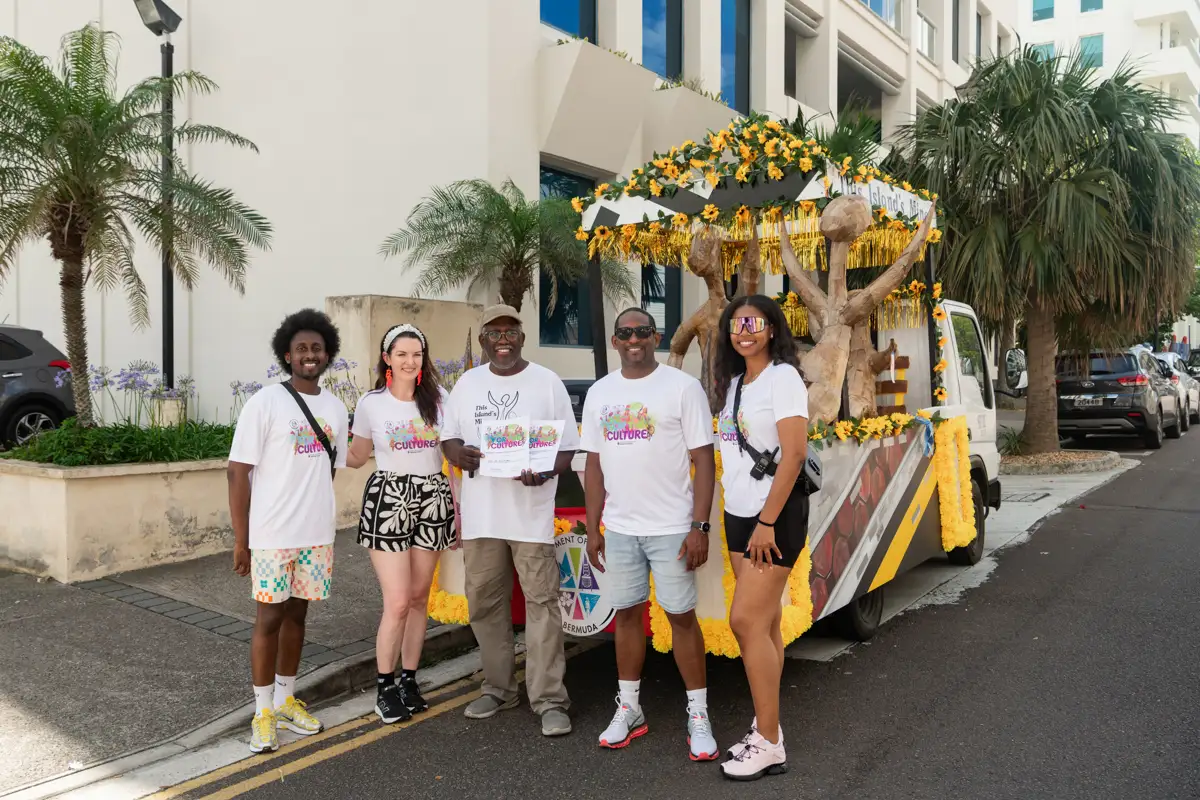
Minister’s Award for Most Original Float (Open for all 3 float categories)- Department of Culture 

Ruth Thomas Award for Best Heritage Float (Open for Natural Heritage float category)- St. David’s Islanders and Native Community

Best Preschool Float- Prospect Preschool

Dr. Kenneth E. Robinson Award for Best Primary School Float- St. David’s Primary School

Mr. George Leon Burt Award for Best Box Cart- Whitney Institute

Dr. Marjorie Bean Award for Best High School Float- CedarBridge Academy Float

Best Individual Float- Stop the Violence Bermuda

L.C.C.A. Award for Best Charity Float- The Portuguese Cultural Association with Vasco da Gama 

Lowdru Robinson Award for Best Government Department- Department of Culture

The Bermudian Excellence Award- CedarBridge Academy Car

Best Historical Float- Bermuda College

Most Community Spirit Float- The Association of Filipinos in Bermuda

Milestone Celebration Award-St. George’s Original Dancerettes 

The Resilience Award – The Association of Filipinos in Bermuda

Best Tribute Award- Department of Sport and Recreation

Most Faithful Award- Bermuda Prayer Center 

Members of the public can rewatch the 2026 Bermuda Day Parade in its entirety here: www.youtube.com/citvbermuda/streams

CedarBridge Academy Float. Photo by Government of Bermuda
Bermuda College Float. Photo by Government of Bermuda
Department of Culture Float. Photo by Government of Bermuda
Department of Sport and Recreation Float. Photo by Government of Bermuda