Monday, November 2, 2026
Home Blog Page 325

Iran seizes two container ships attempting to leave Gulf

Iran’s semi-official Tasnim news agency reported the seizures and added its Revolutionary Guard Corps Navy had warned that any disruption to order and safety in the strait would be considered a “red line.”

International News via Reuters:

Iran said it had captured two container ships seeking to exit the Gulf via the Strait of Hormuz on Wednesday after firing on them and another vessel, in its first seizures since its war with the United States and Israel began in February. 

Iran’s semi-official Tasnim news agency reported the seizures and added its Revolutionary Guard Corps Navy had warned that any disruption to order and safety in the strait would be considered a “red line.”

The seizure of one of the ships, the Panama-flagged MSC Francesca, was confirmed by Montenegro’s minister of maritime affairs, who said four Montenegrin seafarers were on board and that they and the rest of the crew were safe. 

“Negotiations between the shipping company and the Iranian side are ongoing, and the relevant state authorities are in constant contact with the crew,” the minister, Filip Radulovic, said on X. 

SHIPS FIRED UPON

The IRGC accused the MSC Francesca and the Liberia-flagged Epaminondas of operating without required permits and tampering with their navigation systems. 

The Greek-operated Epaminondas had reported being fired upon about 20 nautical miles northwest of Oman. It said it had sustained damage to its bridge after being hit by gunfire and rocket-propelled grenades from an IRGC gunboat, according to the United Kingdom Maritime Trade Operations and maritime security sources. 

Greek operator Technomar Shipping Inc confirmed the attack in a statement and said that its crew were safe.

Epaminondas has a crew of 21 members made up of Ukrainians and Filipinos, according to the Greek coast guard, which could not confirm the vessel’s seizure. Technomar has not confirmed the seizure either. 

“Our priority remains the safety and well-being of our crew as we work with all relevant stakeholders to ensure their continued safety,” the operator said. 

Maritime security sources said that there were three people onboard the gunboat, adding the master of the ship said no radio contact was made prior to the attack and the vessel had received earlier permission to transit the strait.

MSC Francesca was hit by gunfire about eight nautical miles west of Iran, but it was not damaged and its crew were safe, according to the UKMTO and the sources.

Operator MSC, the world’s biggest container shipping group, did not immediately respond to a Reuters request for comment.

According to three sources, the Epaminondas is also on charter to MSC.A third, Liberia-flagged container ship, Euphoria, was fired upon in the same area but was not damaged and had resumed sailing, later reaching Fujairah in the United Arab Emirates, the sources said. 

The attacks occurred while the three ships, some switching their navigation systems off, attempted to exit the Strait of Hormuz in a row in the early morning hours, they added. The seizures were the first since 2024, when Iran had captured the container ship MSC Aries in Hormuz. 

There was no immediate information about what, if any, cargo the ships were carrying.

OIL BOUNCES HIGHER

Oil prices reversed course to head higher after the incidents.”The Iran war and strait closing are unprecedented and there is no line of sight on a final outcome and timing, creating the potential for more headline noise and volatility,” Jonathan Chappell, senior managing director at investment bank Evercore, wrote in a note. 

Tehran imposed restrictions on ships using the strait chokepoint at the southern end of the Gulf following U.S. and Israeli bombing attacks on Iran on February 28, bringing traffic to a virtual standstill.

Iranian shipping remained largely unfettered, however, empowered in part by a one-month U.S. sanctions waiver issued on March 20 allowing it to export crude oil and oil products.

Washington has since closed down that trade with a U.S. blockade of Iranian ships entering or exiting the Gulf.

The strait usually sees about 130 vessels a day enter and exit the Gulf and handles about 20% of the world’s daily oil and liquefied natural gas supply.

That fell to about nine vessels per day after the war began, rising to about 20 during a brief reopening announced and then revoked by Iran last week, according to data provider AXS Marine.

“The latest seizures make clear, even an ‘open’ Strait of Hormuz is not a safe Strait of Hormuz for seafarers, ships and cargo,” said Peter Sand, chief analyst at ocean and air freight intelligence platform Xeneta. 

Reporting by Jonathan Saul in London, Yannis Souliotis and Renee Maltezou in Athens, Nayera Abdallah and Jana Choukeir in Dubai, Aleksandar Vasovic in Belgrade; Editing by Toby Chopra, Jason Neely, William Maclean, Rod Nickel
Gov’t doubles down on marine protection plan

Officials defend 20% MPA target, stressing balance between fisheries and ocean health

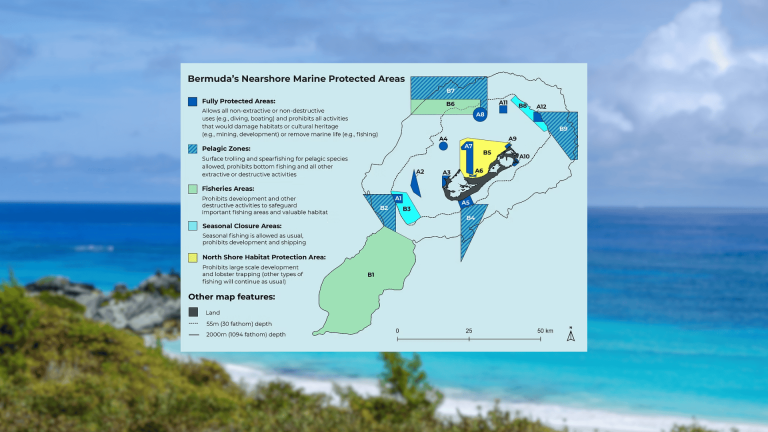
Areas proposed for full protection in the nearshore MPA network (BOPP).

The Government has reaffirmed its commitment to protecting the future of Bermuda’s fisheries and the marine environment that sustains them.

In 2025, the Government made a commitment that it would work in good faith toward an agreement with the Fishermen’s Association of Bermuda (FAB) before proceeding with any new Marine Protected Areas (MPAs), and that is exactly what has been sought.

A Government spokesperson said: “Since then, the Ministry, along with the team at the Department of Environment and Natural Resources (DENR), has met regularly with representatives of the fishing community, listened carefully to their concerns, and worked hard to shape a proposed Memorandum of Understanding (MoU) that responds to their needs as far as reasonably possible.

“This work has been undertaken because the Government values Bermuda’s fishers, respects their knowledge and traditions, and recognises the important role they play in Bermuda’seconomy, culture, and food security as stewards of the ocean.”

The spokesperson added: “At the same time, there is a responsibility to the wider public and to all stakeholders who depend on a healthy ocean. Bermuda’s reefs are not only central to marine life and fisheries, but they also provide enormous value to the country, with formal research showing that their total economic value is estimated at an average of $722 million (USD) per year, with a range of $487.7 million to $1.1 billion per year, as of 2010.

“That value includes tourism ($405m), coastal protection ($266m), recreation ($36.5m), and both commercial and recreational reef-associated fisheries ($4.9m).”

The Government’s aim has always been to find a balanced and practical way forward: one that protects Bermuda’s marine environment for future generations, supports the long-term health of Bermuda’s fisheries, and avoids unnecessary disruption to the current fishing community wherever possible.

This is why, in 2019, the Government committed to fully-protect 20% of Bermuda’s waters.

The design for Bermuda’s proposed MPA network was created following global science and best practices, tailored to Bermuda’s unique ocean environment, and reflects the needs of the community, with over 2,000 local ocean users contributing to the process.

No other stakeholder group has had more influence in shaping the design of the proposed MPA network than the fishing community.

Less than 0.1% of the proposed fully-protected areas fall within the waters where shallow-water fishing occurs, as the full 20% is distributed across Bermuda’s Exclusive Economic Zone, being the waters that fall within Bermuda’s remit. Within the Bermuda Reef Platform, where fishing takes place, 90.4 percent remains open and accessible for fishing.

Fishing for pelagic species in the deeper waters around the Platform and Banks remains 100% open.

In addition, 22.1% of the nearshore is set aside as ‘Fisheries Areas’ specifically designed to safeguard fishing grounds, ensuring the ability to fish in key banks and other valued fishing grounds while limiting development and potentially harmful activities.

In 2024, 196 nations agreed that 30% ocean protection by 2030 is the minimum to keep ecosystems healthy and productive. Research demonstrates that full protection is the most beneficial approach to support ecosystem recovery and resilience to climate change, as it provides a ‘savings account’ for ocean areas to restore without extraction.

The spokesperson also noted: “Considering the fishing community, the Government of Bermuda set its target at 20%, already 10% below the global standard. To reduce this any further would place the entire plan to future-proof Bermuda’s fisheries and protect Bermuda’s waters for other use in jeopardy and would amount to doing nothing at all.

“Agreement remains the Government’s preference, and collaboration remains the Government’s approach. But it must also be ensured that Bermuda moves forward in a way that is fair, science-based, and in the best long-term interests of the whole country.”

Media release supplied by the Government of Bermuda.

Google puts AI agents at heart of its enterprise money-making push

Other top AI companies including OpenAI and Anthropic have aggressively shifted resources to business customers in recent months

International News via Reuters:

Alphabet CEO Sundar Pichai is deepening a push into enterprise software, signaling to investors at Google’s annual cloud conference that AI agents — human-like digital assistants — are a linchpin of its strategy to monetize artificial intelligence.

At the three-day conference in Las Vegas that starts Wednesday, Pichai and key Google executives will seek to position the company’s AI tools as production-ready infrastructure for enterprise customers who are emerging as the industry’s most reliable revenue stream.

Other top AI companies including OpenAI and Anthropic have aggressively shifted resources to business customers in recent months.

Mountain View, California-based Google announced on Wednesday that it was unifying a set of AI products under the name “Gemini Enterprise.” Most notably, this involves rebranding and bulking up Vertex AI, a tool that allows cloud customers to select from a variety of AI models to use for business purposes.

Google also announced a set of new governance and security features for AI agents. Agents are powerful digital assistants that can plan, decide, and act autonomously, a fast-growing field that has sparked worries over safety, reliability and oversight.

“There’s definitely a strategic shift as the models become much more sophisticated,” Google Cloud CEO Thomas Kurian told Reuters in an interview. The primary use case of Vertex AI recently shifted from “old-style machine learning” to a sudden explosion in users building their own custom AI agents, Kurian said.

Google is seeking to outflank both its traditional cloud rivals and AI upstarts as pressure mounts to prove returns on massive generative AI spending.

Google Cloud, once seen as a laggard to rivals such as Amazon and Microsoft, has gained traction with enterprise customers, powered by massive bets on AI and years of heavy investment in data centers, custom chips, and networking gear.

At GE Appliances, that shift is already tangible. Marcia Brey, a senior executive and Google customer, told Reuters that Google’s suite of tools and the enterprise data already stored in Google Cloud allowed her logistics and distribution team to deploy AI faster compared with other products the company had tested.

NEW GOOGLE CHIPS

The company unveiled two new custom tensor processing units (TPUs) on Wednesday, called the TPU 8t and 8i. 

“Both have been sort of architected and designed end to end for (what’s) called the age of agents, and sort of the unique requirements of agent-based solutions and applications,” Google’s Vice President and General Manager of Compute and AI Infrastructure Mark Lohmeyer said in an interview with Reuters.

Google designed the TPU 8t for training the large language models that underpin chatbots like Anthropic’s Claude. Google sets up the training chips in pods of 9,600 chips that are stitched together and can link together to scale to 134,000 chips, the company said. Combined with other Google technology the company said it can string together 1 million chips for large training needs.

Google’s TPU 8i is tuned for the type of computing necessary to generate instant responses from AI agents, a process known as inference. The company boosted memory on the chip itself to help achieve the improved performance. Google said it delivers 80% better performance for speedy inference tasks than the prior generation called Ironwood.

AGENTS OVER CODING

In addition to traditional enterprise providers and other hyperscalers, a new class of competitors is quickly emerging in enterprise AI: model providers.

So far, coding assistants and plug-ins that connect AI models to existing enterprise software have emerged as lucrative channels for AI revenue and payback on their heavy investments.

After early success powered by the raw strength of their models, OpenAI and Anthropic are now pushing downstream, marshalling resources into applications that utilize those models to perform specialized tasks, including agent-building tools.

But while rivals are pushing hard on their coding products, Google, by contrast, kept coding largely out of the spotlight at its cloud conference. Kurian instead cast the AI battleground as one defined by agents, governance and enterprise deployment, saying that some coding announcements were being held back for its I/O developer conference in May.

“Some people are using the models to write code. They can use Gemini and also other tools like Claude,” he said. “But in other cases, we have unique things. There’s capability in the platform that nobody else offers.”

The long-term bet to build out a vast suite of in-house offerings, from models to chips, rather than relying on third-party vendors has given Google an edge over other large cloud providers.

This has helped Google to grow its overall cloud market share to 14% at the end of 2025, though it still trails rivals Amazon and Microsoft, according to data from Synergy Research.

Reporting by Kenrick Cai; additional reporting by Max A. Cherney; Editing by Sayantani Ghosh, Shri Navaratnam and Hugh Lawson

Detours at Dutton Avenue due to sewage spill

The Minister of Public Works and Environment advised that crews are on site to tackle the clean-up

Full statement from the Ministry of Public Works and Environment:

The Ministry of Public Works and Environment advises the public that a sewage spill caused by a sewer main blockage has occurred on Dutton Avenue, Pembroke, near the entrance to Marsh Folly Road.

Response crews are on site carrying out emergency clean-up operations. The affected area has been cordoned off by police, and traffic controls are in place.

Motorists are advised to avoid the area for the rest of the afternoon and use alternate routes where possible to allow crews to complete the clean-up safely and efficiently.

The Ministry thanks the public for its patience and cooperation.

In Mexico, flagship Mayan tourist train leaves trail of broken pledges

Mexico’s Mayan Train, an approximately 1,500-km (1,000-mile) rail project, was meant to bring development to the country’s impoverished south through improved infrastructure and increased tourism

International News via Reuters:

Deep in Mexico’s Maya jungle, brilliant white lights blaze improbably in the wilderness: a maintenance depot for a flagship multi-billion-dollar train line.

But just beyond the perimeter fence an off-grid village lies in darkness.

Mexico’s Mayan Train, an approximately 1,500-km (1,000-mile) rail project, was meant to bring development to the country’s impoverished south through improved infrastructure and increased tourism.

But, two years after it was inaugurated, it is struggling. Ticket sales cover only a fraction of operating costs and hotels built along the route sit mostly empty.

Meanwhile, despite government promises, the local communities near the line say they have seen little benefit. A Reuters review of census data and interviews with dozens of residents in towns along the track found that poverty remains entrenched and well-paying jobs hard to find.

In Vida y Esperanza – “Life and Hope” in English – just steps from a railway maintenance depot, residents had hoped the train would bring change. 

“It’s not like we’re asking for much,” said Mary Sandra Peraza, a 30-year-old mother of four.

Power lines installed for the train run almost directly above her house. But she depends on a rented solar panel and generator for her family’s energy needs.

“There’s no real benefit for us,” she said.

Before dawn, Peraza cooks breakfast on a propane hot plate in a small outdoor kitchen. The village’s lone primary school sits a stone’s throw from the depot but has no grid electricity for fans, computers or even stable lighting.

Its teacher, Lidia Patricia Chan Us – known by her 35 students as “Maestra Pati” – has spent years trying to get power connected.

Authorities have told her electricity cannot be installed until the land beneath the school has formal titles. The red tape issue is a common one for rural communal plots like this, but she had hoped that might change with the arrival of a mega project that the government had vowed would spur development and progress.

“At the beginning, when the project came along, we were happy about it,” Chan Us said. Some residents sold food to construction workers, which she said was a benefit to the community. “But when the construction ended, just as quickly as it arrived, it was gone.”

In the state of Quintana Roo, where Vida y Esperanza is located, the share of homes recorded as having electricity actually fell slightly during the period the railway line was being constructed, according to official data, even as new substations were built to power the line.

Mexico’s public education ministry and its defense ministry, which oversees the operation of the train via a state company, did not respond to requests for comment.

In response to a question about this story after it was published, Mexican President Claudia Sheinbaum defended the line as a success. At her regular morning press conference on Wednesday, she said the project had helped regional development, but added “it’s not something that happens overnight.”

MAYA HAVE LONG LIVED IN POVERTY

Former President Andres Manuel Lopez Obrador promoted the Mayan Train, a loop route connecting cities and archaeological sites through the Yucatan Peninsula, as a way to bring development to Indigenous Maya communities and spread tourism beyond beach resorts like Cancun.

But that development is yet to materialize, government data shows.  

While federal spending on the Mayan Train triggered a historic 13.2% spike in economic growth in Quintana Roo in 2023, that proved to be a temporary construction-related boost. The state plummeted into a 9.7% contraction in the first nine months of 2025, according to the latest data from statistics agency INEGI. 

Quintana Roo did cut unemployment and expanded formal hiring, but about 60% of workers in the Yucatan remain in informal jobs without legal or social security protections.

Historically marginalized, Maya populations in Mexico’s southeast have long faced high poverty rates and limited access to services.

While governments over decades have promised that development would bring opportunity, many community activists say instead that their forests have been fragmented, communal lands eroded and traditions strained.

Legal challenges to the train from environmental groups and Indigenous communities ultimately failed as the government pushed the project forward under national security exemptions.

For many Maya, the land over which it runs is their sacred inheritance, central to their identity and linking them to their ancestors.

“I feel outraged by the way they behaved, because they didn’t take us into account,” said Eliseo Ek, 45, an Indigenous activist from the Quintana Roo community of Nicolas Bravo.

EMPTY WORDS, EMPTY TAPS

In Xpujil, a town close to the train line and near the Calakmul Biosphere Reserve in Campeche state, Nicolas Moreno Jimenez, a 50-year-old beekeeper and farmer, turns a tap inside his modest concrete home. Nothing comes out.

Lopez Obrador promised that the town’s chronic water shortages would be addressed when he inaugurated the Adolfo Lopez Mateos-Xpujil aqueduct in January 2024.

“How do we build a major project like the Mayan Train and not bring in water?” Lopez Obrador said at the event.

But, Moreno said, the taps are still dry.

“They were empty words,” Moreno said about the former president’s promise.

Each week, he brings in water by car from another community so his son, a university student, can bathe, wash dishes and flush the toilet.

Around 70% of the population of Campeche have access to running water, data shows.

EMPTY SEATS, EMPTY ROOMS

Meanwhile, the train itself has struggled to attract the hoped-for interest.

Imagined as a seamless rail link between Cancun and other top tourist locations, legal challenges, environmental rerouting and land constraints pushed key segments inland and left many stations far from city centers and airports, making it a less practical option for visitors.

Reuters visited three stations in November 2025, each largely empty. Fewer than 40 of 230 seats were occupied on a weekday afternoon trip between Bacalar and Chetumal.

Lopez Obrador projected the train would transport 3 million people a year once finished, a figure since slashed to 1.2 million. At the same time, the project’s budget has ballooned from $7 billion to more than $25 billion, with revenue last year covering less than 13% of operating costs.

The train route has also spawned a line of six Tren Maya hotels. One in the Calakmul reserve, surrounded by jungle, features two pools and modern amenities. It was only about 20% full one night in November, according to a reception worker.

Government data reviewed by Reuters shows those properties averaged monthly occupancy rates between 5% and 24% most of last year.

The defense ministry agency that runs the hotels did not reply to a request for comment.

Sheinbaum has pushed back against assertions of problems with the train. She has regularly showcased tourist package offerings in her press conferences and suggested that the railway line could also be used for freight.

For Moreno, the hotels are a particularly painful blow.

His family was displaced decades ago when the government created the Calakmul reserve, a UNESCO World Heritage site intended to protect biodiversity and ruins of the once mighty Mayan empire.

“We had been there since 1980,” said Moreno. “They removed us in 1993. And now they build hotels where we could not even stay.”

“In the press conferences they say the poor come first,” Moreno added. “But they take away our rights.”

Reporting by Cassandra Garrison; Additonal reporting by Daniel Becerril and Paola Chiomante; Editing by Rosalba O’Brien and Daniel Wallis

Investors urge UK audit watchdog to scrutinize HSBC’s climate accounting

Investors said they also lacked visibility on how HSBC’s auditor PwC had verified the bank’s accounting

International News via Reuters:

A group of institutional investors has asked Britain’s accounting regulator to review HSBC’s 2025 accounts and audit to gauge whether the bank is properly assessing the material risks posed by climate change.

Investors said they also lacked visibility on how HSBC’s auditor PwC had verified the bank’s accounting, a letter to the Financial Reporting Council, copied to the bank and the Prudential Regulation Authority and seen by Reuters showed.

“In light of the ongoing lack of disclosures by HSBC and PwC on matters we perceive to be material to investors’ understanding of the bank’s capital resilience, we are writing to ask the FRC to review HSBC’s accounts and audit to determine whether they meet the required standard,” the letter said.

Signatories included Sarasin & Partners, workplace pension investor NEST, Merseyside Pension Fund and asset managers Lombard Odier Investment Management and Edentree Investment Management.

An FRC spokesperson confirmed that the letter had been received but said the watchdog was unable to comment further. PwC declined to comment and HSBC did not immediately respond to a request for comment.

Investors, accounting and finance experts have long argued that some companies are not disclosing the full risks associated with climate change. 

HSBC’s last three financial statements concluded it faces no major hit in the short-to-medium term, despite acknowledging uncertainty about the impact of climate change.

But given the bank’s exposure to physical risks such as floods and wildfires, and transition risks such as changing regulations, investors said they were concerned this might be “excessively optimistic”.

The investors said they had engaged with the bank’s audit committee chair, chief comptroller and auditor since 2023 but had seen “little evidence” of progress.

In talks with the bank during 2025, the group said it had asked the board to review how it assesses climate risks, reflect them in critical accounting assumptions and publish a sensitivity analysis based on more severe climate impacts.

“At a time of rising climate instability and accelerating decarbonisation in key industries, a failure to account for probable losses or liabilities could put investor capital at risk,” the letter said. 

The group also said HSBC Chairman Brendan Nelson’s dual position as chair of the audit committee posed a potential conflict of interest and said it would welcome a thematic review of how financial institutions account for climate change.

Reporting by Simon Jessop and Kirstin Ridley; Editing by Andrea Ricci

Oil prices jump $3 after EIA shows drop in US fuel stocks, reports gunfire hits container ships in Hormuz

Brent crude futures were up $3.32, or 3.37%, at $101.80 a barrel at 12:50 p.m. EDT (1650 GMT)

International News via Reuters:

Oil prices jumped by more than $3 on Wednesday after a surprise gasoline and distillate stock draw in the U.S., and prices got a further boost from reports of gunfire attacks on at least three container ships in the Strait of Hormuz and a lack of progress in peace talks between the U.S. and Iran. 

Brent crude futures were up $3.32, or 3.37%, at $101.80 a barrel at 12:50 p.m. EDT (1650 GMT). West Texas Intermediate futures were up $3.61, or 4.03%, to $93.28. Both benchmarks climbed about 3% on Tuesday.

At the session high, U.S. crude futures were up by more than $4 a barrel. 

U.S. crude stocks rose while gasoline and distillate inventories posted surprise draws in the week ended April 17, the Energy Information Administration said. [EIA/S]

Crude inventories rose by 1.9 million barrels to 465.7 million barrels, while U.S. gasoline stocks fell by 4.6 million barrels to 228.4 million barrels compared with analysts’ expectations in a Reuters poll for a 1.5-million-barrel draw.​

Distillate stockpiles dropped by 3.4 million barrels in the week to 108.1 million barrels, versus expectations for a 2.5-million-barrel drop, the EIA data showed.

Elsewhere, at least three container ships were hit by gunfire in the Strait of Hormuz on Wednesday. Iran’s Revolutionary Guards Navy seized two vessels for what it described as maritime violations and transferred them to Iranian shores, the semi-official Tasnim news agency reported.

Iran and the U.S. have imposed restrictions on ships using the strait, which until the war began at the end of February had carried about 20% of global oil and liquefied natural gas supplies. 

Earlier, U.S. President Donald Trump said he would indefinitely extend the ceasefire with Iran, hours before it was due to expire. Neither side showed up for peace talks in Pakistan.

The ceasefire announcement appeared to be unilateral. It was not immediately clear whether Iran, or U.S. ally Israel, would agree to extend the truce, which began two weeks ago.

Iran’s ​parliament speaker and ​top negotiator Mohammad Baqer Qalibaf said on Wednesday that a complete ceasefire only made sense if it was not violated by the U.S. blockade of Iranian ports.

Qalibaf said in a post on X that the reopening of the Strait of Hormuz was impossible with such a “flagrant breach of the ceasefire”.

RUSSIA TO DIVERT SOME SUPPLIES

Elsewhere, Russia will divert oil supplies from Kazakhstan previously intended for Germany via the Druzhba pipeline to other routes starting from May 1, Deputy Prime Minister Alexander Novak said on Wednesday.

Novak said the logistical change was due to “technical possibilities” and had been agreed with Kazakhstan.

U.S. Treasury Secretary Scott Bessent said on Wednesday that he extended sanctions relief on Russian seaborne oil for 30 days because of requests from countries that are the most vulnerable to oil shortages from the closed Strait of Hormuz.

The European Union is considering requiring countries to hold stockpiles of jet fuel, and potentially redistribute it based on regional needs and shortages, Europe’s energy policy chief told Reuters on Wednesday, as concerns mount over possible shortages.

Additional reporting by Shadia Nasralla, Stephanie Kelly and Yuka Obayashi. Editing by Barbara Lewis, Mark Potter, Nick Zieminski and David Gregorio

Four arrested in $60 million UK home insulation fraud probe

The SFO also launched a public appeal for information about three companies, called Warmfront, JJ Crump and South Coast Insulation Services which are alleged to have submitted claims with little or no work done between 2022 and 2024

International News via Reuters:

Four people have been arrested in Britain and six addresses searched over an alleged 44 million pound-plus ($60 million) fraud involving a government energy efficiency scheme designed to tackle fuel poverty, the Serious Fraud Office said on Wednesday.

The SFO also launched a public appeal for information about three companies, called Warmfront, JJ Crump and South Coast Insulation Services, which are alleged to have submitted claims with little or no work done between 2022 and 2024.

“This scheme was designed to reduce carbon emissions, help households cut costs and stay warm – instead in many cases we suspect little or no work was done,” said Graham McNulty, the SFO interim director, urging people such as installers to speak up.

“Our door is open and coming forward is the right thing to do,” he said.

Warmfront, based in Cannock, central England, was sold in 2024 and now trades under new management not connected to this investigation, the SFO said. South Coast Insulation is permanently closed, its website shows. Sheffield-based JJ Crump did not immediately respond to a request for comment.

The case, part of a UK-wide campaign to tackle fraud codenamed Operation Henhouse, centres on the government’s Energy Company Obligation 4 (ECO4) scheme.

Under the Energy Company Obligation, energy suppliers have to help households reduce energy consumption and lower heating costs. Its latest version, ECO4, began in July 2022.

($1 = 0.7396 pounds)

Reporting by Kirstin Ridley in London and Raechel Thankam Job in Bengaluru; Editing by Shinjini Ganguli and Toby Chopra

Kempe climbs leaderboard as light winds test resolve in Hyères

The second day of racing at French Olympic Week continued to test the patience and tactical prowess of the world’s elite sailors as light wind conditions dominated the second event of the Sailing Grand Slam series.

On a day defined by marginal gains and high-stakes maneuvering, the Bermudian contingent experienced a shift in fortunes across the ILCA fleets. The most significant movement came from Sebastian Kempe, who produced a masterclass in consistency to ignite his campaign. Starting the day buried in the lower half of the standings, Kempe leaped a remarkable 58 places to end the session in 41st overall. A disciplined 19th-place finish provided the platform for a late-afternoon surge, where he crossed the line in 13th to bring his net points total to 43.

His compatriot Campbell Patton remains the highest-placed Bermudian in the ILCA 7 fleet, maintaining a steady hold on 33rd position. Patton demonstrated his ability to read the shifting Mediterranean breezes, improving as the afternoon progressed. After an opening 16th-place finish, he produced a clinical display in the second race of the day to finish 9th, a result that keeps him firmly in the hunt for a top-thirty berth with 37 net points.

In the ILCA 6 fleet, Adriana Penruddocke endured a more frustrating outing as the shifty conditions proved difficult to navigate. Despite starting the day with a solid 13th-place finish—her best result of the regatta so far—Penruddocke was unable to maintain momentum. Finishes of 26th and 25th saw her slip ten places down the leaderboard to 47th overall. With 76 net points on the board, the Olympian will be looking for a return to form as the fleet prepares for the midway point of the competition.

Double delight for Maxwell Smith as personal bests fall at Winthrop

Bermudian standout Massassi Maxwell Smith produced a jumping masterclass this weekend, securing two top-five finishes and a pair of personal bests at the 2026 Winthrop Invitational and Multis.

Representing Coker University at the Irwin Belk Track, Maxwell Smith showcased her technical evolution across both horizontal jump events. In the Women’s Long Jump, she soared to a career-best distance of 5.33m (17 feet 6 inches), a performance that earned her a credible fifth place in a highly competitive field.

However, the senior’s momentum did not stop there. Transitioning to the Women’s Triple Jump, Maxwell Smith eclipsed her previous career high once again, recording a leap of 10.68m (35 feet 0.5 inches). The distance saw her climb the leaderboard to finish in fourth place, narrowly missing out on a podium spot.

The results mark a significant step forward for Maxwell Smith, who has been consistently chipping away at her lifetime bests throughout the 2025-26 outdoor season. Her dual top-five finishes provided a vital points haul for the Coker University squad as they continue their preparations for the upcoming South Atlantic Conference (SAC) Championships.

With the championship season looming, Maxwell Smith’s current form suggests she will be a key contender for silverware as she looks to translate these invitational successes into conference glory.