
Ben Smith has become the One Bermuda Alliance Leader following a whirlwind 48 hours in which Robert King was ousted by a no confidence vote
Profile: New opposition leader Ben Smith

Ben Smith was sworn in this Thursday by Governor Andrew Murdoch at Los Zorros as new opposition leader

Who is the newly-minted leader of the Opposition?
Ben Smith has officially been sworn-in, after serving as the OBA’s deputy leader for several years.
Here’s a snapshot of his political career to date.
No confidence vote is a mystery, says King

Robert King doesn’t know why his fellow MPs are seeking his removal as OBA Leader; he says the party sought professional guidance to move forward following his election
Robert King says it’s a mystery to him why his parliamentary colleagues have sought to dethrone him.
Speaking today, he says the vote of no confidence in his leadership came as a surprise.
He cited some tension over an interview he gave to Bermuda Broadcasting during his leadership campaign, along with decisions he made and subsequently changed in his first 30 days as OBA Leader.
However, from that time until Wednesday of this week, he says he cannot identify what would meet the test for a vote of no confidence.
The OBA Caucus is meeting this evening to determine if Mr. King is also out as the party leader.
Nine OBA MPs against Mr. King’s leadership yesterday, with one abstention – prompting Governor Andrew Murdoch to remove Robert King as the constitutional Leader of the Opposition.
The OBA MPs chose the man he previously beat for the leadership – Ben Smith – to take the Opposition Leader’s role.
Robert King remains the party leader until the Caucus, or if it comes to it, the membership, decide otherwise. That may well be determined today, with Ben Smith having the support of his parliamentary colleagues to assume the role of party leader.
Asked about any possible breakdown of relationship between himself and the other OBA MPs, Mr. King said that the party had brought in a professional to help move them forward following his election.
Consultations were apparently held with MPs between the end of last year and January. However, he says there has not been any subsequent feedback session, and he doesn’t know what the findings were.
We also asked Mr. King about the leadership election last September, and whether he had brought in a lot of new members who may have favoured him for leader…
WATCH the interview above…
Big Tech’s $600 billion spending plans exacerbate investors’ AI headache

Shares of Amazon, which had announced a $200 billion capital expenditure outlay, slid 7% on Friday, while Alphabet lost 3% after the company said on Wednesday that capital spending could double this year

International News via Reuters:
A planned $600 billion artificial intelligence spending splurge by big tech firms in 2026 is adding to investor unease as they assess the implications for profitability as well as a potential existential threat to software firms.
Shares of Amazon, which had announced a $200 billion capital expenditure outlay, slid 7% on Friday, while Alphabet lost 3% after the company said on Wednesday that capital spending could double this year. Meta Platforms was down 1.3%.
Other heavyweight technology companies, however, were trading higher: Nvidia rose 7%, Microsoft gained 1% and Tesla was up 4%. The benchmark S&P 500 added 1.6% while the Nasdaq rose 2% although both indexes are set to finish the week lower.
“The market’s viewpoint is that the AI build-out trade, and the way they’ve pulled forward all these earnings for many, many years, we think that’s just got too pricey,” said Andrew Wells, chief investment officer at SanJac Alpha in Houston. “It’s not that the trade is over, but it got too pricey in pulling forward all these potential future revenues and not really pricing in the risk into all that. So it’s a de-risking trade.”
Nvidia CEO Jensen Huang attributed the uptick in spending to “sky-high” demand. Speaking on CNBC’s “Halftime Report”, he called the rise appropriate and sustainable.
Meanwhile, the equities of data analytics firms continued to come under selling pressure on concerns that they face an existential threat from powerful new AI models.
Canada-based Thomson Reuters, which suffered a record one-day plunge earlier this week, was down 0.7%. London-listed RELX’s shares lost 4.6% and notched a 17% tumble in their worst week since 2020.
The S&P 500 software and services index has fallen almost 8% this week and has seen around $1 trillion in market value evaporate since January 28.
“Headlines that would have pushed shares to fresh highs during the peak of AI optimism are now being interpreted far more cautiously by investors,” said Carlota Estragues Lopez, equity strategist at St. James’s Place in London.
“It’s not just return-on-investment that worries investors, but also the risk of narrow market leadership that struggles to broaden beyond a handful of mega-cap names.”
JOLT TO DATA ANALYTICS FIRMS
A selloff in software and data and analytics firms was triggered by a new plug-in from Anthropic’s Claude.
Shares in London Stock Exchange Group clawed back some ground on Friday, but their price was still down almost 8% for the week in a second straight week of sharp losses.
This week’s drawdown in AI-exposed shares has weighed on broader equity markets. Global shares are on track to ease 0.33% for the week.
The rout has been particularly acute in India, where shares of software exporters plunged another 2% on Friday as they ended a week that has seen $22.5 billion in market value losses.
Investor nerves over potential AI‑driven disruption are coinciding with a growing tendency to punish big tech firms for signaling even heavier spending on the technology.
Google parent Alphabet also upped its spending plans on Thursday, sending its shares as much as 8% lower at one point, although they ended the day flat.
“Both Alphabet and Amazon delivered strong underlying business performance, driven by better-than-expected growth in cloud. But that hasn’t been enough to distract markets from their ballooning capital investment plans,” said Aarin Chiekrie, equity analyst, Hargreaves Lansdown.
Reporting by Chibuike Oguh in New York, Lucy Raitano and Dhara Ranasinghe in London, Additional reporting by Aishwarya Jain in Bengaluru; Editing by Amanda Cooper, Alexander Smith, Nick Zieminski and Pooja Desai
US, China opt out of joint declaration on AI use in military
Tensions in relations between the United States and European allies, and uncertainty over how transatlantic ties will look in coming months and years, made some countries hesitant to sign joint agreements
International News via Reuters:
Around a third of countries attending a military AI summit agreed on Thursday to a declaration on how to govern deployment of the technology in warfare, but military heavyweights China and the U.S. opted out.
Tensions in relations between the United States and European allies, and uncertainty over how transatlantic ties will look in coming months and years, made some countries hesitant to sign joint agreements, several attendees and delegates said.
The pledge underscores growing concern among some governments that rapid advances in artificial intelligence could outpace rules around its military use, raising the risk of accidents, miscalculation or unintended escalation.
Governments are facing a “prisoner’s dilemma”, caught between putting responsible restrictions in place and not wanting to limit themselves in comparison with adversaries, said Dutch Defence Minister Ruben Brekelmans.
“Russia and China are moving very fast. That creates urgency to make progress in developing AI. But seeing it going fast also increases the urgency to keep working on its responsible use. The two go hand-in-hand,” he said in comments to Reuters.
Only 35 countries out of 85 attending the Responsible AI in the Military Domain (REAIM) summit in A Coruna, Spain, on signed a commitment to 20 principles on AI on Thursday.
These included affirming human responsibility over AI-powered weapons, encouraging clear chains of command and control, and sharing information on national oversight arrangements “where consistent with national security”.
The document also outlined the importance of risk assessments, robust testing and training and education for personnel operating military AI capabilities.
At two prior military AI summits in The Hague and Seoul in 2023 and 2024 respectively, around 60 nations, excluding China but including the United States, endorsed a modest “blueprint for action” without legal commitment.
While this year’s document was also non-binding, some were still uncomfortable with the idea of endorsing more concrete policies, said Yasmin Afina, a researcher at the U.N. Institute for Disarmament Research, an adviser on the process.
Major signatories on Thursday included Canada, Germany, France, Britain, the Netherlands, South Korea and Ukraine.
Reporting by Victoria Waldersee; editing by Aislinn Laing and Mark Heinrich
Storm Leonardo forces evacuations in Spain and Portugal with more rain on the way

State weather agency AEMET warned that another storm, Marta, would hit the peninsula on Saturday, bringing more abundant rainfall

International News via Reuters:
One of Spain’s main rivers was close to bursting its banks on Friday and experts warned of landslides from waterlogged ground that could hold no more rain, as Storm Leonardo blew across the Iberian Peninsula with more storms on their way.
Over 11,000 people have been forced to leave their homes in the southern Andalusia region so far in the wake of a “storm train” of consecutive weather fronts pounding Portugal and Spain with torrential rains and strong winds over the past weeks.
A body was found not far from where a woman was swept away by a river in Malaga province as she tried to rescue her dog, military police said on Friday, adding that they still needed to carry out forensic tests to confirm the identity.
State weather agency AEMET warned that another storm, Marta, would hit the peninsula on Saturday, bringing more abundant rainfall.
Several residential areas near the Guadalquivir River in Cordoba province were evacuated overnight due to the dramatic rise in water levels.
Further rain on Saturday could endanger more homes, with the situation around Jaen and the Guadalquivir area of Cordoba particularly worrisome, Andalusia’s regional leader, Juan Manuel Moreno, said during a press conference on Friday.
“We expect 30 mm (of rain). In other circumstances that would be little water but right now it is a lot as the soil is unable to drain and the rivers and reservoirs are full,” he said.
Over 11,000 people have been evacuated, confirmed Antonio Sanz, head of emergencies in the Andalusian regional government.
Authorities in Cordoba halted pedestrian traffic on the city’s Roman bridge as the Guadalquivir rose up.
LANDSLIDE RISK IN THE GRAZALEMA MOUNTAINS
In Grazalema, a mountain village popular with hikers that has been at the centre of the storm, some 1,500 residents were evacuated as water seeped through the walls of houses and cascaded along steep cobbled streets.
The aquifers in the Grazalema mountains were full and could provoke landslides due to pent-up pressure, Moreno said on SER radio.
The Grazalema mountains are made of permeable rock that dissolves when absorbing large volumes of water, potentially leading to structural collapse, Nahum Mendez-Chazarra, a professor of geology at Valencia University, told Reuters.
“It’s possible these cavities will widen and eventually cause the ground to sink, which will obviously affect any house or road on top,” he said.
PORTUGAL EXTENDS CALAMITY STATE
In southern Portugal, large parts of the town of Alcacer do Sal by the River Sado remained semi-submerged for a third day.
“I’m left with nothing, nothing. I only kept the clothes I had on,” Alcacer resident Rita Morgado told Reuters, adding that more than 1,000 people needed help.
Prime Minister Luis Montenegro said late on Thursday his government had extended a state of calamity in 69 municipalities until mid-February, adding “unprecedented” rainfall and flood risks threatened several regions.
The commander of Portugal’s ANEPC civil protection service, Mario Silvestre, said six rivers – including the Tagus – were at risk of significant flooding.
The Tagus river basin was placed on red alert on Thursday due to the abrupt rise in water flow.
($1 = 0.8482 euros)
Reporting by Paolo Laudani, Emma Pinedo, Sergio Goncalves and Andrei Khalip; Writing by David Latona; Editing by Peter Graff, Toby Chopra and Charlie Devereux
Stocks, bitcoin regain some ground along with precious metals

Oil prices were choppy as investors monitored talks between the United States and Iran and assessed the possibility of a supply-disrupting Middle East conflict
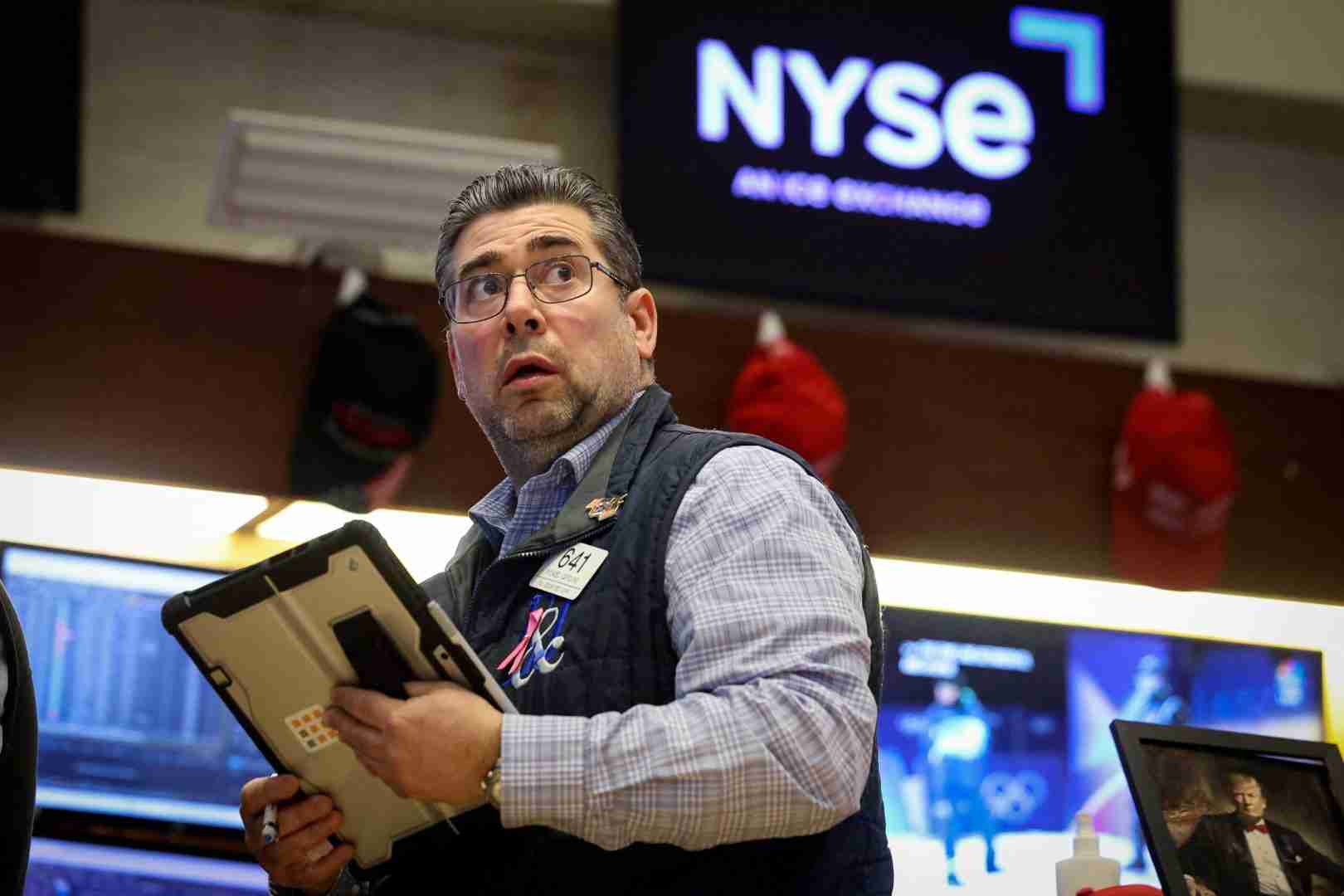
International News via Reuters:
MSCI’s global equities gauge was up more than 1% on Friday after falling in five of the last six sessions, while bitcoin also attempted a comeback from a sharp selloff and spot gold and silver prices attempted to regain some lost ground.
Oil prices were choppy as investors monitored talks between the United States and Iran and assessed the possibility of a supply-disrupting Middle East conflict.
An equities rally on Wall Street boosted the global index as investors crept back into U.S. technology stocks, particularly semiconductors. Tech shares sold off massively in the prior three sessions on concerns around spending and competition disruption related to the artificial intelligence boom.
AMAZON SPENDING PLAN INFLATES AI TOTAL
Amazon.com shares fell sharply after it announced huge spending plans late on Thursday, upping the total for a combined 2026 AI spending spree by Amazon, Microsoft, Alphabet and Meta Platforms to an estimated $600 billion. The sector was also hit by worries about AI disruption in the software and data services sectors.
Regarding the S&P’s bounce on Friday, Robert Pavlik, senior portfolio manager at Dakota Wealth in Fairfield, Connecticut, pointed to technical buying after the benchmark index hit its 100-day moving average on Thursday, adding to some support from bitcoin’s turnaround and investor reconsideration of AI fears.
“The market looks like it was getting a bit overdone to the downside so you’re seeing a rebound in technology and some industrials and financials stocks. It was a healthy selloff,” said Pavlik, also suggesting that investors had recalculated when AI disruption to the software industry would materialize.
“Maybe in the future, but it’s not happening right away and the realization that this is not something that’s happening today brought a little bit cooler heads to the market,” he said.
But gains were mostly concentrated in chipmakers, with the Philadelphia semiconductor index rallying 5.7% after three daily losses in a row. The S&P 500’s software and services index climbed a modest 1.7% after losing more than 17% in the last seven sessions.
On Wall Street at 2:45 p.m. ET (1945 GMT), the Dow Jones Industrial Average rose 1,069.60 points, or 2.19%, to 49,978.32 after briefly breaching the 50,000 milestone for the first time. The S&P 500 rose 113.48 points, or 1.67%, to 6,911.88 and the Nasdaq Composite rose 413.68 points, or 1.84%, to 22,954.27.
MSCI’s gauge of stocks across the globe rose 13.53 points, or 1.32%, to 1,040.77, eying its biggest one-day gain since November. But the index of stocks from 47 countries was still showing a decline for the week.
Earlier, the pan-European STOXX 600 index finished up 0.89% but it fell slightly for the week.
CRYPTO, PRECIOUS BOUNCE
Cryptocurrencies managed to staunch a bruising selloff for now after a wipeout on Thursday, which was part of a larger decline that has knocked $2 trillion in value from the market since October.
Bitcoin gained 11.44% to $70,337.93 after nearing $60,000 on Thursday. Ethereum rose 11.18% to $2,053.26.
“Whether or not this bounce continues is questionable. It’s brought some questions into bitcoin as a store of value and the relative safety that it brings but, when it bounces, you don’t get the margin calls like you would probably be getting when it’s selling off,” said Pavlik.
In the precious metals markets, gold advanced with help from bargain hunting, a slightly weaker dollar and lingering concerns over U.S.-Iran talks in Oman. Silver recovered from a 1-1/2-month low.
Spot gold rose 3.81% to $4,951.46 an ounce while U.S. gold futures rose 2% to $4,958.50 an ounce. Spot silver rose 8.24% to $77.12 an ounce.
SURVEY SHOWS IMPROVEMENT IN U.S. CONSUMER SENTIMENT
In currencies, the safe-haven dollar index was lower as risk assets rebounded. Earlier, the greenback pared some losses after a U.S. survey showed that consumer sentiment improved marginally in early February amid lingering worries about the labor market and the rising cost of living.
The dollar index, which measures the greenback against a basket of currencies including the yen and the euro, fell 0.32% to 97.64, with the euro up 0.36% at $1.1817.
Sterling strengthened 0.67% to $1.3615.
But against the Japanese yen, the dollar strengthened 0.05% to 157.11, with Japanese markets set to come back into focus as investors keep a close eye on Sunday’s election, in which Prime Minister Sanae Takaichi aims to strengthen her majority in parliament.
In U.S. Treasuries, two-year U.S. Treasury yields hit a more than three-month low before turning higher, following a sharp decline on Thursday when unexpectedly weak labor market data raised concerns that the jobs market is worsening faster than thought.
On the U.S. monetary policy front, traders were still betting that the next Fed rate cut would be in June, according to the CME Group’s FedWatch tool.
The 2-year note yield, which typically moves in step with interest rate expectations for the Federal Reserve, rose 1.5 basis points to 3.498%, from 3.483% late on Thursday.
The yield on benchmark U.S. 10-year notes was flat at 4.21% while the 30-year bond yield fell 0.4 basis points to 4.8592%.
In energy markets, oil prices settled slightly higher as traders waited for news on the U.S.-Iran talks. Iran’s top diplomat said the nuclear talks mediated by Oman were off to a good start and set to continue. The remarks could allay concern that failure to reach a deal might nudge the Middle East closer to war.
U.S. crude settled up 0.41%, or 26 cents, at $63.55 a barrel and Brent settled at $68.05 per barrel, up 0.74%, or 50 cents.
Reporting by Sinéad Carew, Sophie Kiderlin, Gregor Stuart Hunter, Rae Wee and Tom Westbrook; Additional reporting by Dhara Ranasinghe; Editing by Jacqueline Wong, Andrew Heavens Gareth Jones, David Holmes and Edmund Klamann
Another round of stormy weather ahead
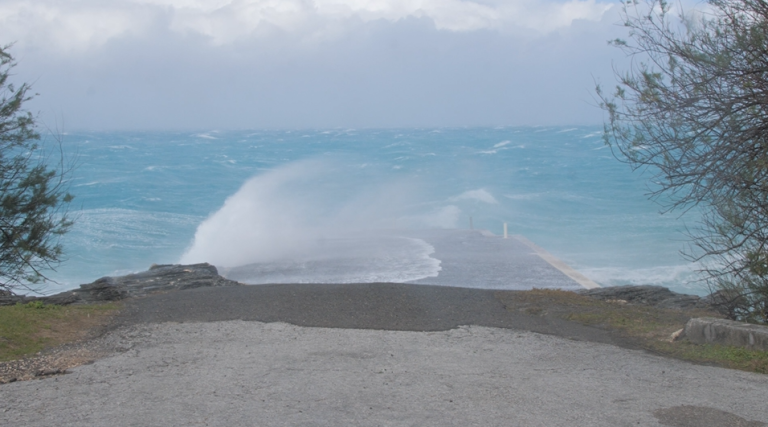
BWS warns of storm-force gusts this weekend
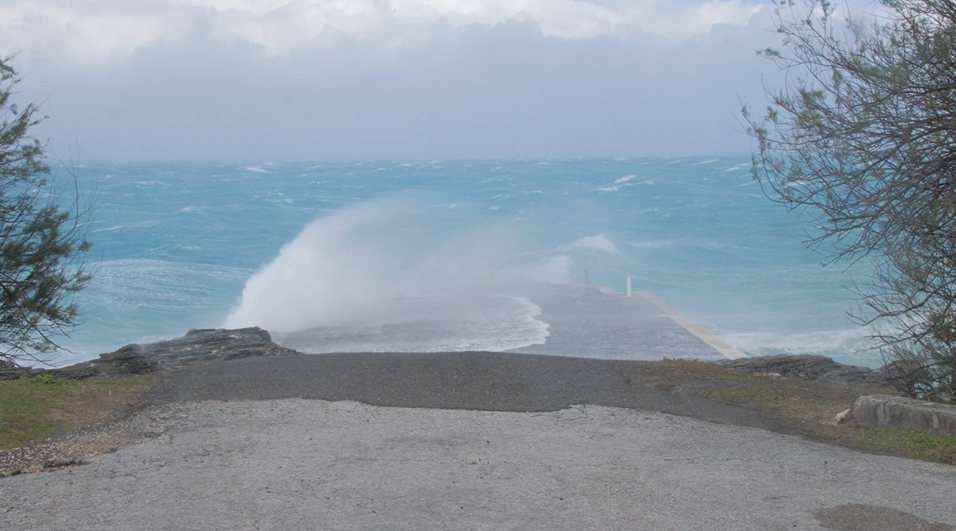
It’s going to be back-to-back weekends of blustery weather … after last weekend’s winter storm, one system is already lashing the island today, with another set to follow tomorrow.
The Bermuda Weather Service has issued both a severe weather watch and a storm warning for Saturday evening through Sunday morning.
BWS forecasters says robust low pressure to the north is bringing continuing gales, storm-force gusts and blustery showers, expected to ease later before conditions ramp up again.
“After a brief reprieve tonight, another low to the north sends further showers, gales and gusts to storm force on Saturday, lingering into Sunday. A severe weather watch has now been issued for sustained winds near 50kts with higher gusts possible for Saturday evening into early Sunday. Increasingly hazardous long period southwesterly swell develops over the weekend.”
The wet and windy conditions have already resulted in pockets of power outages island-wide … affecting, at times, hundreds of BELCO customers.
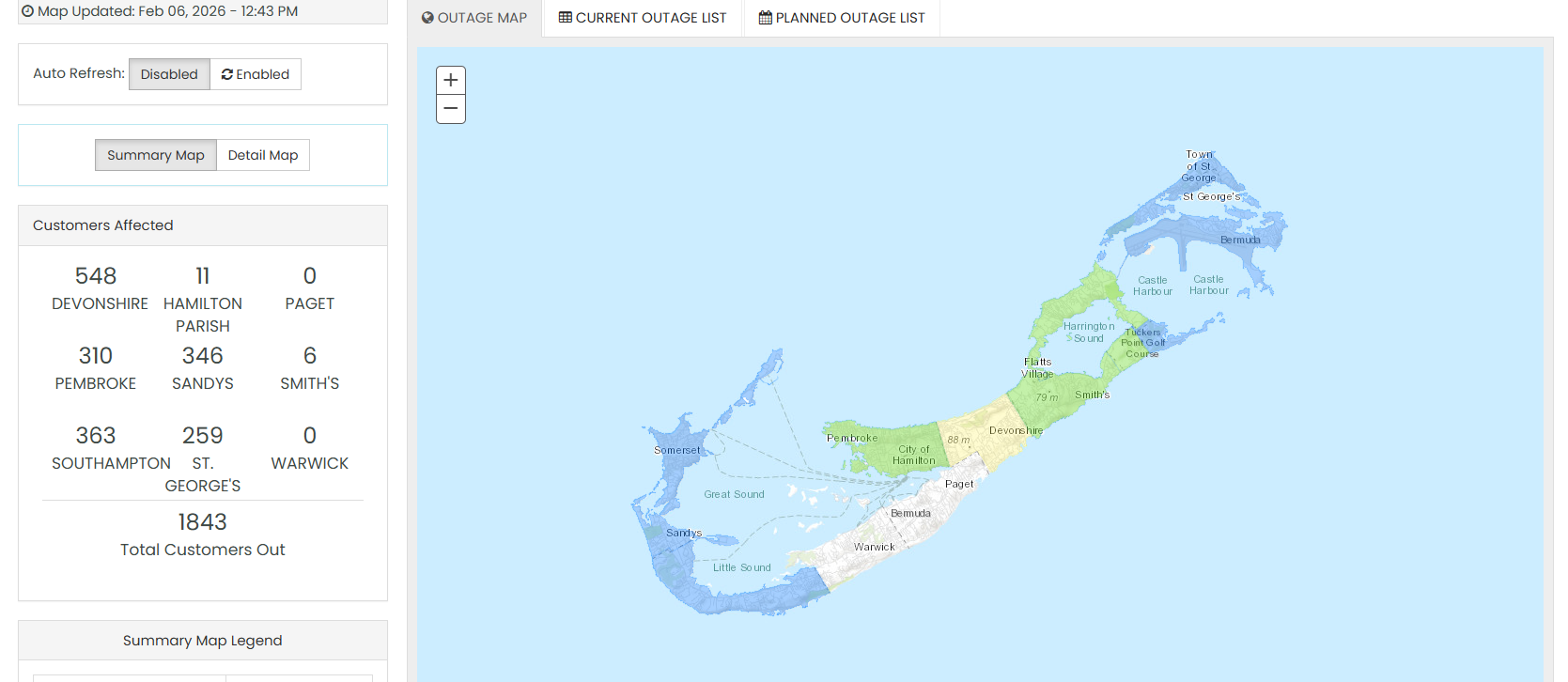
The utility said it has activated its Incident Command Structure, and crews are responding to and restoring power as long as it remains safe to do so.
BELCO adds that its telephone line 955 should be used to report any emergencies, such as pole fires, sparking or downed lines.
Meanwhile, transport has also been disrupted.
All ferry services were suspended today.
A spokesperson for the Department of Marine and Ports Services said routes will be closely monitored to determine when services can resume.
Flights were also affected, with some airlines citing weather as the reason behind delays or cancellations.
Air Canada cancelled its flights to and from the island, listing the reason on its website as “weather conditions at the departure airport, destination airport, or en route.”
BermudAir flights from Newark and Toronto to the island were delayed, with the airline stating to its website: “Due to severe weather conditions expected in Bermuda over the weekend, several of our flights between 6 and 10 February 2026 have been delayed, rescheduled or cancelled.”
Michael Weeks, the Minister of National Security, has urged residents to keep an eye on the forecast and to prepare for unsettled conditions lasting through Sunday.
“As we saw last weekend, severe weather can cause disruptions, so residents and businesses should make sensible plans, secure their property where necessary, and avoid unnecessary risks,” he said. “In particular, I urge motorists to travel with care if they must be on the roads.”
And while the bulk of the impact is expected Saturday evening, the BWS is forecasting blustery showers and gales by late afternoon tomorrow with storm-force gusts lingering into Sunday afternoon, easing later Sunday, then winds of 20 to 30 knots overnight.




Journalist, former judge and lawyer honoured for Black History Month

The Hamilton Princess & Beach Club’s 8th annual Black History Month Celebration Dinner will be held on Friday, February 27th



Full press release from the Hamilton Princess & Beach Club:
The Hamilton Princess & Beach Club is pleased to announce the 2026 honourees for its 8th Annual Black History Month Celebration Dinner: Bermudians former Justice Charles-Etta Simmons, NBC Boston Evening News Anchor Glenn Jones, and insurance and reinsurance legal practitioner Sophia Greaves.
The celebratory cocktail reception and dinner will take place at 6:30 p.m. on Friday, February 27th, in the hotel’s Harbourview Ballroom. The Black History Month Celebration has become a signature annual event at the Hamilton Princess & Beach Club, drawing consistent community support year after year.
Tim Morrison, General Manager of the Hamilton Princess & Beach Club, said: “We are honoured to recognize former Justice Charles-Etta Simmons, Glenn Jones, and Sophia Greaves as the 2026 honourees.
“This celebration is a valued annual tradition for the hotel, bringing together returning attendees and new guests alike to acknowledge
the remarkable contributions of these individuals. The evening highlights not only their personal and professional journeys, but also the importance of recognizing members of our community during their lifetimes.”
During the evening, three presenters will share brief reflections on the honourees’ lives and achievements, followed by appearances from former Justice Simmons, Glenn Jones, and Sophia Greaves before an audience of family, friends, and community members. A specially curated four-course menu has been created in collaboration with the honourees and the hotel’s Bermudian Sous Chef, Richard Zuill.
Tickets are available for the Celebration Dinner via https://www.ptix.bm/Show/8684. A portion of the proceeds from the event, will go to the honourees’ charities of choice: Packwood Home (registered charity #10), the Lady Cubitt Compassionate Association (LCCA registered charity #87) and The Flora Fund (registered with the Bermuda Community Foundation, charity #948)
Dollar retreats from two-week high, yen set for weekly loss

The yen remains on track for its worst weekly performance against the dollar since October and has given up most of January’s hefty gains, as traders brace for Sunday’s national election

International News via Reuters:
The dollar fell from two-week highs on Friday, giving up some of its safe-haven gains as risk assets rebounded from a deep rout driven by concerns over a surge in AI-related spending this year.
Still, the buck remained on track for a weekly gain, and pared some earlier losses against the Japanese yen, after U.S. data showed improving consumer sentiment this month, even as concerns about the labor market and rising costs of living linger.
The yen remains on track for its worst weekly performance against the dollar since October and has given up most of January’s hefty gains, as traders brace for Sunday’s national election.
“The dollar has largely moved inversely to risk assets this week, including equities and bitcoin, as well as precious metals such as gold and silver,” said Uto Shinohara, senior investment strategist, Mesirow Currency Management, Chicago. “Today’s reversal in the dollar has coincided with a reversal in those assets.”
Global shares have seen their biggest weekly selloff since November, as investors fret about the massive spending on artificial intelligence as well as the cascading impact of fast-advancing AI tools that could upend various sectors.
The dollar index, which tracks the performance of the U.S. currency against six others, was down 0.3% after earlier hitting a two-week peak. It was still up 0.52% on the week, on pace for its largest weekly rise since early January.
The catalyst for this week’s gain was President Donald Trump’s nomination last Friday of Kevin Warsh, who is not seen as a big advocate of steep rate cuts, as the next Federal Reserve Chair.
Charu Chanana, chief investment strategist at Saxo, said investors were suddenly pricing three shocks at once.
“Big Tech capex scrutiny, AI disruption risk in software beyond productivity hype, and a silver-driven liquidity/margin flush. This looks like a positioning flush where the same crowded exposures are being de-risked across assets.”
Next up for currency traders is the delayed release of the U.S. payrolls report for January, which lands next week. Various measures of labour market strength this week have suggested the world’s largest economy is losing some momentum and traders are now pricing in a higher chance that interest rates will be cut within the first half of this year, rather than in the second.
“Major downward revisions to payrolls next week would add to the pressure to eventually resume rate cuts,” ING economists said in a note.
YEN FINDS FOOTING AHEAD OF ELECTION
The yen was little changed at 156.98 per dollar ahead of Sunday’s vote where a victory for Prime Minister Sanae Takaichi could be on the cards.
The vote has investors on edge because fiscal worries have sparked a stomach-churning selloff in the currency and bond markets, and a further leg lower would likely reverberate globally.
“Since the news was bad in a three-day streak of market selloff, Friday is closing out the week with excitement over the Japanese election that could translate into long-term deterioration for the yen,” said Juan Perez, director of trading, Monex USA in Washington.
The euro was up 0.32% at $1.1813 after the European Central Bank left interest rates unchanged as expected on Thursday and played down the effect of currency fluctuations on its future decisions.
Sterling recouped some of Thursday’s near 1% slide and was up 0.61% at $1.3608 and was headed for its worst weekly drop against the greenback since October 27.
The Bank of England also kept rates on hold on Thursday in an unexpectedly narrow vote and said borrowing costs are likely to fall if an expected drop soon in inflation is sustained.
In the crypto market, bitcoin rose 8.70% to $68,613.05 after hitting its lowest since October 2024 at $60,017. It was still set for a decline of 9% for the week.
Additional reporting by Ankur Banerjee in Singapore; Editing by Emelia Sithole-Matarise and Gareth Jones