The CBI’s monthly order book balance rose to -30 in January from -32 in December
International News via Reuters:
British industrial orders fell again in January but by the smallest amount since September, while expectations for prices shot to an almost three-year high, the Confederation of British Industry said on Wednesday.
The CBI’s monthly order book balance rose to -30 in January from -32 in December. The index level remains well below its long-run average of -14.
The survey’s gauge of expected prices shot up to +29, the highest reading since February 2023 when Britain was still reeling from an energy price shock sparked by Russia’s invasion of Ukraine.
Ben Jones, senior lead economist at the CBI, said conditions for manufacturers remained “extremely tough”.
“At the same time, cost pressures – from rising wages, high energy prices and taxes – are squeezing margins and weighing on competitiveness, pushing firms to plan price rises even as demand remains subdued,” Jones said.
A quarterly question in the survey showed manufacturers became a little more optimistic in the three months to January, with the business situation gauge rising to its highest since July 2024.
The blue-chip FTSE 100 was flat at 22,997.66 points by 1045 GMT, coming off a three-day losing streak
International News via Reuters:
London’s FTSE 100 held steady on Wednesday as weaknesses in banks and industrials amid renewed trade tensions linked to Greenland overshadowed some upbeat earnings.
The blue-chip FTSE 100 was flat at 22,997.66 points by 1045 GMT, coming off a three-day losing streak.
Market sentiment deteriorated this week after U.S. President Donald Trump threatened to introduce escalating tariffs on eight European nations from February 1 unless the United States is allowed to buy Greenland.
Trump arrives in Davos, Switzerland, on Wednesday, where he is likely to escalate his push for acquiring the island despite European protests.
Banks were the biggest drag on the FTSE 100, down 0.9%, while industrial support services and aerospace and defence lost 2.1% and 1.4%, respectively.
Credit data and analytics company Experian maintained its full-year forecast and reported an 8% growth in its third-quarter organic revenue, though its shares dropped 5.2%.
Helping limit losses, London-listed shares Rio Tinto jumped 5% after the Anglo-Australian miner beat expectations for quarterly iron ore and copper production.
Industrial metal miners and precious metal miners continued to rise as prices of gold, silver and copper gained, with investors also gravitating toward the metals as safe‑haven assets.
Burberry climbed 5% after the luxury brand beat expectations for sales growth in the key holiday quarter.
The FTSE 250 midcap index meanwhile added 0.1% with Premier Foods up 6.6% after the Mr Kipling owner forecast annual profit at the upper end of market expectations.
JD Wetherspoon slumped 6.7% after the pub chain warned that fiscal 2026 profit could fall.
Meanwhile, data showed British inflation rose by more than expected in December, though investors held steady on their bets on the Bank of England cutting interest rates later this year.
“We continue to expect headline inflation to drop significantly in 2026, and remain of the view that the BoE will cut three times in March, June, and September,” Goldman Sachs analysts said in a note.
Reporting by Tharuniyaa Lakshmi and Shashwat Chauhan in Bengaluru; Editing by Vijay Kishore8
Public data made permanently accessible, tamper-resistant, and verifiable for future generations
Davos, Switzerland – Earlier today (Jan. 20), Filecoin Foundation (FF) and the Government of Bermuda announced an initiative to upload publicly available Bermuda government data to the Filecoin network, led by the Ministry for the Cabinet Office and Digital Innovation.
By enhancing the resilience, transparency, and verifiability of critical public information, this collaboration places Bermuda at the forefront of digital public infrastructure and demonstrates how decentralized storage can safeguard public records for generations.
The initiative to upload government data to Filecoin is being carried out in collaboration with Internet Archive as part of the Democracy’s Library project, a free, open, and online collection of government documents, research, and publications from around the world.
Filecoin Foundation and Internet Archive have previously partnered to safeguard a broad range of public datasets through Democracy’s Library.
To date, more than one petabyte, equivalent to millions of photos or hundreds of thousands of HD movies, of government materials has been stored on Filecoin, including:
End of Term Web Archive: Preserving U.S. government websites during U.S. administration transitions.
The Aruba Collection (Coleccion Aruba): Comprising over 100,000 items from Aruba’s memory institutions, including the National Library and National Archives.
This work reflects a shift toward making public data permanently accessible, tamper-resistant, and verifiable for future generations.
The Premier and Minister of Finance, the David Burt, JP, MP, said, “Bermuda has long been committed to responsible innovation and forward-thinking governance. Partnering with Filecoin Foundation and Internet Archive strengthens the resilience of our public records and ensures that Bermuda’s citizens, and people around the world, can verify the integrity of our data. This initiative supports our broader vision for transparent public services built on trustworthy information.”
The initial datasets from the Government of Bermuda include “Employment/Labour publications” that document key trends in the Bermuda labour market, with additional datasets planned for future phases. These records represent critical components of Bermuda’s public archive and provide a foundation for future digital governance initiatives.
Marta Belcher, President and Chair of Filecoin Foundation, “Today’s internet is centralized. The vast majority of data is stored by just three companies, which create single points of failure.
“On a decentralized version of the web, data remains accessible even if some devices fail, so that the availability of information isn’t dependent on any one server or company. This creates a more robust platform for humanity’s most important information. We’re thrilled to work with the Government of Bermuda to demonstrate how verifiable data can form the foundation for the next generation of digital public services.”
Filecoin, the world’s largest decentralized storage network, distributes data across a global network of independent providers rather than relying on a single, centralized provider. Recent disruptions, including the recent Cloudflare outage that impacted services across numerous state and local government agencies, underscore the risks of centralized infrastructure.
Filecoin’s decentralized architecture offers governments, public institutions, and citizens a more resilient approach to safeguarding critical information, delivering several key benefits:
Resilience: Data is replicated across multiple storage providers, eliminating single points of failure and protecting against outages, cyberattacks, and more.
Verifiability: Files receive cryptographic content identifiers (CIDs) that change if the data is altered, making tampering immediately detectable.
Transparency: Files can be retrieved and independently verified, confirming data integrity.
Long-term preservation: Trusted by leading organizations including Internet Archive, Starling Lab, and others, Filecoin ensures public data remains accessible, verifiable, and resilient over the long term.
Since 2018, Bermuda has set a globally recognized example for digital asset regulation through the implementation of the Digital Asset Business Act (DABA) and the Bermuda Monetary Authority’s (BMA’s) principles-based regulatory approach. Together, DABA and Bermuda’s clearly defined regulatory standards have positioned the jurisdiction as a trusted hub for responsible digital asset innovation, attracting leading firms.
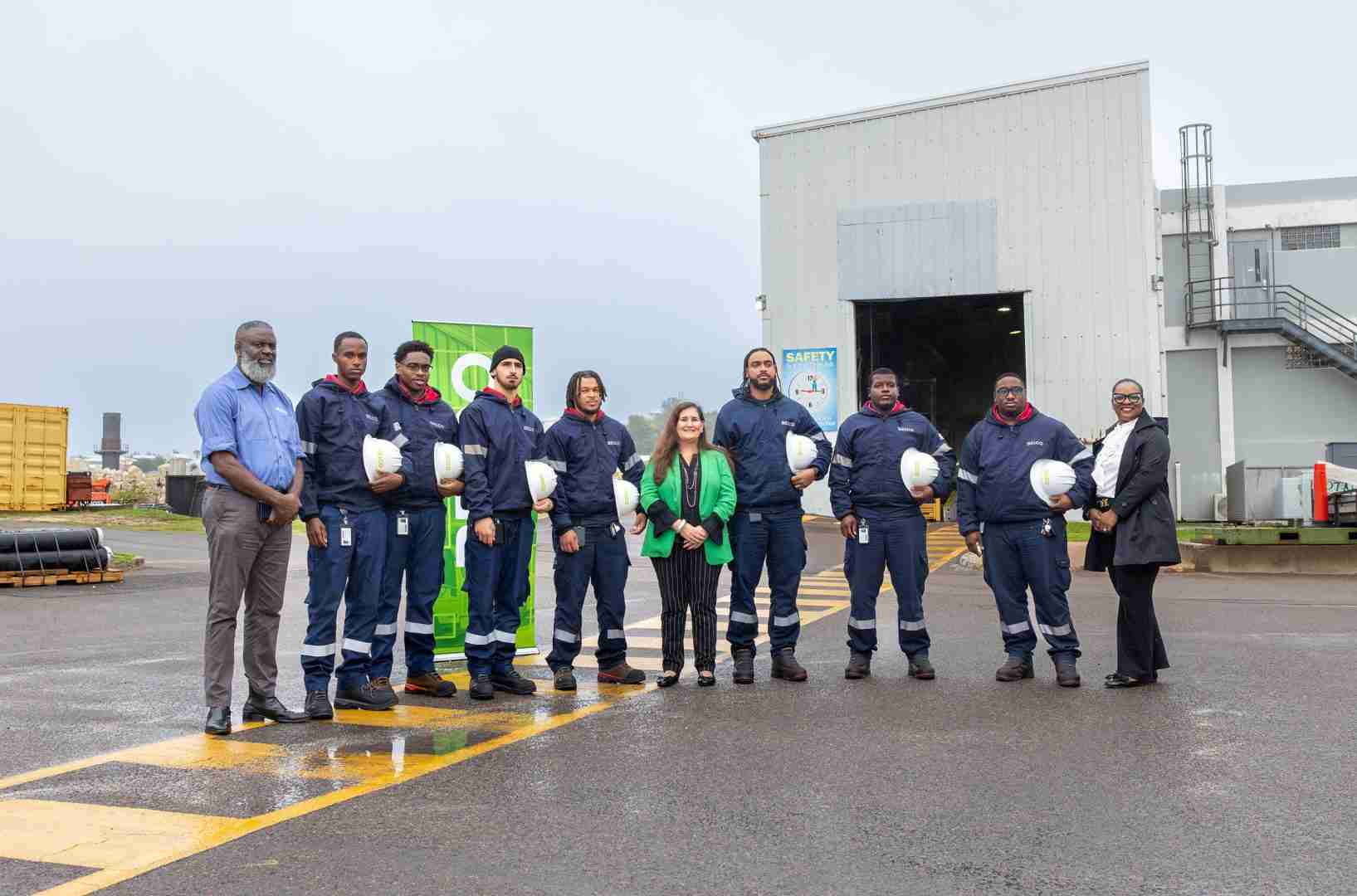
From left to right: Wayne Caines (BELCO President), Seke Spence, Quinaceo Hunt, Christopher Brites, Zion Thompson, Senator Lauren Bell (Jr. Minister for Health, Economy & Labour and House & Municipalities) , Nigel Tucker-Talbot, Xa-naje Degraff-Cyrus, Kian Thompson Malika Cartwright (Director, Dept. Of Workforce Development).
Hamilton, Bermuda (January 20, 2026) – Bermuda Electric Light Company Limited (BELCO) today welcomed seven new apprentices to its 2026 Apprenticeship Programme.
The apprentices officially inducted into BELCO’s 2026 cohort include: Seke Spence, Quinaceo Hunt, Christopher Brites, Zion Thompson, Nigel Tucker-Talbot, Xa-naje Degraff-Cyrus and Kian Thompson.
BELCO President Wayne Caines said: “On behalf of our entire team at BELCO, we’re proud to welcome our seven new apprentices. BELCO’s Apprenticeship Programme has been empowering young Bermudians with rewarding careers at our company for decades.
“We strongly believe in investing in our future and providing hands-on training with apprentices earning while they learn. I look forward to them being part of a highly skilled team that helps transform the energy landscape of Bermuda.”
The four-year programme offers successful applicants the opportunity to earn while they learn, combining technical training with academic study in preparation for a rewarding career. Through work-based learning, apprentices gain hands-on experience that helps them launch their careers within Bermuda’s evolving energy industry.
As part of their comprehensive training, the 2026 cohort will attend the Southeast Lineman Training Center (SLTC) in Dade County, Georgia, this year, where they will receive specialised instruction in line work and electrical systems alongside apprentices from utilities across North America.
Upon completion of the programme, successful candidates will be evaluated for progression to graded positions and transitioned to permanent roles across the company. Apprentices fill various roles within the company including Electrical Fitters, Mechanical Fitters, Line Workers and Electrical Jointers.
Since its inception over 30 years ago, the programme has developed many of the company’s skilled workforce. Past apprentices who graduated from the programme now form a significant part of BELCO’s full-time team.
About BELCO
Bermuda Electric Light Company Limited (BELCO) is a wholly owned subsidiary of Liberty Group Limited. Liberty Group Limited is a Bermuda-based provider of energy and energy-related services, owned by Algonquin Power & Utilities Corp., also parent company of Liberty Power and Liberty Utilities (Liberty). BELCO was established in 1904 as Bermuda’s sole supplier of electricity and currently operates generating plant and transmission and distribution systems to service 36,000 metered connections. For further information about BELCO visit www.belco.bm
The Bermuda Society of Arts is hosting a unique and thought-provoking exhibition titled Isscoldondeebike, bringing together Bermudian artists to explore personal histories and cultural stories connected to bike culture. The show, which reflects shared experiences from different perspectives and uses art as a way to bring people together, runs until February 3rd. We spoke to curators Michael Walsh and Edwin M. E. Smith about the exhibition.
The company acquired roughly 22,305 bitcoin between the period of January 12 and January 19, according to a regulatory filing
International News via Reuters:
Billionaire Michael Saylor’s bitcoin-focused firm Strategy said on Tuesday it bought about $2.13 billion worth of bitcoin over the past eight days, stepping up purchases even as its stock has been pressured by cryptocurrency volatility.
The company acquired roughly 22,305 bitcoin between the period of January 12 and January 19, according to a regulatory filing.
Saylor said in an X post on Tuesday that Strategy holds 709,715 bitcoin as of January 19.
Shares of the company slid about 6.6% as bitcoinfell 2.4%, underscoring the stock’s sensitivity to moves in the cryptocurrency.
Strategy said the purchases of bitcoin were funded with proceeds from its at-the-market offering program.
Earlier this month, Strategy reported an unrealized loss of $17.44 billion on its digital assets in the fourth quarter, reflecting a drop in the value of its bitcoin holdings in the quarter, a paper hit that has weighed on investor sentiment alongside sharp crypto-market swings.
Strategy, which started out as software company MicroStrategy, began buying and holding bitcoin in 2020.
Reporting by Prakhar Srivastava in Bengaluru; Editing by Tasim Zahid
Universal last month offered to divest Downtown’s royalty services platform Curve to address the European Commission’s competition concerns
International News via Reuters:
Universal Music Group is set to secure EU antitrust approval for its $775 million bid for Downtown Music after regulators signalled acceptance of its offer to sell the latter’s royalty services platform, people with direct knowledge of the matter said.
Universal last month offered to divest Downtown’s royalty services platform Curve to address the European Commission’s competition concerns.
The EU antitrust watchdog has not demanded further concessions, the people said.
The Commission, which is scheduled to decide on the deal by February 27, and Universal declined to comment.
The acquisition, via Universal unit Virgin Music Group and announced in December 2024, has drawn criticism and pushback from a wide swathe of independent labels, worried about the boost to Universal’s market power and want the deal to be blocked.
Downtown owns a major music publisher and a number of other businesses that help musicians collect royalties.
The Commission last year warned that Universal may have the ability and incentive to gain access to commercially sensitive data that is stored and processed by Downtown following the acquisition.
Reporting by Foo Yun Chee; Editing by Kirsten Donovan and Louise Heavens
Nearly three-quarters of the global population live in countries classified as “water insecure” or “critically water insecure”, and 4 billion people face severe water scarcity at least one month per year
International News via Reuters:
The world is facing irreversible water “bankruptcy”, with billions of people struggling to cope with the consequences of decades of overuse as well as shrinking supplies from lakes, rivers, glaciers and wetlands, U.N. researchers said on Tuesday.
Nearly three-quarters of the global population live in countries classified as “water insecure” or “critically water insecure”, and 4 billion people face severe water scarcity at least one month per year, the United Nations University Institute for Water, Environment and Health warned in a report.
“Many regions are living beyond their hydrological means, and many critical water systems are already bankrupt,” said Kaveh Madani, lead author and director of the institute.
“By acknowledging the reality of water bankruptcy, we can finally make the hard choices that will protect people, economies and ecosystems,” he said.
The report said water supplies are “already in a post-crisis state of failure” after decades of unsustainable extraction rates that have drawn down water “savings” contained in aquifers, glaciers, soils, wetlands and river ecosystems, with supplies also degraded by pollution.
More than 170 million hectares of irrigated cropland – an area larger than Iran – are under “high” or “very high” water stress, and economic damage from land degradation, groundwater depletion and climate change amounts to more than $300 billion a year worldwide, the report said.
Three billion people and more than half of global food production are concentrated in areas already facing unstable or declining water storage levels, while salinisation has also degraded more than 100 million hectares of cropland, it said.
The researchers wrote that the current approach to solving water problems was no longer fit for purpose, and the priority was not “returning to normal” but a new “global water agenda” designed to minimise damage.
However, Jonathan Paul, geoscience professor at Royal Holloway, University of London, said the report did not address one major factor behind the crisis.
“The elephant in the room, which is mentioned explicitly only once, is the role of massive and uneven population growth in driving so many of the manifestations of water bankruptcy,” he said.
Reporting by David Stanway; Editing by Hugh Lawson
Minister channels Martin Luther King Jr. to encourage youngsters to embrace their power
Yesterday (Jan. 19) the Minister of Home Affairs, the Hon. Alexa Lightbourne, JP, MP, delivered a timely and impassioned address at the annual Martin Luther King Jr. Day recognition event hosted by Imagine Bermuda.
Minister Lightbourne addressed a large audience which included students from Whitney Institute, Bermuda Institute, Victor Scott and The Berkeley Institute.
She began by expressing gratitude to the event organizers, including Mr. Glenn Fubler, for their steadfast commitment to uplifting Dr. King’s legacy and fostering civic dialogue on justice, equity, and social responsibility.
In her remarks, the Minister connected Dr. King’s global fight for civil rights with Bermuda’s own strong legacy of activism, from Dr. E.F. Gordon to the Theatre Boycott and the Progressive Group.
She paid tribute to the historic presence of Ms. Izola Harvey and Ms. Florenz Maxwell, leaders of the 1959 boycott and members of the Progressive Group, calling them “a living reminder of the power of young Bermudians to change the course of history.”
Minister Lightbourne and Florenz Maxwell
Reaching the young people where they are, the Minister framed her message around the declaration “Don’t fumble the bag,” Minister Lightbourne called on Bermuda’s youth to actively protect and build upon the progress achieved by earlier generations.
“Your bag is taking the work that he devoted his life to and using it to secure a future for Bermuda,” she said. “You each have the ability to organize, to speak up, to demand better. The bag is your true power.”
Minister Lightbourne and Izola Harvey
The Minister also addressed Bermuda’s current socio-economic realities, including rising rents, the cost of living, and the need for more accessible housing, all key priorities under the Ministry of Home Affairs.
“These pressures are real for many families, and they directly shape whether young people can build a life, a career, and a future here at home.”
Minister Lightbourne emphasized that government action alone is not enough. Echoing Dr. King’s belief in grassroots activism, she emphasized the importance of youth leadership, unity, and local organizing.
“You don’t have to be Martin Luther King Jr. to make a difference, but you must join a fight,” the Minister said.
And she encouraged attendees to find common purpose with their peers, to stay engaged, and remember that the inheritance passed down from their ancestors must be protected through action. “These were ancestors who didn’t wait for someone else to fix Bermuda. They organized. They spoke up. They risked everything. That’s the bag they left you. That is your inheritance. Now here’s my question: What are you doing with it?”
Also in attendance yesterday were the Attorney General and Minister of Justice, Sen. the Hon. Kim Wilkerson, JP, Senate President Joan Dillas Wright, JP, and Sen. Mischa Fubler, JP.
The country remains in shock after the first-ever fatal accident on the country’s extensive high-speed rail network, which occurred on Sunday evening near Adamuz in Cordoba province
International News via Reuters:
Spain’s rail operator Adif ordered trains on the Madrid-Barcelona high-speed line to limit their speed on Tuesday on concerns about the track’s condition, two days after one of Europe’s deadliest train crashes on another line left at least 42 dead.
The country remains in shock after the first-ever fatal accident on the country’s extensive high-speed rail network, which occurred on Sunday evening near Adamuz in Cordoba province, about 360 km (223 miles) south of Madrid. Experts say a faulty rail joint may be key to determining the cause of the derailment that led to the collision between two trains.
Train drivers last year called on Adif to limit speeds due to their unease about deterioration on several of Spain’s high-speed lines, after it opened the network to private competition in 2020 to offer low-cost alternatives to state-run Renfe’s trains.
“We have detected and reported to all operators much more vibration and wear and tear on the infrastructure since the liberalisation and a 60% increase in traffic,” Diego Martin, general secretary of the Semaf drivers’ union, told Reuters.
Adif said it hoped to lift the speed limit on the line once its maintenance team had inspected two stretches totalling nearly 150 km (93 miles) where drivers have reported bumps on the tracks.
At the site of the crash near Adamuz, rescuers used heavy machinery overnight and in the early hours of Tuesday to level the ground and gain access to the worst-hit carriages as they sought to recover the remains of people still missing.
They aimed to use two cranes to lift the front carriages of the train belonging to the state-run Alvia service, which had plunged down a 4-metre (13 ft) embankment after the crash, and the rear carriages of the train operated by private consortium Iryo.
The collision occurred in rolling, olive-growing countryside in the foothills of a mountain range at a site only reachable by a single-track road, making it difficult for rescuers to gain access with heavy machinery.
One more body was found overnight within the wreck of the Iryo train, which had derailed, and another death was confirmed later on Tuesday raising the death toll to 42, authorities said.
BODIES STILL TRAPPED IN WRECKAGE
Interior Minister Fernando Grande-Marlaska said police had received 43 missing-person reports, which broadly matched the provisional death toll, but cautioned that the final number would not be confirmed until rescue teams had lifted the worst-affected carriages to see what was underneath.
Some relatives continued to wait for news of their loved ones as authorities worked on identifying the dead.
Osiris Sevilla described her anxiety as she waited for news about her husband outside an emergency centre in Cordoba but said she hadn’t given up hope that he’d survived.
“He didn’t like trains… Since we got together, this is the first time he took a train,” she said.
Spain’s King Felipe visited the site of the tragedy on Tuesday and spoke to residents, including 16-year-old Julio Rodriguez, who with his mother and a friend was one of the first to reach the scene of the accident.
He described the scene to El Mundo newspaper as “like a massacre… with dismembered bodies, limbs here and there”.
Survivors also spoke of their ordeal.
Lola Beltran told TVE she had changed carriage minutes before the crash, moving from her assigned seat in one of the hardest-hit cars to another carriage to sit with a colleague.
“We had to break the windows with emergency hammers and pry open the doors to get out,” Beltran said, describing scenes of chaos, screams, and torn-out seats.
BROKEN RAIL: CAUSE OR CONSEQUENCE?
A photo circulated by Spanish police showing a broken rail with the marker “1” beside it strongly suggested the fracture occurred at, or very near, the initial point of the derailment, Scottish railway engineer and author Gareth Dennis told Reuters.
He said the track just before the break looked intact, making it the likely trigger for the train leaving the tracks.
Dennis also said the fracture appeared close to a rail weld, where steel beside the weld can be a weak spot. Cold weather can raise tensile stress as rails contract, he said.
“The interesting question is why did the rail break,” Dennis said, rather than why the train derailed.
Transport Minister Oscar Puente urged patience as the investigation proceeds. He said all hypotheses were open but it was “very strange” for the rear of a train that was not exceeding the speed limit to derail on a straight stretch.
The discovery of a broken rail was “one more piece of data” and did not itself prove any single scenario, Puente said, adding that the key question was whether it was the cause or the consequence of the derailment.
($1 = 0.8516 euros)
Reporting by Nina Lopez, Michale Gore, Susana Vera, Leonardo Benassatto, Corina Pons and Emma Pinedo; Writing by David Latona and Charlie Devereux; Editing by Charlie Devereux, Tomasz Janowski and Gareth Jones
To provide the best experiences, we use technologies like cookies to store and/or access device information. Consenting to these technologies will allow us to process data such as browsing behavior or unique IDs on this site. Not consenting or withdrawing consent, may adversely affect certain features and functions.
Functional
Always active
The technical storage or access is strictly necessary for the legitimate purpose of enabling the use of a specific service explicitly requested by the subscriber or user, or for the sole purpose of carrying out the transmission of a communication over an electronic communications network.
Preferences
The technical storage or access is necessary for the legitimate purpose of storing preferences that are not requested by the subscriber or user.
Statistics
The technical storage or access that is used exclusively for statistical purposes.The technical storage or access that is used exclusively for anonymous statistical purposes. Without a subpoena, voluntary compliance on the part of your Internet Service Provider, or additional records from a third party, information stored or retrieved for this purpose alone cannot usually be used to identify you.
Marketing
The technical storage or access is required to create user profiles to send advertising, or to track the user on a website or across several websites for similar marketing purposes.