Sunday, November 1, 2026
Home Blog Page 724

Oil pauses as markets assess OPEC+ plans, demand concerns

Brent crude futures for December delivery were down 4 cents to $65.99 a barrel by 1037 GMT. U.S. West Texas Intermediate crude fell 5 cents to $62.32 a barrel
International News via Reuters:

Oil prices steadied on Wednesday after falling for two days as investors weighed OPEC+ plans for a larger output hike next month while data from the U.S. and Asia showed signs of demand waning.

Brent crude futures for December delivery were down 4 cents to $65.99 a barrel by 1037 GMT. U.S. West Texas Intermediate crude fell 5 cents to $62.32 a barrel. Both contracts headed 1% lower earlier in the volatile trading session.

On Monday, Brent and WTI both settled more than 3% lower, their sharpest daily declines since August 1. On Tuesday, they each fell 1.5% further.

Oil has dropped on the market anticipating a similar size OPEC+ production increase in November and U.S. and Asian demand starting to fall, Rystad analyst Janiv Shah said.

“U.S. drawdowns have slowed, so some bullish movement could start to flip,” he added.

The Organization of the Petroleum Exporting Countries and its allies, known as OPEC+, could agree to raise oil production by up to 500,000 barrels per day (bpd) in November, triple the increase made for October, as Saudi Arabia seeks to reclaim market share, three sources familiar with the talks said.

However, OPEC wrote in a post on X that media reports of plans to raise output by 500,000 bpd were misleading.

Meanwhile in the U.S., an industry report showed U.S. crude stockpiles fell while gasoline and distillate inventories rose in the week ended September 26, according to market sources citing American Petroleum Institute estimates on Tuesday.

Data on factory activity in Asia, the world’s biggest oil-consuming region, also added to concerns about fuel demand, as manufacturing activity contracted across most major economies in September.

In addition, record U.S. oil production, some caution ahead of the OPEC+ meeting this weekend and a risk off environment due to the U.S. shutdown also played a part, Giovanni Staunovo, an analyst at UBS said.

The U.S. government shut down much of its operations on Wednesday as deep partisan divisions prevented Congress and the White House from reaching a funding deal – which government agencies have warned would halt the release of a closely watched September employment report, amongst other things.

Focus was also shifting to the supply and export disruption in Russia due to continuous and successful Ukrainian assaults, PVM Oil Associates’ analyst Tamas Varga said.

Reporting by Seher Dareen in London, Mohi Narayan in New Delhi; Editing by Christian Schmollinger, Jacqueline Wong, Alexandra Hudson


US Pfizer deal lifts European health stocks as Trump policy haze eases

The agreement, seen as far less punishing than some within the industry had feared, gives hard-hit global drugmakers a degree of clarity after a volatile year

International News via Reuters:

European healthcare stocks jumped on Wednesday, mirroring moves in the United States, propelled by a deal between Pfizer and President Donald Trump to lower prescription drug prices in the Medicaid programme in exchange for tariff relief.

The agreement, seen as far less punishing than some within the industry had feared, gives hard-hit global drugmakers a degree of clarity after a volatile year during which Trump has taken aim at the sector over high U.S. medicine prices.

The Pfizer deal is expected to break the seal for other agreements as companies look to hand Trump pricing wins in return for lower tariffs on their drugs to enter the huge U.S. market.

“We expect EU pharma to follow suit and negotiate with the Trump administration for exemptions,” said Lucy Coutts, Investment Director at wealth managers JM Finn, which holds shares in GSK, AstraZeneca, Roche and Novo Nordisk.

She said this would likely be in the form of investment in U.S. manufacturing and participation in TrumpRX, a website being launched by Trump for Americans to buy drugs at a discount.

SHOT IN THE ARM FOR PHARMACEUTICAL SHARES

Trump sent letters to 17 leading drug companies in July telling them to slash prices to match those paid overseas. He asked them to respond with binding commitments by September 29. Pfizer is the first drugmaker to announce a deal.

U.S. patients currently pay far more for prescription medicines, often nearly three times more than in other developed nations, and Trump has been pressuring drugmakers to lower their prices to what patients pay elsewhere.

On Wednesday, Europe’s healthcare sector index cheered the move, rising 2.8%, which, if sustained, would be its biggest daily percentage gain since April. The index is down 2.9% so far this year.

Pharmaceutical companies and their suppliers – many of which have business in the United States – surged, topping Europe’s STOXX 600 index.

Ambu rose 10%, Sartorius 7.4%, and Merck, Roche and AstraZeneca all climbed around 5%. Novo Nordisk and Novartis gained 3.7% and 2.3%, respectively.

Pfizer shares had risen 7% on Tuesday in the United States, while other U.S. pharma stocks also gained.

Shore Capital analyst Sean Conroy said clarity was beginning to emerge on the potential impact of the Trump administration’s “most-favoured-nation” drug pricing proposal and things looked “far less draconian than feared”.

COMPANIES IN ‘CONSTRUCTIVE’ TALKS WITH US ADMINISTRATION

Britain’s GSK, maker of HIV drugs and vaccines, said it was having constructive conversations with the Trump administration over drug pricing. Germany’s Merck KGaA, which makes cancer drugs, said similar.

Roche said that it and its U.S. unit Genentech remain committed to working with the Trump administration towards strengthening American manufacturing and making medicines more affordable for patients in the United States.

Novo Nordisk, the Danish firm that makes the Wegovy weight-loss injection, said it is engaged in discussions with the Trump administration over the “most-favoured-nation” executive order.

Novartis said it remained committed to finding constructive solutions that lower costs for Americans and address price disparities between the U.S. and other high-income countries.

Berenberg analysts estimated that a 50% reduction in Medicaid sales, which account for about 3% of large pharma revenues, would hit sector earnings per share by an average of 4%, with the biggest impact at GSK at around 7% and the smallest at Pfizer at about 1%.

“We believe that now if the companies are investing in the U.S. they should be on the safe side,” Bernstein analyst Florent Cespedes told Reuters, adding that European firms have announced some $200 billion in U.S. investments.

Angelo Meda, head of equities at Banor SIM in Milan, said 2025 was meant to have been a year of expansion for drugmakers, but this had been hit by tariffs. The deal was a relief.

“Any positive news on that front can breathe new life into a sector that is currently trading at relative lows compared to the broader market,” he said.

Reporting by Alun John in London, Danilo Masoni in Milan, Dimitri Rhodes in Gdansk and Maggie Fick. Additional reporting by Dave Graham, Patricia Weiss; Writing by Adam Jourdan; Editing by Amanda Cooper, Mark Potter and Ros Russell

New Tesla sales in Spain rise 3.4% in September, other EV sales surge

Between January and September, sales of Tesla cars in Spain increased 9.5% from the same period a year earlier

International News via Reuters:

Tesla’s new car sales in Spain rose 3.4% in September from the same month in 2024 to 2,992 vehicles, registration data released by industry group ANFAC showed on Wednesday.

Between January and September, sales of Tesla cars in Spain increased 9.5% from the same period a year earlier, while total sales of electrified vehicles, a category that includes both fully electric vehicles and hybrids, grew by 98%.

Reporting by Javi West Larrañaga; Editing by Emma Pinedo

All eyes on Imelda as Humberto brushes by

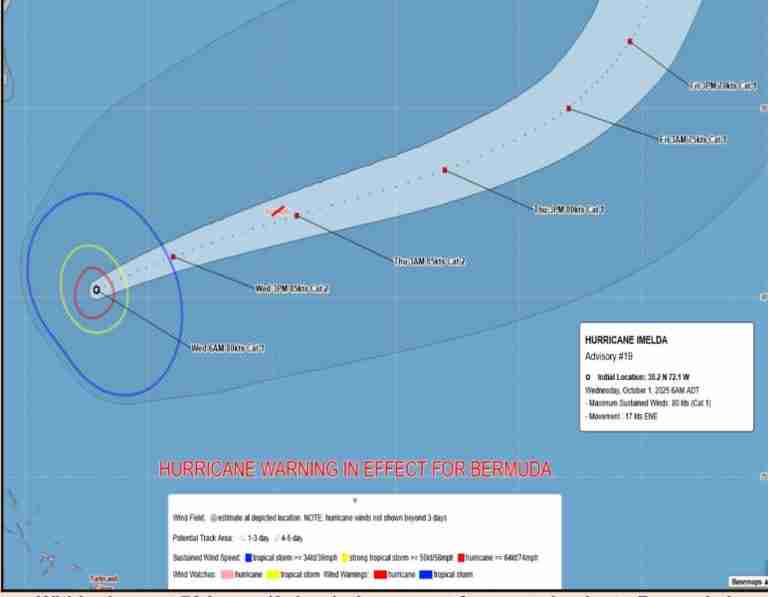
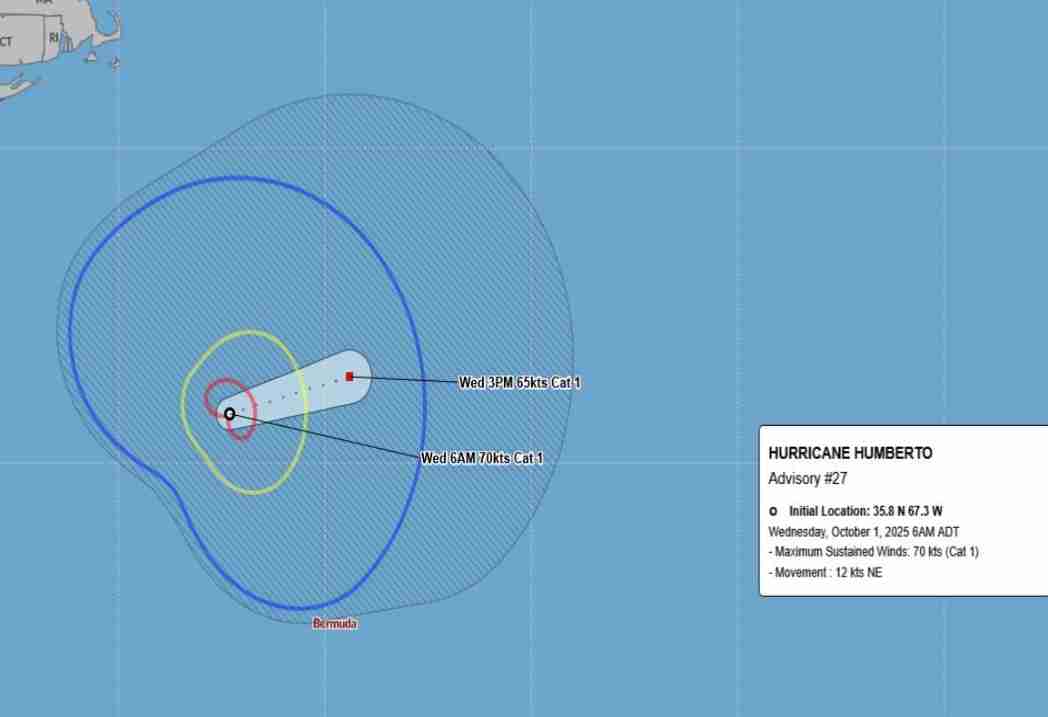
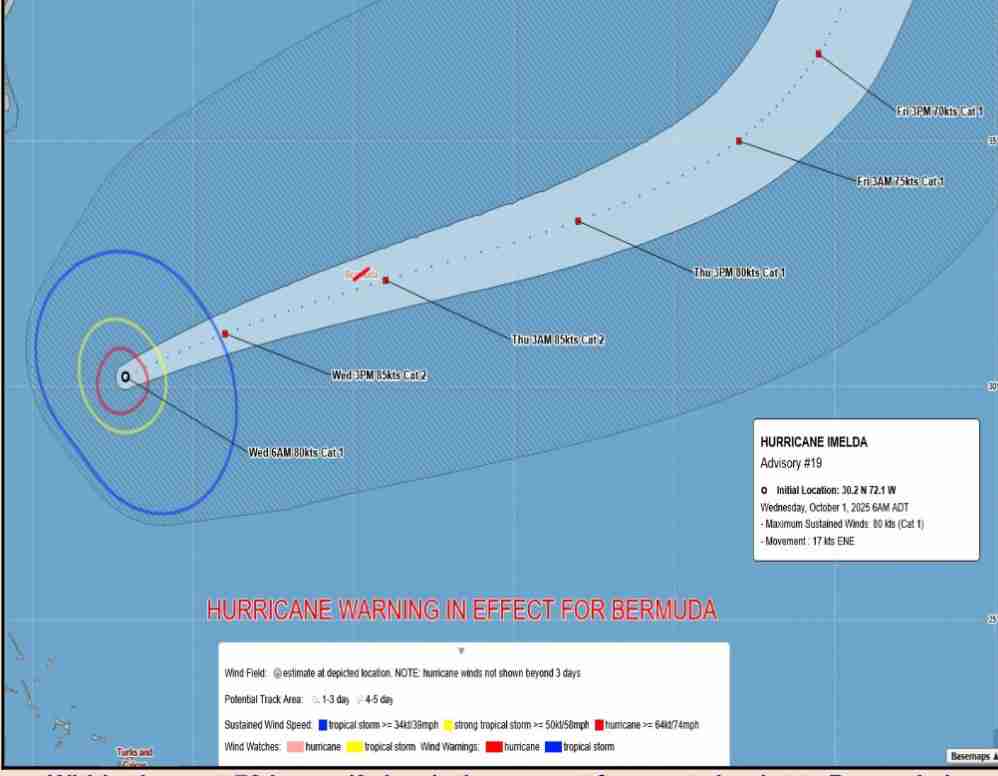
The latest forecast from the Bermuda Weather Service has Hurricane Humberto coming closest to Bermuda at 10am today, when it will be 234 nautical miles to our north-north-west.

Meanwhile, Hurricane Imelda – a much greater threat to Bermuda – is expected to pass within 25 nautical miles of Bermuda – or even make a direct hit – at 1am tomorrow. At that point Imelda is expected to be a Category 2 hurricane. Imelda is currently packing winds of 80 knots, with gusts up to 100 knots, and moving east-north-east at 18 knots.

Factories struggle in September as soft demand in China and US take toll

Euro zone manufacturing slipped back into contraction as new orders fell at their fastest rate in six months

International News via Reuters:

Factory activity shrank in much of the world last month, private surveys showed on Wednesday, as signs of a slowdown in U.S. growth and the anticipated impact of President Donald Trump’s tariffs added to pressure from weak Chinese demand.

Euro zone manufacturing slipped back into contraction as new orders fell at their fastest rate in six months, with export markets acting as a particular drag, signalling that the recovery in the region’s industrial sector was fragile.

The HCOB Eurozone Manufacturing Purchasing Managers’ Index (PMI), compiled by S&P Global, fell to 49.8 in September from August’s 50.7, which was the first reading above the 50.0-point line denoting growth since mid-2022.

“The drop in the PMI is showing up across the board, with respective figures for consumer goods, capital goods and intermediate goods all down on the month,” said Cyrus de la Rubia, chief economist at Hamburg Commercial Bank.

Surveys revealed a split across the currency union with the Netherlands leading the expansion with activity at a 38-month high while growth continued in Greece, Ireland and Spain. Meanwhile, the bloc’s three largest economies – Germany, France and Italy – all registered contractions.

In Britain, outside the European Union, activity shrank at the fastest pace in five months, reflecting subdued domestic demand and fewer export orders, painting a more downbeat picture than recent official data.

In Asia, the stress on manufacturers highlights the challenge policymakers face in protecting their export-reliant region from higher U.S. levies, a key policy of the Trump administration that has upended the global trade order and put the brakes on economic growth.

Export powerhouse Japan and global tech hub Taiwan saw manufacturing activity shrink in September, the surveys showed, leaving businesses in Asia – heavily dependent on the U.S. market – on a fragile footing.

Worryingly, China, a key engine of the global economy, also remained in the doldrums.

An official survey released on Monday showed manufacturing activity in the world’s second-biggest economy contracted for a sixth month in September, dragged down by weak consumption and the squeeze from U.S. tariffs.

The prolonged slump underlines the twin pressures on China’s economy: Domestic demand has failed to mount a durable recovery in the years since the coronavirus pandemic, while Trump’s tariffs have squeezed Chinese factories as well as overseas firms that buy components.

“The September PMI readings for most countries in Asia remained weak and we continue to expect manufacturing activity in the region to struggle in the near term,” said Shivaan Tandon, emerging markets economist at Capital Economics. 

“With growth set to soften and inflation likely to remain contained, we expect central banks in Asia to loosen policy further.”

 The S&P Global Japan Manufacturing PMI fell to 48.5 in September from 49.7 in August, staying below the 50.0 threshold. It shrank at the fastest pace in six months due to steep falls in output and new orders, the survey showed.

Taiwan’s manufacturing PMI fell to 46.8 last month. Factory activity also shrank in the Philippines and Malaysia, the private surveys showed.

By contrast, South Korea’s factory activity expanded for the first time in eight months underpinned by improving overseas demand. The manufacturing PMI in Asia’s fourth-largest economy, released by S&P Global, rose to 50.7 in September, moving above the 50-mark for the first time since January 2025.

The outlook for South Korea’s exporters, however, hinges on negotiations to formalise a July deal aimed at reducing U.S. tariffs on Korean goods imports including automobiles to 15% from 25% in return for South Korea’s investment of $350 billion in the U.S. The talks have stalled due to Seoul’s concerns over foreign exchange implications.

India’s manufacturing sector expansion lost some momentum and slipped to its weakest pace in four months, suggesting Washington’s punitive 50% tariffs on its goods could be starting to hurt Asia’s third-largest economy.

Reporting by Jonathan Cable and Leika Kihara; Editing by Hugh Lawson, Shri Navaratnam and Lincoln Feast

London’s FTSE 100 hits new record high as healthcare stocks surge

The blue-chip index rose 0.7% as of 0950 GMT, building on its record-breaking close in the previous session and capping off the third quarter with a gain of about 7%

International News via Reuters:

London’s FTSE 100 reached a fresh intraday peak on Wednesday, propelled by gains in the healthcare sector, while investors assessed the ramifications of the U.S. government shutdown on the release of critical economic indicators.

The blue-chip index rose 0.7% as of 0950 GMT, building on its record-breaking close in the previous session and capping off the third quarter with a gain of about 7%.

Healthcare stocks emerged as the standout performers, surging 4.6%.

Industry giants AstraZeneca rallied 6.1%, Hikma rose 3.6% and GSK was up 2.6%, in unison with their European counterparts.

This comes a day after Pfizer and President Donald Trump said the U.S.-based drugmaker had agreed to lower prescription drug prices in the Medicaid programme in exchange for tariff relief.

However, caution prevailed in world markets due to concerns surrounding the U.S. government shutdown.

Federal operations in the U.S. were largely suspended on Wednesday, creating an atmosphere of uncertainty at a juncture when markets are particularly sensitive to signals about the Federal Reserve’s monetary policy direction.

The midcap index FTSE 250 fell 0.2%.

Tate & Lyle was the biggest drag on the index after the food ingredients maker warned that its annual profit and revenue would fall due to a demand slowdown in the Americas, its key market.

Its shares plummeted 9.7% to levels not seen since 2009.

The aerospace and defence index was the biggest decliner among sectors, down 1.4%, after gaining more than 2% in the previous session.

On the data front, British house prices rose slightly faster than expected in September with a 0.5% increase, after dropping 0.1% in August, mortgage lender Nationwide Building Society said.

An index of the UK’s homebuilding companies was 0.5% lower.

Among other stocks, Greggs rose 7.4% after the bakery and fast-food chain reported a 6.1% rise in third-quarter total sales, saying business improved in August and September.

Reporting by Ragini Mathur in Bengaluru; Editing by Shreya Biswas

Flash floods kill nine in Odesa after heavy rain in southern Ukraine

Teams worked through the night to rescue some 362 people and pump water from buildings

International News via Reuters:

Flash floods in Ukraine’s Odesa killed nine people including a family of five trapped in their home as it was engulfed by water, emergency services said on Wednesday, as torrential rain left hundreds in need of rescue and thousands without power.

Teams worked through the night to rescue some 362 people and pump water from buildings, the service said on the Telegram messaging app, and it posted pictures of passengers being lifted from a flooded bus and cars pulled from the water.

“A horrific situation in Odesa these days – 9 people have died as a result of the natural disaster, including a child,” President Volodymyr Zelenskiy said on X platform.

He added that the whereabouts of one more person were still being verified.

A family of five who lived in lower ground floor flat of a building was unable to escape the wave of water, the emergency service’s spokesperson for the Odesa region Maryna Averina told Ukrainian television.

Another three women died as they were walking along a road and were swept away, Averina added.

“In just seven hours, almost two months’ worth of rain fell in Odesa,” Mayor Hennadiy Trukhanov said on Telegram earlier. “No stormwater drainage system can withstand such a load.” 

Governor Oleh Kiper said the region was now suffering from torrential rainfall for a second day, which had flooded roads, caused power outages, damaged property and brought down trees.

Over 500 workers were involved in the rescue effort, he said. He added 42,000 customers in 32 villages and towns in the region were still temporarily without power.

Zelenskiy said he instructed his deputy prime minister to conduct a full review of operations in Odesa.

Reporting by Lidia Kelly and Anna Pruchnicka; Editing by Kim Coghill, Clarence Fernandez, Alexandra Hudson

Dozens killed as powerful quake strikes central Philippines

The shallow quake struck late on Tuesday off the coast of the island of Cebu, cutting power and damaging buildings

International News via Reuters:

The death toll from a 6.9-magnitude earthquake that hit the central Philippines rose to 69 on Wednesday, a disaster official said, as authorities mounted a rescue effort to find survivors after one of the country’s strongest quakes in a decade.

The shallow quake struck late on Tuesday off the coast of the island of Cebu, cutting power and damaging buildings. It was not immediately clear how many people were missing. 

The death toll was 69 as of Wednesday late morning said Jane Abapo of the regional Civil Defense office, citing data from the provincial disaster agency that was subject to validation. 

The national disaster agency earlier said the toll could be as high as 60, with 150 reported injured. 

The hospital in Bogo City near the epicentre of the quake was “overwhelmed”, Civil Defense official Raffy Alejandro told reporters. 

The Philippine coast guard deployed a vessel carrying dozens of doctors, nurses and other medical personnel bound for Bogo, while President Ferdinand Marcos Jr assured survivors of swift assistance, with cabinet secretaries on the ground directing relief operations. 

“We are assessing the damage, we are assessing the needs,” Marcos told reporters after distributing aid in Masbate, an island recovering from the impact of Super typhoon Ragasa last week.  

Mariano Martinez, the mayor of San Remigio municipality close to Bogo, said there were 11 casualties in the area, with victims as young as 12 and the death toll expected to climb.

“Our first main problem is finding the casualties, identifying people who needs help”, he told DZMM radio, adding many homes had suffered damage.  

RING OF FIRE

Earthquake monitoring agencies put the quake’s depth at around 10 km (6.2 miles) and recorded multiple aftershocks, the strongest having a magnitude of 6. There was no tsunami threat following the quake.

The Philippines lies in the Pacific “Ring of Fire,” where volcanic activity and earthquakes are common. The country had two major earthquakes in January, with no casualties reported.

In 2023, a 6.7 magnitude offshore earthquake killed eight people. 

San Remigio Vice Mayor Alfie Reynes said among those killed were people who were playing basketball in a sports complex when it partially collapsed. 

She appealed for food and water for evacuees, as well as heavy equipment to aid search and rescue workers. 

“It is raining heavily and there is no electricity so we really need help, especially in the northern part because there’s a scarcity of water after supply lines were damaged by the earthquake,” Reynes said.

Local media posted videos of people rushing out of their homes as the ground shook and buildings collapsed, including a church that was more than 100 years old.  

Cebu, one of the Philippines’ most popular tourist destinations, is home to 3.4 million people. It was not immediately clear the extent of the damage in other areas of the island.

The Mactan-Cebu International Airport, the country’s second busiest gateway, remained operational.

Philippine seismology agency Phivolcs said close to 800 aftershocks have been recorded and warned affected areas to expect more tremors in the coming days, although their strength is expected to gradually diminish.

It reported tremors as far south as Zamboanga del Norte, 330 km  (205 miles) away. 

In the town of Pilar, resident Archel Coraza said most of his family were asleep when their house began to shake violently.

“I woke them up and we all rushed outside into the street,” he told DZMM.  

Reporting by Adrian Portugal and Eloisa Lopez in Cebu and Mikhail Flores in Manila; Reporting and Writing by Karen Lema; Editing by John Mair, Martin Petty

Sterling edges up, dollar hobbled by US shutdown

The shutdown carries the risk of delaying key economic reports that filter into the Federal Reserve’s decisions to adjust monetary policy

International News via Reuters:

The pound rose against the dollar on Wednesday, as the U.S. currency came under broad pressure after the government in Washington DC shut down over funding to add to investor caution around U.S. assets.

The shutdown carries the risk of delaying key economic reports that filter into the Federal Reserve’s decisions to adjust monetary policy.

The central bank meets later this month and, should the shutdown persist, could find itself without meaningful official data. With that in mind, investors will use private sector measures for guidance, such as the ADP monthly employment report later on Wednesday.

Sterling wrapped up September with a 0.4% loss against the dollar, but is still up 7.7% this year, putting it on course for its strongest showing against the U.S. currency since 2017’s 9.5% rally. Against the euro, it has struggled, as the single European currency gained 0.8% last month, bringing the increase for 2025 to 5.6%. 

LOOKING PAST THE DATA

UK data this week has shown the economy virtually stagnated in the second quarter of this year, while the current account deficit blew past expectations in that time to its widest since the start of the year.

“Investors appeared willing to look past these figures, given the overriding U.S. narrative. We, however, remain cautious,” analysts at Monex said.

“Sterling rallies are likely to be capped by domestic headwinds and a Bank of England that we think should be inching toward further easing, especially after the November budget has been delivered.”

The pound was last up 0.2% on the day at $1.3475, while weakening against the euro, which rose 0.12% to 87.365 pence.

British house prices rose slightly faster than expected last month, increasing 0.5% in September after a 0.1% drop in August, major mortgage lender Nationwide Building Society said on Wednesday.

According to Nationwide data, Britain’s house-price-to-earnings ratio, a key metric of home affordability, is at 5.8, around its worst in a decade.

Real wage growth, meanwhile, has slowed to a rate of 1%, from 3.4% a year ago, as inflation has remained sticky, while workers’ earnings have increased more modestly.

British consumers are struggling with persistent inflation, a high tax burden that could potentially increase with finance minister Rachel Reeves’ budget next month, and a weakening labour market. 

Reporting by Amanda Cooper; Editing by Ed Osmond

Price decrease for mobile and broadband paused pending appeal

In a statement the RA said the recommended price changes will not come into effect on October 1st as intended

Regulatory Authority’s Full Press Statement:

The Regulatory Authority of Bermuda (RA) wishes to advise the public that the decisions resulting from its 2025 Electronic Communications Market Review will not come into effect on 1 October 2025 as originally intended. 

The Market Review is a statutory process undertaken by the RA to assess the state of competition in Bermuda’s electronic communications sector. Following months of public consultation and careful analysis, the RA concluded that certain changes were required to improve competitiveness and deliver greater value to consumers. Among these decisions was the introduction of entry-level anchor products in the fixed broadband and mobile markets. 

While the 2025 Market Review required sectoral providers to implement the required changes by 1 October 2025, certain sectoral providers have since exercised their right to appeal the RA’s decision. As a result, the implementation of the measures specifically mandated in the 2025 Market Review have been temporarily paused by the Courts. 

The RA remains steadfast in its view that the changes required by the 2025 Market Review are in the best interest of Bermuda. The Market Review process is guided by clear principles and objectives: to develop and maintain effective, sustainable competition that benefits consumers through fair pricing, greater innovation, and wider choice; to encourage investment in the electronic communications sector; and to establish measures that are effective yet proportionate, balancing compliance costs with consumer benefit. Wherever possible, these measures are designed to apply on a technology-neutral and service-neutral basis, ensuring fairness across the sector. 

 “The Market Review was conducted with thorough analysis and careful consultation, and we stand by the strength of its findings,” said Donn Foggo, Director of Communication & Stakeholder Engagement. He continued: “Despite the legal challenges, we remain committed to pursuing what is in the island’s best interest and will continue to inform the public as this process unfolds.” 

The RA will issue further updates once the legal proceedings have progressed and clarity on the timeline for implementation is available. 

‘Killers are getting better at killing’

Disturbing truths told, and the community once more asked for help at anti-violence Town Hall meeting

The killers are getting better at killing.

That is the chilling reality Police Commissioner Darrin Simons conveyed at last night’s packed Town Hall addressing gun and gang violence.

He said, “when they are actually shooting, they are more likely hitting their target, causing injury, or causing death”.

“It’s very concerning because the reality is the people who are doing these things are getting better… They are collecting intelligence on their targets. They know where they are. They know that there are vulnerable at a particular time, and they’re gathering that information to make sure that they are not wasting their efforts.”

The Commissioner said that police are absolutely using all legal avenues they can to gather intelligence on gang members – but the best information always comes from the community.

He lamented how numbers have declined from the 480 police officers in the force when he started, and he listed some of the staff they will be requesting from the UK, including four Serious Crime Investigators.

Governor Andrew Murdoch, who has ultimate authority over the police, affirmed that the BPS is too small and needs modernising, and he indicated help is coming.

The Police Commissioner, the National Security Minister and the Governor all said the problem is harder to address without witnesses coming forward.

“It’s really, really difficult unless the community talks to you and shares what information that you have”, Governor Murdoch said.

“It’s really difficult for prosecutors to bring those to account who have perpetrated these crimes. They need evidence. They need witnesses.”

National Security Minister Michael Weeks said the violence is out of control, and the loss of young life is heartbreaking.

He said there needs to be a preventative approach as well as enforcement. Appealing to parents,Minister Weeks said “we have to know what our children are doing”.

“Police is not going to do it for you. It starts in your home, and we must know what our children are doing. We cannot ignore the red flags.”

“Don’t be afraid to cry for help. Don’t be afraid to say ‘yes, I need assistance’. A part of our national strategy is actually parenting classes… I even have to challenge the clergy – churches, too, have to do their job.”

“This is not a criticism of anyone. I’m just trying to point out that we as a community have to do this together.”

Standing room only

There was barely room to stand in the packed St Paul AME hall.

When the floor was opened for questions and comments, some appeared to simply vent their frustration at the violence, others called for a return to faith, while others called for heavier consequences for crime.

“I say reopen Casemates”, one man said, adding that “when you get life, 25 years, you do Casemates… No television, no radio. Take a Bible or some books.”

Another attendee told the panel to “change that little party house you got up Westgate into a real prison… because, in Colombia and Cuba, the parents are responsible for the food and water that the prisoners receive.”

Community activists highlighted the need for additional programmes, and the limited diversity of the audience.

“There is a petition online”, said one gentleman… “people who want to see the Ashay Program reinstated in the schools… this program was installed at Dellwood in 2003 to 2008… This program goes directly to the young black boys.”

Community activist and grief specialist Gina Spence asked, “who’s helping the children?”

“I’m not talking about the teenagers… Some of them were in their mothers wombs when the fathers got shot… What happens when they need grief counseling?… I would like to see grief as one of the pillars of the national strategy.”

Another woman lamented, “I just want to state the obvious. There’s not a lot of white people here, and we all need to care about this, because this is not a just a black issue. It is a Bermuda issue… as people who love this community, we should all care.”

We spoke to Minister Michael Weeks after the event, reflecting on a similar event in 2022 ago at the beginning of his tenure as National Security Minister…

“Three years ago”, he said,” I alerted the public in the country as to what the government will do.”

“So three years hence, the government has put things like CCTV in place. We have put more money into community groups… We have had the two day forum and workshop for all the stakeholders that were interested to come together to create the National Violence Strategy… we have increased the reward from for Crime Stoppers.”

“So we’re doing things that that I think is necessary. But but a part of that triangle is the police… the government… but the main piece is the community. So, I’m trying to give the community comfort to come out and say – you know something. They have to do what they need to do in order for us to make our country safe. ”

When asked what it is the community needs to do, Minister Weeks responded, “if you see something, say something.”