Class A shares of the company were up 3.6% at $249.1, while Class C shares climbed 3.4% to $249.5 – both trading at record highs
International News via Reuters:
Google parent Alphabet hit a market capitalization of $3 trillion for the first time on Monday, riding on renewed optimism around artificial intelligence and a favorable antitrust ruling.
Class A shares of the company were up 3.6% at $249.1, while Class C shares climbed 3.4% to $249.5 – both trading at record highs.
Including Monday’s moves, shares have rallied more than 32% so far this year, the best performer among the so-called “Magnificent 7” stocks and outpacing the 12.5% gain for the S&P 500. Alphabet joined other tech giants Apple and Microsoft in clinching a $3 trillion valuation, while AI chipmaker Nvidia, the world’s most valuable company, boasts a market cap of $4.25 trillion.
The latest boost for Alphabet was a ruling by a U.S. court that allowed the company to retain control of its Chrome browser and Android mobile operating system, marking a pivotal moment for the company whose dominance in search and mobile ecosystems has long drawn scrutiny.
While sharing data as part of the ruling will strengthen Google’s advertising business rivals, not having to divest Chrome or Android removes a major concern for investors who view them as key pieces to Google’s overall business.
Investor sentiment also got a lift after the company’s cloud-computing unit delivered an almost 32% jump in second quarter revenue, surpassing expectations as investments in in-house chips and the Gemini AI model began to pay off.
“They still are very dependent on search, but with YouTube, Waymo, and other capabilities and products they’re working on, investors are starting to see that possibility that this isn’t just a search company anymore, this is a company that’s moving into a lot of other things,” said Dennis Dick, chief strategist at Stock Trader Network.
Alphabet trades at around 23 times its forward earnings – the lowest among the “Magnificent 7” – compared to its five-year average 22, according to data compiled by LSEG.
Reporting by Shashwat Chauhan and Johann M Cherian in Bengaluru: Additional reporting by Purvi Agarwal; Editing by Tasim Zahid and Sriraj Kalluvila
The announcement from the State Administration for Market Regulation comes as the U.S. and China hold trade talks in Madrid
International News via Reuters:
China’s market regulator on Monday said that a preliminary investigation had found that Nvidia had violated the country’s anti-monopoly law, marking the latest hit for the U.S. chip giant.
The announcement from the State Administration for Market Regulation comes as the U.S. and China hold trade talks in Madrid, where chips, including the ones made by Nvidia, are expected to be on the agenda.
U.S. Treasury Secretary Scott Bessent said on Monday “the poor timing” of China’s Nvidia investigation on the day of the trade talks was discussed in Madrid.
The announcement from the SAMR was likely timed to give China clout while trade talks are ongoing, analysts told Reuters.
“Both sides appear to be building leverage to negotiate from a more favorable position, but they are doing this through very calculated moves because they understand the stakes at play,” said Alfredo Montufar-Helu, managing director at strategic advisory firm GreenPoint.
CONTROLS TO HAVE ‘CONSEQUENCES’
Zhengyuan Bo, partner at research company Plenum, said that SAMR’s preliminary ruling was likely part of a counterpunch to the Trump administration’s decision on Friday to place 23 Chinese companies on a U.S. trade blacklist.
“It’s a warning that if the U.S. export control paradigm operates in the same way as in the past several years there will be consequences, and China is willing to inflict damage on U.S. companies,” Bo said.
The SAMR announcement could also complicate Nvidia CEO Jensen Huang’s aspirations to overcome U.S.-China tensions to sell modified versions of its advanced chips in the world’s second-largest economy.
Huang has been on a charm offensive in China this year, visiting the country three times to signal the U.S. company’s commitment to the Chinese market, which has in recent years had its access to Nvidia’s most cutting-edge chips repeatedly restricted by U.S. export controls.
Nvidia’s shares fell 2.1% in pre-market trading on Monday.
The brief SAMR statement did not elaborate on how the U.S. company, known for its artificial intelligence and gaming chips, might have violated China’s anti-monopoly laws.
China in December launched an investigation into Nvidia over what it said were suspected violations of the country’s anti-monopoly law, a probe that was widely seen as a retaliatory shot against Washington’s curbs on the Chinese chip sector.
ACQUISITION TERMS COVERED GPU TECH
The Chinese regulator also said the U.S. chipmaker was suspected of violating commitments it made during its acquisition of Israeli chip designer Mellanox Technologies, under terms outlined in its 2020 conditional approval of that deal.
One of those terms was that Nvidia would continue to supply the Chinese market with GPU accelerators, used in computing. In recent years, the company has been forced to end sales of its most advanced accelerators due to export controls implemented by the administration of former President Joe Biden.
The SAMR on Monday added that it would continue its investigations. Nvidia did not immediately respond to a request for comment.
According to China’s antitrust law, companies can face fines of between 1% and 10% of their annual sales from the previous year. China generated $17 billion in revenue for Nvidia in the fiscal year ending January 26, or 13% of total sales, based on its latest annual report.
Beyond the fine, the impact of SAMR’s decision remains unclear, but Nvidia could going forward be required to sell chips in China unaccompanied by Mellanox’s technology, according to Lian Jye Su, chief analyst at consultancy Omdia.
But Su added that as long as there is no outright ban of Nvidia GPU sales, demand in China will remain.
GROWING HEADWINDS FOR NVIDIA IN CHINA
The extent to which China can have access to cutting-edge AI chips is one of the biggest flashpoints in the U.S.-Sino war for tech supremacy.
Nvidia, the world’s top maker of AI chips whose fortunes have soared with the AI wave, has been at the centre of the fray. U.S. President Donald Trump’s administration has imposed and then relaxed some of its more severe restrictions on the company’s sales of advanced chips to China.
At the same time, China is keen for its tech industry to wean itself off U.S. chips. Chinese authorities have summoned companies, including Tencent and ByteDance, over their purchases of Nvidia’s H20 chip, asking them to explain their reasons and expressing concerns over information risks, sources said last month
Also last month, China’s cyberspace regulator summoned Nvidia representatives to explain whether the H20 chip, which Nvidia tailored for China, posed backdoor security risks that could affect Chinese user data and privacy.
Plenum’s Bo said that the SAMR issuing an unfavourable ruling for Nvidia on its antitrust probe was unlikely to affect Nvidia’s bottom line as much as China’s efforts to foster domestic substitutes to the U.S. chipmaker’s most powerful AI chips.
“This should not be taken as a sign that China is trying to kick Nvidia out of the country,” he said.
Reporting by Eduardo Baptista, Liam Mo and Beijing Newsroom; Editing by Bernadette Baum and Sharon Singleton
Bermudian pickleball player Gavin Manders is making a strong push at the Jamaica International Pickleball Open, advancing to the semi-finals in the Men’s Singles Open.
Manders, the fourth seed in the draw, has been in impressive form. After receiving a first-round bye, he battled past Sosan Munasinghe in a 37-minute contest, winning 11-2. He followed that up with another lengthy victory, defeating the 13th seed Zeyar Min 11-5 in 51 minutes.
His most recent win came in a marathon fourth-round match against the fifth seed Brandon Tom, which Manders won 15-7 in 58 minutes, securing his spot in the last four.
In the Mixed Doubles Open, Manders and his partner Anais Fang won their first-round match before being knocked out in the second round by the fifth-seeded pair of Kayla Teape and Aman Chatani.
On Monday, June 29, 2025, officers from the Criminal Intelligence Unit, commenced an investigation into a reported burglary at an address on My Lords Bay Lane, Hamilton Parish.
During the course of the investigation, Detectives from the Criminal Investigation Unit along with officers from the Police Support Unit, executed a search warrant at an address on Wilkinson Avenue, Hamilton Parish, where all the stolen items were recovered.
The officers also recovered items linked to two other burglaries committed at an address on North Shore Road, Hamilton Parish on Saturday, April 18, 2025 and Saturday, July 5, 2025.
The items stolen during the three burglaries included building supplies, furniture and various construction tools and equipment, all with an estimated value of just over 70 thousand dollars.
Detective Chief Inspector, Jason Smith, officer in charge of the Specialist Investigations Unit said, “It was thanks to the assistance of members of the public that police were able to so quickly recover the stolen items. Were it not for the information provided, this investigation could well have become protracted. This is yet another example of what can be achieved when you support your police service by coming forward and telling us what you know about crimes that have been committed or suspicious activity you may have witnessed.”
The investigation into these matters remains ongoing and we are appealing for anyone with information but who has not yet reached out to us, to please do so by contacting Detective Sergeant Seymour Foote on 717-2282 or, via email sfoote@bps.bm.
Bermuda’s Kyle Hamilton and Sean Tucker have concluded their 2025 NORCECA Beach Volleyball Tour campaign in San Salvador, El Salvador, on a high note, securing a win in their final match.
The Bermudian pair, competing at the Flor Blanca Beach Sports Stadium, faced off against Fredy Ronaldo Luna Vivas and Robin Jean Carlos Oliva Véliz from Guyana in the 14th/15th place playoff.
Hamilton and Tucker delivered a strong performance, defeating the Guyanese duo in straight sets, 21-19, 21-17, in a 36-minute match. The victory marks a positive end to a challenging tournament and provides valuable experience for the young team as they continue their journey on the international stage.
Luke Hyland and Rose-Anna Hoey were crowned the MAAC “No Frills” 10K Male and Female champions, while Philippe Froncioni and Naomi Macguinness were the MAAC “No Frills” 5K male and female champions.
Hyland ran to the 10K victory with a time of 41:25, Gap Majors crossed the line second in a time of 43:44, and Tom Neill rounded out the podium with a time of 45:08.
Hoey crossed the line 7th overall with a time of 45:31, Laurie Orchard was the second female finisher and 9th overall stopping the clock in a time of 47:45, and the 11th runner across the line was the third female finisher Nick Greet who was clocked at 52:17.
At the 5K distance Froncioni clocked a time of 18:10, Michael Evans crossed the line second overall with a time of 18:44, and MacGuinness rounded out the podium finishing 3rd with a time of 19:09.
Kip Malpas rounded out the male podium finishing fourth with a time of 20:58, Lesley-Jane Smith was the second female finisher and 13th overall with a time of 24:26, and finishing 16th overall was the third female finisher Nicole Mitchell who clocked 25:55.
The business started out on Fabre’s balcony as the COVID-19 pandemic raged and traditional Cuban agriculture began a more than 50% decline through last year
International News via Reuters:
Every few days, in one of Havana’s poorest neighborhoods, a unique start-up ships small containers of sprouting vegetable seedlings to upscale restaurants in other parts of the city, while neighbors struggle to feed their families amid the worst economic crisis in decades.
Yet architect Oliesky Fabre, the founder of Enparalelo (Parallel Roads), pointed proudly the other day to a 2022 UN World Food Programme award. It was one of 10 projects, out of 200 initiatives, deemed to have the most innovative solutions to combat hunger in Latin America and the Caribbean.
“We are a business, but also the motor for a local development project,” Fabre explained, as he worked inside one of two refurbished shipping containers on a vacant lot in the La Timba barrio.
The business started out on Fabre’s balcony as the COVID-19 pandemic raged and traditional Cuban agriculture began a more than 50% decline through last year, according to the Communist-run government.
Enparalelo now works out of the containers and is building a larger production facility nearby on land donated by the local government.
“Microgreens are high in nutrition, relatively inexpensive and easy to grow,” Fabre said.
Jorge Pena, in charge of the community side of the business, said that’s where the second container, fitted with wheels, comes in.
“This place serves as a classroom for residents interested in becoming microgreen farmers,” he said.
The start-up will supply seeds and other items such as coco fiber mesh, used instead of soil, to grow the microgreens, Pena explained.
The new home-based urban growers can then sell their microgreens back to the company, but also to neighbors, and keep some for their own consumption, he said.
“We have turned this container into an entity that can travel first here in La Timba, then to different communities,” Pena said.
“We will inspire a new generation of producers,” he said.
Reporting by Nelson Acosta and Alien Fernandez; Writing by Marc Frank; Editing by Patricia Reaney
It underperformed listed rivals last year, which didn’t suffer declining profits, mainly because it is more focused on investing in opening new stores, seeing long term opportunity in Britain
International News via Reuters:
The British arm of German discounter Aldi said it would invest 1.6 billion pounds ($2.2 billion) over the next two years to accelerate store expansion, doubling down on its commitment to the UK market despite a 21% drop in annual profit.
Aldi UK, Britain’s fourth largest grocer, on Monday said operating profit dropped to 435.5 million pounds ($590.6 million) in 2024, which it said reflected price cuts, investment in infrastructure and higher staff pay.
It underperformed listed rivals last year, which didn’t suffer declining profits, mainly because it is more focused on investing in opening new stores, seeing long term opportunity in Britain.
Sales rose slightly to 18.1 billion pounds in the year ended December 2024 but its operating profit margin slipped to 2.4% versus 3.1% in the previous year.
The group, owned by Germany’s Aldi Sud, and rival discounter Lidl GB have expanded rapidly in Britain over the past two decades, transforming the country’s supermarket scene and forcing the traditional big players to up their game.
Aldi UK trails market leader Tesco, Sainsbury’s and Asda, but has the latter in its sights.
Currently trading from 1,060 stores, it plans to open 21 stores over the next 13 weeks and 80 over the following two years. It has a long-term target of 1,500.
Grocery industry data published last month showed Aldi UK’s sales rose 4.8% over the 12 weeks to August 10 year-on-year, giving it a grocery market share of 10.8%, just one percentage point behind Asda.
“We’re attracting more customers to more stores, more often,” Giles Hurley, CEO for Aldi UK and Ireland told reporters.
He said inflationary pressures were making it “really challenging” for families across the UK and they were responding by shopping around and prioritising value.
Consumers were increasingly treating themselves at home to premium own brand ranges rather than eating out, said Hurley – a trend he expects to continue in the run-up to Christmas.
As noted by other retailers, he was also uneasy about how consumer confidence and spending could be impacted by speculation of tax increases ahead of the UK government’s budget on November 26.
“We would encourage the government to adopt policies which don’t inadvertently add to the operating costs of businesses in the food sector,” he said.
($1 = 0.7374 pounds)
Reporting by James Davey; editing by Sarah Young, Christina Fincher and Susan Fenton
A former chief justice, Karki became the first woman to lead the country last week
International News via Reuters:
Nepal’s interim Prime Minister Sushila Karki unveiled cabinet roles on Monday for three figures with reformist and anti-graft credentials to lead the Himalayan nation after deadly violence led to parliament’s dissolution.
A former chief justice, Karki became the first woman to lead the country last week, after nationwide anti-graft protests killed at least 72 people, and forced the resignation of Prime Minister K.P. Sharma Oli.
The finance ministry will be headed by Rameshwore Prasad Khanal, the president’s office said in a statement, adding that he had been sworn in by President Ramchandra Paudel.
A former finance secretary, Khanal led a panel that recently recommended key economic reforms.
The energy ministry goes to former state power utility chief Kulman Ghising, the office said. When in office, the engineer had combated the scourge of load-shedding in the mountainous nation.
The home (interior) minister will be Om Prakash Aryal, a human rights lawyer and adviser to the mayor of Kathmandu, the capital, who launched legal battles on various issues of public interest.
Nepal’s worst protests in decades were led by the ‘Gen Z’ group opposing widespread corruption. The unrest and acts of arson and vandalism that followed injured more than 2,100.
Karki, 73, who formally took office on Sunday, tasked with holding national elections on March 5, has asked officials to start rebuilding public structures destroyed in the protests.
These included the complex housing the prime minister’s office and other ministries, along with the supreme court and the parliament building. The homes of political party leaders, such as Paudel and Oli, were also targeted.
Also set on fire were shopping malls, hotels and other businesses.
There is no monetary estimate yet of damages.
Reporting by Gopal Sharma; Editing by Sudipto Ganguly and Clarence Fernandez
London’s FTSE 100 index edged lower on Monday, dragged down by heavyweight AstraZeneca and a strong sterling, as investors braced for an action-packed week of central bank decisions, including from the Bank of England.
The benchmark FTSE 100 was down 0.12% by 0917 GMT.
Britain’s biggest company AstraZeneca became the latest drugmaker to pull back on its business in the country after it paused a planned 200 million pound ($271.26 million) investment in its Cambridge research centre. Its shares fell 3.4%.
Pharma and biotech stocks led sectoral losses as they declined 2.6%.
Sterling’s strength against the greenback also weighed on export-oriented firms as investors braced for a week of pivotal central bank decisions.
Meanwhile, the BoE is expected to hold interest rates steady on September 18 due to rising inflation and to slow down its 100 billion-pound-a-year bond unwind amid renewed volatility in gilt markets.
The central bank is expected to cut rates once next quarter and again early next year, according to a majority of economists in a Reuters poll.
The spotlight will remain on the U.S. Federal Reserve as it announces its policy decision this week, alongside several other central banks, including those in Japan and Canada.
Additionally, the U.S. and Britain will announce agreements on technology and civil nuclear energy during President Donald Trump’s second state visit this week, as the UK hopes to finalise steel tariffs under a highly anticipated trade deal.
Meanwhile, the domestically focused FTSE 250 gained 0.43% led by AO World’s 11.3% jump after the British electronics retailer laid out plans for its first-ever share buyback and raised the lower end of its annual adjusted pre-tax profit forecast.
Among other individual stocks, Sainsbury hit a more than four-year high, up 5%, after the supermarket group said on Sunday it has terminated talks with Chinese e-commerce giant JD.com over selling the Argos general merchandise retailer.
Reporting by Sanchayaita Roy in Bengaluru; Editing by Vijay Kishore
The U.S.-China negotiations at the Spanish foreign ministry’s baroque Palacio de Santa Cruz are the fourth round of talks in four months to address strained trade ties
International News via Reuters:
The U.S. will go ahead with a ban on short-video app TikTok if China won’t drop demands for reducing tariffs and technological restrictions as part of a divestiture deal, a senior U.S. official with knowledge of negotiations said on Monday.
U.S. and China delegations are discussing the divestment from TikTok by Chinese owner Bytedance as part of a round of broader talks on tariffs and economic policy taking place in Madrid. TikTok faces being shut down as early as Sept. 17 in the U.S. unless it moves to U.S. ownership.
The Chinese delegation came to the Madrid talks with a fundamental misunderstanding of the U.S. position on TikTok, the official, who asked not to be named, said.
Speaking to reporters earlier before Monday’s talks began, U.S. Treasury Secretary Scott Bessent and U.S. Trade Representative Jamieson Greer said China wanted concessions on trade and technology in exchange for agreeing to divest from the popular social media app.
“Our Chinese counterparts have come with a very aggressive ask,” Bessent said.
“We will see if we can get there at present. We are not willing to sacrifice national security for a social media app,” he said.
The U.S.-China negotiations at the Spanish foreign ministry’s baroque Palacio de Santa Cruz are the fourth round of talks in four months to address strained trade ties and a looming divestiture deadline for TikTok.
They take place as Washington demands that its allies place tariffs on imports from China over Chinese purchases of Russian oil, which Beijing on Monday said was an attempt at coercion.
“This is a typical act of unilateral bullying and economic coercion, a serious violation of the consensus reached by the Chinese and U.S. heads of state in their phone call, and could severely impact global trade as well as the stability of industrial and supply chains,” a Chinese Commerce Ministry spokesperson said in a press conference in Beijing.
PROGRESS ON TECHNICAL DETAILS
Bessent said both sides had made good progress on technical details but reaching a deal on other issues would be challenging.
Extending the TikTok divestment deadline would depend largely on how talks went on Monday, he said.
“From the Chinese perspective, they view as part and parcel of the potential TikTok deal a variety of matters, whether it’s tariffs or other measures that have been taken over years,” Greer said.
“We still have to grind through negotiations and discussions of the common understanding, and I don’t think this is the moment to just pull all those things.”
Chinese Foreign ministry spokesperson Lin Jian said China had no new information to give.
“Regarding TikTok, China has repeatedly stated its position,” Lin said at a press conference in Beijing on Monday.
Adding further tension, China’s market regulator said on Monday that a preliminary investigation of Nvidia had found the U.S. chip giant had violated its anti-monopoly law.
The probe is widely seen as a retaliatory shot against Washington’s curbs on the Chinese chip sector.
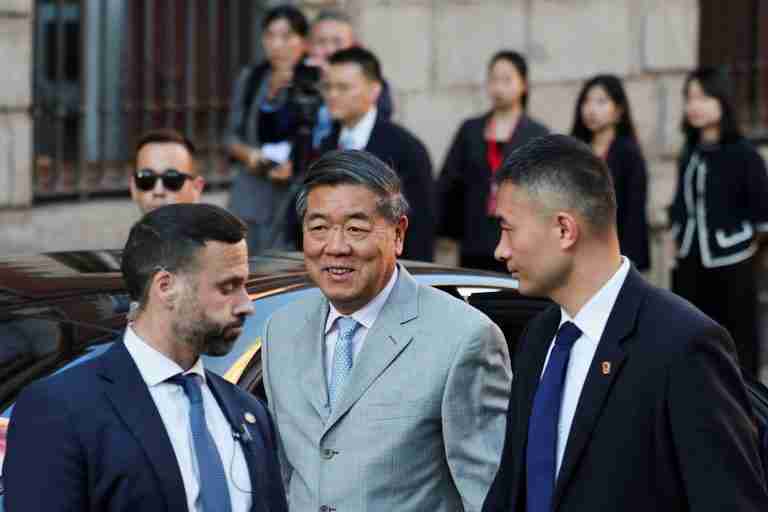
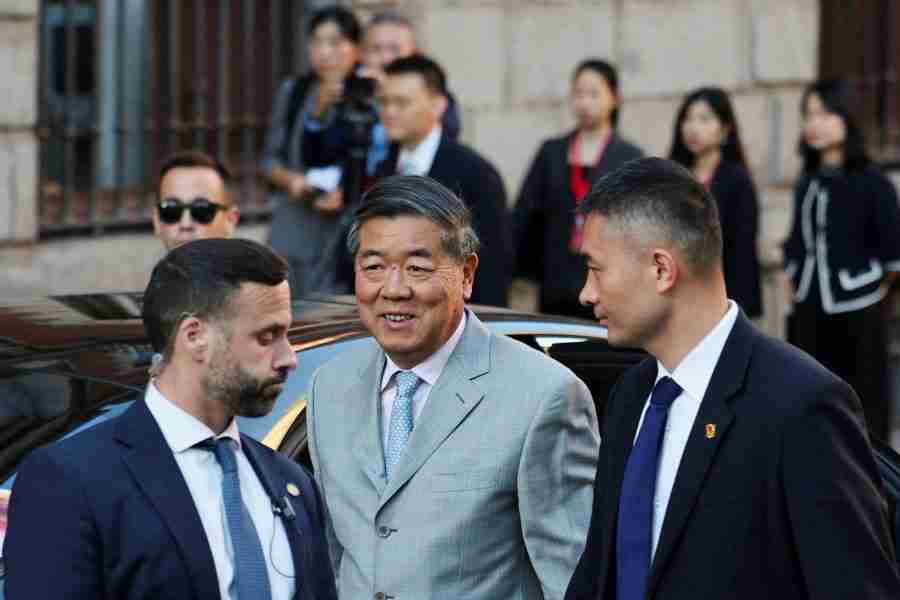
Delegations led by Bessent and Chinese Vice Premier He Lifeng have met in European cities since May to try to resolve differences that prompted U.S. President Trump to raise tariffs on Chinese imports and sparked tit-for-tat measures, including similarly high import duties by China on U.S. goods and a halt in the flow of rare earths to the United States.
The Trump administration, however, faces a ruling from the U.S. Supreme Court that could strike down the U.S. tariffs on Chinese goods imposed this year, potentially weakening Trump’s leverage over Beijing. A ruling is expected by early 2026.
The delegations last met in Stockholm in July, where they agreed to extend for 90 days a trade truce that sharply reduced triple-digit retaliatory tariffs on both sides and restarted the rare-earth exports from China to the United States.
LOW EXPECTATIONS
Experts had low expectations of a significant breakthrough in Madrid.
“I’m not expecting anything substantive between the United States and China unless and until there is a one-on-one meeting between Trump and (Chinese President) Xi,” said William Reinsch, a senior trade adviser at Washington think tank the Center for Strategic and International Studies.
“Setting that up is really what these talks are all about.”
Trump has repeatedly expressed interest in a meeting with Chinese President Xi Jinping, but Reinsch said the Chinese would not agree to such a meeting until they knew the outcome and were pushing for further easing of U.S. export controls on chips and other high-tech goods.
Even if a deal over Chinese divestment from TikTok was not reached it would not affect relations, Bessent added.
“It’s still very good at the highest levels,” “Ambassador Greer and myself have great respect for all counterparts.”
Reporting by David Lawder, Pietro Lombardi and Ethan Wang; Writing by Charlie Devereux; Editing by Lisa Shumaker, Clarence Fernandez and Susan Fenton
To provide the best experiences, we use technologies like cookies to store and/or access device information. Consenting to these technologies will allow us to process data such as browsing behavior or unique IDs on this site. Not consenting or withdrawing consent, may adversely affect certain features and functions.
Functional
Always active
The technical storage or access is strictly necessary for the legitimate purpose of enabling the use of a specific service explicitly requested by the subscriber or user, or for the sole purpose of carrying out the transmission of a communication over an electronic communications network.
Preferences
The technical storage or access is necessary for the legitimate purpose of storing preferences that are not requested by the subscriber or user.
Statistics
The technical storage or access that is used exclusively for statistical purposes.The technical storage or access that is used exclusively for anonymous statistical purposes. Without a subpoena, voluntary compliance on the part of your Internet Service Provider, or additional records from a third party, information stored or retrieved for this purpose alone cannot usually be used to identify you.
Marketing
The technical storage or access is required to create user profiles to send advertising, or to track the user on a website or across several websites for similar marketing purposes.