

Bermuda Evening News starting at 7pm…
CCTV system complete, town hall set for Thursday
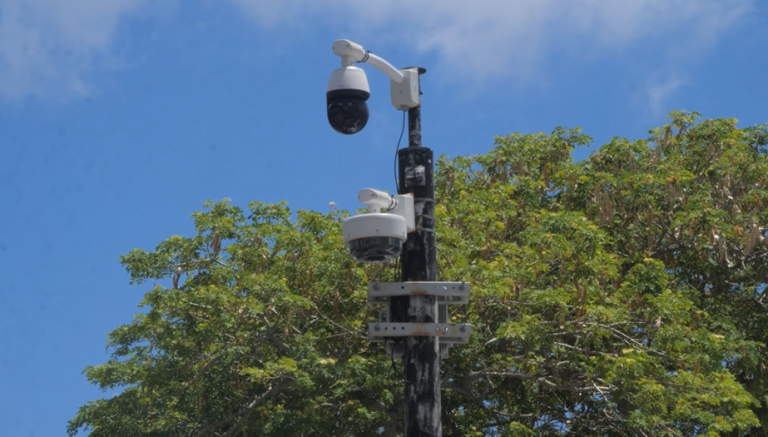
Residents invited to learn how the upgraded island-wide network supports safety, protects privacy, and aids police
The installation of Bermuda’s upgraded island-wide CCTV system is now complete and close to being fully operational.
This update comes from Minister of National Security Michael Weeks, who is inviting residents to a town hall meeting later this week to learn how the network supports public safety, protects privacy, and assists law enforcement.
He will be joined by Commissioner of Police Darrin Simons and Privacy Commissioner Alexander White in a setting that aims to present the facts and give residents a voice.
“The aim ultimately is to make sure that we all understand that the CCTV is not here to be an invasion, but to help us all as a community feel safer,” said Minister Weeks.
The project was completed this month ahead of schedule, with 225 cameras now integrated across 130 locations.
According to the Ministry of National Security, an expansion phase is already underway, with plans to add 20 more sites.
Minister Weeks hopes the upcoming town hall will give residents greater peace of mind about the system’s benefits but also offered a reminder that public safety remains a shared responsibility.
“What I hope to take from the town hall meeting for that that attend, is that any fears can be alleviated as far as the privacy is concerned,” he said. “But I want to stress while I’m talking about it, having the cameras doesn’t mean that we as a community become complacent. We all still have our part to do in helping our community to remain safe. So as I’ve always said, if you see something, say something. So don’t get lulled into the false premise that we’ve got our CCTV cameras up now, I don’t have to participate in community safety. The cameras are only part of the overall us working together to keep us all safe.”
While the system is fully installed, some fine-tuning is still in progress.
“We are complete, but I wouldn’t say at this point in time we’re 100% operational because it’s still got some things to work out, but we’re very, very close,” said Weeks. “I’m excited about it and I’m really confident that the system that we promised the country that we will have – we are very much there now. It’s giving the police another tool in their arsenal of helping to address crime, hopefully get investigations completed quicker and you know to give the everyday Mister and Missus Bermuda safety knowing that there’s a CCTV camera there – you know, somehow if something goes wrong, it could help them.”
Minister Weeks also noted that the presence of cameras may help deter some people from committing crimes.
However, it will still be some time before the system can be used to issue speeding tickets.
“Speed cameras is phase two, and we are already testing some of the cameras and there’s some legislation involved in having speed cameras to be able to send you a ticket in the mail and whatnot,” he explained. “But rest assured that phase two hopefully will be well on its way in the first quarter of 2026. So, beware those of you — not you personally — but those that want to break the law and speed and whatnot, that there will be a camera coming near you.”
The town hall meeting will be held on Thursday from 6 pm to 8 pm at St. Paul AME Centennial Hall in Hamilton.
Monday Sports Round-Up

Earl Basden bring us the latest from home soil and around the world, where our athletes continue to push boundaries. We start tonight with Boccia, and an impressive showing from Yushae DeSilva-Andrade in Poland.





Fight night KO’d by rain

Disappointment for Dockyard crowd as top-of-the-bill clashes called off

Only three official bouts went ahead after the exhibition match-ups and pre-fight entertainment. Photo by Kendal Trott
The highly anticipated Epic Entertainment Fight Night, set to electrify audiences with a night of boxing and kickboxing, ended in frustrating fashion as rain brought an early halt to proceedings.
With the open-air event’s ring uncovered, organisers were left with no option but to call off the evening for the safety of the fighters, as the heavens opened and rendered the canvas too dangerous for competition.
A large crowd had gathered at the Victualling Yard in Dockyard, eager to witness headline acts like Bermuda’s Dash Simmons against Jamaica’s Ian Darby, and the professional boxing debut of Bermudian Adrian Roach, who was set to face Canada’s Brent Coxworthy in the co-main event.
However, after all the exhibition bouts and pre-fight entertainment, only three official contests on the card were able to be completed. Sadie Woodstra secured a victory over Bermudian Muryah Swan by Unanimous Decision, while Jashun Thomas defeated Daniel Bacchus and the middleweight fight between Cole Durham and Michael Roldan, was won by Roldan.
The washout was a bitter disappointment for both fighters and fans who had eagerly awaited the night of combat sports.
Scooter Mart Motor Fest brings the heat with custom rides and Clutchup Corey

The Scooter Mart Motor Fest, held each summer, is a signature event organised by Bermuda Charge.
It took place over the weekend with over 100 vendors, and featured custom and vintage bikes, modified cars, scooters, auto parts, eco-products, foodstalls – and an abundance of community spirit.
While capturing the sights and sounds of the event, Kendal Trott spoke tocelebrity motor stunt rider Clutchup Corey.
Paralympian narrowly misses out on bronze medal

Boccia player Yushae DeSilva-Andrade enjoyed an impressive campaign in Poland
Yushae DeSilva-Andrade, one of the world’s leading BC1 athletes.
Paralympian and current Female Athlete of the Year, Bermuda’s Boccia star Yushae DeSilva-Andrade, has concluded her impressive campaign at the Poznan 2025 World Boccia Challenger in Poland.
After a dominant performance in the group stages and a tightly contested semi-final, she ultimately competed for the bronze medal.
DeSilva-Andrade faced off against Dora Basic from Croatia in the Bronze Medal match. In a hard-fought contest, the Bermudian went down by a score of 6-2.
Her journey in Poznan began with a sensational run through the group stages, where she won all four of her matches to top Pool A in the BC1 women’s division. She advanced to the semi-finals, where she was narrowly edged 3-2 by Desirée Segarra from Spain.
While a bronze medal eluded her in the final match, DeSilva-Andrade’s consistent high-level play throughout the tournament, including reaching the medal round, underscores her status as one of the world’s leading BC1 athletes.
Her performance adds valuable ranking points and crucial experience as she continues to compete on the international Boccia circuit.
Union: Dock bosses must honour agreement

An overtime ban at the docks is the latest in a five-year dispute that raises questions over Collective Bargaining Agreements
Fresh produce may take longer to hit the shelves after port workers have implemented an overtime ban, exacerbated by the breakdown of dock cranes.
The union’s dispute with the management of Hamilton Cargo Docks has dragged on for 5 years, over the unfair dismissal of Chris Furbert Jr, son of BIU President Chris Furbert, back in 2020.
The row may also raise questions about labour relations, and the strength of Collective Bargaining Agreements.
Late last year, an Employment and Labour Relations Tribunal ruled that the dismissal of Chris Furbert Jr was unfair, and awarded Mr Furbert just over $250,000 in compensation. The tribunal did not, however, order that he should be reinstated.
Dawud Tucker, President of the Port Workers Division of the BIU, argues that the Collective Bargaining Agreement states that a wrongfully terminated employee should be reinstated and receive any losses.
Union members cited the potential undermining of the Collective Bargaining Agreement as one of the reasons behind the industrial action.
With a cargo crane out of service, it appears the matter has further threatened local goods reaching the island.
In the report above, Gary Foster Skelton provides the background on the dispute, and speaks with Dawud Tucker, President of the Port Workers Division of the BIU.
One crane back online
Meanwhile, one of two cranes servicing the Hamilton Docks has been repaired.
Randy Rochester, the CEO of Polaris, the parent company for SSL, said one crane is in service, “with the second crane being worked on by the local and overseas technicians.”
He added, “if all goes well, we should have both cranes operating as soon as possible – and things will return to normal on the docks.”
The cause of the fault is unclear.
BBC Radio News: Monday Noon – 30 June 2025

5-year dispute leads to docks overtime ban, PLP MP rejects Opposition call for status to ease living costs & sports news


Fire service installs smoke alarms for seniors
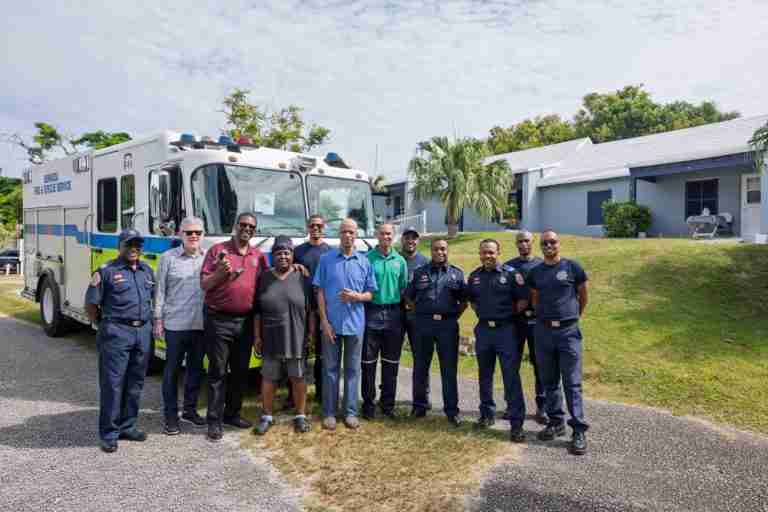
The initiative is part of the BFRS’s fire prevention and community outreach programme
Government of Bermuda media release:
The Ministry of National Security is pleased to highlight the recent community outreach efforts of the Bermuda Fire and Rescue Service (BFRS), as part of its ongoing commitment to public safety.
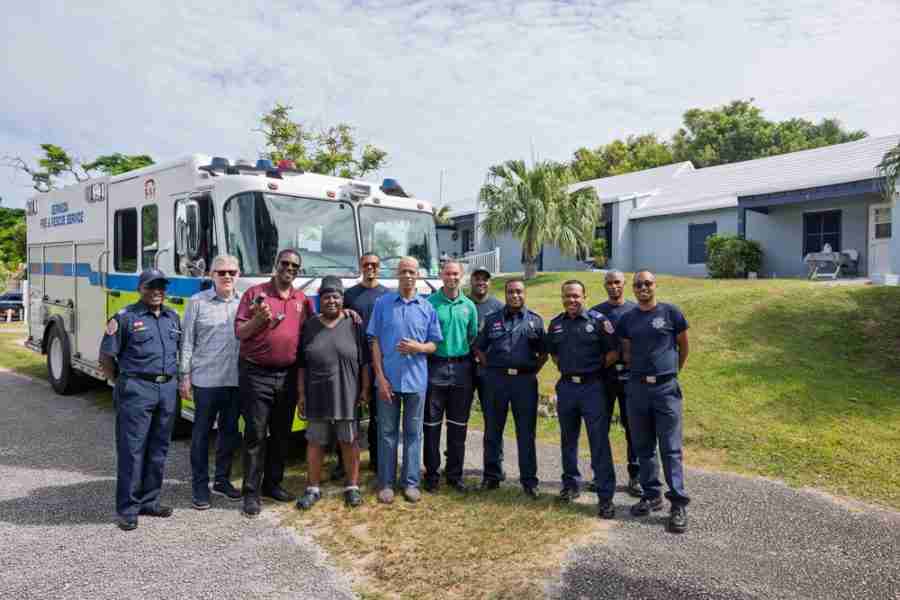
A team from the BFRS visited the Elizabeth Hills seniors’ residences on Happy Valley Road in Pembroke, where they installed free smoke detectors in approximately 15 apartments.
This initiative forms part of the BFRS’s fire prevention and community outreach programmes and provides residents with fire safety literature and smoke alarm brochures.
The Minister of National Security, the Hon. Michael Weeks, JP, MP, praised the initiative, stating: “I want to extend my heartfelt thanks to the dedicated men and women of the Bermuda Fire and Rescue Service for their outstanding service to our community.
“Their proactive approach to fire prevention, particularly in safeguarding our seniors, reflects the very best of public service.
“Our seniors hold a special place in my heart, and I am deeply appreciative of efforts like these that help keep them safe. I also want to sincerely thank Mr. John Barritt, a former Parliamentarian and the chairman of the Bermuda Housing Trust for his support in facilitating this important initiative.”

Acting Chief Fire Officer Troy Furbert added: “The Bermuda Fire and Rescue Service is proud to serve our community in emergencies and through preventative measures like this.
“Our mission is to protect life and property, and initiatives such as these demonstrate the dedication of our team to making a positive impact. We will continue to engage with our most vulnerable residents to promote safety and peace of mind.”
Mr Barritt commented: “We very much appreciate the unsolicited contribution of the Bermuda Fire and Rescue Service in this important way. It was a pleasant and welcome surprise.
“The Trust’s legislated mandate is to provide affordable rental accommodation for our seniors, that is as affordable as possible. We have also had a long-standing policy of never raising rents on sitting tenants.
“There are challenges not the least of which are the rising costs to maintenance of the five properties we manage, some 200 units in total.
“So when the Fire Service stepped up with their offer to assist in this way we embraced it without hesitation. New smoke alarms also add to the safety and security of our seniors. The BFRS is to be commended for its charity and pro-active work in the community.”
NATO fund backs biotech startup in push to counter biological threats

UK-based Portal Biotech’s capability is essential for biosecurity defence and security

International news via Reuters:
The NATO Innovation Fund has made its first investment in a biotechnology company, it said on Monday, seeking to enhance defences against biological threats
The fund is co-leading a $35 million fundraising round for Portal Biotech, which uses protein sequencing to detect engineered threats and defend against biological warfare.
UK-based Portal Biotech’s capability is essential for biosecurity defence and security, said Ana Bernardo-Gancedo, senior associate at NATO Innovation Fund.
“We believe that it is absolutely imperative that we are able to detect, monitor and create countermeasures,” she said.
The fund, created in 2022 after the Russian invasion of Ukraine, plans to invest more than $1 billion in technologies that would enhance NATO’s defences.
Portal Biotech uses an AI-backed technology with biological sensors that can work at the single molecule level on-site, giving results within hours.
“It’s for everything from measuring diseases to better pandemic prevention … you can take this out of large labs with long turnaround times and into the field,” CEO Andy Heron told Reuters.
Heron said the company’s instruments can detect any pathogen and can be used for continuous monitoring of anything from a field to water supply.
“It allows you not just to detect what you did know was out there, but it allows you to detect what you didn’t know,” he said.
Beyond biosecurity, Portal Biotech expects its portable equipment to aid in drug discovery and precision medicine.
The company’s investors include Earlybird Venture Capital, Science Creates VC, Pillar VC, 8VC, We VC and British Business Bank.
Reporting by Supantha Mukherjee in StockholmEditing by David Goodman
China is quietly supplanting Russia as Cuba’s main benefactor

Ships arriving last year from prominent Chinese ports carried solar panels, steel, tools and parts

International news via Reuters:
Hours over rutted roads inland from Havana, the small Cuban city of Jatibonico is a snapshot of late 19th-century living, its streets crowded with horse-drawn carriages and lacking power much of the day and night.
The town’s decrepit sugar mill – once the country’s largest – sits idle, lacking the parts, electricity, and fuel it needs to operate.
Two years ago a Russian company, Progress Agro, announced it would import machinery, fertilizer, and know-how to revitalize the mill, which once employed 2,000 people.
“When are the (Russians) coming? That’s all anybody talks about,” said Carlos Tirado Pino, 58, a mill maintenance worker among the few to retain his post.
Meanwhile, just outside town and out of sight, three bulldozers clear an abandoned cane field to prepare for the installation of a Chinese-financed solar park that will deliver 21 MW of electricity – one of 55 similarly sized such solar parks underwritten by China across Cuba this year.
Cuba is in desperate need of help. Shortages of food, fuel and medicine, grueling hours-long blackouts and plunging tourism and exports – combined with renewed U.S. sanctions under the second Trump administration – have devastated its economy.
A Reuters review of various sites on the ground suggests that where many of Russia’s most recent promises have fizzled, China has discreetly stepped up to fill the void, pushing ahead with a number of critically-timed projects aimed at helping Cuba salvage its economy.
Cuba joined China’s Belt and Road Initiative in 2018, and China has since invested in several strategic infrastructure projects on the island, including major projects in transportation, port infrastructure and telecoms, while Russia, mired in a war in Ukraine and leery of lending more money to crisis-racked Cuba, has faded as a historic partner.
“Russia’s promises have always been bigger than its performance,” said William LeoGrande, a professor of Latin American politics at American University. “If China is now stepping up its assistance in light of Cuba’s desperate conditions, that could prove to be a real lifeline.”
Neither the Russian nor Chinese embassies in Havana responded to a request for comment.
CHINA DELIVERS
The solar park project positions China as a pivotal partner for Cuba at a time of nearly unprecedented crisis: the country’s national grid has collapsed four times in the past year alone, leaving millions in the dark and shuttering schools and businesses.
On February 21, Cuba inaugurated a solar park in Cotorro, outside the capital, in a ceremony that included China’s ambassador to Havana, Hua Xin and Cuban President Miguel Diaz-Canel, who lauded the project in a statement as a “collaboration from our sister Republic China.”
The fine print of the agreements between Russia and China and longtime ally Cuba remain largely confidential, making it difficult to discern how either country operates in Cuba, through private companies or via public financing and how the Cuban government might be repaying them.
Since then, at least another eight have come online, according to grid operator UNE, churning out nearly 400 MW of sun-fueled energy together with existing parks – about a third of the mid-day deficit.
New Chinese-funded projects alone are expected to push that figure over 1,100 MW by the end of the year, according to official estimates, nearly covering the daytime shortfall and saving Cuba precious fuel to burn at night.
Officials at the February event announced China was participating in a project to modernize Cuba’s entire electrical grid, with 55 solar parks to be built in 2025, and another 37 by 2028, for a total of 2,000 MW – a massive undertaking that, when complete, would represent nearly two-thirds of present-day demand.
The port of Mariel – Cuba’s main shipping center just west of Havana – saw traffic from China begin to tick up in August of 2024, according to shipping data and two foreign businessmen who declined to give their names for this story.
Ships arriving last year from Shanghai, Tianjin and other prominent Chinese ports carried solar panels, steel, tools and parts. The “kits” came complete with fuel for overland transport to assure the panels would make it to their destinations, the sources said.
The arrival of Chinese ships is being felt across the Cuban countryside, as tractor trailers with Chinese markings rumble across pot-holed roads to reach far-flung destinations like Jatibonico.
Truck driver Noel Gonzalez, who on a recent morning delivered a load of gravel fill to the solar park site on the city’s outskirts, said he was both amazed and grateful for the Chinese diligence.
“The Chinese (workers) come and periodically check every liter of petroleum, every route we take,” Gonzalez said.
Fulton Armstrong, a former U.S. National Intelligence Officer for Latin America, called China’s investments a “big benefit” but warned they won’t be enough to overcome the Trump administration’s renewed sanctions on the island.
“Havana can’t bank on either Russia or China coming in with magic pills,” he said. “Only massive amounts of Chinese trade and assistance could pull the island through – and that just doesn’t seem plausible.”
China’s strategic investments in Cuba coincide with U.S. accusations that China is installing “spy bases” on the nearby Caribbean Island, though Cuba and China have denied the allegations.
RUSSIAN ROULETTE
Two years ago, as Cuba’s economy was still reeling from the COVID-19 pandemic and U.S. sanctions, Russia too was ready to lend a hand.
In May 2023, Russian Deputy Prime Minister Dmitry Chernyshenko arrived in Cuba for a ribbon-cutting ceremony that marked the reopening of the island’s largest steel mill, a project made possible thanks to $100 million in Russian financing, Cuban state-run media reported.
Chernyshenko called the mill’s reopening a “fine example of Russian-Cuban cooperation.”
The mill’s plant director, Reinier Guillén, promised output of steel bars from the facility would soar to 62,000 metric tons in 2024. But Russia’s investment did not translate into production.
Cuba’s statistics agency ONEI reported in April that the island had churned out just 4,200 metric tons of steel bars in 2024.
On a recent weekday morning, the mill was quiet. A prominent smoke stack was idle, and no activity could be seen within the plant.
Esperanza Perez, a lifelong local resident who works at a small bakery in a ramshackle development of shanties and crudely-built homes, many without electricity or water, said the mill had sat idle for months.
“Talk is cheap. When (the mill) is running, we hear the noise, see the workers, but I haven’t seen any sign that it is operating,” said the 37-year-old Perez. “We’ve seen no benefits here.”
Cuba’s government did not reply to a request for comment on the discrepancy in output. But fuel and electricity generation shortages have affected industry across the island, crippling production.
The day after the ribbon-cutting at the steel mill, Chernyshenko appeared with Diaz-Canel to sign at least eight agreements between Cuban state agencies and Russian state and private companies, according to a document obtained by Reuters summarizing those deals.
The wide-ranging agreements included a deal to guarantee Cuba a supply of wheat for bread making, the opening of a well-stocked “Rusmarket” in Havana, the restoration of historic architecture in the capital’s historic district and cooperation in artificial intelligence.
There was even a bold plan to rebuild the crumbling Tarara residential beach community, whose coveted white sands and palm-fringed waterfront just minutes from Havana have been largely off-limits to foreign capital since 1959.
But on a recent visit, most of the homes at Tarara appeared abandoned or in disrepair, with only a small number near the beach refurbished and no sign of Russian investment.
At the community marina, a single boat, its bottom covered with slime, swayed at the dock, the harbor’s entrance blocked by sediments and its waters stagnant.
Plans to open the Rusmarket – initially celebrated as a foot in the door for Russian vendors and products – have been delayed for two years. The nearby Yumuri department store, where Russian investors planned to open a bigger shop in June or July stocked with everything from Russian auto parts to canned trout and children’s toys, also appeared largely abandoned.
A Russian agreement to restore the 19th century Santo Angel building in Havana’s historic Plaza Vieja, in a nod to Cuba’s rich architectural history, also appeared stalled.
Reuters was unable to make contact with CGC Investments, the Russian firm that had inked many of the 2023 deals.
Neither the Russian embassy nor its Foreign Ministry responded to a request for comment.
To be sure, some of Russia’s promised aid has come through. Russian state-backed companies have supplied cargos by sea of both wheat and oil to the island. And Russia, like China, has promoted tourism to the island, offering a bump in foreign visitors and much-needed foreign exchange.
In May, two years after the 2023 flurry of announcements, Russia’s Chernyshenko announced a plan to subsidize interest rates for businesses interested in investing as much as $1 billion on the island, calling Cuba a “reliable partner.”
“There’s still a lot of hard work to be done, we’ll advance little by little,” Chernyshenko told reporters in Moscow, adding that “it is impossible to achieve things immediately, as if by magic.”
Reporting by Dave Sherwood, additional reporting by Mario Fuentes, Marc Frank and Norlys Perez; Editing by Christian Plumb and Michael Learmonth.
