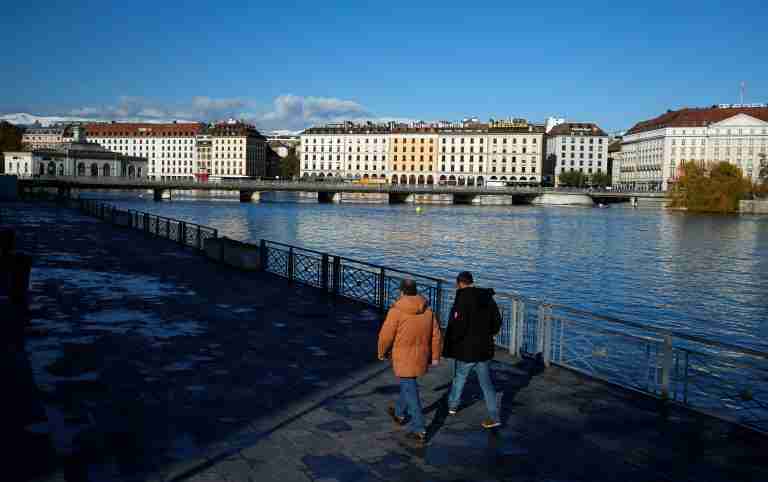
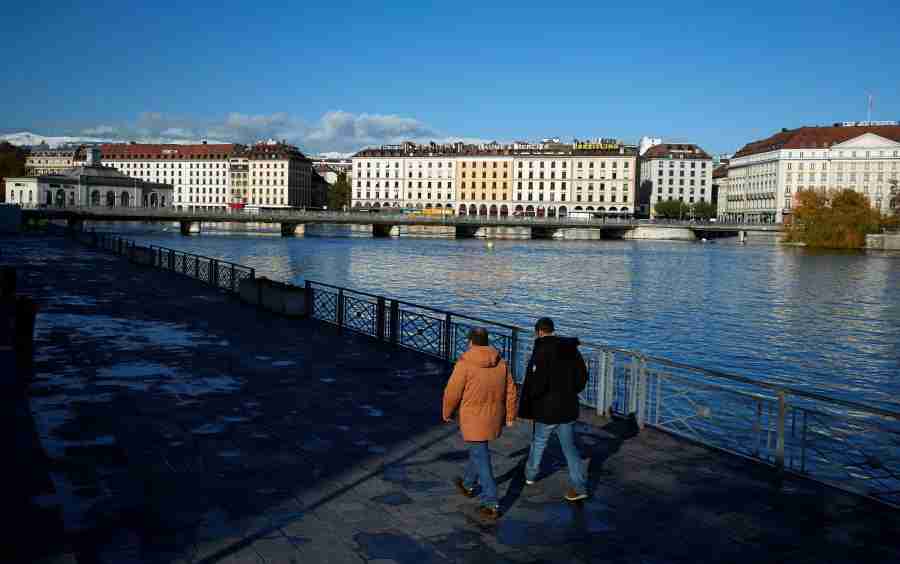
Switzerland is home to around three times as many Fortune Global 500 companies per capita as the United States
FILE PHOTO: People walk along the Leman shores in the commercial and financial District in Geneva, Switzerland, November 12, 2019. REUTERS/Denis Balibouse/File photo
International news via Reuters:
Top Swiss officials will this week test whether big commitments to the U.S. can help secure relief from import tariffs, after pharma giant Roche followed its cross-town rival Novartis in announcing major investments in the United States.
Roche on Tuesday said it would invest $50 billion in the United States over the next five years, a day before Swiss Finance Minister Karin Keller-Sutter and Economy Minister Guy Parmelin lead a delegation on a three-day visit to Washington.
They want to underline how important Swiss business is to the United States as they seek to persuade President Donald Trump not to hit the country with tariffs that were initially set significantly higher than those for the European Union.
Switzerland was shocked by the tariffs and there is broad support in parliament for officials to show how many billions Swiss firms invest now and will do in future, said Sibel Arslan, deputy chair of the lower house foreign relations committee.
“This is the only way,” the Green Party lawmaker told Reuters. “Now we’ll have to see whether the strategy comes off.”
After the U.S. announced its import duties, one prominent Swiss lawmaker said Switzerland, which abolished its own industrial tariffs last year, should tell Trump it would invest $100 billion during his term. Others floated higher numbers.
Purely between Basel-based Roche and Novartis, which committed $23 billion earlier in April, the Swiss officials arrive in Washington armed with hefty investment pledges that Trump-friendly media in the U.S. have vigorously celebrated.
Roche said its investment was aligned with the government and part of ongoing discussions between Switzerland and the U.S.
Chocolate maker Barry Callebaut and engineering group ABB are among other firms to make commitments from Switzerland, the seventh-biggest foreign investor into the United States.
Keller-Sutter, who is also Switzerland’s rotating one-year president, spoke to Trump by telephone hours before he announced a 90-day pause on his original tariffs, which cut the 31% rate for Switzerland to the 10% now applied to most countries.
She is due to meet U.S. Treasury Secretary Scott Bessent on her Washington visit, which takes place during the World Bank and International Monetary Fund Spring meetings. Her government has not given details of other meetings.
GOLDEN EGG
For all the U.S. economic commitment demonstrated by the Swiss, Bern has hinted the Trump administration should not take its financial muscle for granted.
A day after Trump announced his tariffs, Economy Minister Parmelin warned they could work against the U.S. if they led to firms putting “the brakes on certain investments”.
Lawmaker Arslan agreed, saying Switzerland, whose export-oriented economy is bigger than that of many much larger countries, should not allow itself to be taken advantage of.
At around $100,000, Swiss GDP per capita was in 2023 about 20% higher than the United States, World Bank data show.
Switzerland is also home to around three times as many Fortune Global 500 companies per capita as the United States, led by the likes of Nestle, Glencore, Roche and Novartis.
Klaus Stoehlker, a Zurich-based public relations consultant, said given the difficulty even allies of Trump have had in steering him away from tariffs, the Swiss delegation was on a “journey of hope” in Washington.
But big investment announcements were the most powerful weapon Switzerland could deploy in attempting to remind Trump of the ties binding the U.S. and Swiss economies, he said.
Not only are Swiss companies among the top investors in the United States, they are also major sources of revenue for U.S. investors like Blackrock and the Vanguard Group that have big holdings in Swiss corporations, Stoehlker said.
“Economically speaking, Switzerland is part of the U.S.,” he said. “They’re not going to break this Swiss golden egg.”
Reporting by Dave Graham; Additional reporting by John Revill; Editing by Hugh Lawson
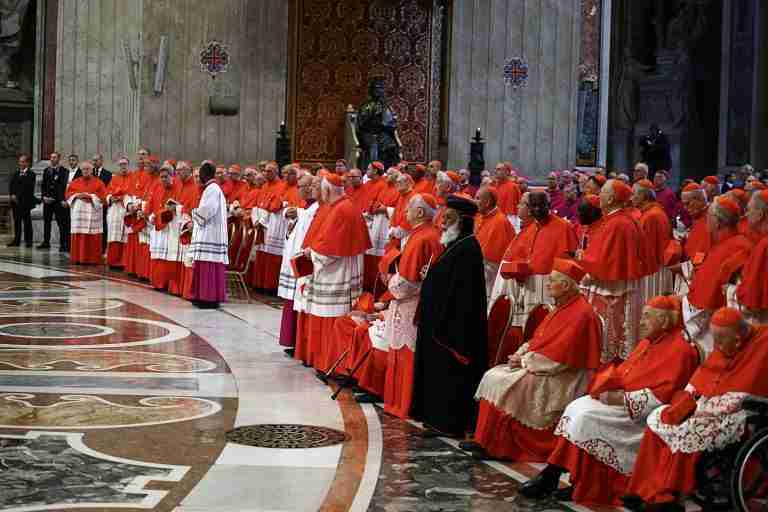
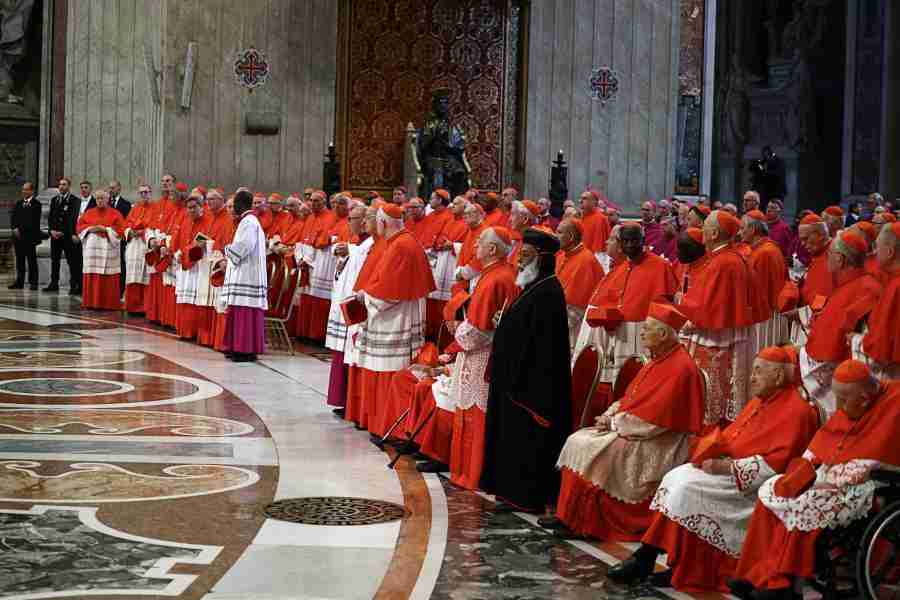
Church law should states that the selection process will begin no earlier than May 6
Cardinals stand, on the day of the translation of Pope Francis’ body, in St. Peter’s Basilica at the Vatican, April 23, 2025. REUTERS/Yara Nardi
International news via Reuters:
No one knows who the world’s Catholic cardinals will choose to succeed Pope Francis as the new leader of the global Catholic Church. But for those watching attentively, there are sometimes hints about who might emerge as the next pontiff.
The process to choose a new pope is long and secretive. Most of the world’s 252 cardinals are coming to Rome to take part. Those under the age of 80, about 135 prelates, are preparing to enter into a conclave to elect the next pontiff.
Once it starts, which by Church law should be no earlier than May 6, the cardinals will be completely shut off from the modern world until a new pope is named.
In the meantime, they can attend public events and give interviews about what they are looking for in the next leader of the world’s 1.4 billion Catholics.
“Reading the pre-conclave signs to identify papal candidates is tricky, because the signs are usually very subtle,” said John Thavis, a Vatican correspondent who covered three papacies.
Francis died on Monday aged 88. There is no clear frontrunner to succeed him.
As the pope was recovering from pneumonia over the Easter weekend, he asked retired cardinals over the age of 80 to preside in his place at the Vatican’s various celebrations of the holiday, possibly because he did not want to signal any favourite successor.
The pope’s funeral, on Saturday, April 26, will be the first big moment to watch for signs of who might be next.
Tens of thousands, including dozens of world leaders such as U.S. President Donald Trump and Ukrainian President Volodymyr Zelenskiy, are expected in St. Peter’s Square for the ceremony. Millions more will be watching across the globe.
The cardinals attending will listen closely to the sermon given by Italian Cardinal Giovanni Battista Re, the ceremonial leader of the College of Cardinals and a retired Vatican official.
At the funeral of Pope John Paul II in 2005, the sermon was delivered by German Cardinal Joseph Ratzinger, who offered what many thought was a stirring elocution on the late pope’s life and legacy.
Eleven days later, Ratzinger would be elected as Pope Benedict XVI.
Re is 91 years old, cannot enter the conclave and is not a papal contender. But insiders expect he might still try to offer a guide for his confreres to follow in the way he chooses to describe Francis’ papacy, or in any words he uses to describe the needs of the Catholic Church today.
HINTS EMERGING SLOWLY
The papal funeral marks the first of nine days of mourning for the global Church. Another Mass of mourning will be held in St. Peter’s Square on Sunday. That will be led by Italian Cardinal Pietro Parolin, often cited as a leading papal contender.
“The cliche … is he who enters the conclave a pope leaves a cardinal,” said Christopher Bellitto, an historian at Kean University in New Jersey who specializes on the Church. “Only prophets know what is going to happen.”
Other hints for possible successors to Francis will likely come out more slowly.
In 2013, as the cardinals gathered in Rome after Benedict’s surprise resignation, some of the U.S. prelates preparing to take part in the conclave started giving press conferences.
The wider group of the world’s cardinals later asked them to stop doing the briefings.
Even if there are no press conferences this time, cardinals spending time in Rome often celebrate Masses at churches across the city. The sermons they offer on those occasions could give indications of what they are thinking.
“Any signs will come in bits and pieces, or phrases used to describe what cardinals are looking for in the next pope,” said Thavis.
“Words like ‘openness’ and ‘reform’ may fit certain cardinals, while ‘administrative skills’ and ‘solid theology’ may describe others,” he said.
BEHIND CLOSED DOORS
The biggest hints will come in the daily meetings the cardinals have in the week leading up to the conclave.
In these meetings, known as “general congregations”, the cardinals have an opportunity to speak freely and even, perhaps, to offer a vision for a future papacy under their own leadership.
In 2013, Argentine Cardinal Jorge Mario Bergoglio offered a short reflection at one of those meetings.
He said the Church, beset by sexual abuse and financial scandals, had become “sick” and too “self-referential”, according to a text that was later published. He said the Church needed to do a better job of trying to open itself up to the modern world.
A few days later, Bergoglio would be elected as Pope Francis.
The final deliberations about who should follow Francis will take place in conclave. The cardinals who enter the Sistine Chapel to vote will be sealed off from the world, forbidden from reading newspapers or speaking with the outside world.
As they enter their deliberations, Archbishop Diego Ravelli, who leads the Vatican’s liturgical celebrations, will shout, in Latin, “Extra omnes!” (Everyone out!)
Reporting by Joshua McElwee; Editing by Alex Richardson
On-record as the worst attack on civilians in India since the 2008 Mumbai shootings
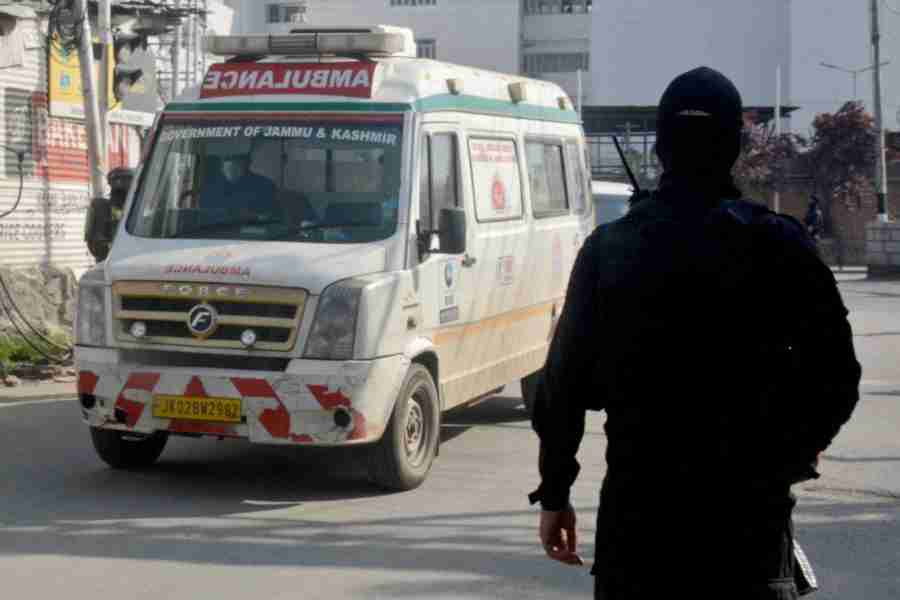
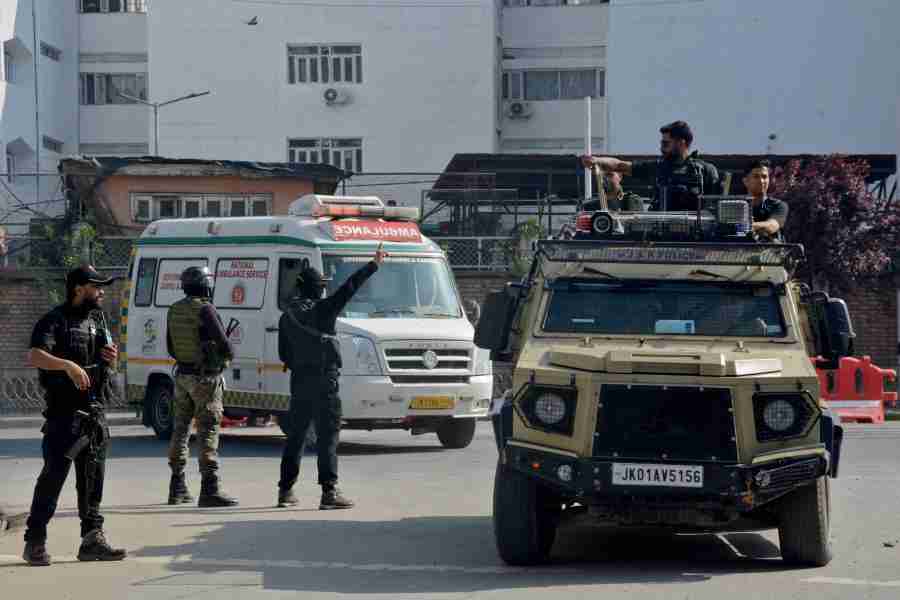
An ambulance carrying the bodies of tourists, who were killed in a suspected militant attack, is seen near Pahalgam, arrive at the police control room in Srinagar April 23, 2025. REUTERS/Stringer
International news via Reuters:
Twenty-six men were killed and 17 were injured when suspected militants opened fire at tourists in India’s Jammu and Kashmir territory, police said on Wednesday, the worst such attack in the country in nearly two decades.
It was the worst attack on civilians in India since the 2008 Mumbai shootings, and shattered the relative calm in Kashmir, where tourism has boomed as an anti-India insurgency has waned in recent years.
The attack took place on Tuesday in the Baisaran valley in the Pahalgam area of the scenic, Himalayan federal territory and the dead included 25 Indians and one Nepalese national, police said.
The attack is seen as a setback to what Prime Minister Narendra Modi and his Hindu nationalist Bharatiya Janata Party have projected as a major achievement in revoking the semi-autonomous status Jammu and Kashmir enjoyed and bringing peace and development to the long-troubled Muslim-majority region.
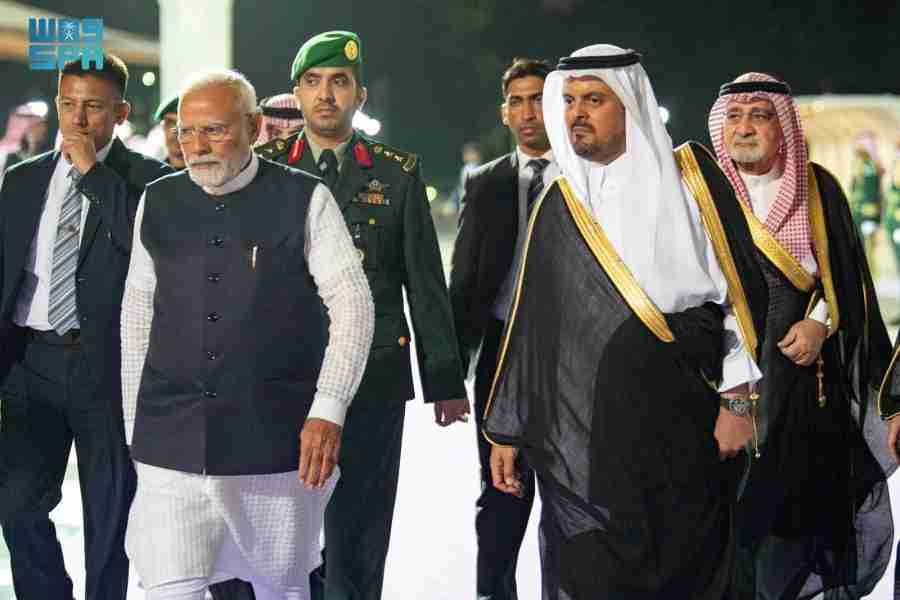
Modi cut short his two-day visit to Saudi Arabia and returned to New Delhi on Wednesday morning. Finance Minister Nirmala Sitharaman was also cutting short her visit to the United States and Peru “to be with our people in this difficult and tragic time”, her ministry said.
Modi held a meeting with the national security adviser, the foreign minister and other senior officials at the airport and a special security cabinet meeting had been called for 1230 GMT, a defence ministry official said.
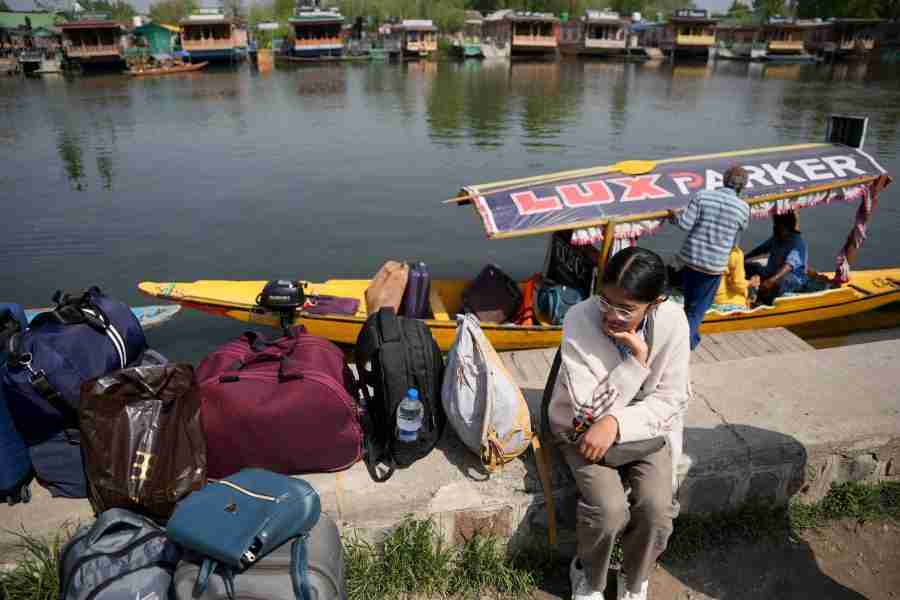
A tourist sits on the banks of Dal Lake with her belongings as she waits for transport to leave for Srinagar airport, following a suspected militant attack near south Kashmir’s scenic Pahalgam, April 23, 2025. REUTERS/Sanna Irshad Mattoo
A little-known militant group, the “Kashmir Resistance,” claimed responsibility for the attack in a social media message. It expressed discontent that more than 85,000 “outsiders” had been settled in the region, spurring a “demographic change”.
In a fresh statement on Wednesday, the group said that the “individuals targeted were not ordinary tourists; instead, they were linked to and affiliated with Indian security agencies”.
“It was not a typical tourist group but rather an undercover agency tasked with research,” it said and added that the attack should “serve as a wake-up call not only for Delhi but also for those who support Delhi’s questionable strategies”.
“Resistance fighters plan to intensify their strategic attacks to ensure that those involved in undermining … (the) resistance struggle face appropriate consequences,” it warned.
Hundreds of security forces rushed to the Pahalgam area soon after the attack and a massive combing operation was launched in the forests there, two security sources told Reuters. About 100 people suspected to have been militant sympathisers in the past were called to police stations and questioned, they added.
Police also released sketches of three of the four suspected
attackers.
The attackers were dressed in traditional long shirts and loose trousers and one of them was wearing a bodycam, one security source said, adding that there were about 1,000 tourists and about 300 local service providers and workers when the attack took place.
Makkah Region Deputy Governor Prince Saud bin Mishal bin Abdulaziz accompanies India’s Prime Minister Narendra Modi as he cuts his two-day trip short to Saudi Arabia, following a suspected militant attack near south Kashmir’s Pahalgam, in Jeddah, Saudi Arabia, April 22, 2025. Saudi Press Agency/Handout via REUTERS
They opened fire at three spots in Baisaran valley which is popular among tourists for its lush meadows and pristine landscape surrounded by dense pine forests on all sides.
Visitors have to trek or hire ponies to reach the spot where there are adventure sports facilities such as ziplining and zorbing.
Indian security agencies say Kashmir Resistance is a front for Pakistan-based militant organisations such as Lashkar-e-Taiba and Hizbul Mujahideen. Pakistan has said it only provides moral and diplomatic support to the insurgency in Kashmir.
“We are concerned at the loss of tourists’ lives,” Pakistani foreign ministry spokesman Shafqat Ali Khan said in a statement. “We extend our condolences to the near ones of the deceased and wish the injured a speedy recovery.”
Indian security forces personnel escort an ambulance carrying the bodies of tourists who were killed in a suspected militant attack near Pahalgam, outside the police control room in Srinagar April 23, 2025. REUTERS/Stringer
KASHMIR SHUTDOWN
On Wednesday, over a dozen local organisations called for a shutdown in the federal territory to protest against the attack on tourists, whose rising numbers have helped the local economy.
Many schools also suspended classes for the day in protest.
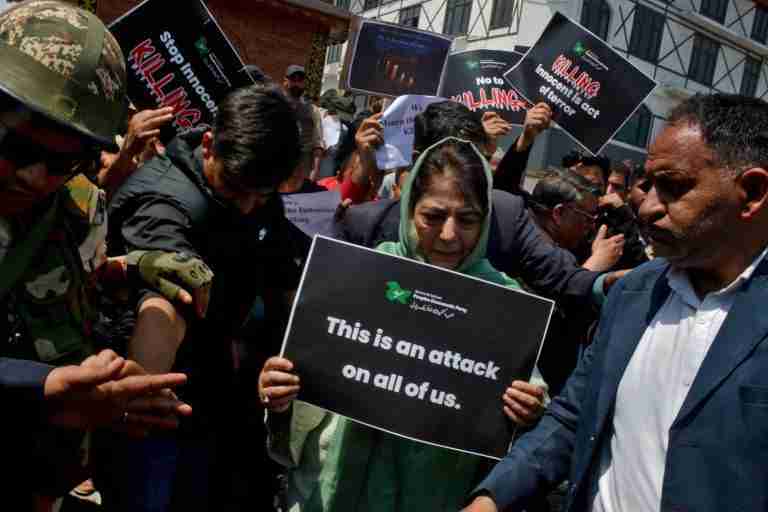
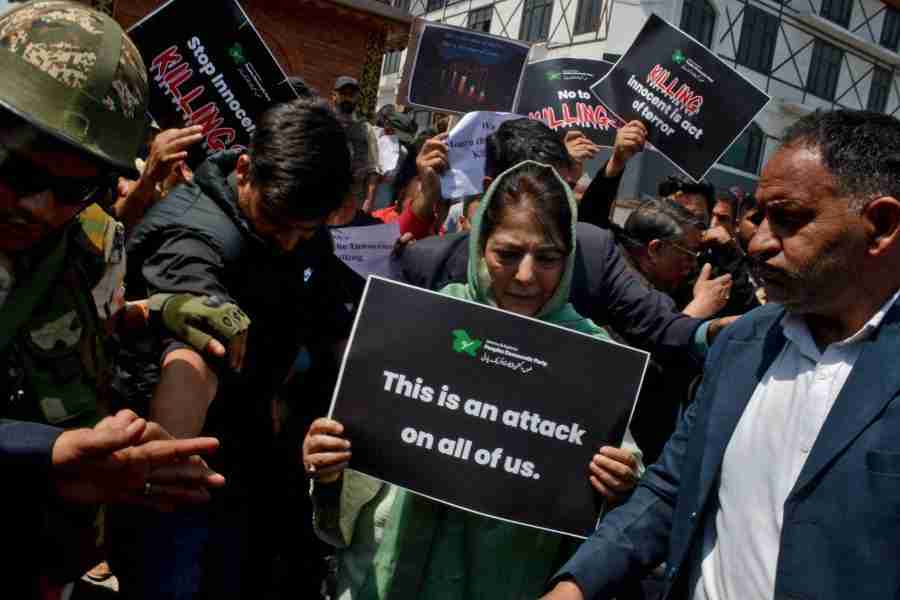
The shutdown was total and protest marches were taken out in parts of the Kashmir Valley, with people shouting slogans such as “Stop killing innocents”, “Tourists are our lives”, “It is an attack on us”.
“I want to say to the people of the country that we are ashamed, Kashmir is ashamed,” former Jammu and Kashmir Chief Minister Mehbooba Mufti said in a statement. “We are standing with you in this time of crisis.”
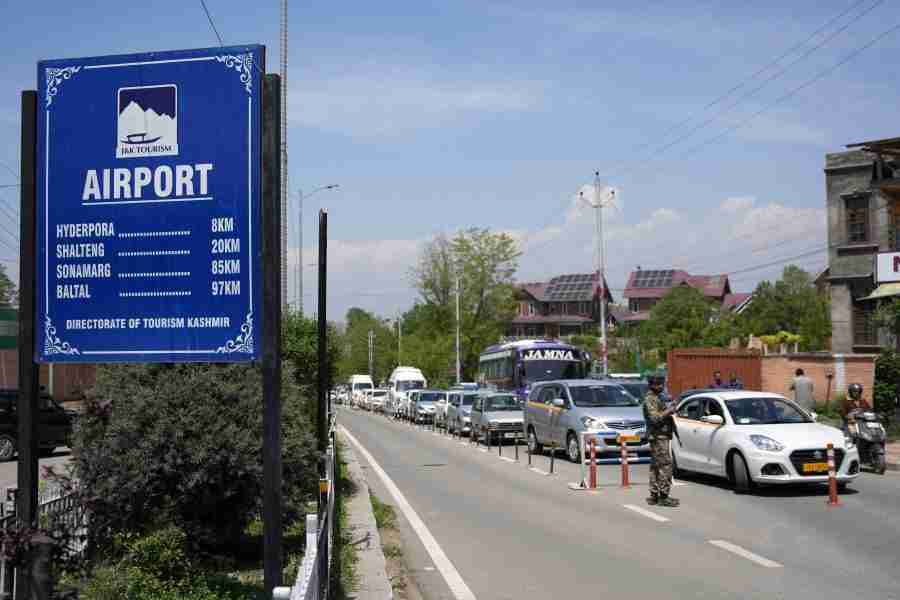
Airlines were operating extra flights from Srinagar, the summer capital of the territory, as visitors were rushing out of the region, officials said.
“It’s heartbreaking to see the exodus of our guests,” serving Chief Minister Omar Abdullah said on X, adding that the main highway connecting Srinagar to the rest of the country which was damaged by heavy rain had been opened for one-way traffic out of Srinagar to help tourists leaving by road.
An Indian security force trooper keeps guard next to vehicles carrying travellers including tourists outside the airport in Srinagar, following a suspected militant attack in south Kashmir’s scenic Pahalgam, April 23, 2025. REUTERS/Sanna Irshad Mattoo
Television visuals showed tourists carrying their bags to taxis and filing out of a hotel in Srinagar.
“How can we continue our trip in such a situation?” Sameer Bhardwaj, a tourist from New Delhi, told news agency ANI. “We need to prioritise our safety.”
Aviation Minister Rammohan Naidu Kinjarapu’s office said four special flights from Srinagar – two to Delhi and two to Mumbai – have been arranged, with additional flights kept on standby.
The aviation regulator said there was an “unexpected demand” from tourists wanting to return from Kashmir and asked airlines to consider waiving cancellation and rescheduling fees.
While some local tourist operators said they were already getting cancellations for the upcoming peak summer season, the local unit of the Travel Agents Federation of India condemned the attack.
“We will continue to encourage travel to the Valley and stand strong against those who seek to spread fear and unrest,” local unit chairman Shamim Shah said in a statement.
Militant violence has afflicted Kashmir, claimed in full but ruled in part by both Hindu-majority India and Islamic Pakistan, since the anti-Indian insurgency began in 1989. Tens of thousands of people have been killed, although violence has tapered off in recent years.
Mehbooba Mufti, former chief minister of Jammu and Kashmir and leader of Peoples Democratic Party (PDP), holds a placard during a protest against the attack on tourists, following a suspected militant attack near south Kashmir’s scenic Pahalgam, in Srinagar, April 23, 2025. REUTERS/Stringer
India revoked Kashmir’s special status in 2019, splitting the state into two federally administered territories – Jammu and Kashmir, and Ladakh. The move allowed local authorities to issue domicile rights to outsiders, allowing them to get jobs and buy land in the territory.
That led to a deterioration of ties with Pakistan, which also claims the region. The dispute has spurred bitter animosity and military conflict between the nuclear-armed neighbours.
Attacks targeting tourists in Kashmir have been rare. The last deadly incident took place in June 2024 when at least nine people were killed and 33 injured after a militant attack caused a bus carrying Hindu pilgrims to plunge into a deep gorge.
Reporting by Fayaz Bukhari; Additional reporting by Nigam Prusty in New Delhi, Sudipto Ganguly and Shilpa Jamkhandikar in Mumbai, and Charlotte Greenfield in Islamabad; Writing by YP Rajesh; Editing by Muralikumar Anantharaman and Raju Gopalakrishnan
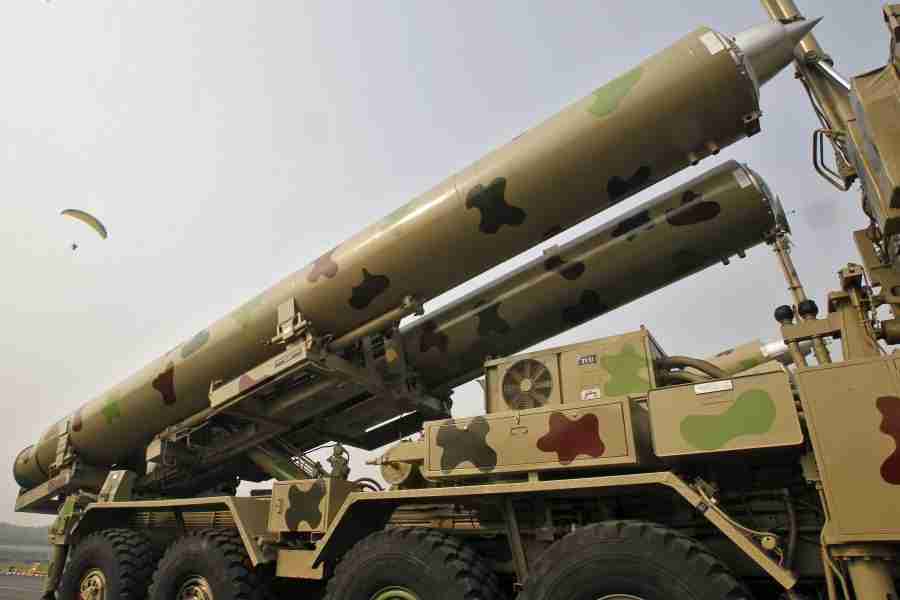
The BrahMos has a range of 290 km (180 miles) and can be fired from land, sea and submarine
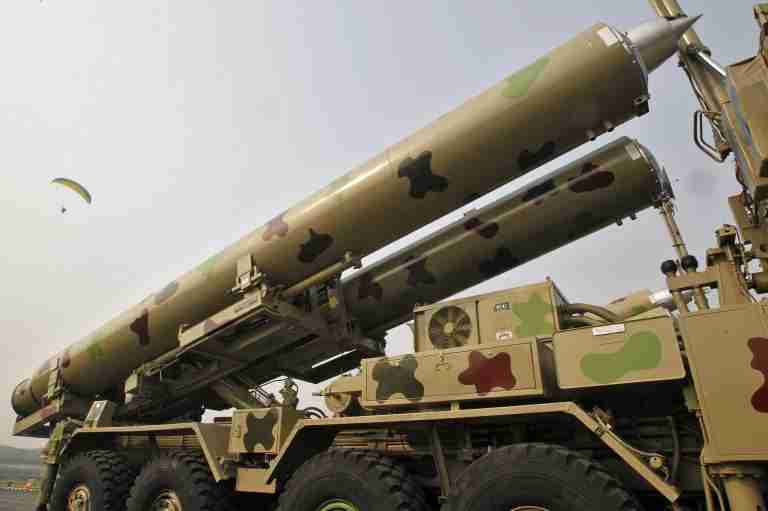
FILE PHOTO: The Indian Army’s BrahMos missile launcher is displayed during the Army Day parade in New Delhi January 15, 2013. REUTERS/B Mathur
International news via Reuters:
The Philippines is set to receive its second batch of BrahMos supersonic cruise missiles from India, its defence secretary said on Wednesday, which should bolster the country’s coastal defence capabilities amid escalating tensions with China.
The expected arrival of the missile system will be the second of three BrahMos missile batteries Manila agreed to purchase under a 2022 deal with Brahmos Aerospace worth $375 million. The first batch arrived in April 2024.
“Now that they’re arriving, we will do what needs to be done to ensure they are used properly,” Defence Secretary Gilberto Teodoro told reporters.
The BrahMos, which has a range of 290 km (180 miles) and can be fired from land, sea and submarine, is part of the Philippine military’s modernisation programme.
The second missile battery delivery comes at a time when diplomatic and security ties between Manila and Beijing are strained due to frequent clashes in the South China Sea, which China claims mostly as its own, and recently accusations of espionage.
Teodoro pushed back strongly against China’s recent arrest of three Filipinos accused of spying, calling the allegations implausible.
Chinese authorities arrested three Filipinos and accused them of working for the Philippine intelligence agency to gather classified information on its military, the state-run China Daily reported on April 3, citing state security officials. It said the three had confessed to the crime.
“What capability do Filipinos have to spy in China?,” Teodoro said. “What interest do we have in what goes inside their country? Our interest is what they are doing in the West Philippine Sea,” he added using the term Manila uses to refer to its exclusive economic zone.
Teodoro also rejected assertions the Philippine government is fuelling anti-Chinese sentiment, saying that if such sentiment exist, the blame lies with the Chinese Communist Party.
“I will say without hesitation that they are the main cause of xenophobia,” Teodoro said. “If there’s xenophobia, it’s because of the overreach of the Chinese Communist Party and President Xi Jinping, not just around the world, but even among their own people.”
There was no immediate comment from the Chinese Embassy in Manila on the Philippine’s defence secretary’s remarks.
Experts say that market sentiment towards U.S. assets remains fragile
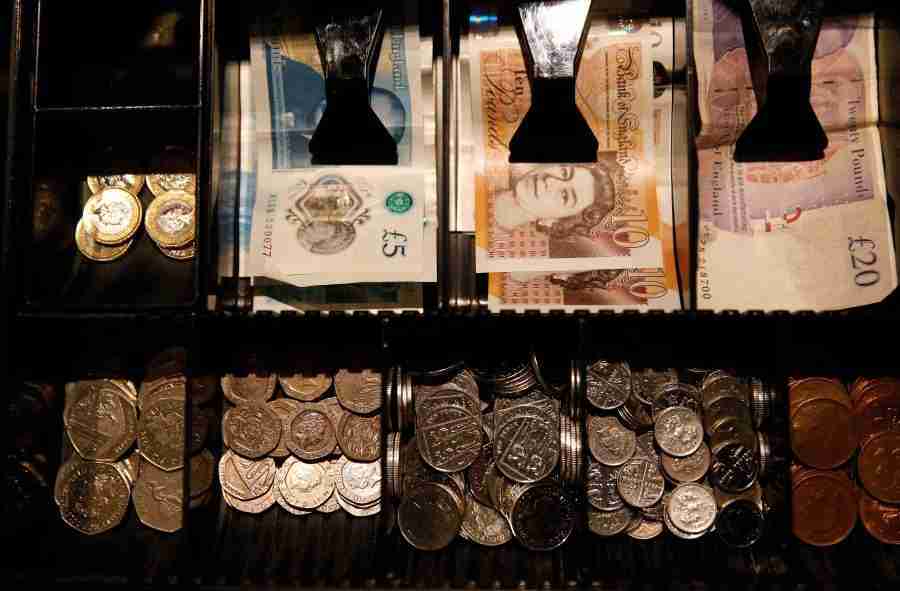
FILE PHOTO: Pound Sterling notes and change are seen inside a cash resgister in a coffee shop in Manchester, Britain, Septem,ber 21, 2018. REUTERS/Phil Noble/File Photo
International news via Reuters:
Sterling recovered from early losses against the dollar on Wednesday, brushing off data showing UK business activity weakened by the most in more than two years due to global trade tensions.
The pound was flat on the dollar at $1.3337, and was also little changed against the euro at 85.71 pence to the common currency. .
Sterling early in the day dropped as much as 0.7% against the dollar, which strengthened after U.S. President Donald Trump backed away from threats to fire Federal Reserve Chair Jerome Powell and expressed optimism over a trade deal with China.
But market sentiment towards U.S. assets remains fragile and the knee-jerk response was shortlived.
The bounce back came despite a survey on Wednesday showing that British private sector activity buckled in April under the strain of an escalating global trade war that threatens to tip the economy into a new downturn.
Export orders fell at the fastest pace since the early months of the COVID-19 pandemic in 2020, while costs faced by businesses grew at the fastest rate in more than two years as higher employment taxes and an increased minimum wage kicked in.
“The market may be reluctant to take kind of a strong view at this point in terms of how that’s likely to impact the UK economy and pound,” said Lee Hardman, senior currency analyst at MUFG.
“But certainly if you look at the (PMI) figures today …it does show that business confidence did drop more sharply than expected in April, so that certainly increases the risk of the UK economy slowing down more in the second quarter.”
Britain also posted a much bigger budget deficit for 2024/25 than expected, according to data on Wednesday.
Reporting by Yadarisa Shabong in Bengaluru; Editing by Hugh Lawson
The sanctions follow a year-long investigation by the European Commission, the EU executive
FILE PHOTO: The logo of Meta is seen at the entrance of the company’s temporary stand ahead of the World Economic Forum (WEF) in Davos, Switzerland January 18, 2025. REUTERS/Yves Herman/File Photo
International news via Reuters:
Apple was fined 500 million euros ($570 million) on Wednesday and Meta 200 million euros, as European Union antitrust regulators handed out the first sanctions under landmark legislation aimed at curbing the power of Big Tech.
The EU fines could stoke tensions with U.S President Donald Trump who has threatened to levy tariffs against countries that penalise U.S. companies.
The sanctions follow a year-long investigation by the European Commission, the EU executive, into whether the companies comply with the Digital Markets Act that seeks to allow smaller rivals into markets dominated by the biggest companies.
Apple said it would challenge the EU fine.
“Today’s announcements are yet another example of the European Commission unfairly targeting Apple in a series of decisions that are bad for the privacy and security of our users, bad for products, and force us to give away our technology for free,” Apple said in an emailed statement.
Meta criticised the EU decision.
“The European Commission is attempting to handicap successful American businesses while allowing Chinese and European companies to operate under different standards,” it said in an emailed statement.
“This isn’t just about a fine; the Commission forcing us to change our business model, effectively imposing a multi-billion-dollar tariff on Meta while requiring us to offer an inferior service.”
The EU competition watchdog said Apple must remove technical and commercial restrictions that prevent app developers from steering users to cheaper deals outside the App Store.
FILE PHOTO: An Apple logo is pictured in an Apple store in Paris, France September 17, 2021. REUTERS/Gonzalo Fuentes/File Photo
It said Meta’s binary pay-or-consent model introduced in November 2023 breached the DMA.
The model gives Facebook and Instagram users who consent to be tracked a free service that is funded by advertising revenues. Alternatively, they can pay for an ad-free service.
Meta is discussing with the EU a new version introduced in November last year. The companies have two months to comply with the orders or risk fines.
Apple avoided a fine in a separate investigation into its browser options on iPhones after making changes that allow users to switch to a rival browser or search engine more easily. Regulators said these comply with the DMA and closed the investigtion on Wednesday.
The iPhone maker was still charged with breaching the DMA rules by hindering users from downloading alternative app stores and apps from the web in a practice known as sideloading.
Regulators criticised Apple’s conditions, saying these disincentivise developers from using alternative app distribution channels on iOS and also requires them to opt for business terms that include a new fee called Apple’s Core Technology Fee.
The EU regulator also dropped Meta’s Marketplace’s designation as a DMA gatekeeper because the number of users fell below the threshold.
“We have taken firm but balanced enforcement action against both companies, based on clear and predictable rules,” the Commission said.
Reuters had flagged the EU decisions on Apple and Meta last month.
($1 = 0.8773 euros)
Reporting by Foo Yun Chee; editing by Barbara Lewis
Portugal spent 1.55% of GDP on defence last year, still well below NATO’s official target of 2%
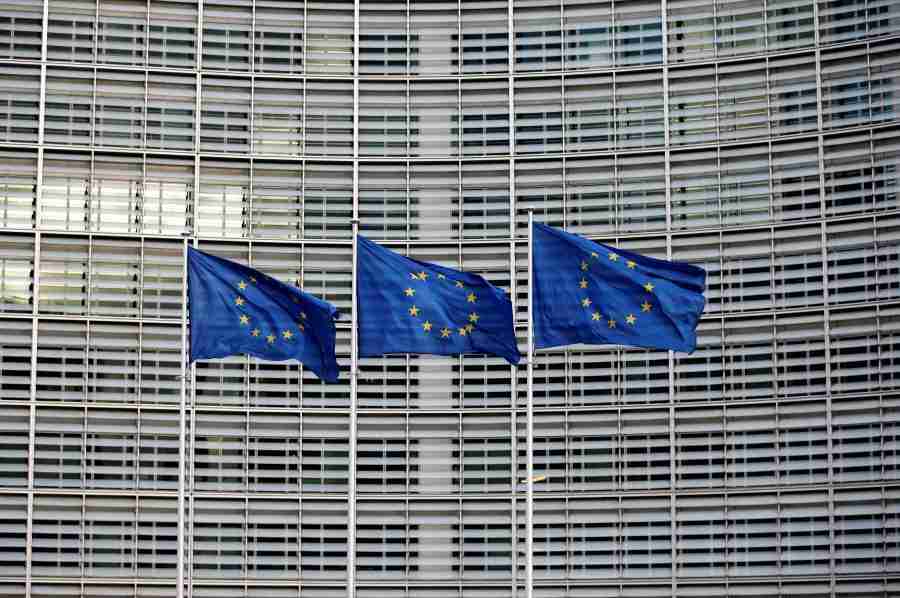
FILE PHOTO: European Union flags flutter outside the EU Commission headquarters in Brussels, Belgium, January 18, 2018. REUTERS/Francois Lenoir/File Photo
International news via Reuters:
Portugal will ask the European Commission to activate the so-called fiscal escape clause to allow for higher defence spending worth up to 1.5% of gross domestic product, the finance ministry said on Wednesday, one of the first member states to do so.
European countries are under pressure from U.S. President Donald Trump, who is pushing NATO allies to lift military spending to as high as 5% and is reluctant to continue funding Kyiv in the war in Ukraine.
Portugal spent 1.55% of GDP on defence last year, still well below NATO’s official target of 2%, but has promised more spending in coming years to bolster production and procurement of military equipment and technology in Europe.
The European Commission has proposed allowing member states to raise defence spending by 1.5% of GDP each year for four years, without any disciplinary steps that normally kick in once a government deficit climbs above 3% of GDP.
The move is part of its plans to mobilize close to 800 billion euros ($910.80 billion) to strengthen Europe’s defence industry and increase military capabilities.
Portugal’s centre-right government, in a caretaker role pending an election in May, has consulted the main opposition Socialist Party before taking the decision to activate the clause, the finance ministry said in a statement.
Unlike most of its euro zone peers, Portugal has been running budget surpluses for several years, which may explain its willingness to try out the escape clause without risking a major deficit blowout.
The government has forecast a surplus of 0.3% of GDP this year after last year’s 0.7% surplus.
Neighbouring Spain, which among the 32 members of NATO had the lowest defence spending as a share of its economic output last year at just 1.3%, on Tuesday rolled out a 10.5-billion-euro plan to meet the 2% goal this year, but said it was still evaluating whether to activate the escape clause.
Italy has said it will not ask for the budget leeway.
($1 = 0.8783 euros)
Reporting by Andrei Khalip and Sergio Goncalves; Editing by Ros Russell and Sharon Singleton
Public sector net borrowing for the 2024/25 financial year was 151.9 billion pounds
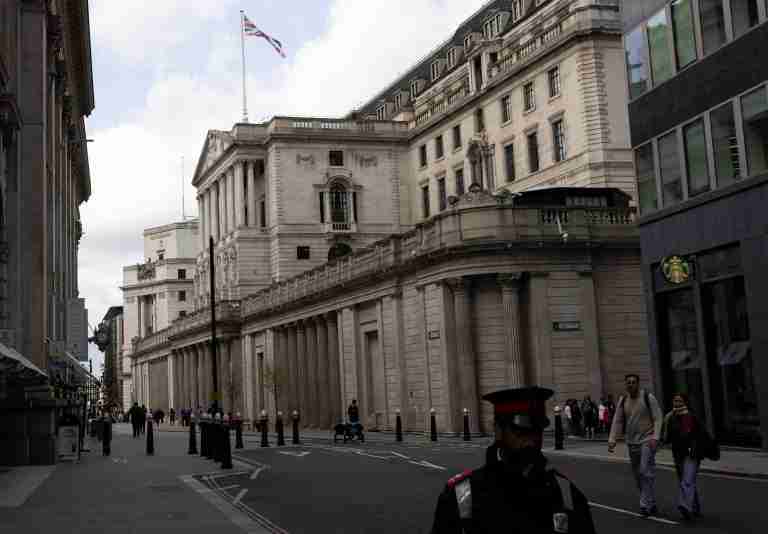
FILE PHOTO: A general view of the Bank of England building in London, Britain, April 14, 2025. REUTERS/Carlos Jasso/File Photo
International news via Reuters:
Britain’s government borrowed almost 15 billion pounds more in the financial year that just ended than official budget forecasters had estimated a month ago, according to data that heaped more pressure on the public finances.
Public sector net borrowing for the 2024/25 financial year was 151.9 billion pounds ($202.1 billion), the Office for National Statistics said on Wednesday.
In its forecasts published in March, the Office for Budget Responsibility had projected a budget deficit for the financial year ending in March of 137.3 billion pounds.
It marked the third-biggest year for government borrowing in cash terms on record.
With finance minister Rachel Reeves’ budget plans hinging on a tiny buffer against the government’s self-imposed fiscal rules – equivalent to less than 1% of annual spending – investors are watching public sector finance data more closely.
British government bonds have become increasingly volatile in recent years, reflecting unease in financial markets over Britain’s mix of low growth, high debt interest costs and persistent inflation.
A closely-watched business survey on Wednesday suggested much of the economy slowed sharply this month.
“We will never play fast and loose with the public finances, that’s why our fiscal rules are non-negotiable,” said deputy finance minister Darren Jones in a statement.
As a percentage of economic output, the budget deficit in 2024/25 was 5.3%, up from 4.8% in 2023/24. The OBR last month projected a reading of 4.8% for the year just ended.
Alison Ring, director of public sector and taxation at the ICAEW professional body for chartered accountants, said tax hikes enacted on businesses this month should help the public finances later this year – at least in theory.
“Unfortunately, the public finances remain vulnerable to the economic headwinds caused by those tax rises that, together with a global trade war, are likely to put significant pressure on the chancellor,” Ring added, referring to Reeves.
The Institute for Fiscal Studies think tank said the data showed the risk of running a budget with only 10 billion pounds of room to spare before running afoul of the fiscal rules by 2029/30.
In March alone, the government borrowed 16.444 billion pounds, the ONS said, compared with the median forecast of 16.0 billion pounds in a Reuters poll of economists.
Debt interest costs in March stood at 4.3 billion pounds – a record for the month.
The ONS revised up borrowing for the previous 11 months of the 2024/25 financial year, largely reflecting new data that showed a weaker picture for tax receipts, including corporation and income taxes.
The Debt Management Office said on Wednesday it planned to issue more Treasury bills in response to the 2024/25 borrowing overshoot, rather than British government bonds.
($1 = 0.7517 pounds)
Reporting by Andy Bruce, graphic by Sumanta Sen; editing by Sarah Young, Hugh Lawson and Toby Chopra
Governor Andrew Murdoch joined area residents for the inaugural trail hike
L-R: Chairwoman (Buy Back Bermuda) Jennifer Gray, Head of Natural Heritage (Bermuda National Trust) Myles Darrell, Governor Andrew Murdoch, President (Bermuda Audubon Society) Janice Hetzel, President (Bermuda National Trust) Mark Orchard at the High Point Nature Reserve in Southampton, Bermuda – 22 April 2025
The High Point Nature Reserve in Southampton is Buy Back Bermuda’s fourth nature reserve, officially opening on Earth Day (22 April 2025). Buy Back Bermuda—the collaborative undertaking of the Bermuda National Trust and the Bermuda Audubon Society—provides 10 acres of pristine parkland for the public to explore and enjoy.
Governor Andrew Murdoch, joined by local media and members of the public, was on-site for a ceremonial vine-cutting and the inaugural first hike of one High Point’s many trails.
Janice Hetzel, President of the Bermuda Audubon Society, says that work is still being undertaken to complete some of the coastal trails, and adding nesting boxes for bluebirds.
“Alongside these efforts, we will continue to we will continue working to remove invasive species, and replace them with native and endemic plants. Many of you know that this is a long and difficult process, but with dedication and perseverance we aim to create a truly healthy ecosystem that’s rich in biodiversity, and mostly free of (invasive plants).”
High Point Nature Reserve, Southampton (22 April 2025)High Point Nature Reserve, Southampton (22 April 2025)High Point Nature Reserve, Southampton (22 April 2025)High Point Nature Reserve, Southampton (22 April 2025)
You can watch our televised segment, including interviews and statements from High Point Nature Reserve stakeholders, below:
Kevin Richards, founder of the Bermuda Innovation and Technology Association is hosting a roundtable discussion next month
Could you be the next stablecoin entreprenuer or Medi-Tech engineer?
Well, there’s a home for innovative ideas to be developed right here on island with the Bermuda Innovation and Technology Association or BITA.
Founder Kevin Richards and his team at BITA have expanded their tech innovation sprint cycle to six weeks increasing the chances of rigourous development to bring the next thing in tech online.
Bermuda could be on track to be one of the world’s top destinations for innovation and technological advances of the future.
Think of it as a sup-tropical Silicon Valley….
It’s the view of BITA founder Kevin Richards who is gearing up for the second installment of the organization’s expanded innovation sprint sessions.
The sessions connect thought leaders, regulatory professionals and other industry insiders to help develop firms such as stable coin adoption or Bermuda’s first Carbon Commission.
Internships will also be offered to students wishing to lend their ingenuity to the sprint sessions.
BITA is aiming to collaborate with an international university to partner companies with the world’s brightest minds in their respective fields.
15 proposals so far have been received that will be developed during two six-month sprint cycles.
ITA will attend private dinners in New York around the AIMA Digital Asset Investment Conference this Thursday to spread the word on what Bermuda has to offer.
And on May 6, they’ll host their next roundtable discussion on Bermuda’s growing tech and innovation ecosystem.
To provide the best experiences, we use technologies like cookies to store and/or access device information. Consenting to these technologies will allow us to process data such as browsing behavior or unique IDs on this site. Not consenting or withdrawing consent, may adversely affect certain features and functions.
Functional
Always active
The technical storage or access is strictly necessary for the legitimate purpose of enabling the use of a specific service explicitly requested by the subscriber or user, or for the sole purpose of carrying out the transmission of a communication over an electronic communications network.
Preferences
The technical storage or access is necessary for the legitimate purpose of storing preferences that are not requested by the subscriber or user.
Statistics
The technical storage or access that is used exclusively for statistical purposes.The technical storage or access that is used exclusively for anonymous statistical purposes. Without a subpoena, voluntary compliance on the part of your Internet Service Provider, or additional records from a third party, information stored or retrieved for this purpose alone cannot usually be used to identify you.
Marketing
The technical storage or access is required to create user profiles to send advertising, or to track the user on a website or across several websites for similar marketing purposes.