Italy’s probe is aimed at Activision Blizzard, among other companies of the Microsoft group, the antitrust authority said in a statement, without naming the others
Microsoft logo is seen on a smartphone placed on displayed Activision Blizzard’s games characters in this illustration taken January 18, 2022. REUTERS/Dado Ruvic/Illustration
International News via Reuters:
Italy’s antitrust authority said on Thursday it had launched a probe into several Microsoft-owned video-game makers over their use of virtual currencies.
• Italy’s probe is aimed at Activision Blizzard, among other companies of the Microsoft group, the antitrust authority said in a statement, without naming the others
• Microsoft was not immediately available for comment
• The move is part of a wider European Union-coordinated initiative by the EU’s Consumer Protection Cooperation (CPC) Network. The network launched actions last month against nine video-game companies, including Riot Games, Ubisoft and Supercell, and had earlier opened a separate action against Microsoft-owned Activision Blizzard
• The aim of the coordinated action is to promote transparency and fairness in the gaming sector, particularly protecting the rights of minors
• The probes focus on the transparency and fairness of in-game virtual currencies used to purchase cosmetic upgrades, weapon enhancements and other digital items, the Italian regulator said
• Purchases are often priced in virtual currencies rather than euros and may involve multiple layers of conversion, making it harder for consumers to understand how much they are spending, the authority said
• The Italian Competition Authority will act as lead authority, working together with peers in Norway and Denmark
• The watchdogs will seek to determine whether the companies may have committed a “widespread infringement” of EU consumer protection rules affecting consumers in at least three EU member states
• The coordinated action complements investigations the Italian regulator opened nationally in December into Microsoft group companies over the popular games “Diablo Immortal” and “Call of Duty Mobile”.
Reporting by Anna Uras; Editing by Giulia Segreti and Xevi Fontdegloria
Carson’s work often blends verse, prose, dialogue and translation in a genre-defying mix
Copies of books by Anne Carson, winner of the 2026 Nobel Prize for Literature, are displayed at Waterstones bookshop in London, Britain, October 8, 2026. REUTERS/Hannah McKay
International News via Reuters:
Canadian poet and writer Anne Carson won the 2026 Nobel Prize in Literature “for her bold and inventive oeuvre that, in playful dialogue with the classical tradition, has created new forms for contemporary literature”, the Swedish Academy said on Thursday.
“She was very taken by surprise,” said Ingrid Carlberg, permanent secretary of the academy, which awards the prize worth 12 million Swedish crowns ($1.2 million).
“We didn’t have so much time to speak, and all she had time to tell me was that she is for the moment in Iceland, where she’s listening to the wind.”
Carson’s work often blends verse, prose, dialogue and translation in a genre-defying mix. Born in Toronto, the 76-year-old has also held Icelandic citizenship since 2022 and has spent considerable time on the Arctic island in recent years.
She is widely known for her translations of classical Greek literature, which heavily influences her work that ranges from opera libretti to literary criticism and verse novels such as “Autobiography of Red” from 1998.
“Almost all her literary production has centred upon the intersection between the philologist’s obsession with words and the poet’s desire for new meaning,” the Academy said.
“She has herself identified the etymology of words as the starting point for all her work. Her translations from Classical Greek may be regarded as independent works in their own right.”
Her style is exemplified in “Norma Jeane Baker of Troy” from 2019, a performance piece which mixes the stories of Helen of Troy in Euripides’ play “Helen” and Marilyn Monroe.
The Academy also praised her ability to explore “the possibilities of writing, a process by which the literary sketch has become of particular value to her”.
“Bearing witness to this is Float (2016), a work consisting of 22 chapbooks on different subjects, capable of being read in any order,” it said.
LIFE WITHOUT PROUST
Often heralded as her greatest work, “Autobiography of Red” demonstrates Carson’s ability to “actualise the classical literary tradition”, the Academy said. In the book, she re-examines age-old questions such as “What happens when you love someone who will ultimately destroy you?”
Tapping into more modern inspirations, Carson reflected on the character of Albertine, one of the narrator Marcel’s love interests in Marcel Proust’s “In Search of Lost Time”, in her own book “The Albertine Workout”.
Carson had spent seven years reading Proust’s masterpiece and said in an interview with Canada’s CBC Radio One in 2016 that she suffered withdrawal symptoms after finishing the book, leading her to write “The Albertine Workout” as a way to prolong the experience.
“You think life goes on after Proust, but it seems so grey,” she said.
Carson started taking boxing lessons when she was already in her 70s because of a Parkinson’s disease diagnosis. The sport is recommended as a therapy because it helps pay attention to hand-eye coordination and the sequencing of actions.
She reflected on the disease’s impact on her handwriting in an interview at the Louisiana Literary Festival in Denmark in 2024: “I scrub out whole paragraphs in shame … the shame of bad handwriting.”
Carson, who has taught classics at universities in Canada and the United States, has said that she considers herself a visual artist as much as a literary one.
“I think of making a poem as making an object. I have always thought of them more as drawings than as texts, but drawings that are also physically enterable through the fact of language,” she said in the CBC interview.
CARSON HAD BEEN AMONG FAVOURITES THIS YEAR
Carson had been among the favourites to win this year’s prize, according to bookmakers Ladbrokes, and takes a place beside luminaries such as Alexander Solzhenitsyn, Alice Munro and Ernest Hemingway as a recipient of the award, which often divides opinion among book lovers.
The Academy has been lambasted for ignoring some of the literary titans of the last 120 years such as Leo Tolstoy, Virginia Woolf and Jorge Luis Borges, criticised for snubbing US authors – though it gave the prize to singer-songwriter Bob Dylan in 2016 – and accused of being too obscure in its choices.
Defenders say the Academy has made popular picks, such as Colombia’s Gabriel Garcia Marquez in 1982 and Doris Lessing in 2007, and argue that part of its task is to highlight lesser-known literary traditions.
Last year’s prize was won by Hungarian writer Laszlo Krasznahorkai.
Established in the will of Swedish dynamite inventor and businessman Alfred Nobel, the prizes for achievements in literature, science and peace have been awarded since 1901.
Literature was the fourth of this year’s Nobels to be announced this week, following medicine, physics and chemistry. The peace prize winner will be announced in Oslo on Friday.
($1 = 10.0190 Swedish crowns)
Reporting by Simon Johnson, Johan Ahlander, Niklas Pollard and Marie Mannes in Stockholm, Terje Solsvik in Oslo, Jonathan Allen in New York and Justyna Pawlak in Warsaw; Editing by Alex Richardson
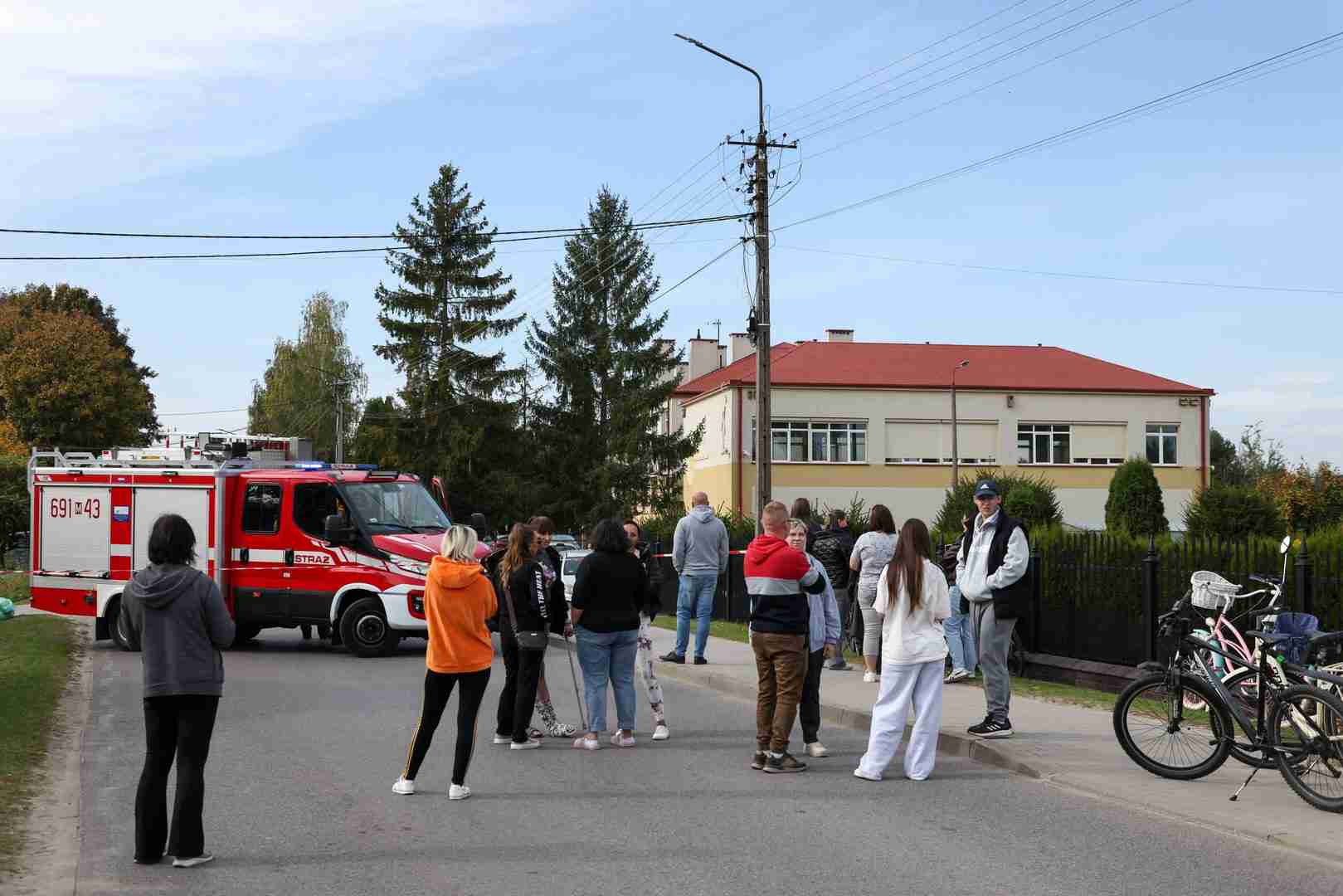
Authorities said a 37-year-old woman who worked as a caretaker had died in the latest attack, which took place at around 9 a.m. in Leszczydol-Nowiny, northeast of Warsaw
People gather next to a cordoned-off area and a fire fighting vehicle at the site of a deadly attack at a school by a 15-year-old former pupil, in Leszczydol-Nowiny, Wyszkow County, northeast of Warsaw, Poland, October 8, 2026. The Thursday incident came a day after another attack at a different Polish school. REUTERS/Kuba Stezycki
International News via Reuters:
A 15-year-old former pupil killed one person and injured two others at a Polish primary school on Thursday, police said, the day after a 19-year-old wounded 10 people including himself at another school.
Authorities said a 37-year-old woman who worked as a caretaker had died in the latest attack, which took place at around 9 a.m. in Leszczydol-Nowiny, northeast of Warsaw.
Head teacher Krzysztof Ochmanski said he had heard a scream and run into the corridor.
“He wounded me with the blade of a rather long knife – he had three knives on him – and hit me with the handle,” he told the public broadcaster Polskie Radio RDC. “By then, I had managed to restrain him.”
Police told the private broadcaster TVN24 that another teacher had also been injured trying to restrain the attacker.
The Interior Ministry said no further lives were in danger.
“The attacker was a former pupil of this primary school and is currently a student at a vocational school,” a spokeswoman said. “At this moment, we do not know the motives.”
A Reuters reporter saw an air ambulance flying away from the school, where a small crowd had gathered. The father of one child, waiting outside the school, said pupils had not yet been allowed to leave, but were safe.
Footage on the state news channel TVP Info showed what appeared to be the attacker being handcuffed and put into a police van.
NUMBER OF TEENAGE ATTACKERS ON THE RISE
Prime Minister Donald Tusk called an emergency meeting amid deepening concern about violence among teenagers.
Inspector Katarzyna Nowak, director of communications for national police, said serious offenders were becoming younger across Europe.
“Over the past few months in Poland, we have seen arrests of teenagers who were preparing to carry out attacks … So, this is indeed a problem we face, and one we must acknowledge,” she told TVP Info.
Interior Minister Marcin Kierwinski said that, in a separate incident in Sierpc in north-central Poland on Wednesday, police had detained a 17-year-old who had mentioned plans to do “something dangerous” on school grounds.
“Data recovered from electronic devices revealed online searches regarding how to orchestrate such a violent event,” Kierwinski said. Police found two knives in his possession.
On Wednesday, 10 people were injured in a knife attack at a school in Ostroleka in northeastern Poland . The teenage suspect was detained soon after.
Reporting by Kuba Stezycki and Kacper Pempel in Leszczydol-Nowiny, Anna Wlodarczak-Semczuk, Pawel Florkiewicz, Alicja Surdy in Warsaw, writing by Alan Charlish; editing by Gareth Jones and Kevin Liffey
The Financial Conduct Authority said the new notice period would give fund managers time to sell assets in an orderly way, making liquidity-driven suspensions less likely
FILE PHOTO: Signage is seen for the FCA (Financial Conduct Authority), the UK’s financial regulatory body, at their head offices in London, Britain March 10, 2022. REUTERS/Toby Melville/File Photo
International News via Reuters:
Britain’s finance watchdog on Thursday proposed that investors holding illiquid assets such as property must give 90 days’ notice to their asset managers to withdraw money, in a move designed to reduce the risk of rushed asset sales that can harm markets.
• The Financial Conduct Authority said the new notice period would give fund managers time to sell assets in an orderly way, making liquidity-driven suspensions less likely
• Existing funds would have two years to comply and will have to give investors at least one year’s notice, the regulator said
• The new rules are intended to strengthen liquidity risk management and help funds meet redemption requests in line with their terms, while protecting remaining investors and supporting market integrity, the FCA added
• It said the proposal brings the UK in line with new international liquidity standards for open-ended funds
Reporting by Yamini Kalia in Bengaluru; Editing by Jonathan Ananda
Twenty-year and 30-year gilt yields rose to their highest since early 1998 at 6.00% and 6.05% respectively, also up around 7 bps in line with US Treasuries
A drone view shows the skyline above central London at sunrise, Britain June 19, 2026. REUTERS/Yann Tessier
International News via Reuters:
British long-term borrowing costs hit fresh multi-decade highs on Thursday as part of a global bond selloff driven by a sharp rise in oil prices triggered by attacks on shipping in the Gulf and concerns that a hurricane will disrupt US oil production.
Ten-year gilt yields – around the maturity that accounts for much of Britain’s new borrowing – increased to their highest since July 2007 at 5.527%, up more than 7 basis points on the day and pushing past a previous high of 5.51% set last week.
Twenty-year and 30-year gilt yields rose to their highest since early 1998 at 6.00% and 6.05% respectively, also up around 7 bps in line with US Treasuries.
Brent crude oil prices jumped 5% on Thursday to $105 a barrel, their highest since September 29.
Reporting by David Milliken; editing by Suban Abdulla
Global government bond yields have climbed sharply over the past weeks, reflecting higher inflation expectations and fiscal worries
FILE PHOTO: The logo of the European Central Bank (ECB) is pictured outside its headquarters in Frankfurt, Germany, April 26, 2018. REUTERS/Kai Pfaffenbach/File Photo
International News via Reuters:
The European Central Bank is expected to hold its deposit rate at 2.50% this month but raise it by 25 basis points in December as inflation runs nearly double its 2% target, a Reuters poll found. Most economists polled had until recently thought the ECB was done.
Global government bond yields have climbed sharply over the past weeks, reflecting higher inflation expectations and fiscal worries. In Europe, investors have focused particularly on France.
Caught between high inflation — at 3.8% in September and very close to the ECB’s latest worst-case scenario — and concerns that rising yields could hurt growth, policymakers have recently argued for what ECB President Christine Lagarde called a “measured response”.
So far there has been scant evidence that higher energy prices caused by the US-Israeli war with Iran are spilling into other consumer prices, which would be a trigger for more ECB rate rises.
All but three of 73 economists polled October 5-8 expected the ECB to hold its 2.50% deposit rate on October 29, matching market pricing. The central bank raised rates for a second time this year in September.
However, a near-90% majority of economists, 64 of 73, now see another hike in December. This marks a clear reversal from the over 90% expecting rates on hold in last month’s survey.
“Given uncertainties, the ECB is likely to remain on the current quarterly adjustment path and that should get us to another hike in December… the main risk is there may actually be one more hike, maybe in March,” said Jens Eisenschmidt, chief Europe economist at Morgan Stanley.
A 58% majority, 40 of 70, saw the deposit rate peaking at 2.75%. But over a third, 24, expect it to be 3.00%, up from just two last month. Markets are currently pricing nearly three hikes by end-2027.
“I do not have a very strong conviction they go to 2.75% and stay there,” said Eisenschmidt.
“Our forecast is predicated on oil prices not increasing more and activity not accelerating further from here,” he said.
Inflation is expected to increase to 3.7% on average this quarter from 3.3% in the third quarter, higher than the 3.3% predicted last month, poll medians showed.
It will average 3.0% and 2.6% this year and next, both upgrades from the 2.9% and 2.3% predicted last month.
Meanwhile, signs of stronger economic activity led to an upward revision to the growth outlook. The euro zone economy is expected to expand 1.0% this year, up from 0.8% in the previous survey. Growth is seen at 1.2% in 2027 and at 1.3% in 2028.
ECB policymakers so far have argued against a rate rise at this month’s meeting, even though the Middle East and Russia-Ukraine wars show no signs of abating just as the weather turns colder and demand for energy rises. The bond market selloff has also lowered expectations of an immediate increase.
“A key argument against an October hike may be that market rates have increased meaningfully and are doing some of the job for the ECB,” said Anatoli Annenkov, senior European economist at Societe Generale.
(Other stories from the Reuters global economic poll)
Reporting by Indradip Ghosh; Polling by Mumal Rathore; Editing by Hari Kishan, Ross Finley and Xevi Fontdegloria
The blue-chip FTSE 100 index fell 0.41% to 10,413.43 points by 0936 GMT, while the midcap FTSE 250 slipped 0.47% to 23,924.76
A worker shelters from the rain under a Union Flag umbrella as he passes the London Stock Exchange in London, Britain, October 1, 2008. REUTERS/Toby Melville/File Photo
International News via Reuters:
UK stocks fell on Thursday as oil prices saw their biggest jump in nearly a month, while investors awaited remarks from Bank of England Governor Andrew Bailey and other central bank policymakers for clues on the interest-rate outlook.
The blue-chip FTSE 100 index fell 0.41% to 10,413.43 points by 0936 GMT, while the midcap FTSE 250 slipped 0.47% to 23,924.76.
• Brent crude futures rose above $104 per barrel and were last up 4%, their steepest gain in about a month.
• Concerns over crude supply persisted following increased attacks on shipping in the Gulf and the Strait of Hormuz [O/R]
• The cost of jet fuel is likely to remain high for the next 12 to 18 months, Ryanair Group CEO Michael O’Leary said
• Among individual stocks, asset management company Aberdeen rose 0.9% after selling 52 million shares in Standard Life for about £436 million ($575.5 million), halving its stake in the insurer as part of efforts to simplify the business
• Tesco shares rose 4.5% and were the top gainer on the FTSE 100, after the food retailer raised its profit forecast to £3.15 billion – £3.3 billion ($4.16 billion – $4.36 billion) for fiscal 2026/27, up from its previous outlook of £3.0 billion – £3.3 billion
• Among the top losers, HSBC Holdings slipped 2.1%. FT reported on Wednesday that the bank plans deep job cuts in its UK wealth business as part of a broader, AI-driven efficiency push
• Bank of England Governor Andrew Bailey will speak at the İstanbul Economic Forum, alongside several European Central Bank and US Federal Reserve policymakers
• ECB’s Primoz Dolenc said the central bank may have to keep raising interest rates given an abundance of upside inflation risks, but the timing and size of any move remain uncertain
Reporting by Darshan Kumar in Bengaluru; Editing by Vijay Kishore
Sterling was last down 0.2% against the dollar at $1.3185, just above a three-month low of $1.3181 reached last week
International News via Reuters:
The British pound was down slightly against the dollar and the euro on Thursday ahead of a speech from Bank of England Governor Andrew Bailey that could shape expectations for the central bank’s next policy move.
Sterling was last down 0.2% against the dollar at $1.3185, just above a three-month low of $1.3181 reached last week.
The pound was down about 0.1% against the euro, snapping a nine-day streak of gains. It was last at 84.79 pence per euro.
“There are concerns about public debt and rising term premium in the UK gilt market, but so far the pound has been resilient,” said Tommy von Brömsen, FX strategist at Handelsbanken.
“Global focus is not on the UK much right now. It’s more on Europe and more on the US.”
The euro has been under particular strain, falling to a 17-month low against the dollar as fiscal concerns in France pushed bond yields sharply higher, dampening expectations for further rate hikes from the European Central Bank.
BOE IN FOCUS
Investors are now awaiting speeches from the BoE’s Bailey and policymaker Clare Lombardelli for any hints on whether the central bank could raise rates next month.
Bailey and Lombardelli are perceived as centrists on the rate-setting Monetary Policy Committee so their speeches will be closely watched, after both voted to keep rates unchanged at the last meeting.
“Any suggestion that they are ready to cross the Rubicon and vote for a hike could depress euro-sterling further today,” said Chris Turner, global head of markets at ING.
Money market futures imply a more than 80% chance of a rate hike next month, while two quarter-point hikes are fully priced in by the February meeting.
Reporting by Samuel Indyk; Editing by Alex Richardson
The global biopharmaceutical industry spends some $140 billion a year on human clinical testing, but only around 12% of drug candidates are approved by regulators — a rate that has changed little in decades
FILE PHOTO: The logo of Novartis, a robot miniature and words ‘AI Artificial Inteligence’ are seen in this illustration taken, July 17, 2023. REUTERS/Dado Ruvic/Illustration/File Photo
International News via Reuters:
Novartis’ experimental del-desiran for a rare type of muscular dystrophy was expected to be a winner, with the Swiss company’s CEO predicting annual peak sales of $5 billion. When a late-stage trial missed its goal last month, shares fell 11%, erasing $30 billion in market value.
AI start-up BioinvestGPT was not surprised. In July, it ran a simulated trial to measure how virtual patients would respond to del-desiran and predicted an insignificant clinical benefit.
It and other artificial intelligence companies say they are working with some drugmakers on virtual trials to boost the odds an experimental medicine will prove safe and effective when used by actual patients in an expensive traditional clinical trial.
The global biopharmaceutical industry spends some $140 billion a year on human clinical testing, but only around 12% of drug candidates are approved by regulators — a rate that has changed little in decades.
AI firms say simulations are being used to identify which pharmaceutical programs are worth moving forward and to assess the value of acquisition targets. As AI tools get better at flagging clinical risks, they say unexpected trial failures may become less frequent.
Human clinical trials typically start with small Phase 1 studies primarily to gauge safety, followed by mid-stage Phase 2 and the large Phase 3 trials required by regulators that also assess efficacy. The process takes years, compared with a month or less for some AI simulations.
“We shouldn’t only ask how to run trials faster. We should ask how to run fewer trials that are going to fail,” said Francisco Beca, chief medical officer at QuantHealth, an AI clinical trial simulation platform headquartered in Tel Aviv.
Investment in AI drug discovery more than doubled to $8.4 billion in 2025 compared to 2023, according to a recent report from McKinsey. It said spending is currently focused where the technology works best today, particularly molecule design, rather than the industry’s major bottlenecks, such as proving a drug will work as intended through lengthy trials.
Pharma companies are “dipping their toes” into AI trial modeling, said McKinsey partner Alex Devereson. They are using different types of the technology, internally or with partners, to do things like assess drug candidates before committing capital to a program, he said.
US health regulators last week announced a set of initiatives aimed at speeding drug trials. If successful, the program could help create a path for predictive AI to be used in clinical development, a federal health official said.
FIVE OUT OF SIX CORRECT
Copenhagen-based BioinvestGPT in July shared with Reuters its detailed analyses of the likely outcome of several high-profile drug trials before the results were known and has so far been correct in five of six.
They include the negative result for del-desiran, success for Moderna and Merck’s melanoma vaccine, a weak clinical benefit for AstraZeneca and Ionis’ heart drug Wainua, the first failed trial for Novo Nordisk’s heart drug ziltivekimab, and success for Vaxcyte’s pneumococcal vaccine.
The fundamental goal of the pharma industry is proof of a superior clinical benefit compared to the standard of care, said Bragi Lovetrue, who co-founded BioinvestGPT with his wife Idonae Lovetrue in 2024.
The AI platform uses DNA sequencing to simulate a human body matching the eligibility criteria for a specific clinical trial. A virtual trial is then done using a model of the test drug.
“We can pinpoint the reason why a drug is effective and safe, and in many cases, why not,” Lovetrue said.
The simulations are not always right. The predictive AI forecast positive results for Novartis’ pelacarsen, which lowers blood levels of a cholesterol-carrier called lipoprotein(a). Novartis in September said the drug did not cut the risk of a major heart attack or stroke in patients with a genetic risk factor in a late-stage trial.
A subsequent analysis showed “we got the mechanism wrong,” by not accounting for genetically set variations in the size of the lipoprotein, Lovetrue said.
QuantHealth, which uses real-world data and AI to simulate patient-level responses to therapies, has published its simulations of ulcerative colitis and cholesterol drug trials.
BIOGEN, TAKEDA TRIALS PREDICTED TO FAIL
BioinvestGPT has done predictions for a wide range of trials.
For anticipated trial results expected before year-end, the AI company predicts failure for two Phase 3 trials of Biogen’s litifilimab in the most common type of lupus, as well as for Phase 2 studies of Japanese drugmaker Takeda’s zasocitinib in Crohn’s disease and ulcerative colitis.
The AI model shows that both drugs are “suboptimal” for those specific trial populations.
Biogen’s drug, which targets an immune cell receptor called BDCA2, is also being studied in a different type of lupus. Takeda filed recently for US approval of zasocitinib, which blocks an enzyme called tyrosine kinase 2, in plaque psoriasis and has a Phase 3 trial in psoriatic arthritis.
Takeda research chief Andy Plump said TYK2 was identified as a target by analyzing human genetics, while machine learning was used to optimize and “polish” the structure of the daily pill.
“I have immense confidence in this mechanism,” Plump said. “I don’t think we are near being able to use tools like AI to make definitive predictions.”
Diana Gallagher, Biogen’s head of clinical development for multiple sclerosis, immunology and Alzheimer’s, said the company uses “every tool available to us,” including AI.
She said only two biologic drugs have been approved for lupus and AI algorithms that rely on historical data could be prone to predicting a negative result.
QuantHealth’s Beca and other experts said human trials will always be necessary, but AI simulations can be valuable when assessing the potential of an experimental drug.
“Is it still ethical in 2026 to expose patients to a trial that most likely will fail?” he said. “With the advancement of this (AI) technology, come 2027, 2028, or 2029, probably the answer is going to be that it no longer is.”
Reporting By Deena Beasley; Editing by Caroline Humer and Bill Berkrot
The software company also presented at the event in San Francisco a high-powered Surface laptop called Ultra powered by Nvidia’s RTX Spark chips
Microsoft CEO Satya Madella speaks at Microsoft Windows & Surface event where new on-device AI capabilities for Windows PCs using Nvidia’s new RTX Spark chips were announced, in San Francisco, California, US, October 7, 2026. REUTERS/Manuel Orbegozo
International News via Reuters:
Microsoft unveiled on Wednesday an AI coding model that can run directly on personal computers and new security technology to prevent AI agents from accessing data without permission, challenging Apple’s push to bring more AI into personal devices.
The software company also presented at the event in San Francisco a high-powered Surface laptop called Ultra powered by Nvidia’s RTX Spark chips. Redmond, Washington-based Microsoft is seeking to turn Windows into a platform for AI agents to handle tasks such as writing computer code or tackling complex business projects on desktops and laptops.
For Microsoft, the move represents a bet that some work that currently happens in its costly Azure cloud computing data centers can shift to high-powered Windows machines in businesses and homes, a market where the firm retains a stronghold — and where its customers foot the hardware bills. It is a market opportunity rival Apple is also chasing with new Mac computers.
For Nvidia, cracking the Windows PC market could help it go after one of the last major markets dominated by Intel and Advanced Micro Devices.
As a guardrail against increasingly autonomous AI agents that have created security risks, Microsoft said it was releasing Microsoft Execution Containers, a tool to prevent agents from accessing data and doing unauthorized tasks when running on a laptop or desktop machine. Anthropic, OpenAI and Nvidia will use the tools, said Pavan Davuluri, executive vice president for Windows and devices.
“We needed to make the desktop the most secure place for agents to execute,” Microsoft CEO Satya Nadella said.
Davuluri said new tools would let IT departments set rules for agents and the Windows operating system would enforce those rules on each employee’s machine.
Nvidia CEO Jensen Huang, who joined Nadella on stage, said Microsoft’s new execution container technology, which goes by MXC for short, “is going to revolutionize how agents are built and deployed.”
“Without it, (agents are) a complete nonstarter,” he said.
Nvidia is trying to prevent a repeat of the hack of AI hub Hugging Face, while Apple is looking to tighten up the process for giving AI agents full access to a Mac computer’s hard drive.
AI MOVES TO THE PC
Microsoft also unveiled AI models that previously required cloud access but can now run locally on high-powered Windows desktops and laptops, including Nvidia’s open-source Nemotron model. Davuluri said a version of Chinese AI firm DeepSeek’s V4 model can run on machines with at least 60 gigabytes of memory and outperform OpenAI’s GPT-5 on some coding and reasoning tasks.
Microsoft is taking a similar approach with its own Copilot AI assistant, splitting tasks between the cloud and individual laptops. “Copilot will still use the cloud for the hardest tasks, but for times when cost or privacy matter more, it can delegate down to local models that run directly on your computer,” said Microsoft’s Copilot chief Jacob Andreou.
Davuluri also said Meta’s Muse personal assistant will come to Windows devices as a native app, using some of Microsoft’s new security tools, and that OpenClaw, the open-source AI agent system, can also work with those security tools.
PRICE BARRIER
One of the key challenges Microsoft and Nvidia face is the steep pricing of these devices after a memory-chip crunch drove up costs.
The new Surface Laptop Ultra will start at $2,599 and rise to $5,899 for a model with a 20-core processor, 128 gigabytes of memory and one terabyte of storage.
Apple’s MacBook Pro with a 40-core graphics chip, 128 GB of memory and two TB of storage costs $6,700, although the machines are not directly comparable. Microsoft’s entry-level Ultra costs more than Apple’s $1,999 base MacBook Pro, but comes with 24 GB of memory compared with 16 GB on Apple’s entry-level model.
When Microsoft originally pitched the idea of running AI tasks on PCs two years ago to save costs, the laptops were mostly priced below $2,000, but Nvidia increased the price of an AI desktop machine called the DGX Spark by about 75% since its launch to $6,950 amid rising memory costs.
Two years ago, “the software wasn’t ready, but the hardware was. Now the software is ready and the hardware is too expensive to actually run it locally,” said Anshel Sag, an analyst at Moor Insights & Strategy. “So it’s becoming this thing where only the people who have the budget can really afford to run AI locally.”
Reporting by Stephen Nellis in San Francisco; Additional reporting by Jaspreet Singh Unnamalai L in Bengaluru; Editing by Muralikumar Anantharaman, Sayantani Ghosh and Rod Nickel
Russian authorities say the 28-year-old laboratory worker died last Friday from pneumonia of an as-yet unestablished origin, in a case that has prompted international concern
FILE PHOTO: A view of the Medical Assistance and Rescue Centre, an infectious diseases hospital, in the town of Shelekhov in the Irkutsk region, Russia, October 5, 2026. REUTERS/Stringer/File Photo
International News via Reuters:
Russia’s health regulator said on Wednesday there were no risks of an epidemic breaking out in Siberia after a plague institute worker there died, as the World Health Organization pressed Moscow for more information about her cause of death.
Russian authorities say the 28-year-old laboratory worker died last Friday from pneumonia of an as-yet unestablished origin, in a case that has prompted international concern, including from US President Donald Trump. Around 200 people were initially placed in quarantine.
Asked on Wednesday whether the death was caused by a bioweapon, Trump told reporters: “Well, we don’t think so. We’re going to find out soon enough, but we don’t think so.”
He said Russia was not saying much about the situation but “they do say they have it very much under control,” adding he had set up a call with Russian President Vladimir Putin.
“They’re sharing (information) a little bit with our people. We expect them to share it a lot with our people,” said Trump, speaking in the Oval Office.
Global health officials – as well as the world’s media – have been particularly alert to pneumonia cases of undetermined cause since the COVID-19 pandemic, which began with a cluster of fast-spreading fatal respiratory illness in China.
However, the cause of individual pneumonia cases can often not be determined.
US Centers for Disease Control and Prevention Director Erica Schwartz said at an event the agency was prepared to monitor and screen travelers although the risk to the US was extremely low.
The WHO initially said it estimated the risk of the Russia case to the public as low, based on what had been made known, but told a press conference on Wednesday it could not make a fuller risk assessment due to insufficient information from the Russian authorities.
Rospotrebnadzor, Russia’s health watchdog, said on Wednesday it was winding down precautionary measures it had put in place after concluding there was no risk of an epidemic and that it had shared its latest information with the WHO.
No cases of plague had been detected among anyone who had come into contact with the deceased worker, Darya Shipilova, it said, and 90% of those placed in quarantine had been released after nearly 5,000 lab tests had failed to detect any dangerous pathogens.
It said Shipilova had been vaccinated and had therefore been “immune to the dangerous infections with which she worked”. It did not say, however, what had caused the pneumonia which killed her or how she fell ill.
WHO CALLS FOR MORE INFORMATION
Tedros Adhanom Ghebreyesus, the director-general of the WHO in Geneva, said on Wednesday his organisation needed more information from Russia to understand what had happened.
“We would like more information to understand which laboratory tests were conducted, which pathogens were evaluated, and if this individual didn’t die from plague, then how did she die?” Maria Van Kerkhove, director of the WHO’s department of epidemic and pandemic management, told a virtual press conference.
Tedros said the WHO had offered assistance to Russia and also repeated a request for Russia to verify “media reports of a second employee with pneumonia of undetermined cause”.
KREMLIN CRITICISES ‘FALSE INFORMATION’ IN MEDIA
The Kremlin said Russia had properly informed the WHO about the incident in line with established procedures.
When asked about the WHO’s request to respond to reports about a second person in Siberia allegedly falling ill, Kremlin spokesman Dmitry Peskov urged caution when it came to using media reports as a reference for what was happening.
“There is a great deal of media coverage, and the vast majority of what the media are reporting about this situation is false information,” said Peskov.
He advised the media and others to rely on information provided by the health regulator. It did not immediately respond to a Reuters request for comment on Wednesday about the WHO’s questions.
EXACT CAUSE OF DEATH REMAINS UNKNOWN
Some Western media outlets have reported — citing unnamed “Russian media” — that a second person in Siberia had died, saying they had died of plague.
Reuters was unable to find any such stories in Russian media or any evidence that a second person in Siberia had died although some bloggers on social media were making — without evidence — such assertions.
After the press conference, the WHO sent Reuters a link to a story about a potential second case by the Russian media organization starhit.ru, a celebrity gossip outlet, and a follow-up from British newspaper the Daily Mail.
Tedros said it was important to be transparent based on the lessons from COVID, adding, “We don’t have any mandate actually to see whether this media is credible or not.”
Russia has not formally responded to the reports about a second person dying, Tedros said, adding that he had heard only informally that Russia had denied those reports.
Tedros’ call for more information echoed that of US Secretary of State Marco Rubio, who has also said Moscow needs to share more information about the incident.
Pneumonia, a lung infection, can have a variety of causes including plague as well as other bacterial infections or viral respiratory diseases, such as flu or COVID-19.
Reporting by Jennifer Rigby in London, Shubham Kalia in Bengaluru, Andrew Osborn, Anastasia Lyrchikova and Dmitry Antonov in Moscow and Bo Erickson in Washington; Writing by Andrew OsbornEditing by Toby Chopra, Alison Williams, Philippa Fletcher, Gareth Jones
To provide the best experiences, we use technologies like cookies to store and/or access device information. Consenting to these technologies will allow us to process data such as browsing behavior or unique IDs on this site. Not consenting or withdrawing consent, may adversely affect certain features and functions.
Functional
Always active
The technical storage or access is strictly necessary for the legitimate purpose of enabling the use of a specific service explicitly requested by the subscriber or user, or for the sole purpose of carrying out the transmission of a communication over an electronic communications network.
Preferences
The technical storage or access is necessary for the legitimate purpose of storing preferences that are not requested by the subscriber or user.
Statistics
The technical storage or access that is used exclusively for statistical purposes.The technical storage or access that is used exclusively for anonymous statistical purposes. Without a subpoena, voluntary compliance on the part of your Internet Service Provider, or additional records from a third party, information stored or retrieved for this purpose alone cannot usually be used to identify you.
Marketing
The technical storage or access is required to create user profiles to send advertising, or to track the user on a website or across several websites for similar marketing purposes.