Monday, November 2, 2026
Home Blog Page 335

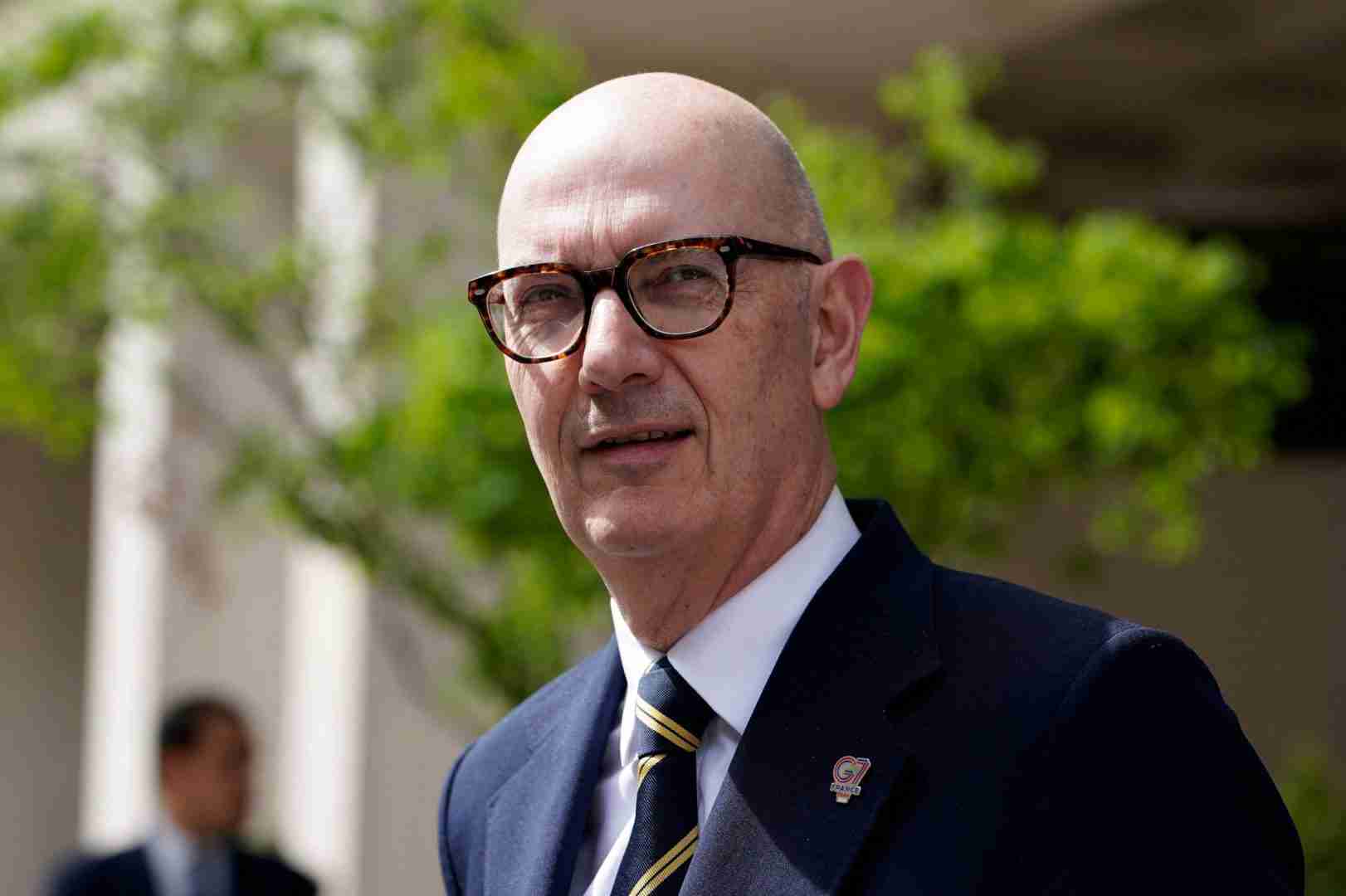
French finance minister calls for more euro-pegged stablecoins 

In pre-recorded comments at a crypto conference in Paris, Lescure said the relatively small volume of euro-pegged stablecoins compared to dollar-pegged ones was “not satisfactory”
International News via Reuters:

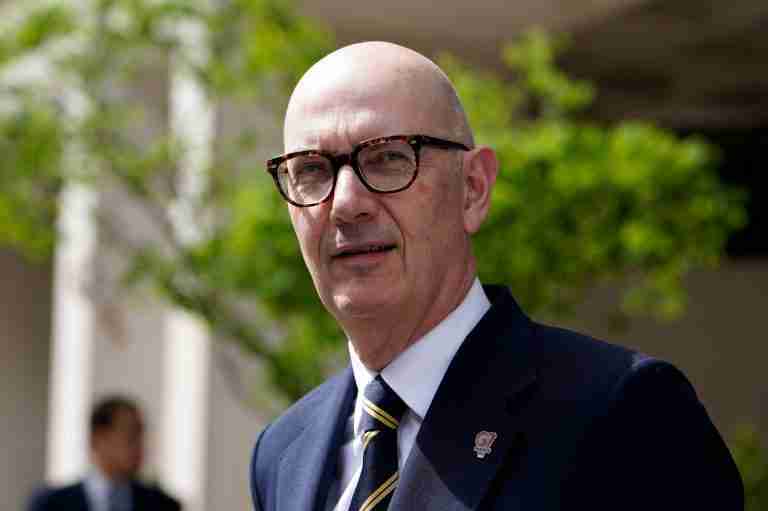
Europe needs more euro-based stablecoins, French Finance Minister Roland Lescure said on Friday, and urged the bloc’s banks to explore tokenised deposits to help end U.S. dominance in digital payments. 

In pre-recorded comments at a crypto conference in Paris, Lescure said the relatively small volume of euro-pegged stablecoins compared to dollar-pegged ones was “not satisfactory”.

Banks worldwide are experimenting with stablecoins, a type of cryptocurrency designed to maintain a constant value and backed by traditional currencies. Several have joined forces to trial the technology, especially since U.S. President Donald Trump last year signed a law establishing rules for stablecoins.

However, the stablecoin market is dominated by El Salvador-based Tether, and the coins are used mostly for crypto trading, with their role in making payments still minimal. Two-thirds of European banks surveyed by RBC Capital Markets said demand for stablecoins remains limited, according to a research note published this week.   

EUROPEAN BANKS SEEK TO WEAKEN U.S. DOMINANCE

A group of European banks, including ING, UniCredit and BNP Paribas have formed a company to launch a euro-pegged stablecoin in the second half of 2026 that they hope will counter U.S. dominance in digital payments.

“That is what we need and that is what we want,” Lescure said on Friday, referring to the initiative. “I also strongly encourage banks to further explore the launch of tokenised deposits,” he added. Tokenisation refers to creating blockchain-based tokens to stand in for existing financial assets. 

European policymakers are trying to reduce reliance on non‑European payment providers, as a result of tense relations with the U.S. that have heightened concerns about the fragmentation of EU payments services.

The European Central Bank has been developing a digital euro to preserve the role of central bank money in a digital economy, although in some countries bank lobbies have resisted the plans and progress in European Parliament has been slow.

Lescure on Friday said he supported ECB plans to put a digital central bank currency at the centre of tokenisation efforts, calling it “the right balance”.

Tether says it has more than $185 billion of its dollar-pegged tokens in circulation. Societe Generale says its euro-pegged stablecoin, launched in 2023, has just 107 million euros ($126 million) in circulation.

($1 = 0.8479 euros)

Reporting by Elizabeth Howcroft, writing by Alessandro Parodi, Editing by Tommy Reggiori Wilkes and Barbara Lewis
A new, forceful Pope Leo steps onto the world stage

The change in rhetoric reflects Leo’s growing concern with the direction of global leadership, experts said, after he maintained a relatively low profile for a pope during the first 10 months of his papacy

International News via Reuters:

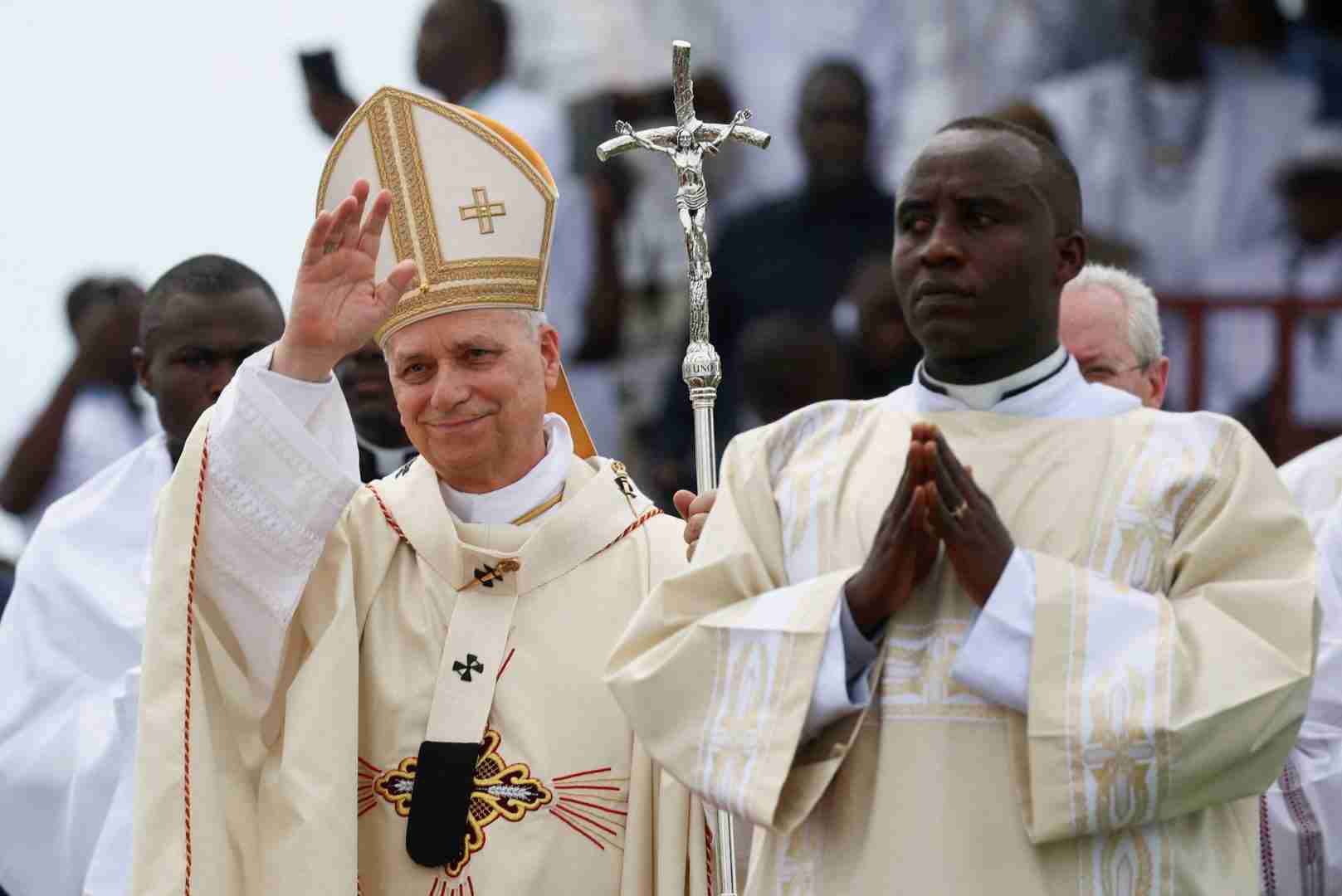
Pope Leo has debuted a new, forceful speaking style on his four-nation Africa tour this week, issuing sharp denunciations of war and inequality that have sparked repeated attacks on the pontiff from U.S. President Donald Trump.

The change in rhetoric reflects Leo’s growing concern with the direction of global leadership, experts said, after he maintained a relatively low profile for a pope during the first 10 months of his papacy.

Trump first attacked Leo as “terrible” on Sunday, in an apparent response to the pope’s criticisms of the U.S.-Israeli war on Iran. He lobbed more criticism again on Thursday, suggesting the pope didn’t understand foreign policy issues.

The first U.S. pope, speaking earlier that day in Cameroon, had said the world was “being ravaged by a handful of tyrants”, without naming individuals.

“Normally popes and the Vatican are cautious when it comes to international politics, preferring diplomacy to public censure,” said John Thavis, a retired Vatican correspondent who covered three papacies.

“(Leo) seems convinced that the world needs to hear explicit condemnation of injustice and aggression, and he seems aware that he is one of very few people who have a global pulpit.”

POPE SEEN AS MORAL LEADER ON GLOBAL STAGE

The pope, known for choosing his words carefully, mostly avoided comment about the U.S. until March, when he emerged as an outspoken critic of the Iran war.

He first mentioned Trump by name publicly only at the beginning of April, suggesting that the president find an “off-ramp” to end the war.

In Africa, the pope has been speaking much more firmly. In speeches this week in Algeria and Cameroon, he warned that the whims of the world’s richest threaten peace and decried violations of international law by “neocolonial” global powers.

“Pope Leo is establishing himself as a moral leader for the global scale,” Bishop John Stowe of Lexington, Kentucky, told Reuters.

Stowe, president of a U.S. Catholic peace organization, said Leo’s recent messages carried more weight by being given during a visit to Africa, “delivered face-to-face with the people who have lived with war, violence, famine and chronic poverty”.

POPE DOESN’T WANT TO BE ‘SOFT ON TRUMPISM’

Popes have long been a moral voice on the global stage, loudly decrying situations of injustice. But they have also generally striven for the Church to remain neutral in world conflicts, allowing the Vatican to act as a mediator if asked to do so.

It is a balance of roles that is difficult to maintain.

Massimo Faggioli, an expert on the papacy, pointed to the example of Pope Pius XII, who directed a clandestine network to shelter Jews during the Holocaust but is accused by some modern critics of not speaking loudly enough about the ongoing genocide.

“There’s always the ghost of Pius XII hanging there,” said Faggioli, a professor at Trinity College Dublin, referring to why Leo may be deciding to speak more forcefully now.

“I don’t think he wants the Vatican to be accused of being soft on Trumpism because he’s an American.”

LEO SPEAKING MORE DIRECTLY THAN PREDECESSOR FRANCIS

Leo, the former Cardinal Robert Prevost, spent decades as a missionary and bishop in Peru before becoming pope.

He lived there during an intense period of internal conflict between Peru’s government and the Maoist guerrilla group Shining Path, when tens of thousands were killed in bloody warfare.

“In rural Peru, Prevost… was immersed in what poverty, corruption, globalization of indifference, climate catastrophe, (and) governmental violence does to people,” said Natalia Imperatori-Lee, an academic at Fordham University.

“He’s uniquely qualified to speak about the dangers of… political corruption and violence,” she said.

Pope Francis, Leo’s predecessor, was from Argentina and was also known for forceful denunciations of conflict. He too clashed with Trump, who once called Francis “disgraceful”.

With his comments this week, Thavis said, Leo may have spoken more forcefully than Francis or any previous pope.

“Other popes, including John Paul II and Francis, have spoken about the dangers of ideological tyrannies and neocolonialism,” said Thavis. 

“But when Leo says the world is ‘ravaged by a handful of tyrants,’ that strikes me as a much more direct challenge to the leaders of powerful nations.”

Reporting by Joshua McElweeEditing by Gareth Jones

Oil falls on prospects for talks to end Iran war

Brent crude futures declined by $3.09, or 3.11%, to $96.30 a barrel at 0942 GMT. U.S. West Texas Intermediate crude futures fell $4.01, or 4.23%, to $90.68 a barrel

International News via Reuters:

Oil prices fell on Friday as possible further talks between the U.S. and Iran at the weekend and a 10-day ceasefire between Lebanon and Israel raised investor hopes that the war in the Middle East could be nearing an end.

Brent crude futures declined by $3.09, or 3.11%, to $96.30 a barrel at 0942 GMT. U.S. West Texas Intermediate crude futures fell $4.01, or 4.23%, to $90.68 a barrel.

“Oil prices are reacting very sensitively to escalation or de-escalation headlines,” said UBS analyst Giovanni Staunovo, after U.S. President Donald Trump indicated that an Iran deal “is very close” on Thursday.

At those levels, Brent futures were heading for a 1.2% gain for the week, and WTI futures were on track for a 6% drop from last Friday’s close.

Addressing a key sticking point in talks to end the Iran war, Trump said Tehran had offered not to possess nuclear weapons for more than 20 years.

“We’re going to see what happens. But I think we’re very close to making a deal with Iran,” Trump told reporters outside the White House on Thursday.

Oil prices have fallen below $100 per barrel but remained elevated this week above $90, off the back of 50% rises in March.

The temporary nature of the Israel-Lebanon ceasefire, Israel’s goal of significantly weakening the Iranian regime, and unlikely prospects for the Strait of Hormuz reopening immediately all provided a floor to prices, PVM analyst Tamas Varga said.

Israel’s campaign in Lebanon has been a major obstacle to securing a peace deal sought by Trump to end the war he launched with Israel in late February. 

U.S. and Iranian negotiators have scaled back their expectations for a comprehensive peace deal and are instead seeking a temporary memorandum to prevent a return to conflict, two Iranian sources told Reuters on Thursday.

Also on Friday, France and Britain will chair a meeting of around 40 nations aimed at signalling to the U.S. that its allies are ready to play a role in restoring flows through the Strait of Hormuz once conditions allow.

“Once the dust settles the hard work begins getting the ships in and out, and getting them into the right locations. There is no doubt a normalization is still months away and the current tightness will continue to underpin the refined product market,” Saxo Bank analyst Ole Hansen said.

Analysts from ING estimate that roughly 13 million barrels per day of oil flow has been disrupted by the closure of the Strait.

Reporting by Robert Harvey in London, Helen Clark in Perth; Editing by Sonali Paul and Joe Bavier

NATO will not collapse and US will defend its allies, Estonian minister says

Estonian intelligence warned in February its neighbour Russia is already stockpiling ammunition for future wars after the conflict in Ukraine ends

International News via Reuters:

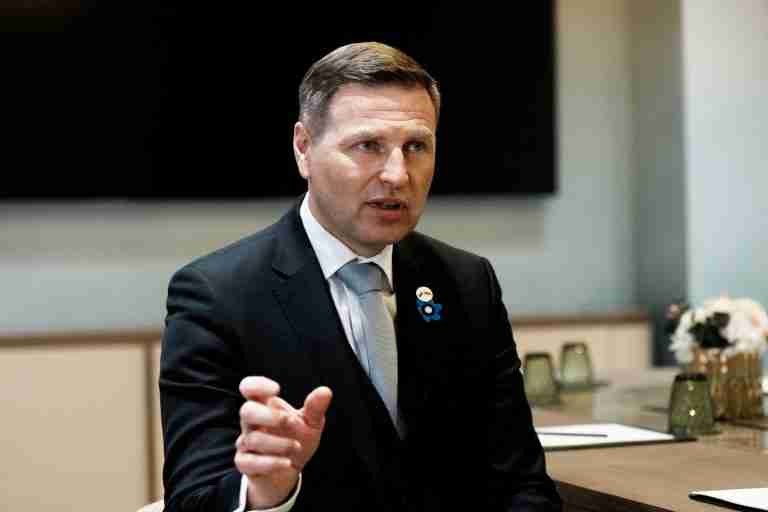
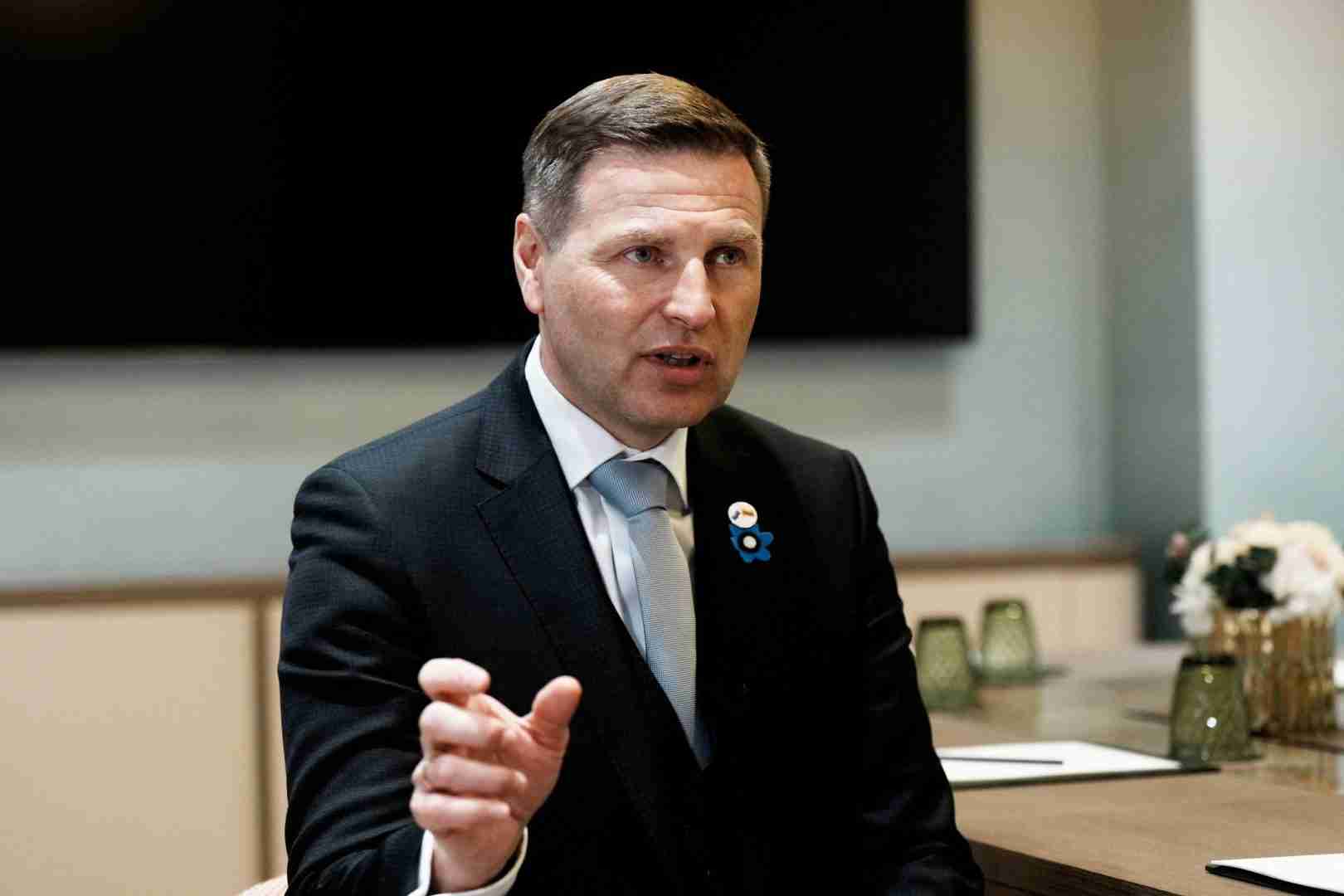
NATO member Estonia has no doubt that the United States would help defend it if Russia attacks, its defence minister told Reuters, while warning that Europe is not ready to stand up to Moscow on its own.

Estonian intelligence warned in February its neighbour Russia is already stockpiling ammunition for future wars after the conflict in Ukraine ends. Russia has described allegations by European leaders that it could attack NATO as nonsense.

U.S. President Donald Trump this month threatened to pull the U.S. out of the alliance over European members’ refusal to send ships to unblock the Strait of Hormuz near Iran. The alliance was already rattled by his plans to take over Greenland from Denmark, a NATO ally.

But Hanno Pevkur, defence minister of Estonia, told Reuters he was in no doubt that the U.S. would come to its defence if Russia attacks.

“Yes I trust the U.S. and yes I trust all our allies,” he said during a visit to the Lithuanian capital Vilnius on Thursday.

He said the U.S. needs Europe for its military as much as Europe needs the U.S., so “I don’t believe that NATO will collapse”.

He compared NATO’s current strains to a long marriage: “There are no 50 years of purely smooth sailing. You have differences and problems, and you need to work through them.”

But the minister said Europe is not ready to stand up militarily on its own now.

“Are we there where we want to be? No”, he said. “All of us (in NATO) need to invest more into defence”.

He said most NATO members are not upholding the agreement last year by heads of NATO members to increase their spending to at least 5% of gross domestic product (GDP) that Trump demanded.

Estonia is due to spend 5.1% of its GDP this year, among the highest in NATO.

Looking beyond Europe, Pevkur said NATO should focus on helping end the conflict in Iran, arguing this could allow the United States to shift more attention back to Ukraine.

“Once it’s resolved, there is a chance to bring more U.S. focus towards Ukraine,” he said. “For our region, that remains the main problem.”

Reporting by Andrius Sytas in Vilnius; editing by Philippa Fletcher

London’s FTSE 100 edges lower as utilities and miners weigh

Shares of utility companies slipped and dragged the benchmark lower after the Financial Times reported on Thursday that the Finance Minister Rachel Reeves vowed to cut the link between gas and electricity prices

International News via Reuters:

UK’s benchmark stock index FTSE 100 dipped slightly on Friday, weighed down by utilities and mining stocks, and was set to snap a three-week winning streak.

Shares of utility companies slipped and dragged the benchmark lower after the Financial Times reported on Thursday that the Finance Minister Rachel Reeves vowed to cut the link between gas and electricity prices. 

The blue-chip FTSE 100 index fell 0.1% to 10,581.06 points by 10:10 a.m. GMT, while the midcap FTSE 250 gained 0.1%, heading for a third straight week of gains. 

• The utilities sector was down 2.7%, with National Grid, Severn Trent down 1.3%; while SSE, Centrica down more than 5%.

• Miners Anglo American and Glencore  down 1.9% and 1.3%, respectively, tracking metal prices.

• Precious metal miners and Industrial miners down more than 1%

• Heavyweight banks down 0.1%.

• Oil giants BP and Shell down 0.5% as crude prices declined on prospects of an end to the U.S.-Iran war.

• Workspace Group plunges 12.5% after the office-space provider expects a substantial step down in annual profit.

• Associated British Foods expected to outline plans to separate its Primark fashion chain from its food businesses, shares down 0.4%.

Reporting by Utkarsh Tushar Hathi in Bengaluru; Editing by Shailesh Kuber

Dollar set for second weekly drop, euro steadies near pre-war levels

A 10-day ceasefire between Lebanon and Israel went into effect on Thursday and U.S. President Donald Trump said the next meeting between the U.S. and Iran could take place over the weekend

International News via Reuters:

The U.S. dollar headed for a second consecutive weekly decline on Friday, while the euro and British pound steadied around pre‑war levels, as investors unwound safe-haven positions on optimism stemming from a ceasefire between Israel and Lebanon and prospects for fresh Iran talks.

A 10-day ceasefire between Lebanon and Israel went into effect on Thursday and U.S. President Donald Trump said the next meeting between the U.S. and Iran could take place over the weekend. 

Meanwhile, U.S. and Iranian negotiators have scaled back ambitions for a comprehensive peace deal and are now seeking a temporary memorandum to prevent a return to conflict, with the nuclear issue remaining a core obstacle.

The dollar index, which measures the greenback’s strength against six major peers, slipped 0.02% to 98.185. It was on track for a second straight week of declines, having given up most of the gains sparked by the war, as ceasefire optimism continued to reduce demand for safe-haven assets.

“Markets are relatively calm… it’s the prospect of an extension of the ceasefire, or let alone a permanent ceasefire… our bias for the dollar for the year remains bearish, however in the near term, we are sceptical,” said Michalis Rousakis, forex strategist at BofA.

The euro was steady at $1.178225 and on track for a third straight weekly gain.

“The euro dollar is currently at the level where it was just before the Iran war despite energy prices being a lot higher than then. This suggests that markets have slightly gone ahead of themselves,” he said.

Rousakis said BofA’s commodity team expected energy prices to normalise over time but that it could take several months.

“Energy prices remaining at those levels is inconsistent with the euro at 1.18,” he said.

Sterling , meanwhile, was unchanged at $1.35225, even as British Prime Minister Keir Starmer faced renewed calls for his resignation from his political opponents after it was revealed his former ambassador to the United States failed security vetting but was still allowed to take up the job.

Both the euro and the pound have now largely recouped losses triggered by the Iran conflict, hovering near their highest levels in seven weeks.

Against the yen, the dollar was steady at 159.225 . Bank of Japan Governor Kazuo Ueda on Thursday steered clear of signalling a rate hike was on the cards this month, heightening the chance it will hold fire at least until June.

The risk-sensitive Australian dollar fetched $0.71710, staying near four-year highs while the kiwi traded roughly 0.1% lower at $0.5887.

In a Friday note, Commerzbank FX analyst Michael Pfister said that implied FX volatilities were showing “hardly any sign of major uncertainty” with a key one tracked by Commerzbank also back at pre-war levels.

“Even if the war were to end, surely the next crisis is waiting for us. The US president has this week once again turned his attention to his favorite topic: the Fed. Geopolitically, Cuba appears to be his next target, not to mention his regular attacks against NATO,” Pfister wrote.

MARKETS WATCH CENTRAL BANK RESPONSE TO INFLATION RISKS

Investors are keen to see how policymakers will tackle war-induced inflation pressures, with central banks taking a largely cautious stance for now.

U.S. Treasury yields held steady on Friday, after rising in the previous session, as still-elevated oil prices kept inflation worries alive. 

The two-year yield was last at 3.7732%, while the benchmark 10-year yield was steady at 4.3054%.

Fed funds futures show markets continue to bet that the Federal Reserve will keep rates on hold this year, sharply shifting from expectations of two rate cuts that were priced in before the war began.

Group of Seven finance ministers and central bank governors have agreed to remain ready to act to mitigate economic and inflation risks caused by the Middle East conflict’s energy price and supply shocks, French Finance Minister Roland Lescure said on Thursday.

The cautious tone was echoed by European Central Bank policymakers, who played down the chance of a rate hike as soon as this month, arguing that more data will be needed and the precise timing of a move was of secondary importance. 

New applications for U.S. unemployment benefits fell more than expected last week, suggesting labour market conditions remained stable. That is also seen giving the Fed room to keep interest rates unchanged for some time while policymakers monitor the inflation fallout from the war.

Reporting by Jiaxing Li in Hong Kong and Lucy Raitano in London; Editing by Kate Mayberry

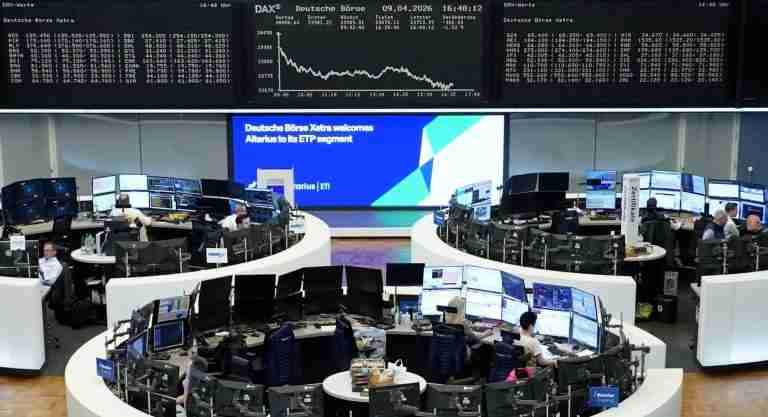
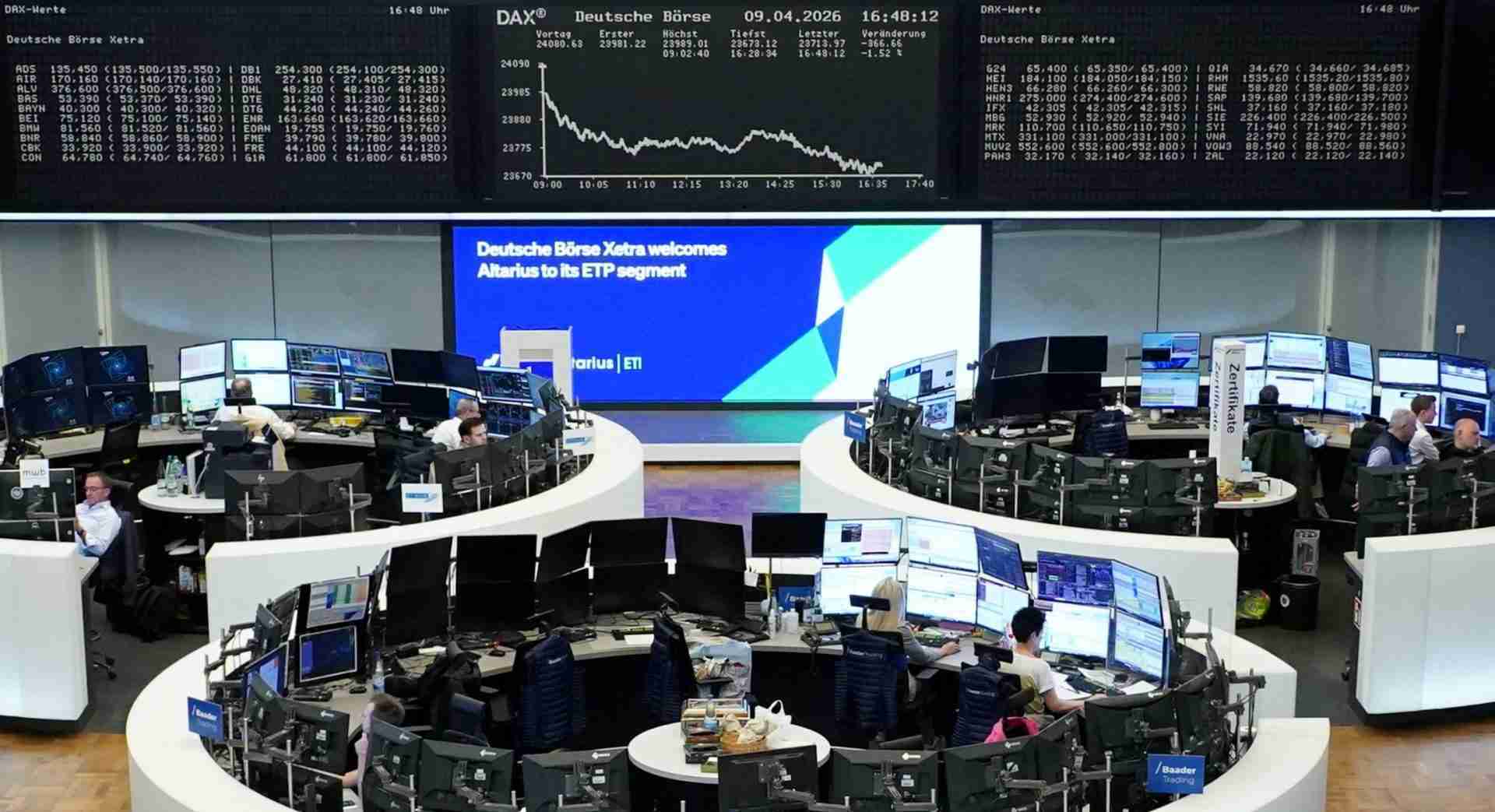
World stocks hold near record highs, oil keeps below $100 on peace deal hopes

Trump said the next meeting between U.S. and Iranian negotiators could take place at the weekend

International News via Reuters:

World stocks held near record highs on Friday and were set for their third straight week of gains, while benchmark oil prices were pinned below $100 a barrel ahead of a crucial weekend that could pave the way for a near-term resolution of the Iran war. 

U.S. President Donald Trump expressed confidence that an agreement could soon be reached to end the conflict and urged the Tehran-aligned Hezbollah group to hold its fire as a 10-day truce went into effect between Lebanon and Israel.

Trump said the next meeting between U.S. and Iranian negotiators could take place at the weekend.

Investors have been quick to take an optimistic view of any signs of denouement this month, even though the Strait of Hormuz – through which a fifth of the world’s oil and gas supplies typically flow – remains largely closed. 

That optimism has kept oil prices below $100 per barrel though they remain well above the pre-war levels. Brent crude futures were down around 1% on Friday to $98.5 a barrel. U.S. West Texas Intermediate crude futures fell 1.2% to $89.1 a barrel.

In stocks, MSCI’s world share index, which tumbled in March due to the war, hit a record high on Thursday and has risen 8.5% so far in April.

“The debate is ‘has this gone too far too fast?’, and ‘what in the world are equities thinking rallying so hard when oil is still at $100?,'” said Ben Laidler, head of macro and equity strategy at Bradesco BBI.

“But that misses the point,” Laidler said, “(Investors) are forward-looking. Relative valuations look pretty good, earnings remain very strong, and it’s a rare geopolitical event that hasn’t been a buying opportunity.”

He said to continue rallying from here, stocks would need some validation of their recent moves from continuing de-escalatory steps in Iran bringing oil prices lower and from first-quarter earnings.

“Expectations are quite high and we need to deliver on them,” he said.

The initial stages of U.S. earnings season have been broadly positive, though on Friday the focus was on Netflix, which slumped 9.6% in premarket trading after forecasting below-expectation second-quarter earnings per share.

Broader index moves were more muted, with traders reluctant to make big bets ahead of a critical weekend when markets will be closed.

Europe’s broad STOXX 600, which has underperformed U.S. and Asian peers, was a whisker higher as were U.S. S&P 500 futures.

Asia stocks dipped earlier in the day, but still posted weekly gains.

BONDS LAG

Government bond markets have regained some of their lost ground, but much less than stock markets have. Investors see less chance of a Federal Reserve rate cut this year than they had pre-war and still see the rate hikes from the European Central Bank they rushed to price in in early March.

The U.S. benchmark 10-year Treasury yield was little changed on Friday at 4.31%, down from late March highs close to 4.5% but well above pre-war levels around 4%. [US/]

The euro zone benchmark German 10-year Bund yield was 3.03%, like its U.S. peer, off its recent high but around 40 basis points higher than late February. [GVD/EUR]

For Andrew Chorlton, CIO for public fixed income at M&G, the last two weeks have been surprising in how quickly markets have been willing to look through the conflict and energy shock. 

“There’s quite a strong contrast between what policymakers and central bankers are saying about the risks that this (conflict) is creating versus what the market is implying,” he said.

“That seems somewhat complacent,” Chorlton added. “It seems unlikely that there shouldn’t be some additional risk premium priced in, either to growth or to inflation.” 

The U.S. dollar benefited from safe-haven flows in March, but has since given up those gains. The euro last bought $1.1782, just below the seven-week high it touched in the previous session. [FRX/]

The yen was slightly weaker at 159.1 per dollar as investors took stock of comments from Bank of Japan Governor Kazuo Ueda, who steered clear of signalling a rate hike was on the cards this month.

The remarks will keep traders guessing on the timing of the next rate hike, with the lack of a clear signal leading markets to reduce bets of a rate increase at the BOJ’s April 27-28 policy meeting.

Gold was steady at $4,789 an ounce. [GOL/]

Reporting by Ankur Banerjee in Singapore; Editing by Kevin Buckland, Shri Navaratnam, Lincoln Feast and Joe Bavier

Bus service disrupted across island due to mechanical faults

Some runs have been cancelled while a manufacturer technician assists with repairs and parts are expected next week, and DPT says 20 new electric buses will arrive in mid-summer

Media Release:

The Department of Public Transportation is experiencing service disruptions due to mechanical issues with buses. Currently, 46 buses are in service across all routes; however, some runs have had to be cancelled due to a lack of available buses.

The department spokesperson said, “Buses are taken out of service for various reasons. Some of the more intricate repairs are due to accidents, mechanical issues and usage levels. To assist the DPT’s mechanics, a technician from the manufacturer is on the island to troubleshoot more complex repairs. We are expecting a shipment of parts next week. Priority has been placed on returning buses to service to meet the schedule.

 “As detailed in the 2026/27 Ministry budget, the Department will take possession of 20 new electric buses, which are in the final stages of manufacture and are expected to be completed by the end of this month, with delivery anticipated in mid-summer. The twenty new buses will increase the number in service, and a robust parts inventory will enable swift repairs. We will soon begin recruiting for vacant Technician positions to manage the workload.

 “The Department has cleared out our old buses to make way for the new electric buses. Public Transportation mechanics stripped obsolete buses of all usable parts before they were disposed. (attached photo)

 “DPT takes this opportunity to apologise for the inconvenience caused by the service disruption. We encourage passengers to check https://forms.gov.bm/Bus-Schedule/Cancellations or the Shorelink App.”

Teachers reimagine STEM education in Bermuda

Participants completed epidemiology and engineering design challenges to prepare classroom-ready lessons

Media Release:

From mapping the spread of a simulated virus to designing the next generation of athletic footwear, nearly 60 Bermuda educators spent a high-energy day at Elliot Primary School redefining what STEM education looks like in the modern classroom.

Led by renowned expert Dr. Natalie S. King, PhD, the session moved beyond traditional lectures to immerse teachers from P2, P3, P6, and Middle Level Science in the same inquiry-based challenges they will now bring to their students. Dr. King, an Associate Professor at Georgia State University and founder of the I AM STEM Foundation, guided the group through a framework that proves science is most powerful when it affirms a student’s own identity and culture.

“Every activity was exciting, purposeful, and immediately applicable to our classrooms. From the paper circuits to the sneaker prototype challenge, we experienced firsthand exactly what engaging, inquiry-based science looks like. I left inspired and ready to bring it back to my students,” said Dana Bean, P2 teacher at Victor Scott Primary.

The workshop centred on the philosophy that STEM education must be evidence-based and equity-centred. To demonstrate this, Dr. King led educators through real-world simulations, including an Epidemiology Disease Spread Simulation and an Engineering Design Sneaker Prototype Challenge. These activities were designed to be culturally responsive, ensuring that every student sees themselves reflected in the curriculum.

“Being able to work alongside colleagues from other schools was invaluable. The collaborative activities, shared resources, and interactive discussions made the learning feel real and relevant. I walked away with new connections, new ideas, and practical tools ready for my science lessons,” said Deonae Dickinson, P2 teacher at  St Georges Prep

The session concluded with a strategic “Call to Action.” Educators didn’t just leave with ideas; they walked away with a concrete roadmap for the remainder of the academic year. This includes standards-aligned lesson templates and a plan to integrate STEAM Project-Based Learning units before the end of the term.

Shannon James, the Department’s Education Officer, Science, said: “Partnering with Dr Natalie King and the I AM STEM Foundation is a testament to our commitment to continue to provide world-class professional learning for our educators. Dr King’s expertise, passion, and ability to connect with teachers at every level were evident throughout the entire day. Seeing a mixed group of educators from across our schools engaged, collaborating, and leaving with practical tools and renewed passion for science teaching is exactly what we set out to achieve. This is the kind of transformative experience that doesn’t just build teacher capacity. It ultimately changes outcomes for our students.”

Minister of Education, Senator, the Hon. Crystal Caesar, JP, said, “Opportunities like this exemplify the direction in which we must continue to move as a public education system. By equipping our teachers with innovative, equity-centred approaches to STEM, we are not only strengthening classroom practice but also ensuring that every child in Bermuda can see themselves as a scientist, engineer, or innovator. The practical application demonstrated throughout this workshop reflects the supportive professional learning that ultimately drives improved student outcomes and prepares our young people to thrive in an increasingly complex, technology-driven world.”

By investing in these transformative instructional frameworks, the Bermuda Public School System continues to equip its educators with the tools to inspire the next generation of innovators.

Political appointments… what should the public know?

OBA wants transparency on Minister-appointed roles; Government says law allows for political appointments; We take a look at the remuneration for some of those jobs…

Should Government be transparent with who they put in Government roles – particularly when such appointments are at the discretion of the Minister?

The OBA’s Jarion Richardson certainly thinks so, suggesting they are open to politicisation.

However, Government has affirmed that the law allows for a number of political appointments.

Our Gary Foster Skelton took a look at some of these roles and found out – the money can be pretty good…

WATCH the report above. (SCROLL down for Jarion Richardson’s comments and the Government’s response)


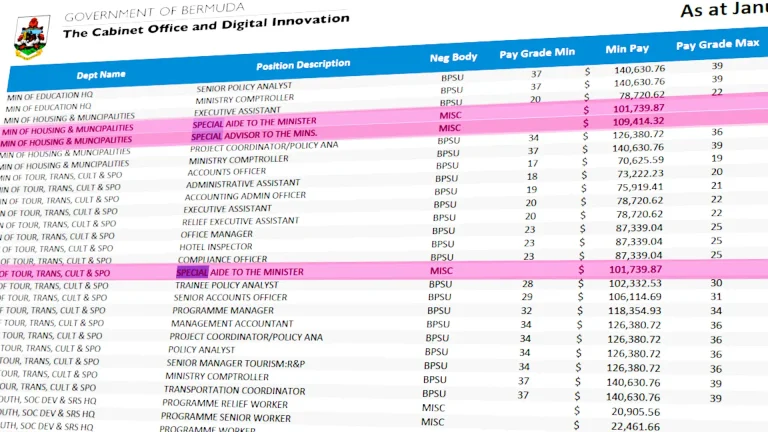
Bermuda Government Salaries as of January 2026:

Selected salaries (Special and Ministerial Advisors and Aides, and Political roles):

Special Advisor, Cabinet Office – $145,035
Special Advisor, Ministry of Economy & Labour – $105,510
Special Advisor, Ministry of Housing – $109,414
Special Advisor, Ministry of Youth, Social… – $105,510
Special Advisor, Ministry of Home Affairs – $119,615

Administrative Assistant (Political), Cabinet Office – $106,699
Political Aide #1, Ministry of Finance – $87,148
Political Aide #2, Ministry of Finance – $89,454
Political Advisor, Ministry of Home Affairs – $105,510
Political Aide/Consultant, Ministry of Justice – $151,511

Special Aide to the Minister, Ministry of Housing – $101,739
Special Aide to the Minister, Ministry of Tourism… – $101,739
Ministerial Aide, Ministry of National Security – $121,170
Minister’s Aide – PW #1, Ministry of Public Works – $66,811
Minister’s Aide – PW #2, Ministry of Public Works – $105,510
Aide to the Premier, Cabinet Office – $105,510
Aide to the Opposition Leader, Legislature – $43,769


Statement from Jarion Richardson, Shadow Minister of Cabinet Office & Digital Innovation (April 12 2026):

The One Bermuda Alliance expresses deep frustration and disappointment at what appears to be yet another example of the Progressive Labour Party rewarding its own candidates and affiliates with roles connected to the machinery of government.

The recent communication issued in relation to the Election Day Experience Survey, bearing the name of a former PLP candidate who has since been engaged in a consultancy role connected to government functions, raises serious and legitimate concerns about the continued blurring of lines between party and state.

This pattern of manipulating the people’s property for political gain has been seen time and again.

This concern is heightened by the fact that the individual in question is not a politically detached professional, but a deeply embedded figure within the Progressive Labour Party.

He has served as Chairman of the PLP’s youth wing, Progressive Minds, has publicly advocated on behalf of the Party’s policy agenda, and stood as an official PLP candidate in the last General Election. He is, by any reasonable standard, a political actor within the governing party’s structure. When individuals with that level of political involvement are then engaged in roles connected to government functions, it raises serious and unavoidable questions about whether such appointments are being made on the basis of independence and merit, or political affiliation.

Bermudians are increasingly concerned that under this Government, access to public roles and opportunities is too often determined not by merit, independence, or transparency, but by political alignment. That perception—whether denied or dismissed by the Government—is corrosive. It undermines confidence in public institutions and reinforces the growing belief that political loyalty is being rewarded at the expense of fairness.

Good governance demands more.

It requires that public appointments, formal or informal, are made through transparent, accountable processes that inspire confidence across the entire community, not just within one political party. It requires a clear and visible separation between those who seek elected office and those entrusted with administering public functions.

When that line is repeatedly crossed, it should concern every Bermudian, regardless of political affiliation.

The One Bermuda Alliance has consistently advocated for higher standards in public life. Our platform and principles are grounded in integrity, accountability, and the proper stewardship of public resources. We believe that government must serve the country, not the party.

This latest development only reinforces why so many Bermudians feel disillusioned with politics. Trust is not lost in a single moment, it is eroded through repeated actions that suggest the system is not operating on a level playing field.

We therefore call on the Government to:

  • Clarify the process by which such appointments are made
  • Disclose the scope, terms, and remuneration of consultancy roles connected to public functions; and
  • Commit to clear, published standards that prevent the politicisation of government work.

Bermuda deserves a system that is fair, transparent, and worthy of public trust.

The One Bermuda Alliance will continue to hold the Government to account and advocate for a higher standard of governance on behalf of all Bermudians.

Response from the Government, 14 April 2026:

“The Government rejects the Opposition’s latest attempt to create confusion about a well-established process.

“Under the laws of Bermuda and the Ministerial Code of Conduct, Ministers are allowed, with the written approval of the Premier, to appoint advisers or consultants to assist them in their work.

“The law is also clear that these appointments may be political or expert in nature. There is nothing improper, unusual, or new about that.

“In this case, the appropriate process was followed and the necessary approval was given.

“What makes the Opposition’s criticism even more perplexing is that the Minister for the Cabinet Office and Digital Innovation is working to deliver on an election promise to modernise Bermuda’s electoral system, including the introduction of absentee voting, a reform the Opposition itself has long said it supports.

“If the Opposition supports absentee voting and electoral reform, why is it complaining about the work being done to advance it?

“For clarity, the appointment was appropriately made. And the work being carried out is aimed at delivering a reform that has broad public support.

“Government is in fact doing the work required to deliver on its pledged promises.”

UK’s Reeves says debt, taxes should not fund military spending boost

Prime Minister Keir Starmer has promised the largest sustained rise in defence spending since ‌the Cold ⁠War, but with the public finances already under strain, his government has not yet published a 10-year defence investment plan

International News via Reuters:

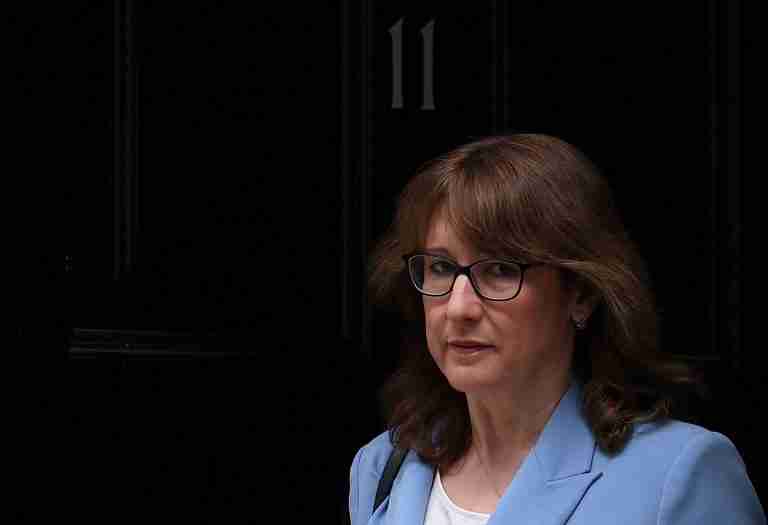
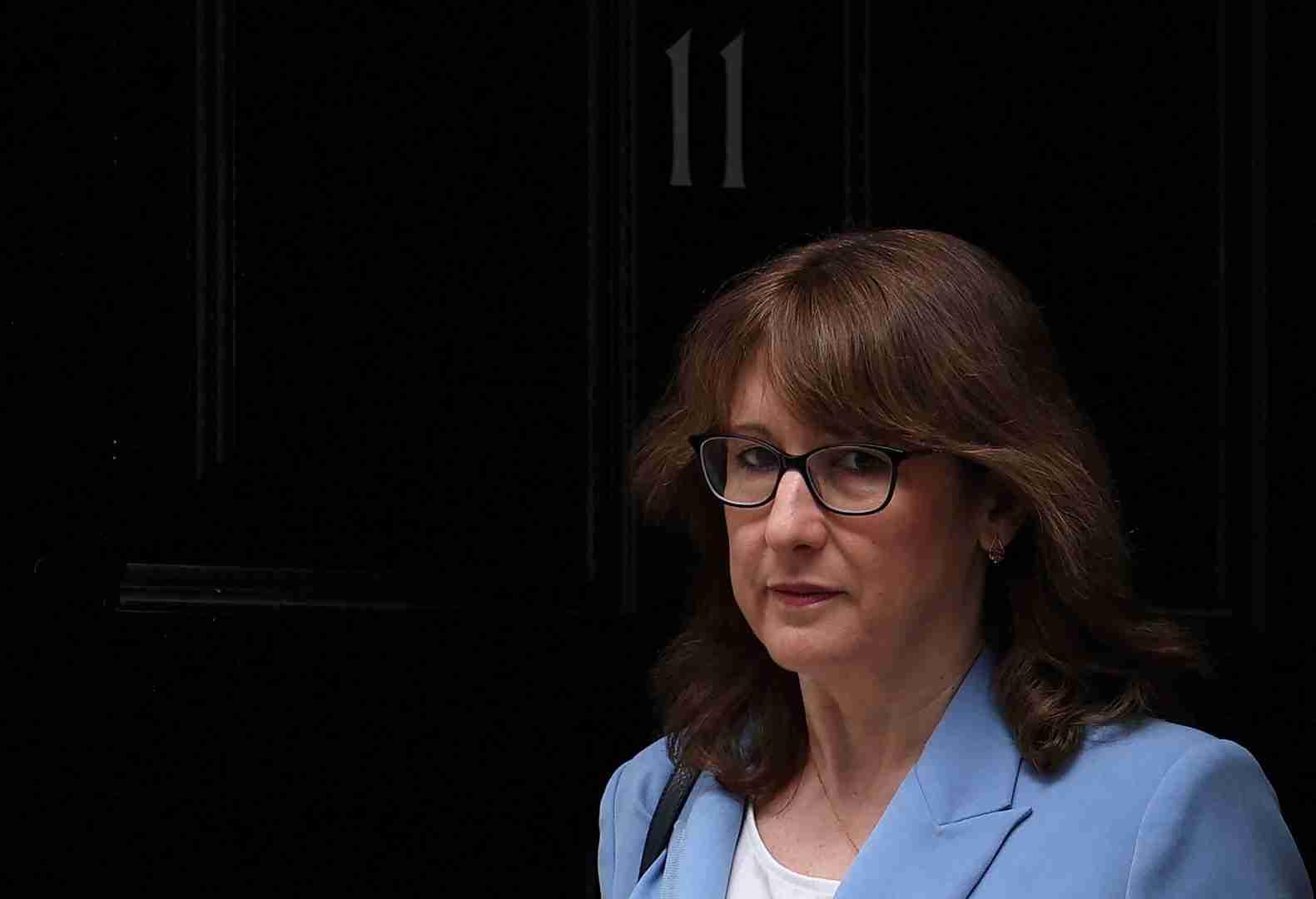
British finance minister Rachel Reeves on Thursday raised the prospect of cuts to some areas of public spending to invest more in the military and said she was working on ways to counter the country’s energy vulnerabilities caused by the Iran war.

Reeves, speaking to reporters during the International Monetary Fund and World Bank spring meetings in Washington, said she did not favour tax hikes or higher borrowing to pay for increases in defence spending, which has become a priority after Russia’s full-scale invasion of Ukraine as well as the Iran war.

“Obviously we are working through a range of options, but my two budgets have both increased taxes substantially and I would prefer not to have to do that again.” 

In terms of borrowing, British government spending on debt interest costs is already too high, she said.

Prime Minister Keir Starmer has promised the largest sustained rise in defence spending since ‌the Cold ⁠War, but with the public finances already under strain, his government has not yet published a 10-year defence investment plan.

If it ruled out raising taxes or borrowing more, the government would probably have to look at cutting other areas of public spending – possibly the big welfare budget – to fund a bigger defence budget.

Reeves said she was not worried about making difficult choices.

George Robertson, a former NATO chief who is a veteran of Starmer’s Labour Party, criticised the government this week for failing to adequately fund defence.

ENERGY PLANS

As well as exposing shortcomings in the armed forces, the Iran war has underscored the vulnerability of Britain’s economy to shifts in energy prices, which have surged due to the conflict in the Middle East.

Reeves said she hoped to announce in the coming days more details on ways to de-link UK electricity prices from gas prices, a change which could help to bring down the high cost of power in Britain.

“This is something that I’ve been attracted to for quite some time, de-linking electricity and gas prices,” she said. “At the moment, when gas prices are so high, we end up paying more for our electricity, even though the cost of producing it doesn’t change.”

According to the International Energy Agency, large energy-intensive companies in Britain paid about four times more for electricity in 2024 than U.S. businesses, and more than double their competitors in France and Germany.

Separately, Reeves said the government was working “pretty intensely” with energy firms to finalise the details of so-called tie-back projects in the North Sea which would allow some new oil and gas production on or near existing fields.

The Labour Party pledged during its 2024 election campaign that it would stop awarding new oil and gas licences to help the move toward net-zero emissions. But its plan for tie-backs, announced in November last year, would allow for new oil and gas licences if they do not require new exploration.

Writing by William Schomberg; Editing by Paul Simao