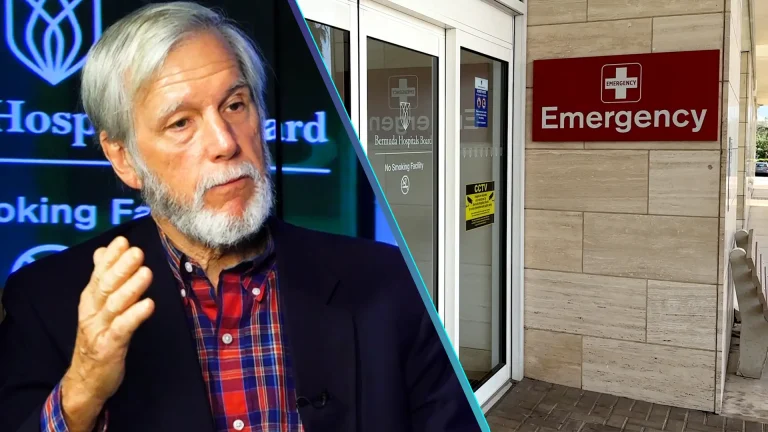
The doctor who went public about emergency care issues that he believes puts lives at risk, says that he had been trying for years to present his concerns to the Bermuda Hospitals Board
Dr. Ed Shultz, Chief of Emergency from 1998 until 2018, says the hospital management were not receptive to his concerns that issues with emergency facilities in the new Acute Care Wing were putting lives at risk.
However, Dr. Shultz told us last week that while he was both Chief of Emergency and later a board member, BHB had “not taken my concerns seriously or acted on them in a serious way”.
WATCH the report above.
We reached out to the Bermuda Hospitals Board for a response to Dr. Shultz’ comments.
A BHB spokesperson responded:
“The Bermuda Hospitals Board (BHB) recognises the concern in the community regarding the current pressures in the Emergency Department, and we are committed to addressing these challenges with urgency and care.
“BHB has been in active discussions with the Ministry of Health, and we are aligned in our shared priority of improving patient flow, reducing bottlenecks, and strengthening the overall experience for those who rely on emergency services.
“We are moving forward with an independent, focused operational assessment to identify immediate, practical steps that can support our teams and enhance the safety and efficiency of care. Our staff continue to work exceptionally hard under difficult conditions, and we are committed to supporting them while this process is underway.
“We remain dedicated to providing timely, safe, and compassionate care for our community.”
Bermuda Broadcasting also reached out to Dr. Michael Richmond, Chief of Staff then CEO of BHB during Dr Shultz’ time on the board.
Now working for the National Health Service in the UK, he told us “Having left the Trust in December 2023, Dr Richmond considers any further discussion on this issue to be a matter for the current Board.”
The former Chief of Emergency who stated publicly that lives are being put at risk is ecstatic that Government has ordered an independent review
“I can honestly say this is one of the happiest days in my life.”
That’s how Dr. Ed Shultz feels about the Ministry of Health directing the Bermuda Hospitals Board to engage in an independent operational review of its Emergency Department.
“I’ve worked for this for 16 years to get this issue addressed”, he says. “I just can’t say how wonderful I feel at this point.”
Kim Wilson, Ministry of Health, said on Tuesday that the Government expects “clear findings, practical recommendations, and prompt implementation” from the independent review.
The hospital has seven days to update the Ministry as to who will perform the review, and the scope and methodology of the review.
Speaking to Bermuda Broadcasting following the announcement, Dr Shultz sought to emphasise “how important the Minister’s actions have been in getting this accomplished.”
Dr. Ed Shultz was Director and Chief of Emergency from 1988 until 2018, followed by six years on the hospitals board, stepping down in December 2024.
He also revealed that he had made a number of proposals to the hospital to relieve overcrowding.
The hospital has previously confirmed that, from January to March this year, about two in five acute care patients did not have a medical need to take up a hospital bed.
However, Dr. Shultz says that his concerns with emergency care boarding had not been taken seriously during his time at KEMH.
He says the Government “is now finally making the hospital act in a manner that’s accountable to the people of this country…
“I’m absolutely convinced it can be fixed, and we don’t have to accept substandard emergency care in this country.”
As for how the independent review order by the Ministry compares to his request for a comission of inquiry, Dr. Shultz says “I think they’re both essentially the same…
“What I want is someone other than the hospital, with external expertise, to come in and analyze what’s going on and say… you need to do A, B, C, and D.”
Dr. Shultz added that, since going public with his concerns last week, he has been “inundated with calls of support”, but also calls recounting “horror stories” of incidents that occured to patients while in the Emergency Department.
“I’ve been contacted by staff who resigned because in good conscience they couldn’t practice under those conditions and deliver a substandard care…
“The only thing I care about is that the people in Bermuda, who I feel deeply indebted to, get the best emergency care in the world – because that’s what they deserve.”
Anthropic’s Mythos is seen by cybersecurity experts as posing significant challenges to the banking industry and its legacy technology systems, raising alarm bells among regulators in Britain and the U.S
International News via Reuters:
European Central Bank supervisors are set to quiz bankers about the risks that Anthropic’s new artificial intelligence model might supercharge cyberattacks, one source familiar with the situation told Reuters on Wednesday.
Anthropic’s Mythos is seen by cybersecurity experts as posing significant challenges to the banking industry and its legacy technology systems, raising alarm bells among regulators in Britain and the U.S.
ECB supervisors are gathering information about the model, with a view to asking banks on their watch about their preparedness for this new possible source of risk, said the source who spoke on condition of anonymity because they are not authorised to comment publicly on the matter.
Unlike in the U.S., this effort will be carried out via the ECB’s regular dialogue with bank staff and no ad-hoc meeting with top management has been scheduled yet.
An ECB spokesperson declined to comment.
Mythos’ capabilities to code at a high level have given it a potentially unprecedented ability to identify cybersecurity vulnerabilities and devise ways to exploit them, experts told Reuters.
This aspect is why Anthropic has said the current iteration, Claude Mythos Preview, will not be made generally available.
Instead, the company announced Project Glasswing, in which it invited major tech companies, cybersecurity vendors and JPMorgan Chase, along with several dozen other organizations, to privately evaluate the model and prepare defences accordingly.
TRUMP BACKS AI SAFEGUARDS IN BANKING SYSTEM
U.S. Treasury Secretary Scott Bessent and Federal Reserve Chair Jerome Powell convened an urgent meeting with bank chief executives last week to warn them about the risks, which President Donald Trump acknowledged on Wednesday. Trump also backed government safeguards.
St. Louis Fed President Alberto Musalem told Reuters the development emphasized the need for the U.S. central bank to “revisit how we’re thinking about cybersecurity” and to check in with banks about their own “resilience and robustness to cyber risk in this new world.”
“Our cyber teams are engaged with the substance of it, not the news of it, but the actual substance of it. And we’re evaluating,” Musalem told Reuters in an interview on Wednesday.
Britain’s Technology Secretary Liz Kendall and Security Minister Dan Jarvis sounded a similar warning to businesses on Wednesday, saying Mythos was “substantially more capable at cyber offence” than any model previously tested by the government’s AI Security Institute.
A new generation of AI models is “becoming capable of doing work that previously required rare expertise: finding weaknesses in software, writing the code to exploit them, and doing so at a speed and scale that would have been impossible even a year ago,” they said in an open letter to businesses.
Bank of England Governor Andrew Bailey said this week that central banks and financial regulators must quickly understand the implications of the new model.
In Canada, Mythos was discussed at a meeting last Friday about cybersecurity attended by representatives of the Finance Ministry and the Bank of Canada as well as bank executives, a ministry spokesperson said.
The ECB already had listed tech risk as one of its top priorities for the 2026-2028 period.
Reporting by Francesco Canepa; Additional reporting by Paul Sandle in London, Howard Schneider in Washington and Promit Mukherjee in Ottawa; Editing by Emelia Sithole-Matarise and Paul Simao
U.S. President Donald Trump said the war with Iran was close to over, as the army chief of mediator Pakistan arrived in Tehran to try to prevent a renewed outbreak of hostilities
International News via Reuters:
The U.S. dollar edged lower on Wednesday and was fluctuating narrowly on either side of unchanged throughout the day as investors assessed the likelihood that peace talks between Iran and the United States would resume shortly.
U.S. President Donald Trump said the war with Iran was close to over, as the army chief of mediator Pakistan arrived in Tehran to try to prevent a renewed outbreak of hostilities.
A source told Reuters that Israel expects a two-week ceasefire, agreed to last week with the Iranians, to be extended as U.S. and Iranian officials weighed a return to Pakistan for further talks. White House press secretary Karoline Leavitt told reporters that reports the White House had requested an extension of the ceasefire in the Iran war were wrong.
The war has effectively throttled the Strait of Hormuz, a crucial waterway for one-fifth of global oil and gas shipments as well as other key products such as fertilizer, since the U.S.-Israeli attacks on Iran began on February 28. That has sent oil prices surging and ignited concerns about the hit to global growth and inflation.
“We’re trying to figure out if negotiations are going to continue, if the ceasefire will continue, and if ultimately tensions can be established as solidified or eased, but no one knows exactly where things are going,” said Juan Perez, senior director of trading at Monex USA.
“Not only are we at the mercy of the headlines over the conflict, but now the focus is going to be on economic growth.”
DOLLAR INDEX CONTINUES TO FADE
The dollar index, which measures the greenback against a basket of currencies, shed 0.01% on the day to 98.06 after climbing as high as 98.286. The session low was 98.005.
U.S. crude rose 0.13% to $91.39 a barrel and Brent ticked up to $94.87 per barrel, a gain of 0.06% on the day.
Four sources told Reuters the European Central Bank (ECB) policymakers are wary about raising interest rates as soon as this month, as they have yet to see firm evidence that an energy-induced inflation shock is becoming broad-based or entrenched. The euro was last up 0.03% at $1.1799.
ECB policymaker Joachim Nagel said on Wednesday the situation surrounding the Strait of Hormuz will be crucial in informing the central bank’s next policy decision, while fellow policymaker José Luis Escrivá said its baseline scenario for the economy, which envisages a short-lived impact from the Iran war, is materializing on the energy market.
The dollar index had dropped as low as 97.968 on Tuesday, its weakest level since March 2, the first trading day after the U.S.-Israeli war with Iran began, but investors said robust demand for U.S. assets and waning prospects for U.S. interest rate cuts should buttress it against sharper declines.
The decline puts the dollar index on track for an eighth straight daily loss, its longest since a nine-session skid that ended on December 3, when investors were largely expecting at least two rate cuts from the Federal Reserve this year.
ECONOMIC DATA IN FOCUS
U.S. Treasury Secretary Scott Bessent told CNBC the economy will be slower this quarter with the Iran war, but that it is in good shape and will rebound. He added that oil prices do not appear to be raising inflation expectations.
The U.S. Labor Department said import prices rose 0.8% last month after a downwardly revised 0.9% gain in February, short of the 2% rise forecast by economists polled by Reuters. In the 12 months through March, import prices shot up 2.1%.
Cleveland Fed President Beth Hammack said that while she sees no imminent need for the U.S. central bank to change its interest rate target-setting, future cuts or even hikes were possible.
Against the yen, the dollar strengthened 0.18% to 159.05, moving closer to the 160 level that has sparked past interventions in the currency market by Japanese officials. Sterling strengthened 0.06% against the greenback to $1.3572.
Reporting by Chuck Mikolajczak; Additional reporting by Amanda Cooper in London and Ankur Banerjee in Singapore; Editing by Janane Venkatraman, Kirsten Donovan, Paul Simao and Edmund Klamann
United Nations Secretary-General Antonio Guterres said at the launch event that the platform is essential for power relations to change
International News via Reuters:
A group of officials from developing economies launched on Wednesday the Borrowers’ Platform, an effort backed by the United Nations to give debt-hit nations a stronger collective voice in dealings with creditors.
United Nations Secretary-General Antonio Guterres said at the launch event that the platform is essential for power relations to change.
“Today, we launch a breakthrough in global financing, a platform in which borrowing countries sit together, learn from each other and speak with a collective voice,” Guterres said.
He said 3.4 billion people live in countries that spend more on debt service than on health or education.
The initiative is seen partly as a counter for institutions like the Paris Club, where official creditors meet to discuss negotiation strategies when a common debtor encounters problems with repayment.
This platform aims also to be an experience repository of sorts, where members share their knowledge and new governments, or new countries, avoid arriving at the table with a lack of preparedness.
“What was once a long-standing aspiration of developing countries has now become a concrete and a collective step forward,” said Ahmed Kouchouk, Egypt’s finance minister. “Today stands as a strong statement of intent that the voice of borrowing nations and countries belongs at the very center of the global financial dialogue.”
The event, presided over by Egypt as chair of the working group, is due to formally open an interim phase for the platform, establish interim leadership and adopt a work program running through October 2026, according to the launch agenda.
The working group that developed the draft modalities was made up of Egypt, Colombia, Honduras, Maldives, Nepal, Pakistan and Zambia. Pakistan served as vice chair.
Under the draft framework, full membership would be voluntary and limited to developing countries that are UN member states, net borrowers and not full members of creditor groupings. The proposed structure includes a Governing Council of finance ministers, central bank governors or equivalent officials, and a Steering Committee of senior technical officials.
“The launch of the Borrowers’ Platform is a major milestone in rebalancing power inequalities in global economic governance,” said Iolanda Fresnillo, policy and advocacy manager at the European Network on Debt and Development (Eurodad), in a statement.
“This long-overdue initiative is a first step towards breaking creditor domination over decision-making on sovereign debt issues.”
Reporting by Rodrigo Campos in New York, Editing by Franklin Paul and Andrea Ricci
Under the consultation, the Financial Conduct Authority (FCA) is seeking feedback on proposed regulations on a range of crypto activities including operating crypto trading platforms
International News via Reuters:
Britain’s financial regulator said on Wednesday it was consulting on how firms might be affected by the regulation of the crypto industry which is due to come into effect by October 2027.
Under the consultation, the Financial Conduct Authority (FCA) is seeking feedback on proposed regulations on a range of crypto activities including operating crypto trading platforms as well as dealing, staking and safeguarding crypto assets, the regulator said.
Reporting by Prerna Bedi in Bengaluru; Editing by Shailesh Kuber
Eight students and one teacher died in the attack in the province of Kahramanmaras, Turkey’s Interior Minister Mustafa Ciftci told reporters, adding that six of the wounded were in critical condition
International News via Reuters:
A 14-year-old student shot at least nine people dead including eight of his fellow pupils and wounded 13 others at a middle school in southeastern Turkey on Wednesday, officials said, in the country’s second school shooting in two days.
Eight students and one teacher died in the attack in the province of Kahramanmaras, Turkey’s Interior Minister Mustafa Ciftci told reporters, adding that six of the wounded were in critical condition.
“This was solely a personal attack carried out by one of our students, it is not a terror incident,” Ciftci said.
Earlier, Kahramanmaras Governor Mukerrem Unluer had said the shooter had shot and killed himself in the commotion.
“An eighth-grade student came with 5 weapons and 7 magazines – which we believe belong to his former police officer father – in his bag, entered two classrooms with fifth grade students, causing deaths and injuries indiscriminately,” Unluer said.
Fifth-grade students are usually aged 10 and 11 in Turkey.
School shootings are very rare in Turkey. Asked by reporters if authorities would take any measures after the shootings this week, Ciftci said: “We will take necessary precautions”, without elaborating.
Broadcaster NTV said the shooter’s father had been detained.
Gun laws are generally strict in Turkey, with only individuals aged over 21 and in possession of a license allowed to own weapons. However, guns are widespread in Turkey, with many security officers allowed to carry and own arms.
Unverified footage showed several students jumping from a second-storey window at the school as gunshots echoed around the grounds. Unverified CCTV footage from the school showed the attacker shooting two students walking down a hallway.
Turkish media footage from the school grounds on Wednesday showed ambulances arriving at the school where police and crowds had gathered by the gate.
On Tuesday, a former student opened fire at a school in the southeastern province of Sanliurfa, wounding at least 16 people, including students and teachers, before killing himself.
Reporting by Tuvan Gumrukcu and Ezgi Erkoyun; Editing by Jonathan Spicer, Alexandra Hudson
The effective closure of the Strait of Hormuz due to the U.S.-Israeli war on Iran has blocked flows from the Middle East
International News via Reuters:
Europe was seeing record inflows of jet fuel from the United States, data from Kpler and LSEG showed, as the region attempts to shore up fuel supplies to make up for the disruption of imports from the Middle East.
The effective closure of the Strait of Hormuz due to the U.S.-Israeli war on Iran has blocked flows from the Middle East, on which Europe depends on for nearly 75% of its jet fuel imports, or around 375,000 barrels per day. This has led European airlines to urge the European Union to step in with emergency measures, including widespread airspace closures, as per a document seen by Reuters.
Inflows from the U.S. are due to reach between 149,000 to 200,000 barrels per day so far in April, based on vessels discharged and those still due to, which is already at record highs per data going as far back as 2015 on LSEG and 2017 on Kpler.
Despite the requirement in the EU countries to maintain 90 days of emergency oil reserves, this doesn’t stipulate how much of it should be a specific fuel. Per the International Energy Agency, Spain is a net exporter of jet fuel, while Britain, which is also the region’s largest consumer, imports 65% of its demand. Stocks of jet fuel held independently in the Amsterdam-Rotterdam-Antwerp refining and storage hub stood at their lowest since March 2023 last week. [ARA/]
The U.S. is, however, already exporting at record highs – in the week ending April 3, the country exported an estimated 442,000 barrels of jet fuel in total, double the 219,000 barrels averaged last year per data from the Energy Information Administration.
While the U.S. is the top consumer of jet fuel globally, exports to regions with a worse fuel crunch like Europe and Asia were fetching better prices.
The IEA also added in its monthly report that if European markets are unable to secure more than 50% of volumes lost from the Middle East, then stocks would hit the crucial 23-day stockpile level in June – the level at which physical shortages would begin.
Reporting by Seher Dareen in London; Editing by Aurora Ellis
The finance ministry last year launched a review of the ring-fencing regime, which was introduced as part of wider post-financial crisis reforms and requires lenders to separate retail banking from riskier trading activities
International News via Reuters:
The incoming head of the Bank of England’s prudential arm said on Wednesday she would not push for further changes to Britain’s bank ring‑fencing rules.
Katharine Braddick, formerly a Barclays bank executive, will on July 1 take up the role of chief executive of the Prudential Regulation Authority, which is responsible for the safety and soundness of 1,300 banks and insurers.
The finance ministry last year launched a review of the ring-fencing regime, which was introduced as part of wider post-financial crisis reforms and requires lenders to separate retail banking from riskier trading activities. It is due to set out its findings later in the year.
At a pre‑appointment hearing before parliament’s Treasury Committee, Braddick said she had no plans to press for additional reforms beyond the government’s review.
“I’ve observed that the government has established it continues to want a ring fence, and that it wants that ring fence to be optimised for efficiency,” she told lawmakers.
“That seems to me to be what the PRA is doing, so I don’t have anything to add to that. It seems to me that the matter is settled.”
INDUSTRY BACKGROUND
UK banks HSBC, Lloyds, NatWest and Santander have previously urged the finance ministry to scrap the regime, saying it hampers growth and has been made redundant by additional reforms to boost bank safety. Barclays is alone among major banks to favour maintaining the status quo.
UK regulators have been under pressure from the government to cut red tape on businesses in an effort to revive sluggish economic growth.
Since Braddick’s appointment was announced, questions have been raised about whether her industry background would make her more inclined toward deregulation than current prudential head Sam Woods, though she gave little away when questioned by lawmakers.
“In terms of my understanding of where the PRA is looking through its current policy process, I think it’s looking in the obvious and right places,” she added, pointing to ongoing work on the bank leverage ratio and efforts to ease data-reporting requirements, among other initiatives.
She also hinted, however, at a possible change in approach to bank supervision, citing lessons that could be learned from a recently announced European Union review of its supervisory approach.
Reporting by Phoebe Seers; Editing by Andy Bruce and Alison Williams
The temporary measures will complement existing state aid rules and “allow member states to address the specific unexpected, sudden, and significant cost increases,” the draft said
International News via Reuters:
The European Commission plans to propose temporary measures such as grants, subsidies, tax breaks and loans to mitigate the impact of the Iran war on agriculture, fisheries and transport, a draft Commission document seen by Reuters showed.
The Commission is currently consulting member states before it adopts a final version by the end of April. Once adopted, these aid measures will be granted until the end of the year and will cover a portion of up to 50% of extra fuel and fertilizer costs arising from the Iran crisis.
The temporary measures will complement existing state aid rules and “allow member states to address the specific unexpected, sudden, and significant cost increases,” the draft said. This aid is directed specifically toward businesses in the agricultural, fishery, road transport, and intra-EU short-sea shipping sectors.
Global fertilizer prices have jumped in recent weeks following the near total closure of the Strait of Hormuz, a narrow shipping route along Iran’s coast. Much of the world’s fertilizer is made in the Middle East, with one-third of global trade in it sailing through Hormuz. The United Nations warned on Wednesday fertilizer shortages would hit food security and therefore stability in developing nations hardest.
“In March 2026, the price increase for nitrogen fertiliser in the EU, amid ongoing developments in the Gulf, rose sharply and currently stands around 58% above 2024 averages,” the draft said.
As reported by Reuters on Monday, the European Commission wants to let countries unleash more public money to help businesses with fuel and fertilizer bills as governments race to offset the economic shock from soaring prices triggered by the Iran war.
The Commission is also due to present a Fertiliser Action Plan this quarter, which aims to improve the availability and affordability of fertilizers for food production and avoid “harmful strategic dependencies”.
Antoine Hoxha, director general at Fertilizers Europe, told Reuters European farmers do not face any fertilizer shortages but they do have an affordability problem.
“Farmers need support. And if the European Union is doing that, it is the right thing to do,” Hoxha said.
Reporting by Alexander Chituc, Editing by Julia Payne and Keith Weir
To provide the best experiences, we use technologies like cookies to store and/or access device information. Consenting to these technologies will allow us to process data such as browsing behavior or unique IDs on this site. Not consenting or withdrawing consent, may adversely affect certain features and functions.
Functional
Always active
The technical storage or access is strictly necessary for the legitimate purpose of enabling the use of a specific service explicitly requested by the subscriber or user, or for the sole purpose of carrying out the transmission of a communication over an electronic communications network.
Preferences
The technical storage or access is necessary for the legitimate purpose of storing preferences that are not requested by the subscriber or user.
Statistics
The technical storage or access that is used exclusively for statistical purposes.The technical storage or access that is used exclusively for anonymous statistical purposes. Without a subpoena, voluntary compliance on the part of your Internet Service Provider, or additional records from a third party, information stored or retrieved for this purpose alone cannot usually be used to identify you.
Marketing
The technical storage or access is required to create user profiles to send advertising, or to track the user on a website or across several websites for similar marketing purposes.