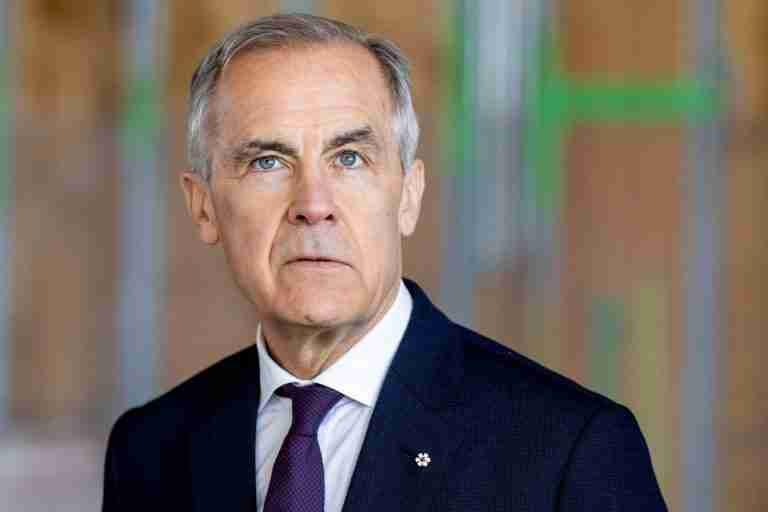
The centrist Liberals, governing with a minority after the April 2025 election, need opposition support to pass key legislation
International News via Reuters:
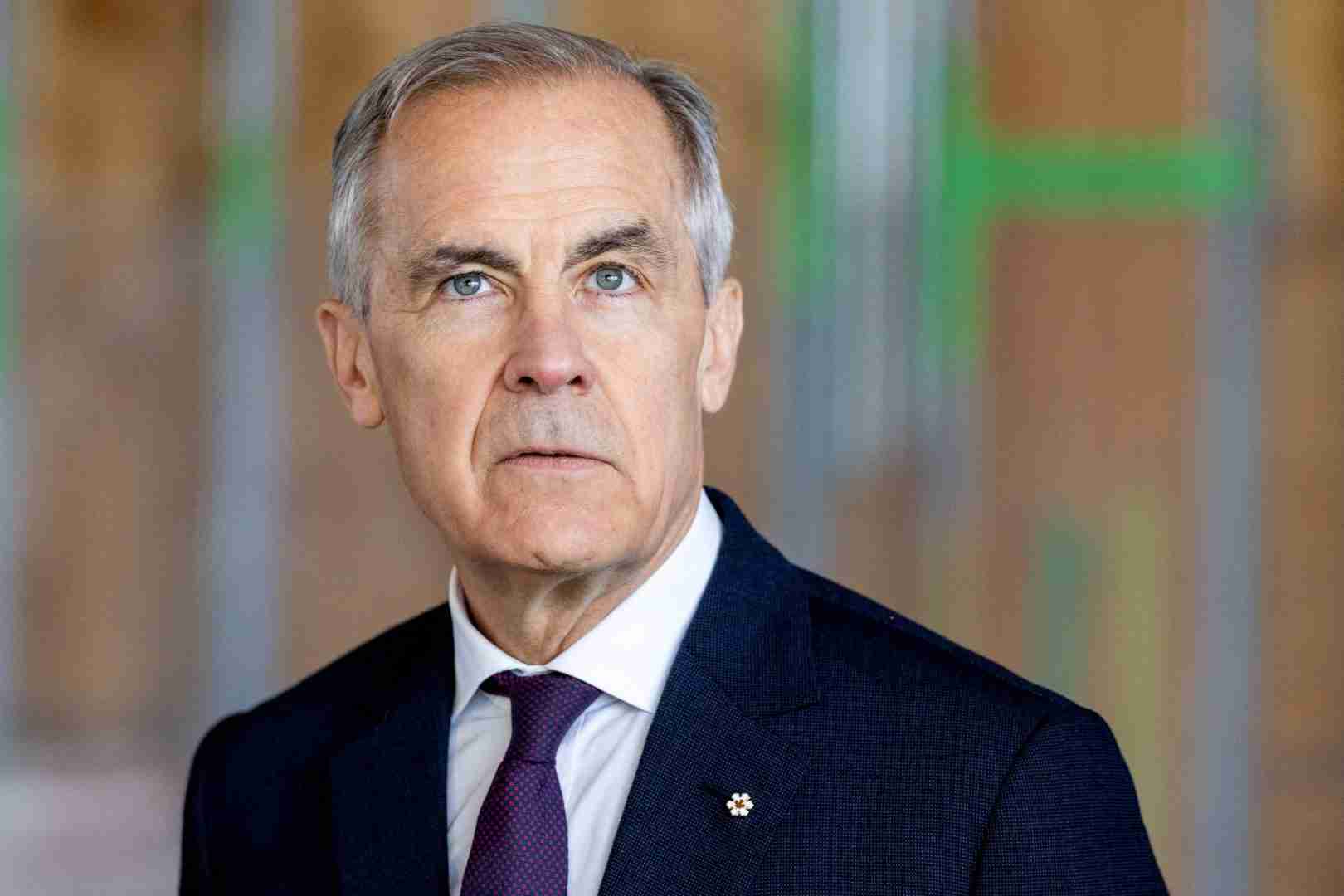
A Canadian opposition legislator defected to the ruling Liberal Party on Wednesday, leaving Prime Minister Mark Carney on the verge of a parliamentary majority that would make it easier to push through his agenda.
The centrist Liberals, governing with a minority after the April 2025 election, need opposition support to pass key legislation. Carney says he needs a majority to deal with U.S. President Donald Trump’s trade measures.
The prime minister welcomed the defection by Marilyn Gladu – a longstanding member of the right-leaning Conservatives – saying it would help the government at a time of global uncertainty.
FOURTH CONSERVATIVE DEFECTION
Gladu is the fourth Conservative legislator to defect to the Liberals since November. A member of the small left-leaning New Democratic Party joined the Liberals last month.
“We need a global leader with a plan to make a more resilient Canada, a stronger Canada, a more self-reliant Canada for this critical moment and that man is our Prime Minister Mark Carney,” Gladu said during a meeting with Carney.
The Liberals now have 171 seats in the 343-seat House of Commons, one short of a majority, and look set to gain at least two more in special elections due to be held on Monday to fill vacant seats.
Conservative leader Pierre Poilievre accused Carney of “seizing a costly Liberal majority that voters denied him, and doing so through backroom deals.” He said in a statement that Gladu should step down and face voters in a special election.
Only the governments led by John A. Macdonald and Jean Chretien have seen more politicians defect to the ruling party, including five legislators who joined Macdonald, Canada’s first prime minister, in a single day in 1869.
Semra Sevi, an assistant professor of political science at the University of Toronto, said the number of defections to Carney’s government was “extraordinary by any historical measure.”
“Switching in the 19th century occurred in a system where party labels barely registered with voters,” Sevi said in an email. In the modern era, she said the number of politicians from opposition parties who have now jumped to Carney’s government “is without precedent at this rate and in this compressed a timeframe.”
A majority would open the way to Carney serving until October 2029.
According to Nanos polling from late last month, Carney was the preferred prime minister of 54.5% of Canadians, with Poilievre scoring 22.9%. Carney has said he has no plans to call an early election.
The latest defection will put more pressure on Poilievre, who survived a leadership review in January after he blew a large lead and lost the 2025 election. The party was not immediately available for comment.
Reporting by David Ljunggren; editing by Maria Cheng, Paul Simao, Rod Nickel
Though numbers remain comparatively small, there have been 17 such departures this year, compared with no more than two per year since 2021, police spokesperson An Berger told Reuters
International News via Reuters:
Smugglers are increasingly using Belgium’s shoreline to transport migrants to Britain since tighter controls began along the French coast, authorities say.
Though numbers remain comparatively small, there have been 17 such departures this year, compared with no more than two per year since 2021, police spokesperson An Berger told Reuters.
Britain and France have both cracked down on small boats bringing thousands of migrants each year across the English Channel, for example introducing a “one in, one out” scheme.
“The shift to Belgian beaches is driven by a combination of factors, and the intensification of French coastal patrols is the most significant one from our perspective,” said EU border agency Frontex spokesperson Chris Borowski.
Smugglers have been using so-called “taxi boats,” Borowski said. A vessel departs from a quiet beach in Belgium with a small group, then travels along the coast to pick-up points before crossing to the UK.
Migrants pay about 2,000 euros ($2,300) to smugglers, with no guarantee of boarding a boat and sometimes face threats and abuse including sexual violence, authorities say.
Last month, volunteers pulled 19 people from a sinking dinghy during a night-time operation in the Belgian coastal municipality of De Haan, Berger said, adding only one had a life jacket.
More attempts are expected with better weather coming.
“Every boat that departs is one too many,” said Belgian Migration Minister Anneleen Van Bossuyt in an emailed response to a Reuters request for comment.
The numbers from Belgium are still dwarfed by the France-Britain route, where about 41,500 people were detected crossing the Channel in small boats last year.
Some 2,200 people crossed in the first two months of 2026, according to data from the University of Oxford’s Migration Observatory.
($1 = 0.8664 euros)
Reporting by Charlotte Van Campenhout and Amina Ismail, Editing by Andrew Cawthorne
The effort nearly unravelled after an Iranian strike on a Saudi petrochemical facility triggered fury in Riyadh and threatened to derail weeks of back-channel diplomacy
International News via Reuters:
Mediation efforts to halt the war in Iran were hours from collapse when Pakistan mounted an overnight diplomatic push to secure a temporary ceasefire and bring Washington and Tehran into direct negotiations, four Pakistani sources told Reuters.
The effort nearly unravelled after an Iranian strike on a Saudi petrochemical facility triggered fury in Riyadh and threatened to derail weeks of back-channel diplomacy, the sources – with direct knowledge of the talks – said.
With a deadline set by U.S. President Donald Trump looming, Pakistani officials mounted a last-ditch attempt to pass messages between Tehran and Washington, after Trump warned that continued fighting that night could wipe out “a whole civilization.”
Pakistan’s effort involved direct contact with top officials across all sides, including Trump, Vice President JD Vance and U.S. special envoy Steve Witkoff, as well as Iranian Foreign Minister Abbas Araqchi and senior Revolutionary Guards commander Ahmad Vahidi, one of the sources said.
After what a second source described as several “intense, breathless” hours during which “the talks were almost dead”, Iran agreed to a temporary ceasefire without preconditions and to enter negotiations.
“In the evening, Iran was on thin ice after the attacks on KSA (Saudi Arabia) but they knew there would be no extension to the deadline,” the first source said.
Pakistan’s military and civilian leadership remained engaged through the night, speaking to senior U.S. and Iranian, Saudi and other officials until Trump announced the breakthrough.
Minutes before Trump posted the announcement, he was on the phone with Pakistan’s army chief, Field Marshal Asim Munir, the source said.
ASSURANCES ON ISRAEL
While Pakistan conveyed its “strongest ever anger” to Iran over the strike on Saudi Arabia, with whom Islamabad has a mutual defence pact that could drag it into the war, it simultaneously sought assurances from Washington that it would rein in Israeli strikes on Iran.
Iranian officials said they had launched the strike on the petrochemical complex in Jubail after an Israeli attack on an Iranian petrochemical facility, the second source said. Tehran could not enter negotiations if such strikes continued, they added.
Pakistan then told Washington that Israeli actions were jeopardising its peace efforts and that Islamabad might not be able to persuade Iran to come to the table, the source said.
Only after receiving an assurance that Israel would hold back, was Pakistan able to persuade Tehran to agree to a temporary ceasefire without preconditions.
Two Israeli sources said Israel had opposed a deal with Iran, believing more could be achieved militarily, although it ultimately decided to support any decision taken by Trump.
An Israeli official said Washington had coordinated with Israel and the truce did not include any commitment to permanently end the war, compensate Iran or lift sanctions.
The official added that in any negotiations with Tehran, the United States would insist Iran hand over its nuclear material, halt uranium enrichment and remove the threat posed by its ballistic missile programme.
The Israeli prime minister’s office did not respond to a request for comment.
NO ONE SLEPT
Around midnight (1900 GMT), Pakistani Prime Minister Shehbaz Sharif urged all parties to observe a ceasefire to allow the peace process to begin.
The request was a coordinated move to lock in the ceasefire and came after both sides had already agreed in principle, the first source said.
“We wouldn’t have made the request if the answer was going to be negative,” the source said.
The late-night conversations included repeated exchanges over a 15-point U.S. proposal and two core questions: what would the ceasefire look like and the parameters for the talks, a diplomat from the Middle East who has been in contact with both sides said.
Iran proposed recognition of its sovereignty over the international waterway at the centre of much of the conflict – the Strait of Hormuz – a demand likely to be unacceptable to Washington, the diplomat said.
Tehran was also asking for the right to pursue nuclear energy and strike bilateral defence deals with regional states, as mediators tried to steer talks away from issues that could cause immediate clashes, the diplomat added.
Talks will start on Saturday and the U.S. delegation will be led by Vance, with Witkoff and Trump’s son-in-law Jared Kushner also part of the team, the White House said in an announcement that followed hours of speculation on what Trump would decide.
Iran has indicated it would turn over its stocks of enriched uranium, White House press secretary Karoline Leavitt told reporters as she made the announcement about talks.
Two Pakistani sources said the Iranian delegation would be led by Araqchi and parliament speaker Mohammad Baqer Qalibaf.
A third Pakistani source said the hardest part of the process was convincing Iran to accept a truce without preconditions.
“Until the last hours, Iran acted as a hardliner. The Iranians were not ready to budge without first putting their demands forward. We told them the demands can wait for the talks to happen,” the source said.
By the time Trump announced the ceasefire and Sharif extended invitations to delegations from both countries, the sun was nearly rising over Islamabad.
“We have been working throughout the night,” Sharif said at a cabinet meeting on Wednesday. “… if we turn it into a book it will serve as a big lesson for this nation and for generations to come, about how not to give up in a hopeless situation.”
Reporting by Asif Shahzad and Saad Sayeed in Islamabad, Ariba Shahid in Karachi, Alexander Cornwell in Tel Aviv, Humeyra Pamuk in Budapest, Mubasher Bukhari in Lahore, Timour Azhari in Dubai and Ethan Wang in Beijing; Writing by Saad Sayeed; Editing by Ros Russell
A Cabinet Office spokesperson said, “We are seeing an increase of videos using the likeness of Premier David Burt and other Government officials.”
Photo: Pexels/Gustavo Fring
Deep fakes and AI generated content made in the likeness of political figures, including Premier Burt are on the rise on social media.
The Government is urging people to be vigilant. In a news release issued today, a spokesperson said social media posts or messages are being used to mislead and potentially defraud their victims. No government official would use social media to promote an investment scheme, they added. A Cabinet Office spokesperson said, “With the rise of artificial intelligence, fake videos, false representations, and messages are becoming more common. Unfortunately, individuals have been scammed in the past, and we urge all residents to exercise caution and remain vigilant when using the internet.”
“As a reminder, no government official will ever use social media to promote an investment. The public is once again encouraged to only rely on official information and official advisories from the Government of Bermuda.” Residents are urged to report any fake AI posts of this particular nature directly to police.
Residents push back on proposed emergency housing site
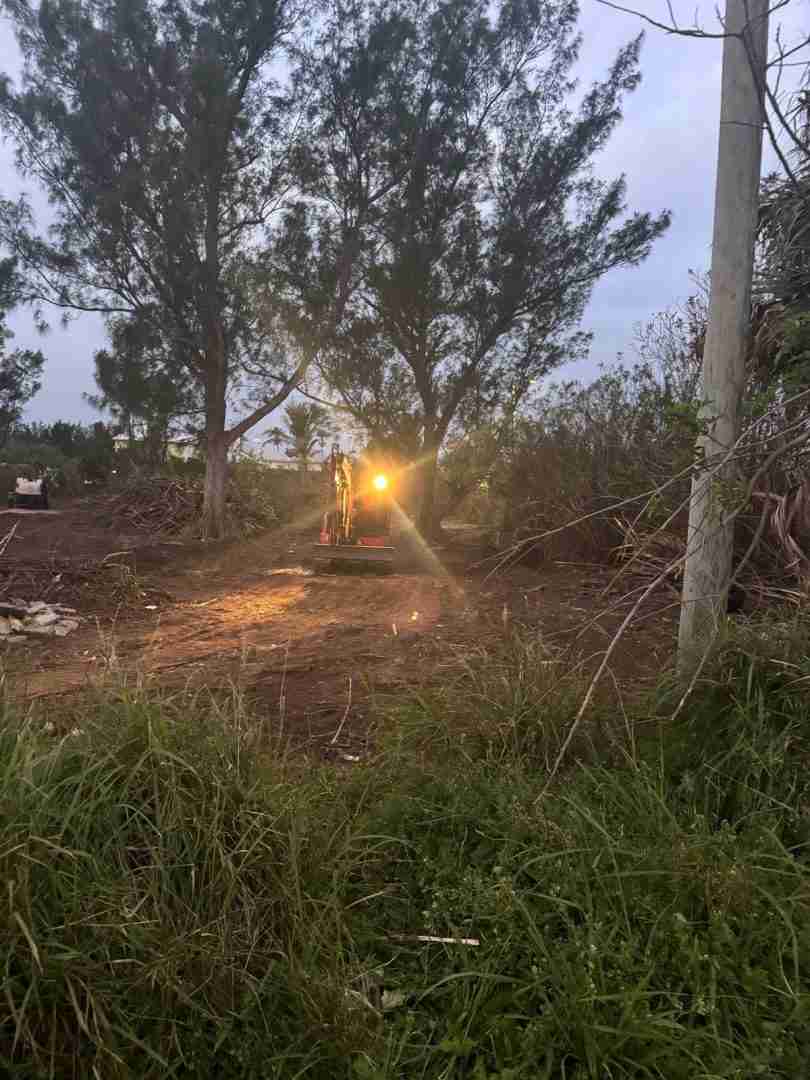
Left: Image of reported site-clearing activity supplied. Right: Government’s vision for the capsule home pilot.
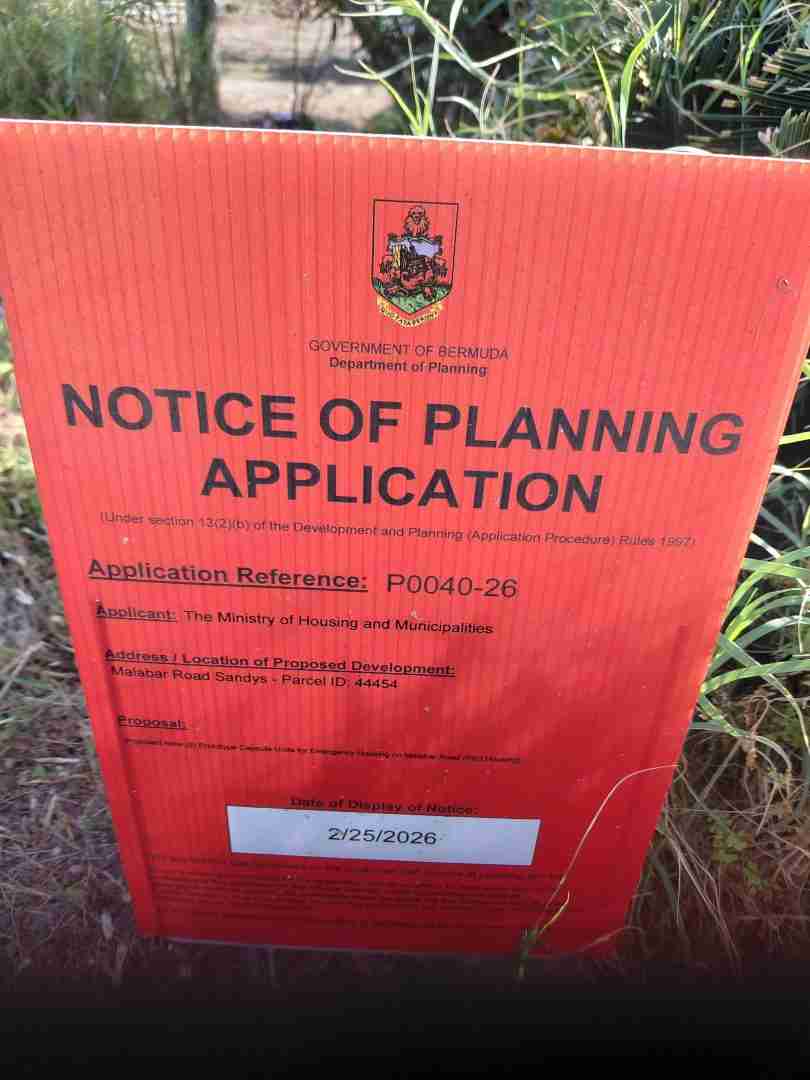
West End residents are raising concerns over the Government’s proposed installation of emergency capsule housing units in the Boaz Island area.
According to the Department of Planning’s website, around a dozen objections have been submitted.
This morning, Bermuda Broadcasting received a media release from a group calling itself Boaz Island Community Voices, which is urging greater transparency and meaningful public engagement.
As previously reported, Zane DeSilva, the Minister of Housing and Municipalities, unveiled plans for the pilot project in December. The proposal involves installing nine capsule homes on a government-owned parcel of land accessible via Malabar Close.
Officials have said the units are intended to be transitional, providing short-term housing for residents in urgent need.
However, Boaz Island Community Voices is calling for the project to be relocated, citing concerns about population density, infrastructure capacity, traffic, safety, environmental impact, and the preservation of the neighbourhood’s character.
The group also alleges that site activity, including tree clearing, took place before the planning application was approved. Work has reportedly paused following a request from residents.
In addition, residents claim consultation has been “limited,” with key details such as the duration of the housing, long-term plans for the site, and ongoing management yet to be clarified.
“Residents are urging the relevant authorities to provide clear, comprehensive information and to ensure that all stakeholder perspectives are properly considered as a final decision is made,” the media release stated.
Bermuda Broadcasting has reached out to the Government for comment.
Full media release issued by Boaz Island Community Voices:
Members of the Boaz Island community are raising concerns regarding the proposed installation of temporary modular housing units between the Boaz Island Village Condominium Complex and the Malabar/Kitchener Close condominiums.
While residents acknowledge Bermuda’s growing housing challenges and the need for emergency and transitional housing solutions, there is significant concern about the suitability of this particular location and its potential impact on the surrounding community.
Boaz Island is a quiet, close-knit residential area. Residents believe that the introduction of temporary housing units in such close proximity to established condominiums raises important questions around population density, infrastructure capacity, traffic, safety, environmental impact, and the preservation of the neighbourhood’s character. There are also concerns about the precedent this type of development may set for similar residential areas.
To date, at least 15 formal objections have been submitted to the Department of Planning by concerned residents. While official approval for the development has not yet been granted, a response letter from the Bermuda Housing Corporation, dated March 18, 2026, was uploaded to the planning application documents on April 2, 2026 for objectors to review. Many residents feel that the contents of this response remain high-level and do not fully address the specific concerns raised. In particular, responses rely on future assurances rather than providing concrete, site-specific detail, contributing to ongoing frustration and uncertainty within the community.
Residents also note that, while a community meeting was held, consultation has been limited. Key details—including the duration of the housing, long-term plans for the site, and ongoing management—have not been clearly communicated.
Residents further note that site activity, including tree clearing, commenced on Monday, March 30th despite the fact that the Planning Application had not been approved. They requested that the cutting of the trees be stopped by the government pending the outcome of the application and were told on Wednesday, April 1st that it would be halted immediately. However, up until the evening of Monday, April 6th the cutting of trees continued. Today, the clearing has paused, however, this pause has coincided with the reported discovery of asbestos at the site. Members of the community are seeking clarity on the current status of the project, including whether this pause reflects a reconsideration of the proposal or is solely related to environmental and safety remediation.
The Boaz Island community is calling for greater transparency and meaningful engagement before any decisions are finalized. It is their desire that this “Pilot” Project be located at an alternative location. Residents are urging the relevant authorities to provide clear, comprehensive information and to ensure that all stakeholder perspectives are properly considered as a final decision is made.
Trump’s upbeat talk towards Iran in three Wednesday social media posts marks a dramatic, 24-hour turn in tone
International News via Reuters:
The United States will work closely with Iran and the two countries are discussing tariff and sanctions relief, U.S. President Donald Trump said on Wednesday, following the announcement of a two-week ceasefire.
Trump’s upbeat talk towards Iran in three Wednesday social media posts marks a dramatic, 24-hour turn in tone. On Tuesday he had threatened to end the country’s whole “civilization” while on Wednesday he declared “A big day for World Peace!”
Trump said on social media that many of the 15 points in the U.S. plan proposed to Iran had been agreed to, but did not elaborate.
“We are, and will be, talking Tariff and Sanctions relief with Iran,” Trump said.
Despite his ebullient comments, and widespread relief on Iran’s streets and in global financial markets over the ceasefire, the main disagreements between Washington and Tehran remain unresolved and the two sides are sticking to competing demands for a potential peace deal.
Trump’s agreement to a two-week cool-down came less than two hours before the deadline he had set for Tehran to reopen the Strait of Hormuz, a key shipping lane, or risk its bridges and power plants being destroyed.
He said on Wednesday the United States “will be helping the traffic buildup” in the Strait. Some analysts have predicted it will likely take more than two weeks to clear the backlog of more than 1,000 ocean-going vessels trapped within the Gulf.
The president also said any country supplying weapons to Iran would immediately face a 50% tariff on any goods exported to the U.S., although he did not specify under what authority he would impose the levies. The Supreme Court in February struck down his use of the authority invoked for last year’s sweeping global tariffs, and other tariff options available have limitations to their scope and hurdles to swift imposition.
Beijing and Moscow have helped Iran build military capacity to counter U.S. and Israeli pressure, supplying missiles, air-defense systems and technology intended to bolster deterrence. But that support appeared capped during the U.S.-Israeli attacks on Iran.
Both countries have denied any recent weapons supplies, although allegations against Moscow have persisted. U.S. imports of Russian goods have shriveled since the invasion of Ukraine in 2022 and the wave of sanctions imposed on Moscow as a result.
‘VERY PRODUCTIVE REGIME CHANGE’
Trump offered praise on Wednesday for Iran’s current leaders after U.S. and Israeli strikes killed a number of top officials including Supreme Leader Ayatollah Ali Khamenei. He has been replaced as supreme leader by his son, Mojtaba Khamenei.
“The United States will work closely with Iran, which we have determined has gone through what will be a very productive Regime Change!” Trump wrote in a post on Truth Social.
The negotiations could happen in person, but no final decision has been made, White House press secretary Karoline Leavitt said in a statement.
U.S. Vice President JD Vance, while traveling in Budapest, Hungary, said that he has been working to advance a deal and that Trump is “impatient” to find progress.
He said the president told his team to negotiate in “good faith” if Iran does, as well. “But that’s a big if, and ultimately, it’s up to the Iranians how they negotiate. I hope they make the right decision.”
Trump, whose initial reasoning for U.S. military operations centered on preventing Iran from obtaining a nuclear weapon, also declared in his posts that there will be “no enrichment of Uranium, and the United States will, working with Iran, dig up and remove all of the deeply buried (B-2 Bombers) Nuclear ‘Dust.'”
“Nothing has been touched from the date of attack.”
The war waged by the U.S. and Israel has yet to deprive Iran either of its stockpile of near-weapons-grade highly enriched uranium or its ability to hit its neighbors with missiles and drones. And Iran’s clerical leadership, which faced a mass uprising months ago, has withstood the six-week onslaught with no sign of domestic opposition.
Regardless, the president is also seeing opportunity in Iran if it moves into a reconstruction phase, promising that the United States will be “hangin’ around” to try to usher in a “Golden Age of the Middle East.”
“There will be lots of positive action!” Trump posted just after Wednesday midnight in Washington. “Big money will be made.”
Reporting by Doina Chiacu, Susan Heavey, and Bo Erickson in Washington; Humeyra Pamuk in Budapest, Hungary,Editing by Tomasz Janowski, Gareth Jones, Ross Colvin, Philippa Fletcher
On Tuesday, investors sold a combined 8,600 lots of Brent and U.S. crude futures at 1945 GMT, according to LSEG data
International News via Reuters:
Investors placed an approximately $950 million bet on oil prices falling just hours before the U.S. and Iran announced a ceasefire, the latest large wager on the direction of the world’s most traded commodity ahead of a major policy announcement by President Donald Trump.
On Tuesday, investors sold a combined 8,600 lots of Brent and U.S. crude futures at 1945 GMT, according to LSEG data.
At around 2230 GMT on Tuesday, Trump stepped back from threatening the destruction of “a whole civilization” and announced a two-week ceasefire with Iran, knocking crude futures down by some 15% to below $100 a barrel at the start of Wednesday’s official trading session.
Taking large positions on oil prices rising or falling is not unusual as traders use them to hedge large volumes of physical oil trade.
But such deals are very rarely done in big lots, as traders prefer to use sweeping orders across many exchanges and ask brokers to use algorithmic trading over many hours to execute the order to avoid impacting prices with their bets. Large orders also are seldom executed after settlement, which happens Monday to Friday at 1830 GMT.
The bet follows similar moves on March 23, when investors sold $500 million in oil futures just 15 minutes before an announcement by Trump that he would delay attacks on Iran’s energy infrastructure, which stunned markets and then triggered a 15% drop in the crude price.
In Tuesday’s trading, some 6,200 lots of Brent futures changed hands at 1945 GMT, roughly 1% of the total volume traded in the day’s regular session, while some 2,400 lots of WTI futures traded at this time, also equal to around 1% of that day’s regular volume.
CME Group declined to comment. ICE did not immediately respond to a Reuters request for comment.
Trading volumes and volatility have exploded since the start of the war. On average, in the three years leading up to the war, some 300,000 lots of Brent crude futures would change hands on a daily basis.
That amount has doubled in the last four weeks as daily volumes have hit record highs above 1 million lots, equal to a billion barrels of oil.
Reporting by Amanda Cooper, Alex Lawler and Ahmad Ghaddar in London; Editing by Elisa Martinuzzi, Dmitry Zhdannikov and Elaine Hardcastle
Willie Walsh, director general of the International Air Transport Association (IATA), warned it would take months for jet fuel supply to recover even if Iran reopened the Strait of Hormuz
International News via Reuters:
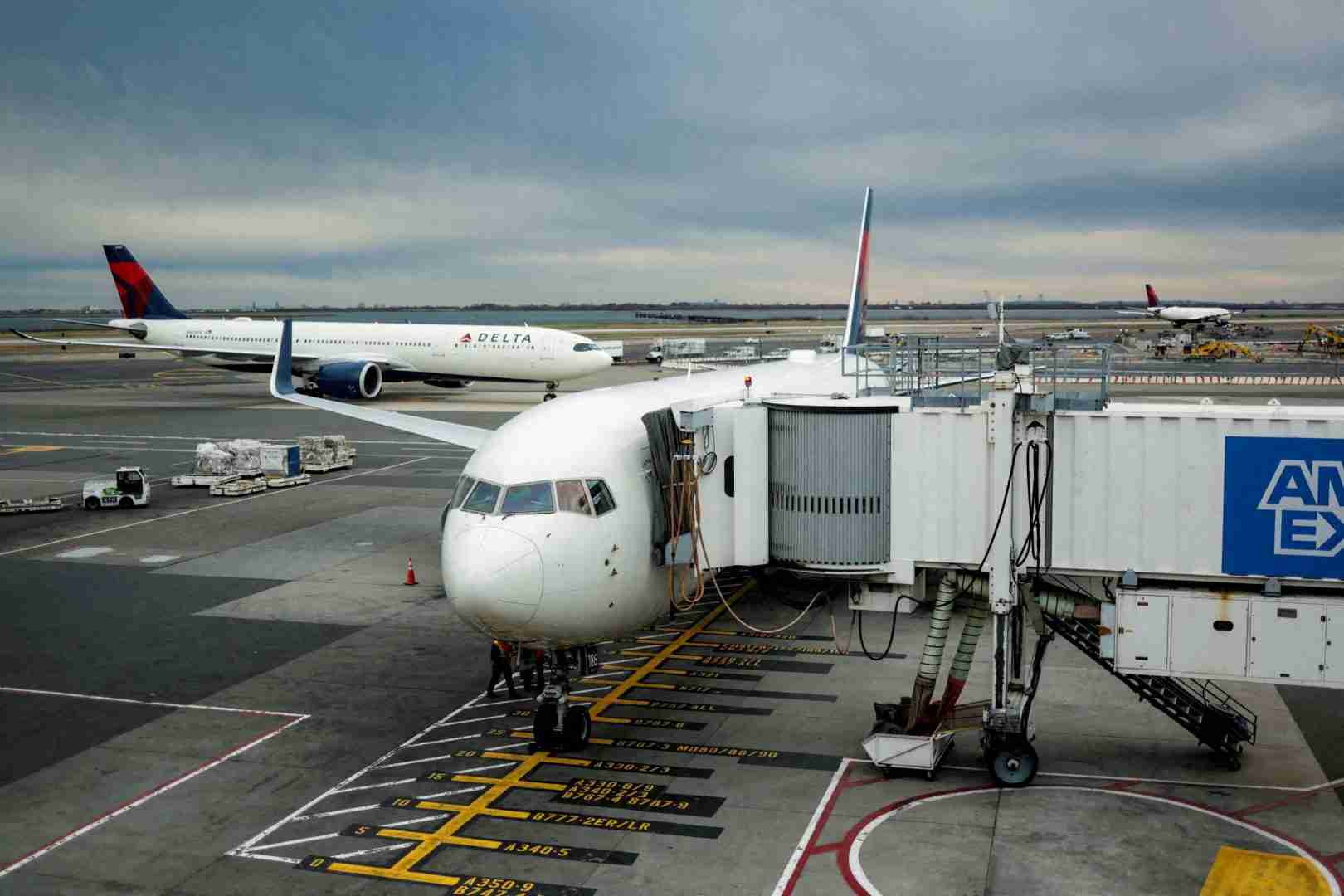
U.S. President Donald Trump’s two-week ceasefire with Iran is unlikely to provide immediate relief to the global aviation industry as it reels from its worst crisis in years, executives said on Wednesday, even as airline shares rallied after the deal.
Willie Walsh, director general of the International Air Transport Association (IATA), warned it would take months for jet fuel supply to recover even if Iran reopened the Strait of Hormuz, given disruptions to Middle East refining capacity.
Delta Air Lines forecast lower-than-expected profit for the second quarter and said it would cut capacity across the board to make up for the $2 billion in extra fuel costs it expects to book in the second quarter.
OIL PRICES DROP AFTER CEASEFIRE DEAL
Fuel is the second-largest expense for airlines after labour, typically accounting for about 27% of operating expenses.
Iran’s closure of the Strait of Hormuz has choked supplies of jet fuel globally, and news of a ceasefire and the possibility of safe passage through the Strait sent airline stocks soaring.
Oil fell below $100 per barrel after Trump said he had agreed to a two-week ceasefire with Iran, subject to the Strait’s immediate and safe reopening.
But comments from executives and experts across the industry highlight deepening pain for airlines facing a doubling of jet fuel prices and worries about constrained supplies.
Carriers across the world have been hiking fares, cutting flights, carrying extra fuel from home airports and adding refueling stops as the Middle East conflict squeezes supply.
Walsh told reporters that while he expected crude oil prices to fall, jet fuel costs were likely to remain slightly elevated due to the impact on refineries.
“If it were to reopen and remain open, I think it will still take a period of months to get back to where supply needs to be given the disruption to the refining capacity in the Middle East,” Walsh said.
AIRLINE SHARES SURGE, BUT TOURISM RECOVERY WILL TAKE TIME
Jet fuel prices normally move in tandem with oil prices, but they have more than doubled since the Iran conflict, far outpacing a 50% rise in crude prices prior to the two-week ceasefire.
That has inflated costs, disrupted schedules, prompted airlines to cut routes and pushed the limits of what travelers will pay.
On Wednesday, Delta said it expects to pay about $4.30 a gallon for jet fuel in the June quarter, adding more than $2 billion to the price a year earlier.
Even so, global airline and travel stocks rose. Australia’s Qantas Airways jumped more than 9%, Air New Zealand rose over 4%, Hong Kong’s Cathay Pacific climbed 5% and while India’s IndiGo rose 8%.
In Europe, travel operator TUI was up more than 12%, Wizz Air gained 10%, Air France-KLM climbed around 14%, and Lufthansa was up 11% by 1132 GMT, outperforming gains in European equity indexes. U.S. airlines rallied in premarket trading too.
While jet fuel supply disruption remains a risk, the ceasefire provided “a buying opportunity for quality airlines”, analysts at Panmure Liberum said in a note.
STRANDED CRUISE SHIPS AND LONG RECOVERY FOR TOURISM
TUI said it was looking at options for its two cruise ships – “Mein Schiff 4” and “Mein Schiff 5” – which have been stranded in Abu Dhabi and Doha since the war began.
Skeleton crews are keeping the ships operational, according to the company. It will take at least four weeks to ready them for their next planned trips, depending on the route, weather, and operational conditions.
Even with travel through key transit hubs potentially reopening with a ceasefire, the Middle East’s tourism industry – worth some $367 billion – will also take time to recover.
It could take months even in a best-case scenario, Oxford Economics economist Aaron Goldring said in a briefing.
“You basically have a tail of around seven months post ceasefire of sentiment impact,” Goldring said, “with the perception of safety coming back quite gradually.”
Reporting by Lee Yi-Chin in Singapore and Julie Zhu in Hong Kong, Alessandro Parodi and Cian Muenster in Gdansk, Ilona Wissenbach in Frankfurt and Rajesh Kumar Singh in Chicago and Shivansh Tiwary in Bengaluru; Writing by Josephine Mason; Editing by David Holmes
Bermuda’s Kayla Bardgett and her Savannah College of Art and Design (SCAD) teammates have reached the pinnacle of collegiate equestrianism, officially being named the 2025-26 Tournament of Champions Series winners.
In a historic 35th anniversary season, the SCAD “Bees” delivered a campaign of unprecedented dominance. The team secured their first national title of the year by claiming victory in three of the four major shows across the calendar, underlining their status as the premier force in the discipline.
Such was their clinical form that SCAD had already mathematically secured the overall championship before the final show in Findlay. However, rather than coasting, the Bees produced a performance that served as an exclamation point on a legendary year, finishing the series with a record-high 98 points.
Under the guidance of head coach Ashley Henry, the season’s crowning achievement came in January 2026, when the Bees recorded the Tournament’s first-ever “perfect” score during the Winter Classic.
For Bardgett and her teammates, the title marks the culmination of a relentless training program. With one national crown secured, the focus now shifts to adding further silverware to a record-breaking 2025-26 campaign.
Oil fell below $100 per barrel after U.S. President Donald Trump late on Tuesday agreed to a two-week suspension of strikes on Iran, subject to the immediate and safe reopening of the strait
International News via Reuters:
U.S. and European energy stocks slid on Wednesday, as a ceasefire to the Middle East conflict punctured the hefty war premium built into oil prices due to fears of supply disruption through the Strait of Hormuz.
Oil fell below $100 per barrel after U.S. President Donald Trump late on Tuesday agreed to a two-week suspension of strikes on Iran, subject to the immediate and safe reopening of the strait.
“The initial market reaction has been significant, but sentiment will remain driven by headline risk,” said Achilleas Georgolopoulos, senior market analyst at brokerage XM.
“Any sign that the ceasefire is hanging by a thread can quickly reverse today’s improved risk appetite, with oil prices reacting first.”
Brent futures hit their lowest in nearly a month at $90.40, retreating from record monthly gains in March driven by supply disruptions related to the conflict.[O/R]
Brent and U.S. West Texas Intermediate have risen 50.8% and 68.5%, respectively, since late February to April 7, when Middle East tensions disrupted the Strait of Hormuz, a key oil shipping corridor.
Matthew Ryan, head of market strategy at global financial services firm Ebury, said volatility is likely to remain elevated as markets assess ceasefire negotiations and shipping activity.
OIL SLIDE PUNCTURES CONFLICT-DRIVEN RALLY
Energy equities, which had surged earlier in the year on higher oil prices, led broader market declines.
Shares of Exxon Mobil and Chevron fell more than 5%, while producers including Occidental Petroleum, Devon Energy, Diamondback Energy and ConocoPhillips slid between 5.1% and 7.5%. Oilfield services companies and refiners also fell broadly.
Capital One Securities analysts said it’s going to be a painful day for E&P (exploration and production) and most energy-related names.
Liquefied natural gas exporters, which had benefited from elevated spot prices during the conflict, were among the worst hit, with Venture Global and Cheniere Energy down 12% and 5.9%, respectively.
The pullback follows a strong first quarter for the sector, when soaring oil prices pushed the S&P 500 Energy Index up more than 37%, making it the top-performing sector in the S&P 500 index, which fell about 4.6% over the same period.
Ashley Kelty, an analyst at Panmure Liberum, said the pause may allow markets more time to digest the fallout of the conflict and price in the damage to facilities and time needed to ramp-up production.
LNG EXPORTERS, EUROPEAN MAJORS HARDEST HIT
In Europe, shares of TotalEnergies, Shell, BP, Eni, and Repsol fell between 4.6% and 7.7%.
Norway’s Equinor slumped 8.7%, while Var Energi and Aker BP lost 11.8% and 9.9%, respectively.
Europe’s oil & gas sector was the worst performer, shedding 2.6% and on track for its biggest daily fall since April 2025. The index is still up nearly 30% so far in 2026.
Elsewhere, falling oil prices lifted airline shares, with United Airlines, Delta Air Lines and American Airlines each gaining over 7%, offering relief after weeks of pressure from higher fuel costs.
Reporting by Pooja Menon and Joel Jose in Bengaluru and Danilo Masoni in London; Editing by Alun John, Subhranshu Sahu and Arun Koyyur
Bermuda’s Teagan Mewett has secured a remarkable individual milestone at the XXXIX Carifta Aquatics Championships, claiming her third medal of the meet as the pool action concluded in Martinique.
Competing in the 15-17 Girls 100m Breaststroke at the Pierre Samot Community Aquatic Centre, Mewett demonstrated her elite pedigree with a disciplined and powerful performance. Navigating a high-caliber field, she touched the wall in 1:16.35 to secure the bronze medal, successfully fending off a late surge from the chasing pack.
This latest success completes a “hat-trick” of medals for Mewett, following her standout performances in the breaststroke sprints earlier in the week. Her consistency has been a cornerstone of the Gombey Warriors’ campaign, which has seen Bermuda punch well above its weight in the overall points standings.
While the pool portion of the championships now draws to a close, Mewett’s clinical finale highlights the burgeoning strength of the island’s aquatic program. Bermuda heads into the post-meet celebrations firmly established as a dominant force in Caribbean age-group swimming.
To provide the best experiences, we use technologies like cookies to store and/or access device information. Consenting to these technologies will allow us to process data such as browsing behavior or unique IDs on this site. Not consenting or withdrawing consent, may adversely affect certain features and functions.
Functional
Always active
The technical storage or access is strictly necessary for the legitimate purpose of enabling the use of a specific service explicitly requested by the subscriber or user, or for the sole purpose of carrying out the transmission of a communication over an electronic communications network.
Preferences
The technical storage or access is necessary for the legitimate purpose of storing preferences that are not requested by the subscriber or user.
Statistics
The technical storage or access that is used exclusively for statistical purposes.The technical storage or access that is used exclusively for anonymous statistical purposes. Without a subpoena, voluntary compliance on the part of your Internet Service Provider, or additional records from a third party, information stored or retrieved for this purpose alone cannot usually be used to identify you.
Marketing
The technical storage or access is required to create user profiles to send advertising, or to track the user on a website or across several websites for similar marketing purposes.