Curtis Dickinson’s lawyers argue that the party has not been forthcoming with some of information that the court ordered them to hand over
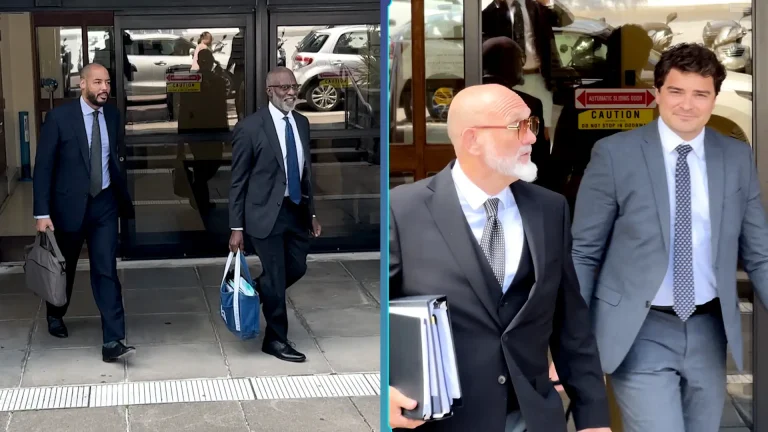
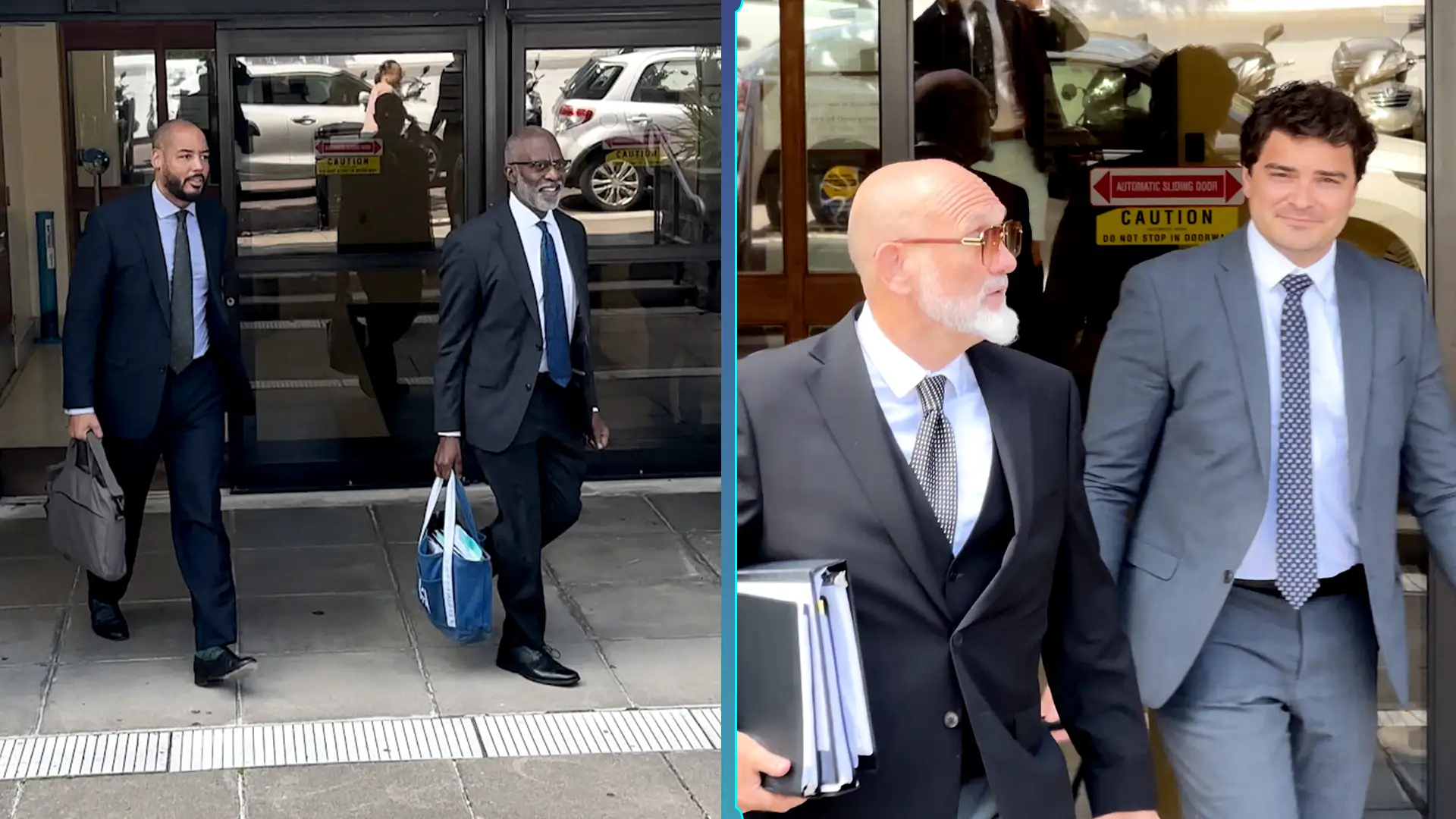
Left: Ryan Hawthorne and Delroy Duncan of Trott & Duncan, representing Curtis Dickinson. Right: Mark Pettingill and Matthew Frick of Chancery Legal, representing the Progressive Labour Party (as Chairperson Dawn Simmons and General Secretary Patricia Basden). Photos by Gary Foster Skelton
Yet another day in Supreme Court for the PLP, as Curtis Dickinson’s lawyers argued that the party has not been forthcoming with some of information that the court ordered them to hand over.
The judge also ruled that certain statements from the PLP’s submissions that allege voter fraud must be stricken.
Furthermore, the PLP’s counsel sought to ‘wrap up’ the proceedings – but Mr Dickinson’s lawyers were having none of it.
Mark Pettingill, representing the PLP’s Chairperson and General Secretary, stood up at the beginning of today’s court hearing and cited his client’s desire to “turn down the heat” on this matter.
He added that even if the vote on the membership amendments is ruled unconstitutional, “there will be a Special Delegates Conference… so what are we doing?”
Justice Shade Subair Williams asked if Mr Pettingill was asking for more time. He was granted a few minutes to talk with Delroy Duncan, who is representing Curtis Dickinson and four other plaintiffs.
When he addressed the court a few minuted later, Mr Duncan said the discussion was “singularly unproductive”, asserting that “Mr Dickinson wants this settled more than anyone”.
However, he said Mr Pettingill’s assertion that the PLP wants to hold an SDC is so they can pass the amendments is currently restrained by the court.
That would amount to a retroactive removal of members, he said, which is not in line with the PLP’s constitution as it stands now.
Mr Duncan added that the only way for this matter to conclude is for the court to deliver a judgement.
He then argued that the defendants have not complied with all the court’s rulings by failing to provide certain information.
The existence of a document outlining the PLP’s 2026 membership process came into question. Mr Duncan cited references to the document in the affidavits, but Mr Pettingill said he had been told that there is no specific document outlining the 2026 membership process.
Nevertheless, Justice Subair Williams instructed that any documents connected with the membership process should be submitted.
As for some of the other information that Mr Duncan said was missing, including minutes from certain meetings, Mr Pettingill referenced PLP Chair Dawn Simmons and Secretary General Patricia Basden, who have been named by the plaintiffs as representatives of the PLP.
Mr Pettingill said that the two women, who were present in the court with family and supporters, have done their best to hand over what they can.
Mr Duncan cited sections in the affidavits which speak of efforts to validate memberships, with specific insinuations of “voter fraud and voter manipulation”.
The courtroom only heard one detailed example from the affidavits, in which a named individual was called up for validation, and they responded that a membership form was submitted without their consent.
Mr Duncan argued that such an example is just the validation process working as it should, rather than fraud.
He also argued that some allegations in the affidavits are hearsay.
He said, “the lack of a basis in the affidavits of a ground to suggest … voter manipulation and fraud – it is the most groundless allegation, the most baseless allegation, that I have heard in this court for many a year.”
Mr Duncan also said such allegations are irrelevant to the case.
Mark Pettingill argued that concerns over how people become members of the PLP should be considered as relevant, because the membership process determines who will vote in the PLP’s internal elections.
He said members should be able to show that they are not joing the party simply to select a particular candidate.
Ultimately, it was agreed that the portions of the affidavits implying ‘voter fraud’ which could be considered hearsay must be removed, and the judge amended the court order accordingly.
Mr Pettingill sought to further argue that it should be understood why the PLP makes certain decisions, but Justice Subair Williams stopped him.
The judge said she was not interested in the “politics behind any of this”, and affirmed, “this is a contract case”.
The case will be heard in the Supreme Court on October 1st and 2nd.
Former government Senator Curtis Richardson denies causing the death of Mr Warren by driving without due care and attention
A police officer told a jury today that defendant Curtis Richardson claimed to be a ‘good Samaritan’ while being arrested as a suspect in the investigation of the incident that killed Marco Warren.
Former government Senator Curtis Richardson denies causing the death of Mr Warren by driving without due care and attention.
PC DeForest Evans, Tactical Operations within the Roads Policing Unit, told the jury he was put in charge of the investigation.
He described specifically seeking out anything of evidential value from the scene of the incident.
This included searching along Trinity Church Road and Fractious Street near Bay Corner and to relay any findings Detective Christopher Sabean.
He said he seized a Kia Rio vehicle, on May 24, 2023, belonging to crown witness Renee Wallace and the Hyuandai H1 taxi vehicle driven by defendant, Curtis Richardson, to be examined by the forensic support team and traffic collision investigator.
On November 6th that same year, PC Evans said he arrested and cautioned Mr Richardson at the Hamilton Police Station on suspicion of causing the death of Marco Warren by dangerous driving.
He told the court what Mr. Richardson said: “I was told by Detective Jason Smith that I would be answering some questions. I asked if I was a person of interest. Now I’m arrested? I was being a good Samaritan.
“Next time, I will just drive off.”
Later that evening, after conducting a video interview with Mr Richardson alongside two other detectives, PC Evans said he charged Mr Richardson with careless driving.
During cross examination, defense counsel Victoria Greening asked PC Evans if he recalled a witness statement from Renee Wallace stating that she saw a Mazda hatchback car in the area of Bay Corner.
He initially denied remembering that part of Ms Wallace’s statement.
Do you recall her stating,”It was traveling quite fast. I had to move away – closer to the left hand side of the road.”
PC Evans replied: “In reviewing CCTV footage, I did not see a Mazda. Nothing of evidential circumstance was recovered.”
In his work on the case between May 14 and October 31 that year, PC Evans said he tried to identify the BMW i3 that was in close proximity to T1194, driven by the defendant.
Under questioning on the initial arrest of Mr Richardson, he said he carried it out after speaking with Detective Smith.
He told the court there was an arrangement for Mr Richardson to come in and give a witness statement at the police station.
He said Mr Richardson was advised to contact Detective Smith because he wanted to help the family of Mr Warren.
Payroll records for almost 1.5 million employees as of July this year showed male workers received average annual bonuses of £5,442 ($7,300) compared with £3,062 for women
International News via Reuters:
Women in Britain continue to receive substantially lower bonus payments than men, according to human resources data firm Brightmine.
Payroll records for almost 1.5 million employees as of July this year showed male workers received average annual bonuses of £5,442 ($7,300) compared with £3,062 for women.
The gap narrowed only slightly from a year earlier.
The data, published on Friday, also showed:
• 14% of male employees received a bonus compared with 9% of females
• The disparity widened with age: at 56, men received average bonuses of £8,817 compared with £3,769 for women
• Some of the biggest gaps were in finance and in professional and business services
• Sheila Attwood, HR insights and data lead at Brightmine, said the findings suggested differences in progression, seniority and access to higher-value incentive schemes
• 13% of employees received a bonus, unchanged from a year earlier
• The study was based on payroll data for almost 1.46 million employees at 1,190 organisations
• Britain’s statistics office has estimated that the gap in overall pay between men and women stood at 6.9% in April last year
Writing by William Schomberg, editing by Andy Bruce
The move will benefit Thyssenkrupp’s steel unit TKSE and Poland’s Stalprodukt SA, among the last European producers of electrical steel, which is used in wind turbines and power grids
International News via Reuters:
The European Union will impose a set of import quotas and minimum prices for electrical steel and downstream products, it said on Friday, in a bid to shield the EU from cheap imports, principally from Asia.
The move will benefit Thyssenkrupp’s steel unit TKSE and Poland’s Stalprodukt SA, among the last European producers of electrical steel, which is used in wind turbines and power grids.
To keep production in Europe going, the EU will establish ‘safeguards’ in the form of quotas for grain-oriented electrical steel (GOES), as well as laminations and transformer cores containing the metal. For the steel itself, the minimum price will be set between €2,800 and €3,400 per metric ton within the quotas and at €3,500 per ton for volumes above them.
“What is particularly significant is that, for the first time, an entire value chain, from electrical steel to the transformer core, is being protected rather than a single product alone,” TKSE CEO Marie Jaroni said.
The European Commission launched an investigation into safeguards for GOES in March. The measures to apply from September 25 are provisional, while the investigation continues. Definitive measures, at the end of the investigation, would require a qualified majority of EU members to be imposed.
Electrical steel was not covered by broader measures imposed earlier this year to protect Europe’s struggling steel sector, which has come under intense pressure from low-cost competition, including from China.
Thyssenkrupp last year announced temporary production stops at its electrical steel sites in Germany and France as a result of rivals selling excess capacity on the European markets at what sources have said are 25% discounts.
Brussels’ move comes as the continent’s industry is increasingly calling for better protection against China, the EU’s second-largest trading partner after the United States, with automotive, chemicals and steel firms all facing pressure.
Imports of electrical steel from China, Japan, Russia, South Korea and the United States have been subject to anti-dumping measures, also in the form of minimum import prices, since 2015. The new minimum prices, while not strictly comparable, are significantly higher than those already in place. They will also apply to downstream products.
China represented more than 50% of EU imports of the steel and its downstream products in 2025.
Reporting by Philip Blenkinsop and Christoph Steitz; Editing by Kevin Liffey and Louise Heavens
The blue-chip FTSE 100 index closed 1.4% lower at 10,659.13 points, logging a small weekly gain
A worker walks near an LSEG (London Stock Exchange Group) branded cube inside the LSEG headquarters in Paternoster Square, London, Britain, September 8, 2026. REUTERS/Toby Melville
International News via Reuters:
London’s FTSE 100 pulled back from a more than one-week high on Friday as financial stocks weighed, ending a week packed with economic data and central bank decisions.
The blue-chip FTSE 100 index closed 1.4% lower at 10,659.13 points, logging a small weekly gain. The midcap FTSE 250 finished 0.6% lower on the day, but still recorded its sharpest weekly rise since early August.
• On Friday, financial stocks were the biggest drags on the index. Banks lost 2.1%, with Lloyds and HSBC falling 2.9% and 1.6% respectively.
• Telecom stocks were the biggest percentage decliners with a 4.8% tumble. Airtel Africa lost 11.3% after a report said its Airtel Money was considering downsizing its London IPO.
• On the flip side, construction and materials stocks rose 1.3%, led by gains in Galliford Try.
• Data showed British consumers unexpectedly increased their shopping in August, although they cut fuel purchases after prices jumped.
• The report comes a day after the Bank of England held interest rates steady but warned that policymakers might have to raise borrowing costs if the Iran war drags on.
• Brokerages changed their rate calls following the decision, with Barclays joining J.P.Morgan in expecting a hike in November.
• The central bank on Thursday also paused UK government bond sales for six months and halted long-dated gilt sales entirely, days after a global bond rout. Gilts steadied on Friday after last session’s rally.
• The US Federal Reserve hiked rates by 25 basis points this week, and the central bank reinforced its fight against inflation, sparking a rally across global markets on Thursday.
• Among individual stocks, Softcat was among the top losers on the FTSE 250 index with a near 4% fall after the IT firm agreed to buy US-based GDT at an enterprise value of $1.05 billion.
• Globally, the mood was also sour as elevated developed market bond yields pressured riskier assets. [MKTS/GLOB]
Reporting by Purvi Agarwal and Johann M Cherian in Bengaluru; Editing by Alex Richardson
EU finance ministers and central bank governors were meeting in Dublin to discuss a European Commission report that called for less political interference in bank mergers and the removal of barriers to cross-border banking within the bloc
International News via Reuters:
European banks need greater scale and deeper capital markets if they are to compete with US rivals, senior European officials said on Friday, as the European Union looks to strengthen its position in an increasingly competitive global economy.
EU finance ministers and central bank governors were meeting in Dublin to discuss a European Commission report that called for less political interference in bank mergers and the removal of barriers to cross-border banking within the bloc.
“If European banks want to compete directly with large US banks in that area, they need to be able to operate on a much larger scale in a deeper capital market,” European Central Bank Vice President Boris Vujcic told Reuters.
Vujcic said EU banks compared well with US peers on liquidity, capitalisation, profitability and efficiency, but lagged in trading and post-trading activities rather than traditional lending and deposit-taking.
“That is an area where scale really matters,” he said.
One of the most high-profile cases of political interference in bank mergers in Europe happened in June when Germany rejected an offer from Italy’s UniCredit to take over Commerzbank. UniCredit began its pursuit of Commerzbank in September 2024, but it has faced strong opposition — highlighting how hard it is to pull off cross-border banking deals in Europe.
“Greater integration and further cross-border consolidation would give European banks the scale to invest, innovate and compete,” euro zone finance ministers’ chair Kyriakos Pierrakakis said. “We need European banking champions capable of competing globally.”
Pierrakakis said the largest US banks invest more than two-and-a-half times as much in information technology relative to their assets as European lenders, a gap that matters in areas such as artificial intelligence, digital payments and cybersecurity.
Vujcic pushed back against calls from some bankers for lower capital requirements, saying this would not necessarily boost lending and could instead fuel share buybacks.
Instead, he said the EU should complete its banking union and savings and investments union to create a truly integrated financial market.
“The European financial market remains highly fragmented in many ways,” Vujcic said, citing differing tax regimes, rules and legal systems that raise costs and reduce efficiency.
Reporting by Jan Strupczewski; Editing by Hugh Lawson
The Black Sea is a vital route for shipments of grain, crude oil and refined products
International News via Reuters:
London’s marine insurance market has widened the area in the Black Sea it deems as high risk as the Ukraine-Russia conflict escalates, according to an advisory issued this week.
The Black Sea is a vital route for shipments of grain, crude oil and refined products. Its waters are shared by Russia and Ukraine as well as Bulgaria, Georgia, Romania and Turkey.
Russia and Ukraine have stepped up attacks on each other’s commercial shipping in the past two months, in an escalation of their war, now in its fifth year.
The Joint War Committee (JWC) comprises syndicate members from the Lloyd’s Market Association and representatives from the London insurance company market and its guidance influences underwriters’ considerations over insurance premiums.
“This week, the JWC has expanded the Black Sea reporting requirements to the whole of the Black Sea area. The coastal waters of Russia and Ukraine were already listed,” Neil Roberts, head of marine and aviation at the LMA and secretary of the Joint War Committee, said on Thursday in a note accompanying the advisory.
“However, voyages within the territorial waters of adjacent countries still do not require notification.”
War risk premiums, which are adding hundreds of thousands of dollars in additional costs for every seven-day voyage, have surged in recent weeks as dozens of ships have been attacked in the Black Sea.
More than 72,000 people surged into the enclave from Morocco at the end of July, although most later left
International News via Reuters:
Images of migrants crossing into Spain’s North African enclave of Ceuta have fuelled support for far-right parties despite a sharp decline in irregular arrivals in Europe following tougher migration policies, EU Migration Commissioner Magnus Brunner said on Friday.
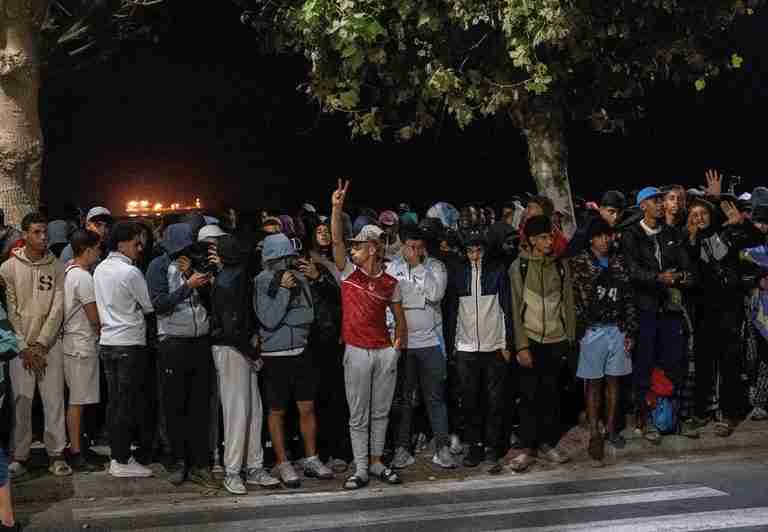
More than 72,000 people surged into the enclave from Morocco at the end of July, although most later left. Spain estimates 12,000 migrants remain in the tiny territory, including minors.
“We have the decreasing numbers, but images from Ceuta, of course, overshadow the actual successes and the actual facts and figures,” Brunner told Reuters in an interview.
He said these images “fuel the far right”, which was why “it is so important to return those people as soon as possible to show that we have control.”
Asked about Commission President Ursula von der Leyen’s proposal on Wednesday for an emergency framework to prevent “engineered and weaponised” mass movements of migrants, Brunner said the details would be discussed at the next EU Council meeting of member states. But “first of all, we have to implement the system we already agreed on,” he added.
Anti-immigration sentiment has remained a potent political force across Europe since more than 1 million people, many of them Syrians fleeing war, arrived in the bloc in 2015. The surge has helped boost support for nationalist and far-right parties and pushed many governments towards tougher migration policies focused on deterrence and returns.
Brunner also defended the European Commission’s decision to facilitate talks between EU member states and Taliban officials, as governments seek ways to return Afghans convicted of crimes in Europe. Rights groups criticised the move, saying it lent legitimacy to Afghanistan’s Islamist rulers, put Afghans at risk and undermined core EU values.
“They are murderers; they’re criminals. And I think it’s in the interest of the European Union and the European people, of course, to return them,” Brunner said when asked how the bloc could ensure that deportees sent to Afghanistan would not face persecution or harm.
“I think first and foremost, it’s about European security and the security of the European citizens.”
Reporting by Amina Ismail, additional reporting by Victoria Waldersee in Madrid; Editing by Toby Chopra
The average hedge ratio fell from 57% to 46%, the lowest level since tracking began in the first quarter of 2024, when the survey began
International News via Reuters:
Companies in the United States and Britain cut their hedges against big swings in the currency markets to the lowest in at least two years in the second quarter on the back of growing uncertainty about interest rates and inflation, according to a survey by FX and cash management solutions firm MillTech.
Here are the main findings of MillTech’s quarterly corporate hedging survey released on Friday:
• The average hedge ratio fell from 57% to 46%, the lowest level since tracking began in the first quarter of 2024, when the survey began. Average hedge lengths also declined, falling from 6.62 months to 5.7 months and reaching a new series low.
• Almost half of firms are now hedging between 26% and 50% of their exposures, while the proportion hedging between 51% and 75% fell from 54% to 34%, which suggests companies are adopting a more tactical approach, retaining greater flexibility rather than locking in higher levels of protection for longer periods, MillTech said.
• Having spiked in the first quarter of the year with the start of the war in the Middle East, realised currency volatility – how much currencies actually moved – fell consistently in the second quarter, according to LSEG data.
• “Overall, in Q2, corporates stepped back from the more defensive approach seen at the start of the year. Shorter hedges and lower ratios may provide greater flexibility as firms wait for clearer policy signals, but record-low levels of protection leave less room for error if rate paths diverge further or currency volatility increases,” the survey said.
• The survey showed that monetary policy was the single biggest factor that influenced FX hedging decisions for companies in the UK, while for US companies, it was volatility.
• MillTech surveyed 285 senior finance decision-makers at UK and US corporates between July 24 and August 5.
Reporting by Amanda Cooper; Editing by Toby Chopra
Anthropic’s CEO Dario Amodei in an online essay urged firms to slow the pace at which they improve AI model capabilities and called for an antitrust waiver allowing leading developers to jointly develop safety measures after researchers warned about the dangers of AI
International News via Reuters:
Europe’s leading AI company Mistral and others have accused US rivals of using safety concerns to entrench their dominance, rejecting Anthropic’s calls for advanced developers to slow down as Europe struggles to catch up.
Anthropic’s CEO Dario Amodei in an online essay urged firms to slow the pace at which they improve AI model capabilities and called for an antitrust waiver allowing leading developers to jointly develop safety measures after researchers warned about the dangers of AI, including that it could wipe out humanity.
While OpenAI’s chief Sam Altman and xAI’s Elon Musk also warned about the risks posed by increasingly powerful AI systems and agreed on the need to pace development, companies and officials in Europe have taken a more sceptical line.
“Some incumbents are using this moment to consolidate their market position, pushing for regulation designed to favour them over competitors,” said French startup Mistral in a statement, noting that the risks had already been clear for months.
MOVES BY US FIRMS ‘TOTALLY SELF-SERVING’
Europe has produced few frontier AI developers, with 3-year-old Mistral seen as the region’s best hope for developing its own frontier AI model to challenge US and Chinese dominance.
For now, the region relies heavily on models developed by OpenAI, Anthropic or Microsoft, leaving many wary of the ongoing dependence on US tech.
“I think this is totally self-serving,” Raphael Auphan, chief operating officer of Swiss privacy software company Proton, told a tech event in Paris on Wednesday. “They just want to preserve a dimension of dependency on their service.”
Ben Brooks, head of public policy at German AI startup Black Forest Labs, said moves to enforce a gap between big labs and new entrants “on the basis of arbitrary thresholds will chill open innovation at or near the frontier”.
“It’s not time to slow down but to accelerate,” CEO of French-American software company Hugging Face, Clement Delangue, said on X last week. However he endorsed Amodei’s proposal to embed “independent evaluators” inside AI companies.
EUROPE SEES COMPETITIVE RISKS
Leading AI developers have long warned that artificial intelligence poses an existential threat to humanity, and that safeguards are needed to stop powerful systems causing harm.
Amodei argued that AI development is moving faster than governments can regulate. In his essay, he said leading developers should voluntarily coordinate on safety standards and submit to oversight by permanent embedded evaluators that would monitor compliance.
“Unfortunately, passing laws can take time, and AI is advancing very quickly. Therefore, in parallel with the regulatory route, AI companies can and should voluntarily work together to set standards,” he said.
Kristian Kersting, professor of AI at Germany’s Technical University of Darmstadt, said Amodei’s proposals amounted to “regulatory capture”.
“If a handful of large companies decide for themselves what constitutes ‘dangerous’, select the appropriate inspectors and demand an exemption from competition law, that is no longer genuine regulation,” Kersting said.
European policymakers and industry groups voiced similar concerns. Commission President Ursula von der Leyen said on Wednesday that the EU’s landmark rules governing AI use put the bloc in a position to shape global efforts to tackle the risks. Britain’s King Charles hosted tech and AI leaders to discuss the issues at a summit in Scotland on Thursday.
“Making everyone behind them slow down so they can stay in first place – I can clearly see their self-interest,” French finance minister Roland Lescure told Reuters.
Germany’s digital affairs ministry said stopping AI development was unrealistic given Europe’s need for digital sovereignty, while Daniel Abbou, head of Germany’s AI industry association, said Europe should focus on closing the technological gap.
“For European firms, this debate is irrelevant. We first need to catch up on our technological backlog,” Abbou said.
Reporting by Florence Loève and Elizabeth Howcroft in Paris and Hakan Ersen in Frankfurt; Editing by Dominique Patton, Adam Jourdan and Elaine Hardcastle
Bermudian harness driver Kiwon Waldron was back in the sulky in Indiana, claiming a fifth-place finish at Harrah’s Hoosier Park.
Competing in Race Six on the card, Waldron lined up in the pace class behind Rockin Pet.
In a brisk contest over the Hoosier oval, Waldron guided the pacer across the line in a time of 1:54.3 to secure fifth spot, continuing his competitive campaign on the North American circuit.
To provide the best experiences, we use technologies like cookies to store and/or access device information. Consenting to these technologies will allow us to process data such as browsing behavior or unique IDs on this site. Not consenting or withdrawing consent, may adversely affect certain features and functions.
Functional
Always active
The technical storage or access is strictly necessary for the legitimate purpose of enabling the use of a specific service explicitly requested by the subscriber or user, or for the sole purpose of carrying out the transmission of a communication over an electronic communications network.
Preferences
The technical storage or access is necessary for the legitimate purpose of storing preferences that are not requested by the subscriber or user.
Statistics
The technical storage or access that is used exclusively for statistical purposes.The technical storage or access that is used exclusively for anonymous statistical purposes. Without a subpoena, voluntary compliance on the part of your Internet Service Provider, or additional records from a third party, information stored or retrieved for this purpose alone cannot usually be used to identify you.
Marketing
The technical storage or access is required to create user profiles to send advertising, or to track the user on a website or across several websites for similar marketing purposes.