Saturday, November 7, 2026
Home Blog Page 915

U-turns wipe out UK welfare savings and strain budget, analysts warn

The government backed down on its plan to make it harder to claim the Personal Independence Payment
International News via Reuters:

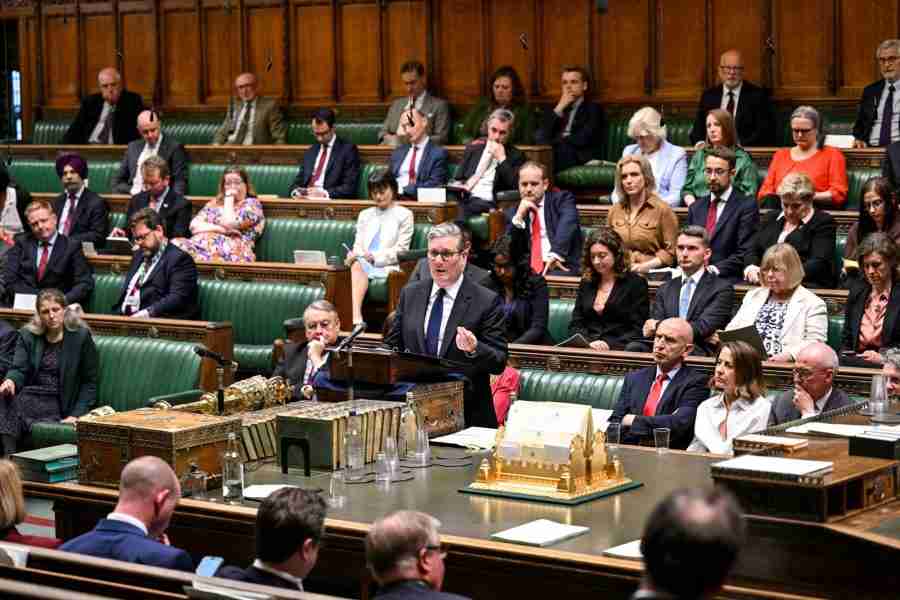
Prime Minister Keir Starmer’s U-turns to pass welfare reforms mean they will no longer save taxpayers any money and have shredded the margin Britain relies on to meet its fiscal rules, analysts said on Wednesday.

Starmer won a vote in parliament on his welfare plans on Tuesday, but only after his Labour Party lawmakers forced him to scale back cuts in a blow to the prime minister’s authority.

In particular, the government backed down on its plan to make it harder to claim the Personal Independence Payment, a benefit for people with health conditions.

Starmer had hoped his welfare reforms would save 5.5 billion pounds ($7.5 billion) in the current parliamentary term, which should end in 2029.

“Without reform to Personal Independence Payment, the watered-down bill is not expected to deliver any savings over the next four years,” said Helen Miller, the incoming director of the Institute for Fiscal Studies think-tank.

The reforms would create “huge” disparities between the treatment of existing and future claimants with health conditions and disabilities, the IFS added.

Tuesday’s vote, which saw 49 Labour lawmakers vote against the government, was bruising for Starmer, illustrating the breakdown in ties between his leadership team and parliamentarians and undermining his government’s goal of fiscal probity.

In a last-minute concession before the vote, the government said it would not finalise changes in eligibility for PIP until a review into the welfare system was completed – a move that a senior Labour lawmaker said could be reversed by reintroducing that section of the bill at a later date.

For now, Labour lawmakers are keen to suggest that unity has returned in the party in its pursuit of reforms, which Liz Kendall, work and pensions minister, admitted were “never easy, perhaps especially for Labour governments”.

The centre-left party has traditionally seen itself as the defender of Britain’s welfare state, built after World War Two.

Lawmakers will continue to scrutinise the bill on July 9.

BUDGET PLANS STRAINED

The watering down of the government’s welfare bill further strains finance minister Rachel Reeves’ budget plans, which hinge on a tiny buffer against the government’s self-imposed fiscal rules – equivalent to less than 1% of annual spending.

Reeves must also fund a partial reversal of cuts to winter fuel payments made to pensioners, as well as rising commitments to defence spending.

On Tuesday, the Office for Budget Responsibility said its past economic growth forecasts had been too optimistic, meaning it is likely to downgrade its projections for this year’s budget – another headache for Reeves.

“The welfare concessions last night blow a hole in Rachel Reeves’ fiscal rules. Combined with U-turns on fuel payments, her 9.9 billion pounds ($13.6 billion) of headroom has almost gone,” said Rob Wood, chief UK economist at consultancy Pantheon Macroeconomics.

“With the OBR signalling that it’s likely to downgrade long-term growth forecasts in the autumn, Reeves will have to raise taxes markedly again.”

While Britain’s government has borrowed slightly less than the OBR predicted during the first two months of the 2025/26 financial year, economists say budget plans could yet be knocked off course by a fractious global economy and conflicts abroad.

The British government bond market has become increasingly volatile in recent years, reflecting unease among investors over Britain’s mix of slow economic growth, high debt interest costs and persistent inflation.

($1 = 0.7297 pounds)

Reporting by Andy Bruce; additional reporting by Elizabeth Piper; Editing by Alex Richardson

BoE’s Taylor warns soft landing for UK economy at risk, sees more rate cuts

Charts published in Taylor’s speech showed interest rates could fall to around 2.25%

International News via Reuters:

Bank of England policymaker Alan Taylor said on Wednesday that a soft landing for Britain’s economy is now at risk and that economic data had recently argued for five interest rate cuts in 2025 rather than four.

“Previously, I had seen a UK soft landing in the cards, with some remaining upside risks to inflation from the bump in 2025,” Taylor said in a speech at a European Central Bank summit in Sintra, Portugal.

“Now I see that soft landing as being at risk, and greater probability of a downside scenario in 2026 pushing us off track, as demand weakness and trade disruptions build.”

Economists use the term “soft landing” for a situation where employment rises and economic growth continues after a cycle of rising interest rates.

Taylor has voted to cut interest rates in five out of seven Monetary Policy Committee meetings since he joined in September. In May, he backed an outsized 0.5 percentage-point cut, followed by a 0.25 percentage-point cut in June.

He told Bloomberg TV on Wednesday that he did not believe bigger interest rate cuts were necessarily needed.

However, having only eight Monetary Policy Committee meetings per year posed an “integer problem” for policymakers seeking a faster pace of easing, he told Bloomberg TV.

Taylor, who has caught the eye of economists since joining the MPC because of his clarity about his own expectations for the path of interest rates, said in his speech the MPC would be “well-served” by finding a vehicle for communicating its beliefs on future rates.

“After some shocks and noise clouded my view of the economy and global developments in the first quarter, my reading of the deteriorating outlook suggested to me that we needed to be on a lower rate path, needing five cuts in 2025 rather than the market-implied quarterly pace of four,” Taylor said.

Charts published in Taylor’s speech showed interest rates could fall to around 2.25% in the second half of next year if his downside scenario for the economy comes to fruition.

The BoE held interest rates at 4.25% last month, and investors are betting on the central bank to reduce borrowing costs in two further quarter-point moves to 3.75% by the end of the year.

Reporting by Suban Abdulla and Muvija M; Writing by Andy Bruce; Editing by William James and Alison Williams

ECB should keep rates at 2% unless new shocks hit, IMF says

The IMF is taking a different view than markets because it anticipates higher inflation next year than the ECB

International News via Reuters:

The European Central Bank should keep its deposit rate at the current 2% level unless new shocks materially change the inflation outlook, Alfred Kammer, head of the IMF’s European Department, said on Wednesday.

The ECB has cut rates by two percentage points since June 2024 but signalled a pause for this month, even if financial investors still see another cut to 1.75% later this year.

“Risks around euro zone inflation are two-sided,” Kammer told Reuters on the sidelines of the ECB Forum on Central Banking in Sintra, Portugal.

“This is why we think the ECB should stay the course and not move away from a 2% deposit rate unless there is a shock that materially changes the inflation outlook. Right now we don’t see anything of such magnitude.”

Part of the reason why the IMF is taking a different view than markets is because it anticipates higher inflation next year than the ECB.

The ECB projects price growth falling below its 2% target for 18 months from the third quarter, bottoming out at 1.4% in early 2026.

“For next year, we see inflation at 1.9%, which is above the ECB’s own projections, partly because we take a different view on energy prices,” Kammer said.

While most ECB policymakers see inflation risks balanced, there is an increasing group, including Finland’s Olli Rehn, Belgium’s Pierre Wunsch and Portugal’s Mario Centeno, who have all warned about the risk of inflation falling too low.

Reporting by Balazs Koranyi; editing by Mark Heinrich

Heatwaves may cut GDP by 0.5 pct points in Europe, Allianz says

Climate change is increasing the frequency and intensity of heatwaves, droughts and wildfires, with far-reaching economic repercussions

International News via Reuters:

Recent heatwaves across Europe could slow economic growth in Europe by half a percentage point in 2025, a report by Allianz Research showed, comparing a day with temperatures above 32 degrees Celsius to half a day of strikes.

In Europe, GDP losses range from 0.1 percentage points for Germany to as much as 1.4 percentage points for Spain, where temperatures are around ten degrees higher in summer.

Climate change is increasing the frequency and intensity of heatwaves, droughts and wildfires, with far-reaching economic repercussions.

Globally, the heatwaves translate to a GDP reduction of 0.6 percentage points this year, Allianz Research said.

China, Spain, Italy and Greece could each see GDP losses of nearly one percentage point due to the current heatwaves, the Allianz Research report said, while the U.S. may face a decline of around 0.6 percentage points and France of up to a third of a point.

Extreme temperatures also reduce labour productivity, with the International Labour Organization forecasting that heat stress will reduce total potential working hours worldwide by 2.2% by 2030.

Productivity losses due to heat can be mitigated, Allianz Research said, calling for structural measures to prepare cities and adapt workplaces.

Reporting by Maria MartinezEditing by Ludwig Burger

Oil prices rise as Iran suspends cooperation with UN nuclear watchdog

Planned supply increases by the Organization of the Petroleum Exporting Countries appear already priced in by investors

International News via Reuters:

Oil futures edged up on Wednesday as Iran suspended cooperation with the U.N. nuclear watchdog and markets weighed expectations of more supply from major producers next month while the U.S. dollar softened further.

Brent crude added 60 cents, or 0.9%, to $67.71 a barrel at 1017 GMT, while U.S. West Texas Intermediate crude rose 55 cents, or 0.8%, at $66 a barrel.

Brent has traded between a high of $69.05 a barrel and low of $66.34 since June 25, as concerns of supply disruptions in the Middle East producing region have ebbed following the ceasefire between Iran and Israel.

Iran put into effect a law on Wednesday that stipulates that any future inspection of its nuclear sites by the International Atomic Energy Agency needs approval by Tehran’s Supreme National Security Council. The country has accused the institution of siding with Western countries and providing a justification for Israel’s air strikes.

“The market is pricing in some geopolitical risk premium from Iran’s move on the IAEA,” said Giovanni Staunovo, commodity analyst at UBS. “But this is about sentiment, there are no disruptions to oil.”

Planned supply increases by the Organization of the Petroleum Exporting Countries and its allies including Russia, know as OPEC+, appear already priced in by investors and are unlikely to catch markets off-guard again imminently, said Phillip Nova senior market analyst Priyanka Sachdeva.

Four OPEC+ sources told Reuters last week the group plans to raise output by 411,000 barrels per day next month when it meets on July 6, a similar amount to hikes agreed for May, June and July.

“We are all talking about additional supply coming to the market, but the supply has not really hit the market,” Staunovo said. “Probably because it’s being consumed domestically.”

Saudi Arabia lifted shipments in June by 450,000 bpd from May, according to data from Kpler, its highest in more than a year. However, overall OPEC+ exports are relatively flat to slightly down since March, Staunovo said. He expects this to persist over the summer as hot weather drives higher energy demand.

The greenback continued to weaken, falling to a 3-1/2-year low against major peers earlier on Wednesday. A weaker dollar tends to support oil prices, as it could boost demand for buyers paying in other currencies.

U.S. non-farm payrolls data due on Thursday will shape expectations around the depth and timing of interest rate cuts by the Federal Reserve in the second half of this year, said Tony Sycamore, analyst at IG.

Lower interest rates could spur economic activity which would in turn boost oil demand.

Official U.S. oil stockpile data from the Energy Information Administration is due Wednesday at 10:30 a.m. ET. [EIA/S]

American Petroleum Institute data late on Tuesday showed U.S. crude oil inventories rose by 680,000 barrels in the past week at a time when stockpiles typically draw amid the summer demand season, sources said.

Reporting by Anna Hirtenstein in London; Additional reporting by Sudarshan Varadhan and Trixie Yap in Singapore; Editing by Christian Schmollinger, Rachna Uppal and David Evans

UK shares mixed as investors assess corporate news, dealmaking

The UK stock market has lost out on major initial public offerings in recent months

FILE PHOTO: Branding is seen inside the LSEG (London Stock Exchange Group) headquarters in Paternoster Square, London, Britain, April 25, 2025. REUTERS/Toby Melville/File Photo

International News via Reuters:

London’s blue-chip stock index edged higher and the midcap index fell on Wednesday as investors assessed a mixed bag of corporate news, including a media report that AstraZeneca is moving its listing to the U.S.

The blue-chip FTSE 100 added 0.2% while the domestically focussed midcap index fell 0.5% by 0930 GMT.

FTSE’s most valuable company AstraZeneca is considering moving its listing to the U.S., the Times reported on Thursday, citing multiple sources.

“The CEO seems frustrated at the lack of financial support to open new laboratories and manufacturing facilities in Europe and might see a full U.S. stock listing as a stepping stone to receiving better treatment Stateside,” said Dan Coatsworth, investment analyst at AJ Bell.

The UK stock market has lost out on major initial public offerings in recent months including money transfer firm Wise and online fast fashion retailer Shein, with Brexit-related challenges pressuring UK market valuations.

Gains on Wednesday were led by industrial metals and mining stocks tracking higher metal prices. Glencore rose 3.2% and Ferrexpo and Antofagasta were both up 2.3%.

Oil and gas companies gained 1.6%, with heavyweights BP and Shell adding 2.2% and 1% each.

Among individual stocks, Spectris gained 4.6% after the firm agreed to a debt-inclusive 4.7 billion pounds ($6.46 billion) offer from KKR over Advent’s rival offer.

Bytes Technology slumped 26% to the bottom of the midcap after warning of lower operating profit for the first half of 2026.

British fast food chain Greggs fell 14.1% on saying its annual operating profit could dip as a heatwave in the UK discouraged customers from eating out.

Restaurant chain operator SSP Group climbed to the top of the midcap index, rising almost 8% after filing for Indian IPO of airport lounge operator Travel Food Services.

Reporting by Twesha Dikshit; Editing by Sahal Muhammed

Stocks inch up, dollar struggles under weight of Trump tariffs, Fed uncertainty

The dollar index hovered near its lowest since early 2022 and was last at 96.705

International News via Reuters:

Global stocks edged higher and the dollar was pinned near a three-year low on Wednesday as investors pondered the prospect of U.S. interest rate cuts and the scramble for trade deals ahead of President Donald Trump’s July 9 deadline for tariffs.

Trump said he was not considering extending the deadline for countries to negotiate trade deals with the United States, and cast doubts again that an agreement could be reached with Japan, although he expects a deal with India.

The European Union’s trade chief is also expected to hold negotiations this week in Washington to avert higher U.S. tariffs.

Europe’s STOXX 600 edged up 0.1%, and Germany’s DAX climbed 0.3% in early trading. Across the Atlantic, futures tracking the S&P 500 pointed to a higher open after the benchmark index eased from its record high in the previous session.

MSCI’s broadest index of Asia-Pacific shares outside Japan witnessed a choppy session earlier in the day and was last up 0.1%. However, trade ambiguities weighed on Japanese stocks that lost 0.5%.

“You’ve seen it with other trade negotiations that they take years if you want to do them properly,” said Matthias Scheiber, senior portfolio manager and the head of the multi-asset solutions team at Allspring Global Investments.

“It’s not something you negotiate within a week. I think that’s also what the U.S. is realizing now. If the tariffs get ramped up again and the situation sours, short-term, we can definitely see some volatility.”

Data on Tuesday showed the U.S. labour market remained resilient with a rise in job openings for May, sharpening the focus on the payrolls report due on Thursday as investors try to gauge when the Federal Reserve is likely to cut rates next.

Fed Chair Jerome Powell, under fire from Trump to cut rates immediately, reiterated that the U.S. central bank plans to “wait and learn more” about the impact of tariffs on inflation before lowering interest rates.

Traders are pricing in about 64 basis points of cuts this year from the Fed, with the odds of a move in July at 21%.

The dollar index, which measures the U.S. currency against six rivals, hovered near its lowest since early 2022 and was last at 96.705. Analysts have said that any signs of labour market weakness could further weigh on the greenback.

TRUMP’S BILL

Investor focus over the last few days has pivoted to the progress of Trump’s massive tax-and-spending bill, which is expected to add $3.3 trillion to the national debt, slash taxes and reduce social safety net programmes.

The legislation heads to the House of Representatives for possible final approval after U.S. Senate Republicans passed it by the narrowest of margins.

The bill has stoked fiscal worries, but the reaction was relatively muted in bond markets after it passed the Senate.

Aninda Mitra, head of Asia macro strategy at BNY Investment Institute, said the legislation solidifies a steady deterioration of the fiscal position and the debt trajectory of the U.S. government.

“The near-term impact is mostly in the price, but the uncertainty factor could keep term premia elevated. We don’t think long-term yields will fall back materially in the 6-12 month horizon.”

Uncertainties about the outlook on public finances, trade and interest rates have caused investors to flee U.S. assets and look for alternatives. This was evident in the U.S. dollar’s 10% loss, its worst first-half performance since the 1970s.

In commodities, spot gold slipped 0.2% to $3,331 per ounce, after surging 1% in the previous session. The yellow metal is up 27% this year on safe-haven flows. [GOL/]

Reporting by Ankur Banerjee and Johann M Cherian; Editing by Shri Navaratnam, Jamie Freed and Saad Sayeed

Bermuda Tonight – 01 July 2025

Bermuda Evening News starting at 7pm…

Governments, multilateral lenders launch push for debt payment pauses

The initiative pushes for the systematic inclusion of clauses in new public and commercial lending

International News via Reuters:

A number of wealthy creditor nations and multilateral lenders have launched an initiative that aims to give sovereign borrowers breathing space on debt payments in the event of a climate or humanitarian crisis, Spain said on Tuesday.

The Debt Suspension Clause Alliance was launched during a U.N. conference in Seville – a once in a decade meeting aimed at furthering development finance goals and guidelines.

The initiative pushes for the systematic inclusion of clauses in new public and commercial lending that allow for a temporary suspension of debt payments in the face of extraordinary events, such as natural disasters, food crises or health emergencies.

“The logic behind these clauses is simple but powerful: to create immediate fiscal space in times of greatest need, allowing countries to focus their resources on response and recovery without risking their solvency or ability to meet social spending,” said economy minister Carlos Cuerpo.

Speaking on the sidelines of the conference, Spain’s Foreign Minister Jose Manuel Albares told Reuters that the suspension clause for debt repayments could also cover war.

The governments of Canada, France and Britain were among the co-leaders of the initiative together with multilateral banks, including the Inter-American Development Bank, the European Investment Bank, the African Development Bank, the Development Bank of Latin America and the Caribbean and the Asian Development Bank.

Deutsche Bank has become the first private institution to join the initiative, Cuerpo later told a press conference in Seville, without giving details on what this would mean in practice for Germany’s largest bank.

“What we want is to… advance in standardizing the different concepts within these clauses, expand their application, and also be able to broaden their ability to open up more fiscal space when it would be needed going forward,” Cuerpo said.

Deutsche Bank declined to provide additional details.

A number of multilateral lenders have already added such clauses in their lending – including inserting them retroactively in some existing loans.

The Inter-American Development Bank said in the statement on Tuesday that adding climate-resilient debt clauses in sovereign loans had extended $3.2 billion in protection across several countries. It said it would expand this to more nations and broaden its scope.

The European Investment Bank last year made climate-resilient debt clauses available to 70 developing countries.

The World Bank – one of the biggest multilateral development lenders – has also broadened the scope of its Climate Resilient Debt Clauses for the most vulnerable countries in recent years.

Reporting by David Latona in Seville and Karin Strohecker in London, additional reporting by Virginia Furness in London and Tom Sims in Frankfurt, editing by Ros Russell

Government’s first wave of tax cuts takes effect today

The move is part of a phased relief plan to ease living costs

The Government of Bermuda issued the following media release.

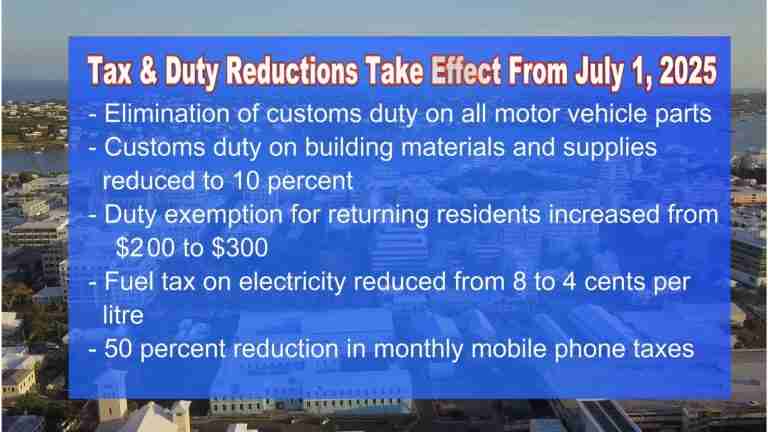
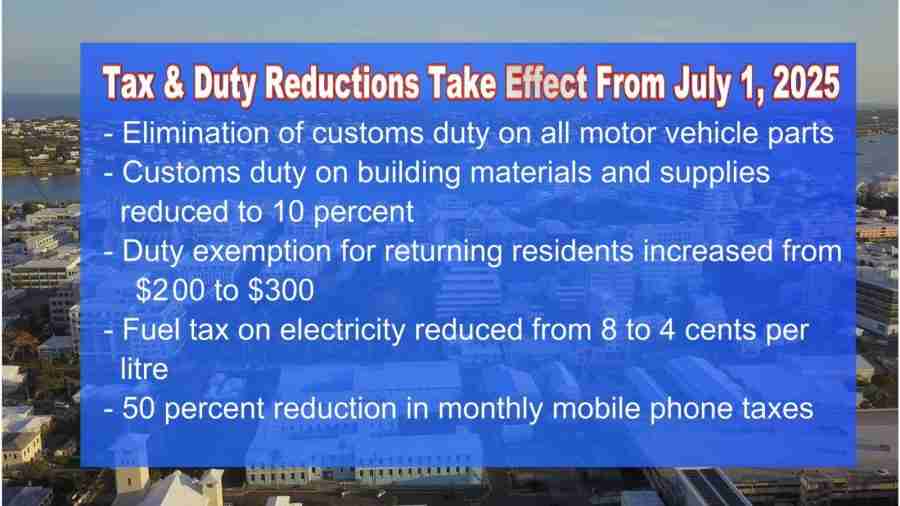
The Ministry of Finance advises that the first phase of the tax and duty reductions announced in the 2025 Budget Statement takes effect today, July 1.

Premier and Minister of Finance, the Hon. E. David Burt, JP, MP, stated, “This year’s Budget contained a series of tax reductions that will come into effect over the next nine months. The Government will do all that it can to reduce the cost of living and cost of doing business in Bermuda, and these tax and duty reductions will have a positive impact. The first stage of these reductions takes effect from today, and it is important that residents are aware of these changes.”

  • Elimination of customs duty on all motor vehicle parts
  • Customs duty on building materials and supplies reduced to 10 percent
  • Duty exemption for returning residents increased from $200 to $300
  • Fuel tax on electricity reduced from 8 to 4 cents per litre
  • 50 percent reduction in monthly mobile phone taxes

The Ministry of Finance also wishes to advise that further tax and fee reductions will come into effect over the next nine months. On January 1, 2026, the base rate of land tax will be reduced by 50% from $300 to $150 a year. Further, on April 1, 2026, vehicle licensing fees for private cars will be reduced by a further 10%.

Premier Burt concluded, “Our mission is clear: to build a Bermuda that is fairer, more stable, and more affordable for all. These tax reductions are part of a broader strategy to return savings to the people, reduce financial burdens, and stimulate inclusive economic growth. We are delivering on our promise to make everyday life more affordable for working families, seniors, and small businesses.”

Below is an excerpt from the 2025 Budget Statement showing examples and fiscal context for the impact of these tax and duty reductions.

Challenge to dollar supremacy a long way off, central bankers say

“Investors are looking at options” in a climate characterised by uncertainty and unpredictability

FILE PHOTO: U.S. Dollar banknotes are seen in this illustration taken July 17, 2022. REUTERS/Dado Ruvic/Illustration/File Photo

International News via Reuters:

There is no prospect of a major challenge to the dollar’s status as the world’s reserve currency of choice any time soon, central bankers gathered for an annual conference in the Portuguese resort of Sintra said on Tuesday.

U.S. President Donald Trump’s unpredictable economic, trade and security policies have spurred questions over whether the U.S. currency, which accounts for 58% of the world’s reserves, can remain at the centre of the global monetary system.

European Central Bank President Christine Lagarde, who has argued the euro could over time become an alternative to the dollar if Europe’s currency zone enacted necessary reforms, said 2025 could in future be viewed as “pivotal” in this respect.

“(But) for a major change to occur it will take a lot of time and a lot of effort,” she told a panel with her U.S., British, Japanese and Korean counterparts.

She noted that “investors are looking at options” in a climate characterised by uncertainty and unpredictability and that there was evidence that the euro was benefiting from that.

“It’s not going to happen just like that overnight. It never did historically,” she said. “But there is clearly something that has been broken. Whether it is fixable, or whether it is going to continue to be broken – I think the jury’s out.”

Bank of Japan Governor Kazuo Ueda also noted that any significant change would depend on structural reforms.

“It’s to a certain extent up to what areas like Europe or China will do in terms of improving the efficiency or convenience of their currencies,” he said, citing as an example the efforts at capital market integration in the euro zone.

Bank of England Governor Andrew Bailey said any change to the dollar’s status was a long way off.

“I don’t see … a sort of a major shift at the moment,” he said, arguing that any reserve currency had to offer a supply of safe assets into the market that can be used for purposes of collateral and security.

Bank of Korea Governor Rhee Chang-yong said the prospect of a long-term shift of the dollar sentiment was a subject of discussion for some even as they retained their dollar holdings.

“It looks like people are talking about it. But at this moment they keep the dollar share while increasing their hedging ratio,” he told the panel.

Lagarde told a recent audience in Berlin that there was an opening for a “global euro moment”, if it earned it.

She said Europe would need to build a deeper, more liquid capital market, bolster its legal foundations and underpin its commitment to open trade with security capabilities.

While the dollar’s current share of international reserves is the lowest it has been in decades, its 58% tally is still well above the euro’s 20% share.

Writing by Mark John. Editing by Mark Potter

Activist investors slow pace of demands amid global uncertainties-data

The slowdown comes after a record number of corporate agitators made demands

International News via Reuters:

Activist investors who push companies for operational changes and management shake-ups waged fewer campaigns during the first half of 2025 as tariffs, wars and U.S. President Donald Trump’s unpredictable policies made them more cautious, new data show.

The pace of investor demands, aimed at pushing up a company’s share price, fell 12% to 129 campaigns launched during the first six months of 2025, compared with 147 a year ago, according to numbers compiled by investment bank Barclays.

“The environment was shaped by mixed economic signals, fears about wars and geopolitical tensions and the instability created by future tariffs and trade wars,” said Jim Rossman, global head of shareholder advisory at Barclays. “And taken together that is creating an environment of caution.”

The slowdown comes after a record number of corporate agitators made demands last year and the pace of campaigns jumped by 17% in the first three months of this year.

Elliott Investment Management, among the world’s most powerful corporate activists, pressed for changes at six companies, including BP and Hewlett Packard Enterprise, roughly half the number of campaigns it launched a year ago. But it deployed $8.8 billion in assets, the most of any activist this year.

Also so-called first-timers who were becoming more comfortable employing activist tactics last year stepped to the sidelines late in the first half.

During the second quarter when stock markets gyrated as Trump threatened harsher tariffs only to reverse course before suggesting them again, campaigns launched by first-timers dropped 27% from the first quarter of this year, the data show.

But the slowdown does not hint at a pause in activity or suggest activist investors are going soft, Rossman said.

Corporate agitators, including Mantle Ridge, Ancora Holdings and Jana Partners have, as a group, forced bigger changes at companies in the first half of this year than a year ago, the data show.

Settlements between activist investors and companies jumped 32% to 37 in the first half of 2025 and left activists with 86 board seats, marking a 16% increase. They won seats, often a measure of success for activists, at companies ranging from industrial gases maker Air Products and Chemicals to food processing company Lamb Weston.

“As a group activists are having a strong year, winning settlements and board seats and managing to engage with a number of companies privately,” Rossman said.

Most activists continue to focus their attention on companies in the United States with 60 campaigns launched, down from 61 a year earlier. There were 37 campaigns in Japan, down from 51 a year ago. Activity in Europe declined by 17% to 24 campaigns launched in the first half compared with a year ago.

Reporting by Svea Herbst-Bayliss; Editing by Stephen Coates