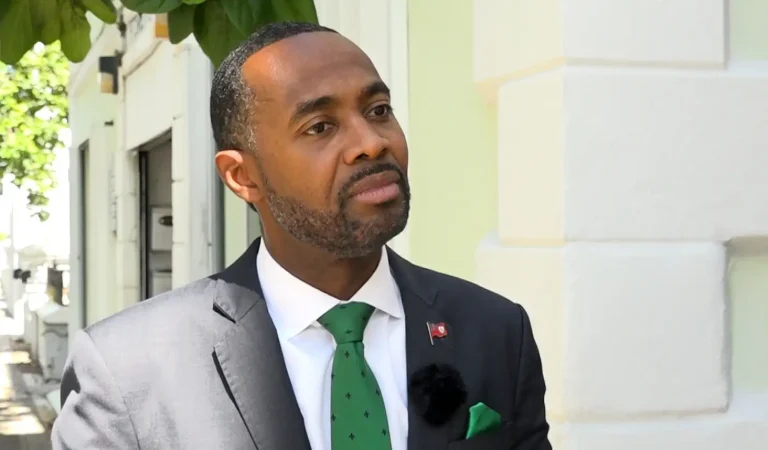
Premier and Finance Minister David Burt delivered a fiscal performance update to the House of Assembly on Friday
Premier David Burt has performed the first verse of his swan song as Finance Minister.
Delivering a fiscal performance update to the House of Assembly on Friday, the Premier cited the Bermuda’s economic position when the PLP returned to power in 2017, and said that, thanks to the collective work of his Government, he will leave office with a much better economy than the one his party inherited.
Premier Burt reiterated his points in conversation with Jasmine Patterson:
Premier Burt says he will provide a further update in November, along with the next phase of tax reductions and relief.
He cited that the first projected Corporate Income Tax collections that are more than 100 million dollars above original estimates at $291million.
When we suggested that the CIT is enabling some increased spending, the Premier said that revenues are up in other areas…
Bermudian golfer Dylan Muso produced a determined final-round fightback to climb 17 spots on the individual leaderboard, steering McDaniel College to a tie for 12th place at the West Pines Collegiate Golf Tournament in Georgia.
Across three competitive rounds at West Pines Golf Club in Douglasville, the Maryland-based Green Terror closed the 54-hole event with a combined team total of 26-over-par 878 to share 12th alongside Dickinson College and Randolph-Macon.
Muso proved the catalyst for McDaniel’s closing charge, mounting a gritty recovery over the final 18 holes.
Starting the concluding day tied for 65th, the Bermudian signed for a steady one-over-par 72 to leap into a share of 48th at seven-over-par overall.
Muso’s final circuit was defined by poise and pinpoint iron play, collecting three birdies and 12 solid pars to hold off the damage of two bogeys and a double bogey.
The disciplined finish capped an impressive week of progression for Muso, who rebounded convincingly from an opening-round 76 with back-to-back rounds of 72 to anchor the Green Terror through the closing stages.
Bermudian sailors Jordan Vieira and PJ Rodrigues helped Eckerd College claim a share of top honours after mounting a thrilling final-day comeback at the weather-disrupted Charleston Fall Interconference regatta in South Carolina.
Competing across the tricky tidal waters of Crab Bank, the Tritons overcame frustrating delays to finish tied for first alongside hosts College of Charleston in a competitive 15-team fleet.
Saturday’s opening proceedings tested the sailors’ patience, with light breezes forcing a wind hold until 12:30. When racing finally got under way in Club 420s, crews contended with an ebbing current and testing winds of 5 to 6 knots.
Vieira steered Eckerd’s A Division boat alongside crew Angelina Manchuk—later joined by Avery Guck—while Rodrigues paired with Peyton Seidle in the B Division.
Four races were completed before threatening thunderstorms forced an early halt, leaving Eckerd fourth overall overnight on 45 points.
With officials racing to beat Sunday’s 15:00 deadline, Eckerd produced an electric start. Vieira and Guck clinched an emphatic bullet in the A Division, matched stride-for-stride by Rodrigues and Seidle, who sailed home to victory in the B Division.
The double triumph ignited Eckerd’s climb up the leaderboard as breezes freshened to gusts of 12 knots.
However, around 13:00 the wind vanished entirely, forcing race committee officials to abandon further action. With Race 9A voided, the standings reverted to the completed rounds, confirming Eckerd level with Charleston at the summit on 76 points.
Saltus Grammar School and Warwick Academy emerged victorious as Bermuda’s leading secondary school talents battled for silverware at the 2026 Senior School Field Hockey Tournaments.
Staged at the National Sports Centre in Devonshire, the competition saw Saltus produce a flawless campaign to secure the senior girls’ crown with three wins from three, while Warwick Academy showcased nerves of steel in two razor-thin encounters to take the senior boys’ title.
Spearheaded by the clinical finishing of Stella Marsh, Saltus Grammar navigated a competitive four-team girls’ division with a 100% record.
Saltus dispatched Somersfield Academy 3-0 in their opener courtesy of a Marsh brace and a strike from Leilani Peters, before edging a resilient Warwick Academy Blue 2-1 with Marsh netting twice more to counter Sayla Williams’ reply.
The title decider came down to a fierce showdown against Warwick Academy White, who entered the contest buoyed by a 1-0 win over Somersfield and a 1-1 derby draw against Warwick Blue, with Naina Seth scoring in both fixtures. However, goals from Holly Lathwell and Marsh proved decisive in a 2-1 triumph for Saltus, holding off a late reply from Warwick White’s Hayleigh Cherry. Somersfield picked up their own win in the group, defeating Warwick Blue 2-1 behind strikes from Anya Aeleishe Pearman and Della Masters.
In the senior boys’ tournament, Warwick Academy relied on tactical poise to navigate two nail-biting clashes.
Somersfield Academy had laid down an early marker with a 4-1 cruise over Saltus Grammar behind doubles from Louis Manning and Will Bohus. Warwick Academy quickly seized control, edging Saltus 3-2 in an end-to-end clash through a Michael Schrah double and a Max Kimberley goal, despite Saltus answering via Johny Bart and Ryan McLean.
With the championship on the line against Somersfield, Warwick delivered a disciplined defensive masterclass, with Will Britten striking the lone goal in a 1-0 victory to claim the trophy.
One of the key challenges for Microsoft and Nvidia will be to show that agents, the long-running AI systems that can tackle complex problems on their own, can be safely contained on personal computers
FILE PHOTO: Executive Chairman and CEO of Microsoft Corporation Satya Nadella speaks during the “Microsoft Build: AI Day” event in Jakarta, Indonesia, April 30, 2024. REUTERS/Ajeng Dinar Ulfiana/ File Photo
International News via Reuters:
Microsoft will unveil on Wednesday a new laptop powered by Nvidia’s chips, seeking to turn Windows into a platform for AI agents to handle tasks such as writing code without having to access the cloud, analysts said.
For Microsoft, the move represents a bet that some work that currently takes place in its costly Azure cloud computing data centers can be shifted to high-powered Windows machines in businesses and homes, a market where the Redmond, Washington-based firm retains a stronghold — and where its customers foot the hardware bills. It is a market opportunity that longtime rival Apple is also chasing with new Mac computers.
For Nvidia, cracking the Windows PC market could help it go after one of the last major markets dominated by its longtime rivals Intel and Advanced Micro Devices.
The Microsoft-hosted event in San Francisco, which the company billed as an update on its Windows operating system and Surface line of hardware, will be the culmination of years of work between the flagship operating system maker for PCs and the AI chip company to bring many tasks such as writing computer code or tackling complex business projects directly to desktops and laptops with Nvidia’s RTX Spark chips announced in June.
Microsoft CEO Satya Nadella and Nvidia CEO Jensen Huang will take the stage to introduce the Surface Laptop Ultra, as the new machine will be called.
One of the key challenges for Microsoft and Nvidia will be to show that agents, the long-running AI systems that can tackle complex problems on their own, can be safely contained on personal computers. Nvidia is already trying to prevent a repeat of the hack of AI hub Hugging Face, while Apple is looking to tighten up the process for giving AI agents full access to a Mac computer’s hard drive.
But analysts said the biggest question will be the price of the new offerings after a memory-chip crunch has driven up prices for desktop and laptop machines.
When Microsoft originally pitched the idea of running AI tasks on PCs two years ago to save on costs, the laptops were mostly priced below $2,000, but in recent weeks, Nvidia increased the price of an AI desktop machine called the DGX Spark by about 75% to $6,950, thanks to the surging costs of its 128 gigabytes of memory.
Anshel Sag, an analyst at Moor Insights & Strategy, told Reuters that the memory prices are affecting both Apple and Microsoft’s efforts.
Two years ago, “the software wasn’t ready, but the hardware was. Now the software is ready and the hardware is too expensive to actually run it locally,” Sag said. “So it’s becoming this thing where only the people who have the budget can really afford to run AI locally.”
Reporting by Stephen Nellis in San Francisco; Editing by Muralikumar Anantharaman
The company, part of International Distribution Services, said the changes would be done through natural attrition and voluntary redundancy and would not impact frontline roles, including posties and drivers
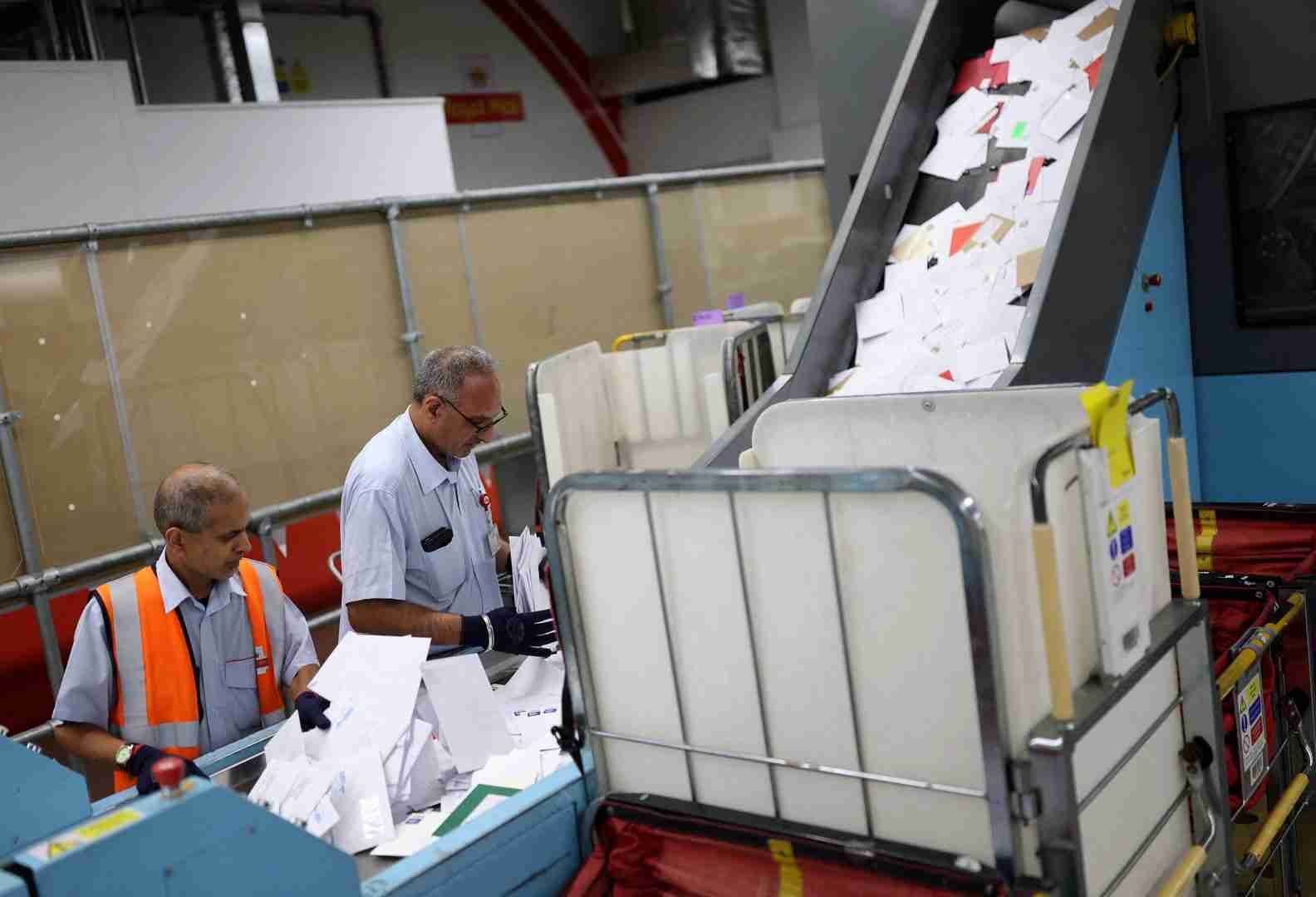
Royal Mail workers sort mail at the processing plant at the Mount Pleasant Mail Centre in London, Britain, December 9, 2025. REUTERS/Hannah McKay
International News via Reuters:
Royal Mail said on Wednesday it plans to cut up to 2,500 head office and support jobs by the end of 2027 as part of a restructuring, affecting less than 2% of its more than 131,000 employees.
The company, part of International Distribution Services, said the changes would be done through natural attrition and voluntary redundancy and would not impact frontline roles, including posties and drivers.
The job cuts come as the group overhauls its operations post regulatory pressure and scrutiny over missed delivery targets.
“These proposed changes remove duplication and allow us to invest further in the service we deliver for our customers,” Chief Executive Alistair Cochrane said in a statement.
Royal Mail said the review aims to speed up decision-making as it implements Universal Service reform amid a decline in letter volumes of more than 70% since their peak.
The more than 500-year-old Royal Mail, whose iconic red post boxes with the Royal Crest dot Britain, said it has briefed unions the Communication Workers Union and Unite CMA, with formal consultation now underway.
Reporting by Raechel Thankam Job in Bengaluru; Editing by Janane Venkatraman and Nivedita Bhattacharjee
Kenya is the fourth country to record a case linked to the Ebola epidemic in eastern Congo, the second largest on record with more than 8,000 cases
A staff member sanitizes an area at Nairobi Hospital where an Ebola patient was isolated immediately upon arrival and treated at the hospital’s physically separate East Wing Isolation Facility, but later died, in Nairobi, Kenya October 7, 2026. REUTERS/Monicah Mwangi
International News via Reuters:
Kenya confirmed its first Ebola case on Tuesday after a Kenyan citizen who had travelled from Democratic Republic of Congo died in Nairobi.
Kenya is the fourth country to record a case linked to the Ebola epidemic in eastern Congo, the second largest on record with more than 8,000 cases.
Uganda reported 20 cases and two deaths earlier in the year but was declared Ebola-free in August. A doctor who returned to France in June from Congo tested positive but there was no further spread of the virus.
The Kenyan patient, who had lived in Congo for seven years, had been ill for about a month before travelling by road from Congo to Uganda’s capital, Kampala, and then flying to Nairobi on Saturday, Kenya’s Health Minister Aden Duale told a news conference.
After arriving at Nairobi’s international airport, he passed through health screening and was later taken by a relative to Nairobi Hospital. He was admitted with fever, chills and bleeding beneath the skin and was quickly placed in isolation, Duale said.
He died late on Monday.
Eight of his family members and 21 healthcare workers who attended to him have been quarantined and are being monitored, Kenyan President William Ruto’s office said.
PATIENT BURIED UNDER HEALTH PROTOCOLS
The patient was buried under protocols designed to prevent further spread of the virus, Ruto’s office said.
Health authorities are trying to trace 23 passengers and four crew members who were on his Jambojet flight, Duale said.
The health minister said Kenya had trained nearly 5,000 health workers across the country on prevention and management and the UN’s senior Ebola coordinator, Julien Harneis, told Reuters he expected a “solid health response” from Kenya to manage the disease.
The Africa Centres for Disease Control and Prevention (Africa CDC) said in a statement that it was immediately sending a high-level team to Kenya to provide support, adding that the case “underscores the importance of sustained preparedness across the region”.
World Health Organization Director-General Tedros Adhanom Ghebreyesus said on X that the WHO was supporting the Kenyan and Ugandan governments and recommended against any travel restrictions on countries affected by the outbreak.
Nevertheless, the incident raised questions about measures meant to prevent the spread of the virus across borders.
Kenya’s health ministry director-general, Patrick Amoth, said the patient may have passed through airport screening because medication had masked his symptoms.
Uganda’s health ministry said screening teams observed he had a normal temperature at Entebbe airport.
It was also not clear how he had crossed from Congo into Uganda, given that the border has been closed since May. The Africa CDC said he spent a night in Uganda before boarding the flight to Kenya.
Asked about this, Ugandan government spokesperson Alan Kasujja said in a text message: “Leave Uganda out of this conversation … We don’t have Ebola here.”
KENYA HOSTS US EBOLA QUARANTINE FACILITY
After the outbreak was declared in Congo, the United States built a 50-bed Ebola quarantine camp for US citizens on an air force base in central Kenya.
The facility is currently empty and has only housed seven people. Kenyan officials have said it could receive Kenyans and other nationalities, but the US government has not confirmed that.
Ebola spreads through direct contact with the bodily fluids of infected people, whether living or dead. The disease can cause fever, vomiting, diarrhoea and, in severe cases, internal and external bleeding.
The outbreak in Congo was declared in mid-May but may have started months earlier. Caused by the rare Bundibugyo strain, it has been blamed for more than 4,000 deaths.
Reporting by Vincent Mumo Nzilani and Edwin Okoth in Nairobi. Additional reporting by Emma Farge in Geneva and Elias Biryabarema in Kampala, Writing by Aaron Ross, Editing by Alexander Winning, Mark Potter, Susan Fenton and Sanjeev Miglani
Georgieva did not indicate in her prepared remarks whether the IMF’s latest World Economic Outlook would change the overall 2026 global growth forecast from the sluggish 3.0% rate forecast in July
International News via Reuters:
The global economy is under threat from persistently high energy prices, record public debt and risks from the AI investment boom, International Monetary Fund Managing Director Kristalina Georgieva warned on Wednesday, urging governments to implement protective fiscal and monetary policy measures.
In a speech previewing IMF and World Bank Annual Meetings next week in Bangkok, Georgieva said the world was being pulled in two directions — a negative energy supply shock from the Middle East conflicts and a positive demand shock from artificial intelligence that is also fuelling inflation.
“The combined impact of these two forces is highly uneven across the world,” Georgieva said, adding that the AI boom was bypassing many countries.
New IMF growth forecasts to be released during the Bangkok meetings will show the biggest growth downgrades will come in economies ravaged by war, Georgieva said. These include Ukraine, suffering significant damage to civilian and economic infrastructure, and Gulf countries hit by Iranian strikes and sharply reduced energy exports.
Georgieva did not indicate in her prepared remarks whether the IMF’s latest World Economic Outlook would change the overall 2026 global growth forecast from the sluggish 3.0% rate forecast in July.
That forecast, which predicted a rebound to 3.4% growth in 2027, assumed the Strait of Hormuz would start to reopen in mid-July and return to pre-war conditions by March 2027. It assumed oil prices would average $89 a barrel in 2026 and $78 a barrel in 2027.
Georgieva said oil prices remain at $100 a barrel, with impaired refining capacity adding another $100 in “crack-spread” margins per barrel for key products including diesel. The winter heating season will boost demand even as natural gas supplies remain restricted by threats to LNG shipping through the Strait of Hormuz, she added.
“Even if the war in the Gulf were to end soon, the problem of high energy prices will likely persist for some time,” Georgieva said, adding that Brent crude oil futures predict high oil prices through 2027.
Higher energy prices are pushing up inflation, policy rates and benchmark bond yields, she said, noting that US, German and Japanese 10-year sovereign yields are now at their highest levels since 2007, 2009 and 1996, respectively, and still climbing.
GROWING DEBT LOAD
Adding to the worries to be discussed by the IMF’s 191 member countries next week is a growing public debt burden that is sapping growth and adding inflationary pressures, Georgieva said. The IMF says public debt is at the highest level since World War Two and is projected to exceed 100% of GDP before 2030.
Georgieva singled out advanced economies, led by the United States, as the “worst offenders” on debt loads, with debt-to-GDP ratios higher than emerging markets and low income countries.
Policymakers can no longer rely on higher growth rates alone to solve fiscal problems, she said.
“And yet we don’t see decisive action in the high-debt advanced economies where the need of the hour is for credible medium-term fiscal consolidation plans, supported in some cases by upfront fiscal measures, including to take some pressure off monetary policy,” she said.
After five-and-a-half years of above-target inflation, Georgieva said inflationary pressures were persisting, from the AI build-out, energy and food price shocks, tariffs, higher defense spending and higher debt service costs.
“Now may be a good time for a prudently hawkish bias in many countries’ monetary policy,” Georgieva said, adding that rate hikes by the US Federal Reserve, the ECB and the Bank of Japan were “highly appropriate.”
In a fireside chat following her speech, Georgieva added that the “most important task” for monetary policy in the current environment is to focus on price stability and for central banks to communicate their resolve in maintaining it.
“They can only do it when central banks are independent, and when central banks resist pressure that may come from the fiscal side to ease the burden by basically stepping up, buying debt, making it so that the situation from the fiscal side eases,” she said.
“I would call this monetary cowboys, running to the rescue of the fiscal agents, and my message is: please don’t.”
AI RISKS ABOUND
Georgieva highlighted other risks from AI, where investment as a share of GDP is likely to exceed that of railroads, the electricity grids or telecommunications infrastructure.
The rising economic and financial concentration puts pressure on AI companies to deliver productivity and earnings gains to justify lofty valuations, she said, warning that market disappointment could turn into “a far-reaching shock.”
But she said IMF research suggests that AI, done right, could add a half percentage point of extra world growth annually.
AI preparedness is key, she said, including regulatory guardrails that “help manage AI’s substantial perils, which include large-scale labor market fallout, serious cyber and stability risks and frontier models threatening to escape human control and run amok.”
In addition to building fiscal strength, even at difficult political costs, Georgieva said governments should take other steps to boost growth, including reforms that would develop improved workforce skills, make corporate startups and wind-downs easier, boost energy security and streamline regulations.
Reporting by Rae Wee in Singapore ad David Lawder in Washington; Writing by David Lawder, Editing by Lincoln Feast
According to UNICEF data, obesity has surpassed being underweight as the most common form of malnutrition in school children and adolescents worldwide
A selection of injector pens for the Saxenda weight loss drug are shown in this photo illustration in Chicago, Illinois, U.S., March 31, 2023. REUTERS/Jim Vondruska/Illustration
International News via Reuters:
The World Health Organization on Wednesday recommended diet, exercise and counseling over popular weight-loss drugs in its first global guidelines addressing rising obesity among younger children.
According to UNICEF data, obesity has surpassed being underweight as the most common form of malnutrition in school children and adolescents worldwide.
The health agency said weight-loss drugs may be considered for adolescents aged 10 to 19 with obesity but only after supervised interventions have failed. Bariatric surgery could be considered for physically and mentally mature adolescents with severe obesity after six months of unsuccessful treatment, it said.
For children under 10, WHO endorsed diet, physical activity and combined behavioral support instead of obesity medication, surgery or devices because of doubts over their safety and long-term effectiveness.
Luz María De Regil, director of the Department of Nutrition and Food Safety, said there is currently insufficient evidence on GLP-1 drugs, though researchers are monitoring efficacy and safety trials and may revise that assessment as more data emerges.
“The foundation of obesity care for children and adolescents is not medicine or surgery, but access to comprehensive support that enables healthy eating, physical activity and sustainable behaviour change,” De Regil said.
Some GLP-1 medicines are already approved for weight-loss in younger patients. Novo Nordisk’s Wegovy and Saxenda can be used by certain adolescents 12 and older in the United States and the European Union. The EU also allows Saxenda for some children aged six to 11.
For children and adolescents with obesity, WHO strongly suggested tailored diets, physical activity and behavioral programs involving caregivers, with supervised digital support cited as optional.
Healthy diets and physical activity must also be accessible and affordable because treatment alone cannot halt rising obesity, WHO said.
About 400 million people aged 5 to 19 were overweight in 2024, including 170 million living with obesity, WHO said. Obesity prevalence in the group has quadrupled since 1990.
Reporting by Kunal Das and Christy Santhosh in Bengaluru; Editing by Pooja Desai
The moves highlight a new hierarchy in the ever-evolving rankings of European debt
International News via Reuters:
Traders have turned more discerning following a bond market rout, dumping the debt of European countries they deem the riskiest and rushing to safe-haven Germany.
The moves highlight a new hierarchy in the ever-evolving rankings of European debt.
France, once a beneficiary of a flight to safety, has been hit by selling. Previously shunned Italy and Britain are less exposed but still fragile, while Dutch and Swiss debt have rallied alongside Germany.
“We’ve seen bond vigilantes come out in force,” said Man Group Chief Market Strategist Kristina Hooper.
“They are punishing those countries that they do not believe are fiscally disciplined. We can see that in yields across Europe in the past week.”
FRANCE WOBBLES
France is at the centre of a storm on worries about the country’s large budget deficit and looming 2027 presidential election.
Its 10-year bond yield jumped 70 basis points (bps) in September and hit its highest since 2002. That is driving up borrowing costs and making the fiscal maths harder.
France said in September that the deficit will overshoot the government’s 5% target. The government has announced belt-tightening measures to bring some calm, but investors are sceptical that they can be carried out. Meanwhile, France plans to sell a record €340 billion ($381 billion) of bonds in 2027 to fund the government and refinance COVID-era debt.
The spread between French and German 10-year bond yields, a gauge of France’s risk premium, hit almost 160 bps last week, its highest since 2012. While the spread retreated somewhat earlier this week, it is widening again on Wednesday, in a move which many investors expect to continue.
The euro, hurt by the selloff, could weaken to $1.10, analysts say.
Still, the yield gap between Germany and other euro zone countries is far below peaks seen in the European debt crisis, when Italy’s spread topped 500 bps and Greece’s 3,000 bps.
ITALY UNDER PRESSURE
Investors worried about the sustainability of Italy’s public finances fear contagion from the France selloff.
Italy’s 10-year bond yield gap over Germany widened to 130 bps last week from 80 bps a month earlier.
Its bond market could come under more pressure should debt-related worries resurface.
Italy’s cabinet said last week its deficit is set to rise well above the European Union’s 3% ceiling and the country’s massive public debt will start to fall only in 2028. Its debt-to-GDP ratio, currently at 138.6%, is expected to overtake Greece’s this year as the highest in the bloc.
TS Lombard European and global macro director Davide Oneglia said he was also watching politics in Italy, which holds an election next year and could face uncertainty.
The Greek/German bond-yield spread, meanwhile, has hit its highest level in two years, while the Belgian 10-year yield rose 49 bps in September, more than most peers bar France.
BRITAIN, SPAIN DODGE WORST
Previously pressured bond markets in Britain and Spain have dodged the worst of the recent drama.
The turmoil in Britain’s gilt market in 2022 around then Prime Minister Liz Truss’ “mini-budget” has become a case study of how high debt levels can spook bond investors. Gilts underperformed in subsequent global selloffs.
But the 10-year gilt yield rose 36 bps in September to around 5.43%. That was around half the move in France.
Investors are less nervous about an October UK budget, but will be looking for reassurance on fiscal discipline as well as plans to boost long-term economic growth.
Spanish debt was once among the least favoured in the euro zone, but strong economic growth in recent years has driven a rally in its bonds. Its 10-year yield is now 75 bps below France’s; it was 500 bps above during the 2012 euro zone crisis.
Investors say Spain is a test of how much worries about France infect other markets.
“Full-on contagion would involve … a more pronounced widening in other European sovereign spreads, including those of countries with stronger fundamentals, such as Spain and Portugal,” said Jeff Mueller, co-head of fixed income at Morgan Stanley Investment Management.
INVESTOR DARLINGS
Germany is back as Europe’s safe haven. Recent fears it might lose that status due to higher spending on infrastructure and defence have proved overdone for now.
The German 10-year Bund yield fell 17 bps last week, even as France’s jumped 13, as investors sought safety.
Japan’s Sumitomo Mitsui DS Asset Management, for example, said on Tuesday it recently sold some French bonds in favour of German and Japanese debt, describing the decision to buy German bonds as a “flight-to-quality move”.
The debt of other low-debt European countries also rallied last week. Dutch yields fell 11 bps, the Swiss, 12, and the Swedish, 14.
($1 = 0.8929 euros)
Reporting by Alun John, Harry Robertson and Sara Rossi; editing by Dhara Ranasinghe and Xevi Fontdegloria
The blue-chip FTSE 100 index fell 0.4% to 10,498.53 points by 0948 GMT, while the midcap FTSE 250 slipped 0.2%
A worker shelters from the rain under a Union Flag umbrella as he passes the London Stock Exchange in London, Britain, October 1, 2008. REUTERS/Toby Melville/File Photo
International News via Reuters:
UK’s FTSE 100 edged lower on Wednesday after three consecutive sessions of gains, weighed down by banking stocks, as rising oil prices and surging bond yields kept investors cautious.
The blue-chip FTSE 100 index fell 0.4% to 10,498.53 points by 0948 GMT, while the midcap FTSE 250 slipped 0.2%.
• Oil prices rose, with Brent futures holding above $100 a barrel, as investors weighed higher Gulf exports against persistent supply risks from the Middle East conflict and a storm approaching US oil-producing regions [O/R]
• Shell expects third-quarter refining margins to jump to a record $42 a barrel, sharply above $24 a barrel in the previous quarter
• Shares in the oil major rose 0.7%
• British 10-year borrowing costs climbed, tracking higher oil prices and US Treasury yields, to reach their highest level since October 1, when they touched a near 20-year high
• Investors also awaited minutes from the Federal Reserve’s latest meeting for further clues on the outlook for US monetary policy and the timing of any future interest-rate cuts
• Heavyweight banking stocks led declines on the benchmark index, with HSBC, Standard Chartered and Barclays falling between 2% and 3%
• The Financial Times reported that HSBC plans deep job cuts in its UK wealth business as part of a broader, AI-driven efficiency push
• Pennon Group tumbled 21%, making it the biggest decliner on the FTSE 250, after the water utility launched a fully underwritten £550 million ($728.5 million) rights issue and cut its dividend
• Shares in protective equipment provider Avon Technologies jumped 14% after it said annual results were expected to beat market expectations
• British house prices were flat in September after recording their first annual decline since 2023 in August, according to Lloyds data, which came in weaker than analysts had expected
Reporting by Darshan Kumar and Ragini Mathur in Bengaluru; Editing by Vijay Kishore
The euro fell 0.27% to 84.49 pence, its lowest level since June 2025, extending its losing streak to a ninth straight session
International News via Reuters:
Sterling scaled a 16-month high against the euro on Wednesday as France’s fiscal concerns continued to weigh on the single currency, although the pound weakened against a broadly stronger dollar.
The euro fell 0.27% to 84.49 pence, its lowest level since June 2025, extending its losing streak to a ninth straight session. Against the dollar, the euro slumped 0.6% to 1.1199, weighed down by worries about France’s fiscal position ahead of the 2027 presidential election.
Euro zone bond-market turmoil has also dampened expectations for further rate hikes from the European Central Bank, even as traders bet that the Bank of England will belatedly resume tightening policy to catch up with other central banks.
Unlike the ECB and the US Federal Reserve, the Bank of England has kept interest rates unchanged since the outbreak of the Iran war, though markets now see an 81% chance of a rate increase at its November meeting, according to LSEG data.
The pound weakened 0.3% to 1.3239 against a broadly firmer dollar as rising oil prices supported the greenback.
British 10-year borrowing costs rose sharply on the back of higher crude oil prices, with the 10-year gilt yield <GB10YT=RR > touching 5.44%.
After the UK’s long-term borrowing costs reached their highest level since the 1990s last week, the focus remains firmly on finance minister John Healey’s first budget on October 28.
“It’s going to be a budget which leans towards fiscal tightening and ultimately impacts growth,” said Dominic Bunning, head of G10 FX strategy at Nomura. If it includes tax increases, such as a rise in capital gains tax, investment could suffer and that could weigh more on sterling’s cyclical outlook than its structural one, he said.
Reporting by Medha Singh in Bengaluru, Editing by Xevi Fontdegloria
To provide the best experiences, we use technologies like cookies to store and/or access device information. Consenting to these technologies will allow us to process data such as browsing behavior or unique IDs on this site. Not consenting or withdrawing consent, may adversely affect certain features and functions.
Functional
Always active
The technical storage or access is strictly necessary for the legitimate purpose of enabling the use of a specific service explicitly requested by the subscriber or user, or for the sole purpose of carrying out the transmission of a communication over an electronic communications network.
Preferences
The technical storage or access is necessary for the legitimate purpose of storing preferences that are not requested by the subscriber or user.
Statistics
The technical storage or access that is used exclusively for statistical purposes.The technical storage or access that is used exclusively for anonymous statistical purposes. Without a subpoena, voluntary compliance on the part of your Internet Service Provider, or additional records from a third party, information stored or retrieved for this purpose alone cannot usually be used to identify you.
Marketing
The technical storage or access is required to create user profiles to send advertising, or to track the user on a website or across several websites for similar marketing purposes.