Executive Order allows trade officials to pursue fees on China-built ships; potential impact on Bermuda remains unclear
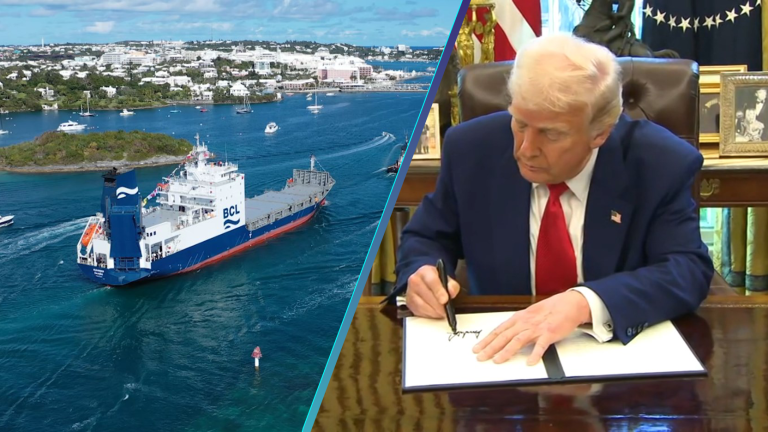
Photos: Bermuda Container Line’s MV Oleander, built in China (file); US President Donald Trump signs Executive Order (CBS)
Under initial proposals, which sent shockwaves through Bermuda, Chinese-built vessels entering a U.S. Port – which would have included Bermuda’s MV Oleander – might have faced massive new port fees. But a new Executive Order does not make specific reference to fees on Chinese-made ships.
The wide-reaching document directs U.S. Government officials to deliver a Maritime Action Plan within 210 days, identify key components for rebuilding and expanding the U.S. maritime industry, enforce the collection of fees for harbour maintenance, and make a proposal to incentivize shipbuilding in the U.S..
The Order also directs the United States Trade Representative to coordinate with appropriate agencies to support and enforce actions, if any are taken, in connection with the USTR’s investigation into China’s targeting of the Maritime, Logistics, and Shipbuilding Sectors.
However, Reuters reported this week that such fees may be softened, with lower fees for smaller ships – such as those serving Bermuda.
The Executive Order also directs the USTR to consider tariffs on Chinese-built ship-to-shore cranes and other cargo handling equipment – another manufacturing area dominated by China.
A Bermuda industry insider told Bermuda Broadcasting that the absence of language in the Executive Order that directly targets China-made vessels “gives me hope that the U.S. is pivoting away from the initially proposed fee structure…”
“Either way the can has been kicked 90-180 days, depending on how you read this.”
Russia and U.S. bring spa worker and tech smuggler back home in prisoner swap
Journalist Antonina Favorskaya, accused of taking part in the activities of an “extremist” organization founded by late opposition politician Alexei Navalny, gestures inside an enclosure for defendants before a court hearing in Moscow, Russia October 2, 2024. REUTERS/Maxim Shemetov/File Photo
International news via Reuters:
Russian prosecutors have asked for jail terms of five years and 11 months for four journalists accused of working for banned organisation of the late opposition leader Alexei Navalny, the journalists said as they were led out of court, a Reuters witness said on Thursday.
The United States and Russia swapped prisoners on Thursday, bringing a dual citizen jailed in Russia back home in return for a Russian-German national accused of exporting sensitive U.S. electronics for use in Russia’s military.
Following are some facts about Ksenia Karelina and Arthur Petrov.
KSENIA KARELINA
Russian-American dual citizen Ksenia Karelina, accused of treason for making a donation to a charity supporting Ukraine, attends a court hearing in Yekaterinburg, Russia August 15, 2024. REUTERS/Dmitry Chasovitin/
Karelina, a Los Angeles spa worker who was born in Russia, was arrested in February 2024 while visiting family in Yekaterinburg after agents from Russia’s Federal Security Service (FSB) inspected her phone and found she had donated about $50 to a New York-based charity providing humanitarian aid to Ukraine.
The FSB accused Karelina of collecting funds for the benefit of the Ukrainian army. The charity, Razom for Ukraine, has said its donations only go to humanitarian projects.
Russian-American citizen Ksenia Karelina, serving a 12-year prison sentence in Russia after she was found guilty of treason, is escorted by a security officer towards a plane at an airport in an unidentified location during a prisoner swap between Russia and the United States, in this still image from video broadcast in Russian state media April 10, 2025. Russian State Media/Handout via REUTERS
Karelina, who was born in 1991, arrived in the U.S. on a work-study programme in 2012 and settled in Maryland, where she was briefly married. She later moved to Los Angeles where she took a job as an aesthetician at a spa.
She was tried behind closed doors in Yekaterinburg, a city in the Urals. Karelina pleaded guilty to the treason charge in the hopes of receiving a lighter sentence, her lawyer said at the time.
She was found guilty last August and sentenced to 12 years in prison.
ARTHUR PETROV
Arthur Petrov, a dual German-Russian citizen who was released by the U.S. during a prisioner swap with Russia in exhange of Ksenia Karelina, is seen in this picture obtained from social media by Reuters on April 10, 2025. Arthur Petrov via LinkedIn/via REUTERS
Petrov, a dual Russian-German national, was arrested in August 2023 in Cyprus at the request of the U.S. for allegedly exporting sensitive microelectronics to manufacturers supplying weaponry and equipment to the Russian military.
Petrov worked for LLC Electrocom VPK, a Russia-based supplier of electronic components for weapons and equipment manufacturers supplying the Russian armed forces, according to court documents cited by the U.S. Department of Justice.
The U.S. says Petrov and two accomplices who also worked for Electrocom fraudulently procured microelectronics from U.S. distributors using a network of shell companies, based in Cyprus and other third countries, to disguise that the ultimate destination for the equipment was Russia.
Arthur Petrov, a dual German-Russian citizen arrested in 2023 at the request of the U.S. for allegedly exporting sensitive microelectronics, sits in a plane during a prisoner swap between Russia and the United States, in Abu Dhabi, United Arab Emirates, in this still image from video broadcast in Russian state media April 10, 2025. Russian State Media/Handout via REUTERS
Petrov and his co-conspirators imported more than $225,000 worth of electronic components from the U.S. to Russia in the course of the scheme, according to the Justice Department.
Following his arrest in Cyprus, Petrov was extradited to the U.S. and charged with multiple crimes including conspiracy, violating export controls, conspiracy to smuggle and money laundering.
Follows announcement that Donatella Versace was stepping down as the chief creative officer
FILE PHOTO: People stand outside a Prada store in Galleria Vittorio Emanuele II in Milan, Italy, January 10, 2025. REUTERS/Claudia Greco/ File Photo
International news via Reuters:
Prada struck a deal on Thursday to buy smaller rival Versace from Capri Holdings for $1.375 billion, which includes its debt, in a move that unites two of the biggest names in Italian fashion.
Prada is seeking to expand, having defied a slowdown in luxury demand, while Versace has been operating at a loss. The merger strengthens Italy’s hand in a luxury industry led by French conglomerates.
The deal follows the announcement on March 13 that Donatella Versace was stepping down as the chief creative officer of the brand founded by her late brother Gianni.
“We aim to continue Versace’s legacy celebrating and re-interpreting its bold and timeless aesthetic,” said Prada Chairman Patrizio Bertelli.
“At the same time, we will provide it with a strong platform, reinforced by years of ongoing investments and rooted in longstanding relationships,” added Bertelli, husband of Prada designer Miuccia Prada. The couple are leading shareholders in the company.
The price Prada has agreed to pay for Versace is a big discount to the roughly $2.15 billion including debt that Capri paid for Versace in 2018. Previously known as Michael Kors, Capri bought Versace from the Versace family and Blackstone.
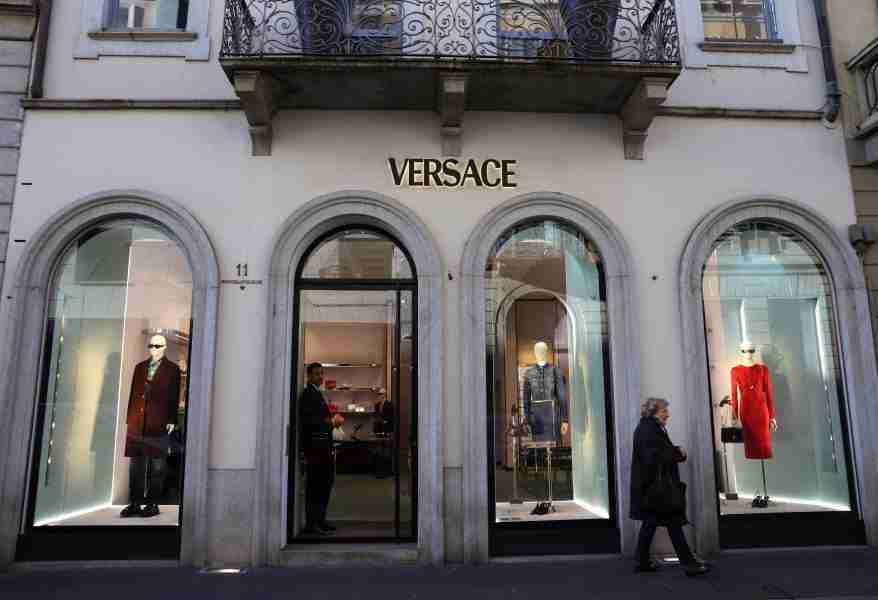
FILE PHOTO: A person walks outside a Versace store in Corso Montenapoleone in Milan, Italy, January 10, 2025. REUTERS/Claudia Greco/ File Photo
Owning Versace, with its bold, baroque-style prints, will bring new customers to Prada, known for its minimalist style.
“Versace has huge potential. The journey will be long and will require disciplined execution and patience,” said Andrea Guerra, the CEO of Prada.
The move comes at a time when several acquisitions and IPOs have been scuttled in the wake of a global equity sell-off and fears of recession triggered by U.S. President Donald Trump’s new tariffs this month.
Since Prada’s acquisitions at the end of the 1990s of Helmut Lang and Jil Sander, which leading Prada shareholder Bertelli called “strategic mistakes”, the group has largely steered clear of major dealmaking.
Reporting by Elisa AnziolinWriting by Keith WeirEditing by Matt Scuffham and Elaine Hardcastle
Cost-jump predicted following higher social security payments imposed by the government
FILE PHOTO: Apples and fresh fruits are seen on sale at a Tesco Extra supermarket in Cheshunt, Britain, March 25, 2025. REUTERS/Toby Melville/File Photo
International news via Reuters:
Tesco, Britain’s biggest food retailer, warned on Thursday its profit would likely fall this year as it set aside cash to deal with a step up in the “competitive intensity” of the market, sending its shares down over 6%.
Last month, Asda, Britain’s third largest grocer, said it would take a hit to profit to finance a major campaign of price cuts aimed at reversing a slide in market share.
Tesco CEO Ken Murphy said its guidance reflected not only Asda’s move but “a general intensification of competition across the board” and was issued from a position of strength.
“Competitors are clearly looking to defend the share gains we’ve been taking,” he told reporters.
“Whatever the competitive environment and whatever comes our way, we’re capable of dealing with it, that’s the message,” he said. Without declaring a full-blown price war, he noted that last week Tesco cut the prices of hundreds of key items.
Tesco, whose share of Britain’s grocery market has grown this year to nearly 28%, a level not seen since 2016, forecast adjusted operating profit of between 2.7 billion and 3.0 billion pounds ($3.5-$3.9 billion) in the year ending February 2026. That compares with a slightly better-than-expected 3.13 billion pounds in 2024/25, a 10.6% increase on the prior year.
Before the update, analysts had on average been forecasting a 3.2-billion-pound profit for 2025/26.
Shares in Tesco, which had fallen 11% since Asda’s warning last month, were down 6.3%. Rivals Sainsbury’s and Marks & Spencer were down 4.7% and 2.1% respectively. In contrast, the FTSE-100 index was up 3.8% after the U.S. tariffs pause.
‘GETTING THE KNUCKLE-DUSTER OUT’
Shore Capital analyst Clive Black said Tesco was “getting the knuckle-duster out”.
“Whilst there is no price war at present, Tesco is giving the market a clear statement that it is up for a fight,” he said.
Most analysts think Tesco’s strategy of matching the prices of discounter Aldi on key items, together with its Clubcard loyalty scheme, which provides lower prices for members, is working.
The group’s sales rose 3.5% to 63.6 billion pounds in 2024/25. Fourth quarter UK like-for-like sales rose 4.3%, having been up 3.8% in the third quarter.
Tesco is facing a jump in costs in 2025/26 due to higher social security payments imposed in the Labour government’s first budget last October, a hike in the national minimum wage and a new packaging levy.
To offset a 235 million pound increase in employer national insurance payments and a 5.2% pay rise for store workers costing 180 million pounds, Tesco will seek a further 500 million pounds of savings in 2025/26.
Finance chief Imran Nawaz said investors should read a further share buyback of 1.45 billion pounds and a 13.2% hike in the dividend “as a sign of confidence”.
Reporting by James Davey. Editing by Paul Sandle and Mark Potter
Could include an A.I. hub, autonomous vehicles, space launches, and high-speed rail
FILE PHOTO: U.S. Vice President JD Vance arrives to board Air Force Two after touring the U.S. military’s Pituffik Space Base in Greenland on March 28, 2025. Jim Watson/Pool via REUTERS/File Photo
International news via Reuters:
As the Trump administration intensifies efforts to acquire Greenland from Denmark — or take it by force — some Silicon Valley tech investors are promoting the frozen island as a site for a so-called freedom city, a libertarian utopia with minimal corporate regulation, three people familiar with the matter told Reuters.
The discussions are in early stages, but the idea has been taken seriously by Trump’s pick for Denmark ambassador, Ken Howery, who is expected to be confirmed by Congress in the coming months and lead Greenland-acquisition negotiations, the people said.
Howery, whose involvement with the idea hasn’t been previously reported, once co-founded a venture-capital firm with tech billionaire Peter Thiel, a leading advocate for such low-regulation cities. Howery is also a longtime friend of Elon Musk, a top Trump advisor.
Howery declined to comment. The White House did not respond to requests for comment. Sources who spoke to Reuters requested anonymity to discuss private conversations.
The vision for Greenland, one of the people said, could include a hub for artificial intelligence, autonomous vehicles, space launches, micro nuclear reactors and high-speed rail.
The discussions reflect a longstanding Silicon Valley movement to establish low-regulation cities globally, including in the United States, which Trump himself promised to do in a 2023 campaign video.
Proponents use different names for variations on the idea, including startup cities or charter cities, with the common goal of spurring innovation through sweeping regulatory exemptions.
The administration’s consideration of such a quixotic quest underscores the growing clout of tech magnates and Trump’s increasingly expansionist foreign policy.
After campaigning on a largely isolationist platform, Trump has since his November election suggested taking back the Panama Canal, annexing Canada and redeveloping the war-torn Gaza Strip after seizing the beachfront land from displaced Palestinians.
Greenland is about three times the size of Texas with a population of only 57,000. But the island is strategically important to the U.S. military, which has a base there, and contains substantial deposits of minerals, including rare-earths.
Trump has refused to rule out taking Greenland by military force if Denmark won’t sell it.
“We have to have Greenland,” Trump said late last month as his Vice President, J.D. Vance, visited a U.S. military base on the island.
Vance toured Greenland with his wife Usha Vance, a visit that ignited protests from Greenlanders, who overwhelmingly oppose becoming part of America, polls show.
The island is owned by Denmark but governs itself. Greenland’s new prime minister, Jens-Frederik Nielsen, said the U.S. visit signalled a “lack of respect.”
Speaking to troops at the U.S. military base, Vance accused Denmark of failing to protect Greenland from “very aggressive incursions from Russia, and from China and other nations,” without detailing the alleged aggression.
The government of Denmark declined to comment on the idea of U.S. tech investors founding a city there. Greenland didn’t respond.
FILE PHOTO: A view shows the city of Nuuk, Greenland, March 28, 2025. REUTERS/Leonhard Foeger/File Photo
‘NEW MANIFEST DESTINY’
The freedom-city movement reflects a fascination with settling new American frontiers, rooted in nostalgia for the nation’s 1800s western expansion. Expanding to Greenland “can be the dawn of a new Manifest Destiny,” said tech investor Shervin Pishevar, referring to the 19th-century philosophy that America was an exceptional nation with a God-given mission to conquer territory.
Thiel, a libertarian and early Trump supporter, wrote in 2009 that he no longer considered democracy compatible with freedom and has advocated escaping politics by colonizing outer space or seasteading — building communities in ungoverned oceans.
Fellow venture capitalist Marc Andreessen, an informal advisor to Musk’s Department of Government Efficiency (DOGE), is part of a tech-investor consortium seeking to build a city on grazing land outside San Francisco.
Another venture capitalist and informal DOGE advisor, Joe Lonsdale, also promotes low-regulation cities. In a statement to Reuters, Lonsdale celebrated “expanding our country to Greenland” but did not comment on plans for a city there.
Thiel and Andreessen, leading proponents and financiers of the startup-city movement, are among those supportive of a Greenland outpost, two of the sources said.
Reuters could not determine whether the two billionaires are actively lobbying the Trump administration for a Greenland city.
Andreessen declined to comment. Thiel spokesman Jeremiah Hall said: “Peter isn’t involved in any plans or discussions regarding Greenland.” Musk did not respond to comment requests.
Thiel has invested along with Andreessen and Pishevar in Pronomos Capital, a venture-capital firm that has launched a half dozen charter-city projects globally, according to Pronomos founder Patri Friedman, the grandson of famous free-market economist Milton Friedman.
Most Pronomos projects are in development and negotiations with various governments, Friedman said, but it has helped finance one existing startup community in Honduras called Próspera.
Pronomos also invested in Praxis, a city-building venture that in October announced $525 million in financing for a new city.
Praxis’ investors include Lonsdale, a fund launched by OpenAI CEO Sam Altman and his brothers, and Pishevar, who co-founded Hyperloop One, a defunct venture once championed by Musk.
Praxis co-founder Dryden Brown told Reuters other companies have approached Praxis about helping to establish a Greenland city.
Brown flew to Greenland last year. He advocates for building a city there in part because its harsh environment could provide a test site for colonizing Mars – one of Musk’s highest ambitions.
“We must build a prototype of Terminus on Earth before departing for Mars,” Brown posted on X in November, using Musk’s term for a red-planet settlement. “I believe Greenland is the place, @elonmusk.”
Reporting by Rachael Levy in Washington and Alexandra Ulmer in San Francisco; Additional reporting by Patricia Zengerle; Editing by Anna Driver and Brian Thevenot
Australia ships almost a third of its goods to China, and less than 5% of to the United States
FILE PHOTO: Australian Deputy Prime Minister and Defence Minister Richard Marles speaks during a tour of the Sheffield Forgemasters site, where steel used in defence programmes including a future fleet of nuclear-armed submarines is manufactured, in Sheffield, Britain, July 13, 2024. REUTERS/Temilade Adelaja/Pool/File Photo
International news via Reuters:
Australia on Thursday declined Beijing’s proposal to work together to counter U.S. tariffs, saying instead it would continue to diversify its trade and lower its reliance on China, its largest trading partner.
“We are not going to be holding hands with China in respect of any contest that is going on in the world,” Deputy Prime Minister Richard Marles told Sky News, referring to the Chinese ambassador’s proposal for countries to “join hands” on trade.
“We are not doing that. What we are doing is pursuing Australia’s national interests and diversifying our trade around the world.”
He said Australia would build its economic resilience by strengthening trade ties with the European Union, Indonesia, India, Britain and the Middle East.
In an opinion column in The Age newspaper, China’s ambassador to Australia Xiao Qian urged Canberra to collaborate with Beijing to defend the multilateral global trading system.
“Under the new circumstances, China stands ready to join hands with Australia and the international community to jointly respond to the changes of the world,” Xiao said.
U.S. President Donald Trump, in a stunning reversal, on Wednesday said he would temporarily lower hefty duties on dozens of countries but continue to target China, raising the tariff to 125% from 104%, further escalating a trade war between the world’s two largest economies.
That could pose a risk to Australia, which ships almost a third of its goods to China. Exports to the United States are less than 5% of Australia’s total goods exports.
Australia’s central bank has warned the ongoing uncertainty over tariffs and other trade restrictions between the U.S. and other major economies could have a chilling effect on business investment and household spending decisions in the country.
Trump has imposed a unilateral 10% tariff on Australia, the low end of his reciprocal tariffs for all imports into the United States.
Prime Minister Anthony Albanese has said that while the duty on Australia, a key U.S. security ally in the Indo-Pacific, has “no basis in logic”, his government would not retaliate.
Reporting by Renju Jose in Sydney; Editing by Stephen Coates
Kremlin calls European allegations of Russian sabotage unsubstantiated
A sign of the National Prosecutor’s Office is seen on their headquarters in Warsaw, Poland, March 27, 2025. REUTERS/Kacper Pempel
International news via Reuters:
Fake cosmetics, massage pillows and sex toys. Crude homemade explosives. A Russian known as Warrior. A code word: Mary.
These are among the key elements of a suspected Russian-run sabotage plot that led to three parcels being detonated at courier depots in Britain, Germany and Poland last summer, a person with knowledge of the Polish investigation told Reuters.
The pillows, packed into the parcels with the cosmetics and sex toys, contained hidden homemade incendiary devices made of a cocktail of chemicals including highly reactive magnesium, according to the person familiar with the case who provided the most granular account yet of the alleged plot.
The chemicals were ignited by pre-timed detonators adapted from cheap Chinese electronic gadgets used to track items like lost keys, with the effect enhanced by the tubes of what looked like cosmetics but in fact contained a gel made of flammable compounds including nitromethane, according to the source.
“The proceedings in this case concern criminal activities inspired by Russia’s GRU,” this person said, referring to Moscow’s foreign military intelligence agency.
A view of a sign of the National Prosecutor’s Office at their headquarters in Warsaw, Poland, March 27, 2025. REUTERS/Kacper Pempel
Reuters is reporting the details of the investigation for the first time, drawing on the account provided by the source close to the Polish case as well as interviews with more than a dozen European security officials. The findings provide a rare insight into how sabotage campaigns play out on the ground.
European security chiefs made the parcel fires public in October, describing them as part of a “hybrid war” being waged by Russia to destabilize the functioning of countries that support Ukraine, involving tactics like arson and cyberattacks.
They said the parcels – which caught alight in warehouses, causing fires but not hurting anyone – were a dry run for a future Russian plot to detonate similar packages in midair on cargo flights to the United States and Canada.
“With the war in Ukraine, these attacks have intensified, they became more frequent, more assertive,” said Nicu Popescu, Moldova’s deputy prime minister and foreign secretary until early last year and now distinguished policy fellow at the European Council on Foreign Relations think-tank.
“Of course, this poses a risk to people, to citizens across the European Union.”
The Kremlin rejected the accusation of Russia having a hand in the fires. “We know nothing about it,” spokesman Dmitry Peskov told Reuters. “We do not rule out that this is just more fake news or a manifestation of blind Russophobia.”
A view of the National Prosecutor’s Office headquarters in Warsaw, Poland, March 27, 2025. REUTERS/Kacper Pempel
The Kremlin said European allegations of a Russian sabotage or hybrid campaign were wholly unsubstantiated.
The GRU didn’t respond to a request for comment.
The package detonations took place on July 19, 20 and 21 in the British city Birmingham, Leipzig in Germany and near the Polish capital Warsaw.
Two EU security officials with knowledge of alleged attacks, who requested anonymity to discuss sensitive information, said the Polish cell was typical of Russian intelligence’s methods. Russian handlers often recruit local criminals to carry out their plans, the officials added, giving them basic instructions via Telegram and paying each operative up to a few thousand euros per job.
The ingredients and igniters detailed in the case are widely available in stores selling products like fertiliser inputs and pyrotechnics, said Jaroslaw Stelmach, a former bomb-disposal specialist who runs the Safety Project, a consultancy that advises on the security of public buildings among other things.
While the small, crude devices might only be able to cause a small fire, they could be difficult to detect, he told Reuters. “This is an extremely cheap, very effective, highly anonymous method of producing explosive devices,” he added.
Silhouettes of people walking are seen in front of the communist-era Palace of Culture and Science in the centre in Warsaw, April 2, 2025. REUTERS/Kacper Pempel
WARRIOR, MARY AND A FOURTH PARCEL
The Polish prosecution case is based on testimony from at least five suspected members of the alleged sabotage cell as well as the classified findings of security services, according to the person with knowledge of the investigation.
The national prosecutor’s office told Reuters that investigators had also seized a fourth parcel that failed to explode at a Warsaw depot, allowing them to examine the contents intact.
Polish investigators allege a Ukrainian named Vladyslav D who lived in southern Poland played a key role in the European dry run, acting on instructions he received on Telegram from a GRU handler whom he knew only as “Warrior”, the source said.
Polish law doesn’t allow the public disclosure of the surnames of people facing criminal charges.
However, the suspect’s full name – Vladyslav Derkavets – was publicly disclosed in a related court case in Bosnia, where there are no identification restrictions, in which another suspected member of the alleged parcels plot faced extradition to Poland.
On July 18, Vladyslav drove an Opel Astra from his home in Katowice across the border to the Lithuanian city of Kaunas where he collected more than a dozen items from the trunk of a parked car, according to the person close to the Polish prosecution case.
The 27-year-old drove on to Lithuania’s capital Vilnius where he boxed up four packages, each with a pillow plus a few of the cosmetics tubes and sex toys.
Before sealing them, he pressed two buttons to activate pre-timed detonation mechanisms, according to the source who said the gadgets were of a type that allowed users to set trigger times from a few seconds to months ahead.
On July 19, he handed the parcels over to a man in a park in Vilnius who used the code word “Mary”, the person said. The packages were posted on the same day from the city, they added.
Vladyslav was arrested in Poland in early August and charged with performing terrorist acts on behalf of Russian intelligence. In January, a Warsaw court extended his detention near the capital until May while the investigation continues.
A view of the National Prosecutor’s Office headquarters in Warsaw, Poland, March 27, 2025. REUTERS/Kacper Pempel
Reuters was unable to contact Vladyslav in detention and his court-appointed lawyer said he couldn’t comment given his lack of knowledge of the details of the investigation, which is at a pre-trial stage.
The national prosecutor’s office told Reuters that the suspect denied both the charges levelled at him including working for a foreign intelligence agency, and provided “extensive explanations” for his actions which the office said it was unable to disclose because of investigation confidentiality.
When questioned after his arrest, Vladyslav told investigators he had been introduced to Warrior by a friend and that they only communicated over Telegram, the source familiar with the investigation said.
Polish prosecutors accuse another man, 44-year-old Alexander B, of being part of the same Polish cell as Vladyslav.
His task, they say, involved preparing the way for targeting the North American-bound cargo planes by organising for packages of sneakers and clothes to be sent from Warsaw to Washington and Ottawa to gather information about parcel-processing methods and timing.
Alexander was the suspect Polish authorities sought to extradite from Bosnia, where he was publicly named in full as Alexander Bezrukavyi, a Russian national from Rostov-on-Don.
He told a hearing in Bosnian capital Sarajevo in January that he had no part or knowledge of any plot to target depots or cargo planes.
Bezrukavyi lost his extradition battle and was extradited to Poland in February. Reuters was unable to contact him in detention or reach a lawyer acting for him.
He has denied the charges levelled against him including working for a foreign intelligence agency, according to the person familiar with the Polish investigation.
(\Reporting by Anna Koper and Marek Strzelecki in Warsaw, Filipp Lebedev in London and Andrius Sytas in Vilnius; Additional reporting by Daria Sito-Susic in Sarajevo, Sabine Siebold in Berlin, Jan Lopatka in Prague, Mike Holden and Sam Tobin in London, Lili Bayer in Brussels, David Ljunggren in Ottawa and Erin Banco in New York; Editing by Mike Collett-White and Pravin Char
Formal allegations have yet to been made against Procter & Gamble
Tide detergent, a brand owned by Procter & Gamble, is seen for sale in a store in Manhattan, New York City, U.S., June 29, 2022. REUTERS/Andrew Kelly/File Photo
International news via Reuters:
Tide detergent maker Procter & Gamble has been identified as the subject of an EU antitrust regulators’ investigation initiated last month that had also targeted Coca-Cola bottlers, Bloomberg reported on Thursday citing people familiar with the matter.
The European Commission had conducted inspections at the premises of companies active in the non-alcoholic drinks sector and had also quizzed an unidentified personal care company in March over concerns of possible curbs on the trade of goods across Europe and carving up markets.
Companies risk fines of as much as 10% of their global annual revenues if found guilty of breaching EU antitrust rules against cartels and abuse of market power.
EU officials have sent over a questionnaire to P&G and are collecting evidence from competitors and customers, the Bloomberg report said. No formal allegations have been made against Procter & Gamble.
The European Commission and Procter & Gamble did not immediately respond to Reuters request for comment.
Reuters had identified Coca-Cola bottlers as the target of EU antitrust regulators, citing a person with direct knowledge of the matter.
Reporting by Anuja Bharat Mistry in Bengaluru; Editing by Tasim Zahid
Refurbished space reopens during National Library Week, highlighting its role as a safe and inclusive community hub
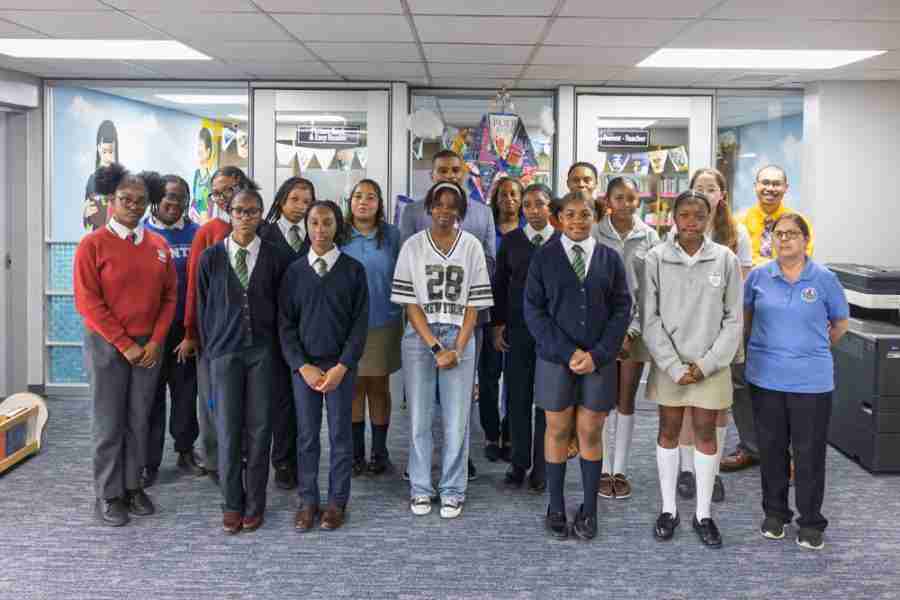
Images supplied by the Government of Bermuda
The Youth Library has officially reopened following months of renovations.
The Minister for Cabinet Office and Digital Innovation, Diallo Rabain, welcomed young readers to the transformed space at a ribbon-cutting ceremony yesterday.
He stated: “Today, we unveil a refreshed and revitalised library—one that not only honours its history but is now better able to serve future generations.”
The works include new ceiling and carpet tiles, fresh flooring, energy-efficient LED lighting, a repainted interior and exterior, and modern shelving units.
“The result is a brighter, safer, and more welcoming environment for all,” said Minister Rabain.
New ground-level bathrooms are to be completed soon, eliminating the need for young visitors to leave the building to use the facilities.
Unexpected roof repairs and weather-related delays were part and parcel of the challenges that come with any major project, the Minister advised.
The opening coincides with National Library Week, highlighting the space’s importance in the community.
“The Youth Library has long served as a cornerstone of our community, providing a safe, inclusive space where young people can explore, learn, and grow,” said Minister Rabain.
“As old as I am, as a young boy under 10 years old, I can remember spending hours on a Saturday afternoon here reading books like the Hardy Boys mystery novels or the detective adventures of Encyclopedia Brown.”
Previous programmes offered by the Youth Library are set to resume the week of 14 April, and the team is also “preparing to roll out new initiatives that will strengthen literacy skills and spark a lifelong love of reading,” announced Minister Rabain.
Meanwhile, a “Golden Ticket” challenge was launched, which will see lucky readers who find hidden tickets in books entered into a prize draw at the end of the challenge.
Minister Rabain said the reopening is the result of “months of planning, hard work, and collaboration”.
He added: “I want to extend my heartfelt thanks to everyone involved in this project, from the property owner, Gibbons Management Services Limited, and dedicated contractors to our incredible library team: Mrs. Marla Smith, Mr. Kieron Hall, Ms. Kristina Bean, and Ms. Lorie Fox. You have worked tirelessly throughout this journey, and your commitment and effort have brought us to this proud moment.
Minister Rabain also shared that his family are “passionate supporters of the library’s mission”, with his daughter a member of TAB, the Youth Library’s Teen Advisory Board.
He encouraged high school students seeking community service hours to consider joining TAB, stating, “It’s a meaningful way to give back to the community, develop leadership skills, and make a positive impact.”
Over 50 years have passed since Branwen Smith-King won Bermuda’s first gold medal in the Carifta Games. Since then, Bermuda has gone on to win the prestigious Austin Sealy Award for the most outstanding athlete twice as well as multiple track and field medals. BNAA President, Dr Freddie Evans, says this year’s team of 16 athletes competing in 8 disciplines, will be looking to expand on our past accomplishments when the 2025 edition of the regional youth track meet kicks off on Good Friday in Port of Spain in Trinidad.
The 16-strong team has now been finalised. Saturday’s Last Chance Meet, gave several athletes one final opportunity to make the Carifta standard or to impress the committee. And as Dr Evans explains, while there was some joy and there was also some disappointment.
The 2025 Carifta Games will be held in Trinidad April 18th to the 21st.
The hotel was shuttered in March 2020 in the face of the COVID-19 pandemic
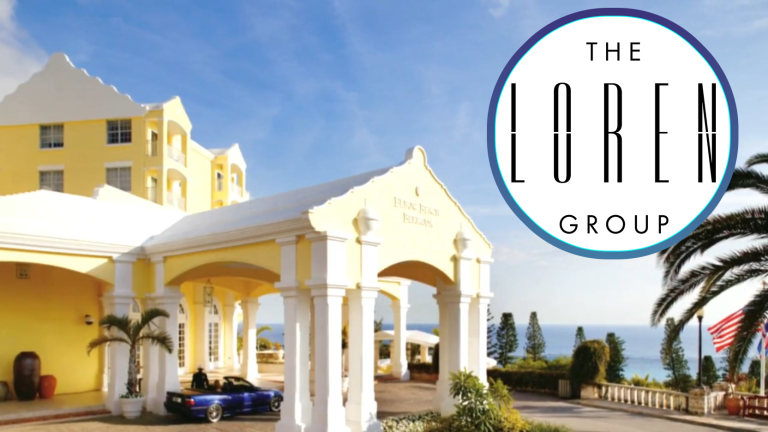
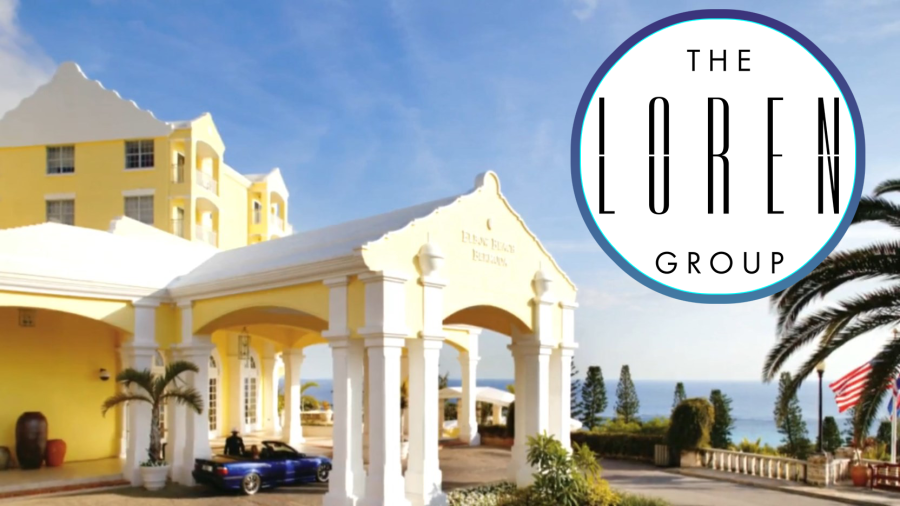
Photo: Elbow Beach Hotel (file)
The Loren Group has formally announced their acquisition of Elbow Beach Hotel.
The hotel was shuttered in March 2020 in the face of the COVID-19 pandemic, and in the following July announced its formal closure until 2021, although the resort was never reopened.
In 2022, the hotel was put up for sale. In 2023, the resort went into liquidation, and it was put back on the market in 2024.
The acquisition by the Loren Group marks the company’s second investment in Bermuda, following The Loren at Pink Beach, which opened in 2017.
The Loren Hotel Group Press Release:
The Loren Group is delighted to announce the acquisition of the iconic Elbow Beach Hotel and Fritholme Garden Residences in Bermuda, a landmark property situated on Bermuda’s picturesque southern shore. This strategic acquisition underscores The Loren’s commitment to expanding its luxury hospitality and residential footprint and enhancing Bermuda’s hospitality landscape. The Loren at Pink Beach, which opened in 2017, has been the marquee, luxury property in Bermuda, raising the bar for contemporary hospitality on the island.
“We are honored to take ownership of the historic Elbow Beach Resort, a property that holds a special place in Bermuda’s rich cultural and hospitality heritage. Our vision is to rejuvenate this esteemed property, blending its storied past with The Loren’s signature style to create an unparalleled destination for both locals and visitors,” says Stephen King, CEO & Founder of The Loren Group. “This deal is a testament to our dedication to Bermuda and the opportunity we see for continued growth as a luxury hospitality brand. We would like to thank all those involved in the transaction including Butterfield Bank, EY, Rego Sotheby’s International Realty, and the Government of Bermuda and look to many more years of doing business in Bermuda.”
The Elbow Beach Resort, which has remained closed since early 2020, has been a beloved fixture in Bermuda for over a century. The Loren Group plans to undertake a comprehensive redevelopment of the property. Detailed plans will be shared in the coming months and will deliver a world class mix of luxury real estate, an expansion of the Loren Hotel, restaurants, member and wellness facilities, reflecting the brand’s “uncompromising by nature” ethos. In addition to providing new opportunities for ownership in Bermuda, this new project will create significant employment opportunities to support the local economy. The Loren Elbow Beach will participate in the brand’s Roots Initiative, a program designed to capture carbon through biodiverse reafforestation.
To provide the best experiences, we use technologies like cookies to store and/or access device information. Consenting to these technologies will allow us to process data such as browsing behavior or unique IDs on this site. Not consenting or withdrawing consent, may adversely affect certain features and functions.
Functional
Always active
The technical storage or access is strictly necessary for the legitimate purpose of enabling the use of a specific service explicitly requested by the subscriber or user, or for the sole purpose of carrying out the transmission of a communication over an electronic communications network.
Preferences
The technical storage or access is necessary for the legitimate purpose of storing preferences that are not requested by the subscriber or user.
Statistics
The technical storage or access that is used exclusively for statistical purposes.The technical storage or access that is used exclusively for anonymous statistical purposes. Without a subpoena, voluntary compliance on the part of your Internet Service Provider, or additional records from a third party, information stored or retrieved for this purpose alone cannot usually be used to identify you.
Marketing
The technical storage or access is required to create user profiles to send advertising, or to track the user on a website or across several websites for similar marketing purposes.