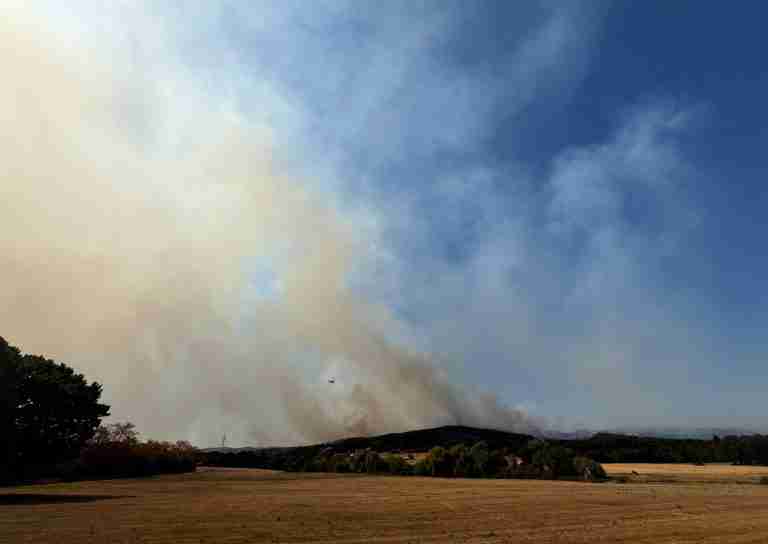
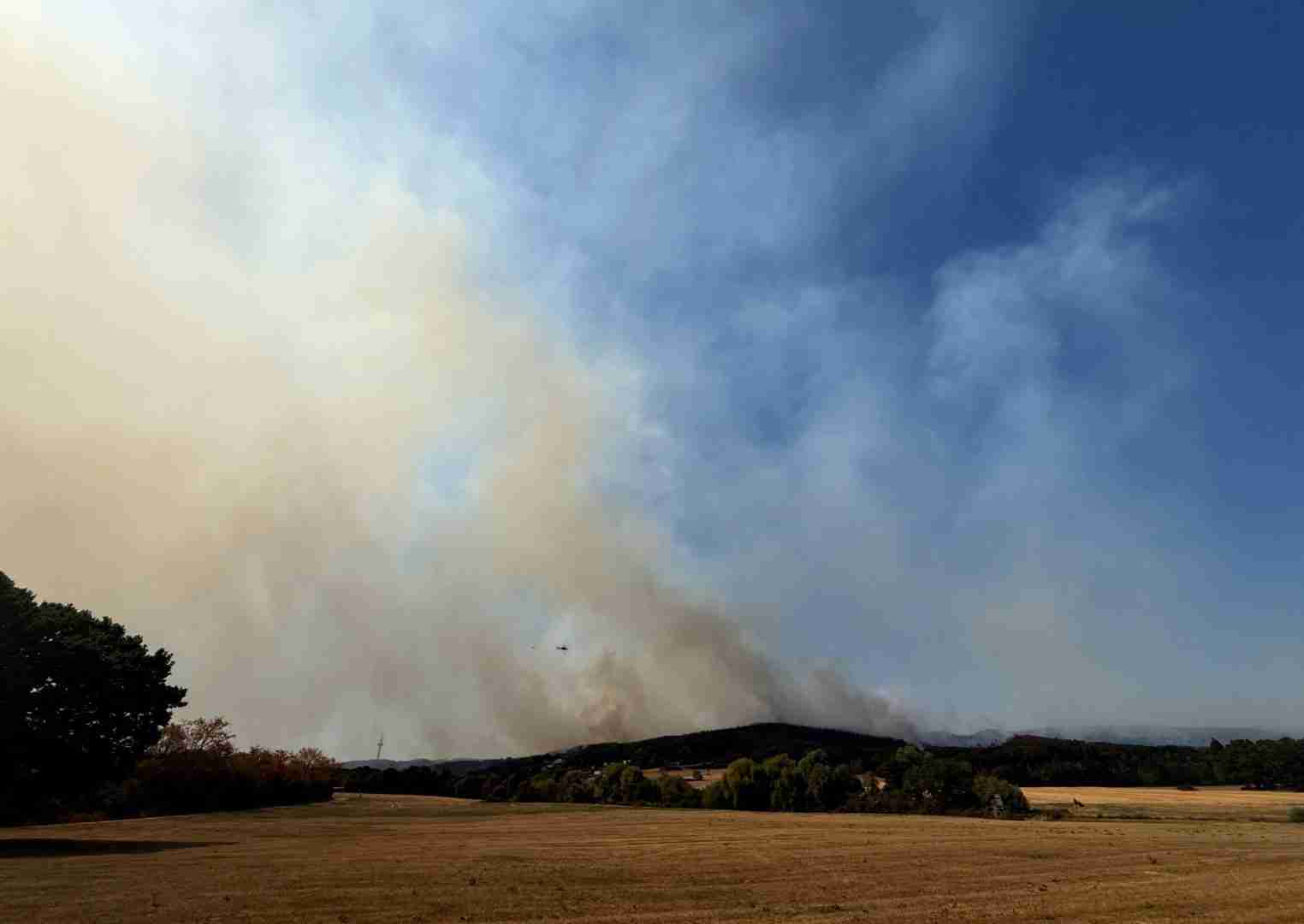
Residents were asked to leave their residences in the village of Gey at around 4:00 a.m
International News via Reuters:
More than 2,000 people were evacuated from their homes in western Germany on Friday, after a wildfire near the Belgian border spread towards a village, local authorities said.
Residents were asked to leave their residences in the village of Gey at around 4:00 a.m. (0200 GMT) and go to an assistance centre set up at a primary school in a nearby village, the authorities said in a statement.
“At about four o’clock we got a message via the app saying we had to leave the place straight away,” resident Leo Braun told Reuters. “So we gathered our things – which we’d already packed beforehand – and then fled.”
They were urged to carry only essential belongings, identification papers and necessary medicines.
Chancellor Friedrich Merz said he was being “kept constantly informed of developments,” adding that the federal police and the Bundeswehr were providing assistance where possible.
WWII ORDNANCE COMPLICATES CONTAINMENT
Stephan Cranen, mayor of Huertgenwald municipality which contains Gey, said the situation remained critical and the flames were now around 300 metres (1,000 ft) from the village, regional public broadcaster WDR reported.
Cranen was quoted as saying one of the wildfires that remain out of control had spread overnight towards a former munitions depot in the nearby town of Dueren.
There is unexploded World War Two munitions in parts of the surrounding forest because the hilly terrain prevented complete clearance of the area, and occasional detonations were heard during the wildfire, firefighters were quoted as saying.
About 300 hectares (740 acres) were burning as two German army tanks helped firefighters by clearing access routes through the forest area that were difficult to reach.
“If you look down from above, you can see that there are still a lot of fires – including smaller ones – that are still burning openly,” a local official told Reuters. “There are a lot of hot embers, so we’re far from done.”
Reporting by Friederike Heine in Berlin and Andi Kranz in Huertgenwald; editing by Clarence Fernandez, Sharon Singleton and Toby Chopra
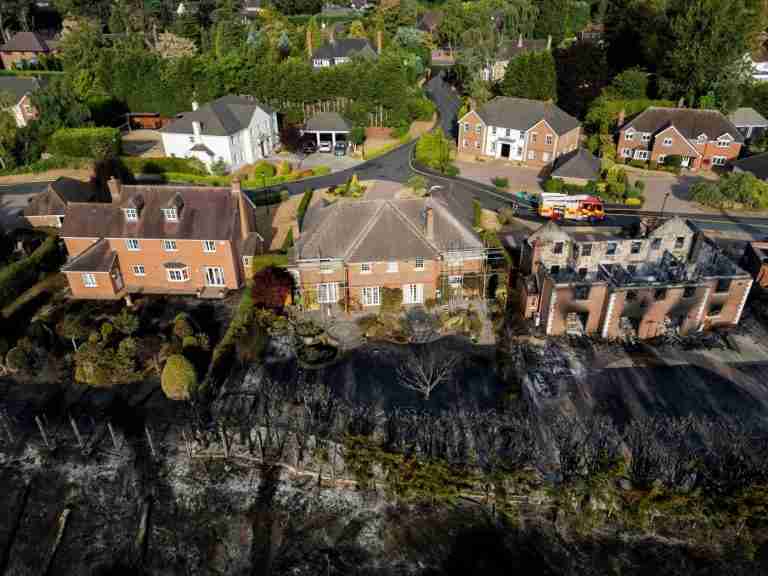
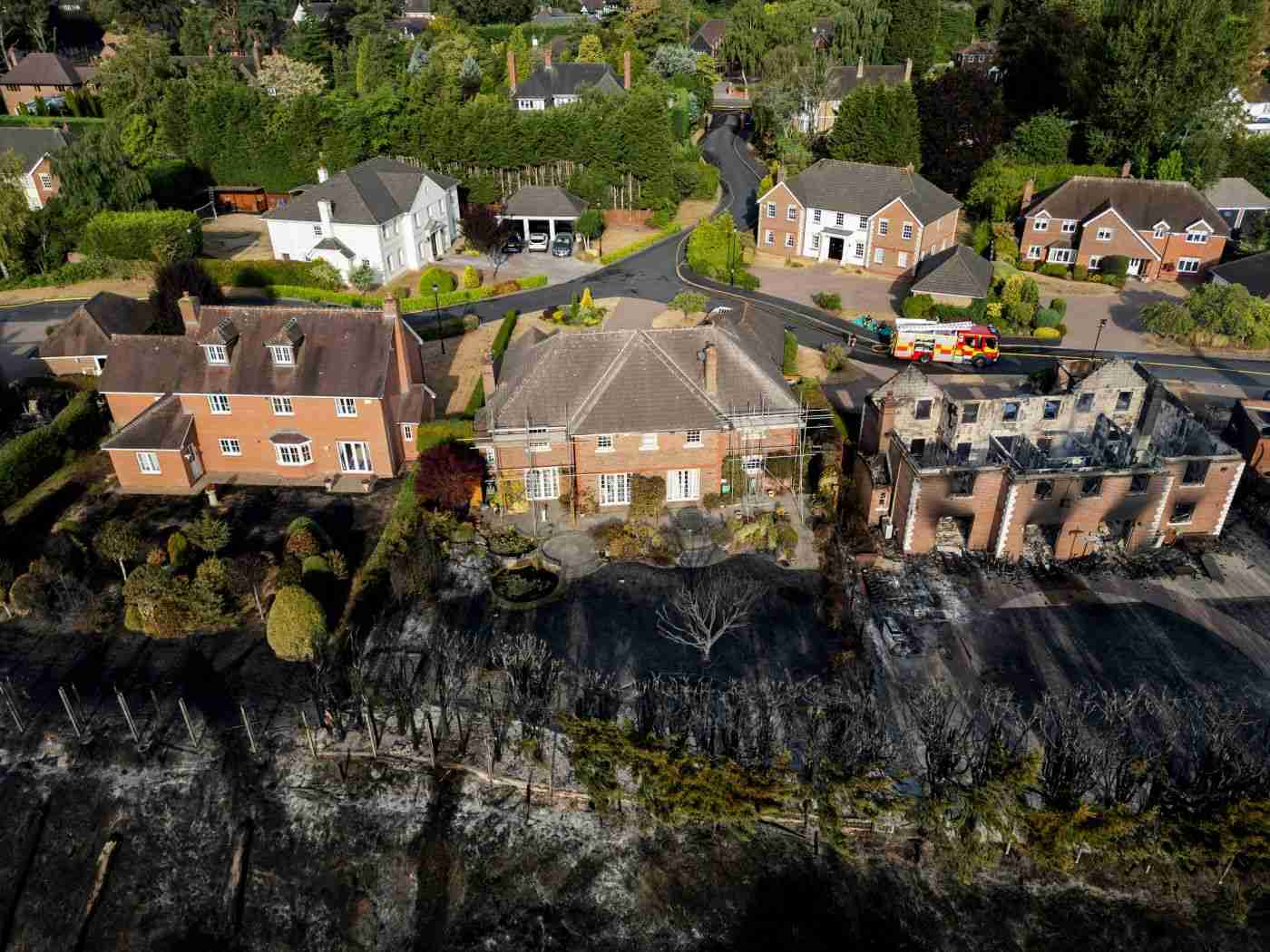
Aerial pictures from a Sky News helicopter showed at least three properties ablaze close to the fire about 127 miles (204.4km) from London
International News via Reuters:
A major grass fire in Stourbridge, central England, has affected six properties and left two people suffering from the effects of heat and smoke, emergency services said on Thursday.
Aerial pictures from a Sky News helicopter showed at least three properties ablaze close to the fire about 127 miles (204.4km) from London.
West Midlands Fire Service said the fire was affecting a number of locations around Ounty John Lane, Racecourse Lane and Stourbridge Road and that it had increased resources at the scene.
Some local rail services were halted for safety reasons and a number of nearby properties were experiencing power issues, the fire service said.
About 60 firefighters were tackling the blaze. There was no further information on injuries or the extent of the damage.
Reporting by Sam TabahritiEditing by James Davey and David Goodman
There have been more than 900 attacks between January and August this year, resulting in at least 900 deaths and more than 1,400 injuries
International News via Reuters:
Attacks on healthcare facilities, workers and patients in conflict zones including Ukraine and Gaza have continued to rise in 2026, reaching an average of more than four per day, the World Health Organization said on Friday.
There have been more than 900 attacks between January and August this year, resulting in at least 900 deaths and more than 1,400 injuries, according to WHO data presented in Geneva by Altaf Musani, the agency’s director of humanitarian and disaster management.
Ukraine, Lebanon and the occupied Palestinian territory account for the largest share of reported incidents, although attacks have also been recorded in countries including Iran, Sudan, Myanmar, Syria, Nigeria and the Democratic Republic of Congo, Musani said.
“What we are witnessing are multiple forms of violence,” Musani said, citing the use of heavy weapons, destruction of health facilities and the detention or abduction of healthcare workers and patients. During this period 94 healthcare workers have been detained.
In Gaza, all 36 hospitals have been damaged and only about half remain partially functional, while in Sudan 37% of health facilities are reported non-functional this year, he said. In Ukraine, the WHO has verified more than 3,100 attacks since Russia’s full-scale invasion, including a recent strike affecting a WHO warehouse.
“An attack on healthcare does not end when an attack gets verified,” Musani said. “It is the patient who cannot receive healthcare tomorrow. It is the ambulance that cannot make the next referral.”
A WHO study of 69 attacks in northwest Syria found outpatient consultations fell by 51% immediately after an attack and remained depressed for more than a month.
Attacks can also undermine responses to disease outbreaks, Musani said. In the Democratic Republic of Congo, 12 verified attacks on healthcare since an Ebola outbreak was declared in May have disrupted surveillance, contact tracing, treatment and community outreach efforts. Such incidents make it harder to detect and contain outbreaks, he said.
The 156 verified attacks in Ukraine so far this year, out of a total of 3,100 since Russia’s full-scale invasion began, have affected hospitals, ambulances, warehouses and medical supply chains, Musani stated.
Since the WHO’s surveillance system began tracking such incidents in 2018, more than 10,400 attacks have been verified across 29 countries and territories, resulting in about 5,700 deaths and over 8,500 injuries, Musani said.
Musani said not a single one of the more than 10,000 verified attacks had yet entered an accountability process.
Health facilities are protected under international humanitarian law and the Geneva Conventions, he noted.
Reporting by Olivia Le Poidevin; Editing by Saad Sayeed
The fire, which has razed 1,100 hectares (2,700 acres) after it began on Thursday, has spread to within 2 km (1.2 miles) of the centre of Luglon
International News via Reuters:
French authorities have evacuated 525 people from the village of Luglon after a wildfire broke out in the southwestern Landes region, not far from an area already devastated by major blazes this summer.
The fire, which has razed 1,100 hectares (2,700 acres) after it began on Thursday, has spread to within 2 km (1.2 miles) of the centre of Luglon, regional official Gilles Clavreul told reporters on Friday.
The Landes area is swathed in pine forests that become highly flammable when dry.
“The situation is unfavorable and the fire remains raging,” Clavreul said, adding that 500 firefighters were tackling the flames and six aircraft have been sent in to assist.
Roads to the north and south of the village have been closed.
Clavreul did not comment on the possible origin of the fire.
Luglon is about 100 km (62 miles) southeast of the tourist area of Arcachon Bay, where two major wildfires destroyed more than 50,000 hectares (124,000 acres), spurring the evacuation of as many as 220,000 people in late July.
French media reported on Friday that a 15-year-old has been arrested in connection with a July fire near Bordeaux airport, in the same region, that killed two firefighters.
The youth, who has been placed under judicial investigation, allegedly threw away a cigarette butt that sparked the fire, local newspaper Sud Ouest reported. The Bordeaux prosecutor’s office did not immediately respond to a request for comment.
The French interior ministry said 474 people have been arrested on suspicion of starting a fire, whether that be intentional or not. Of that total, 183 are younger than 18. About 70% of the people detained are suspected of arson, the ministry has previously said.
Southwestern France has broiled in heatwaves this summer and temperatures are expected to soar to 36 degrees Celsius (97 degrees Fahrenheit) on Friday afternoon.
The area burned so far this year exceeds that of the previous record year of 2022.
Reporting by Stephanie Lecocq; Additional reporting by Gus Trompiz; Writing by Inti Landauro and Jean-Stephane Brosse; Editing by Clarence Fernandez and Edwina Gibbs
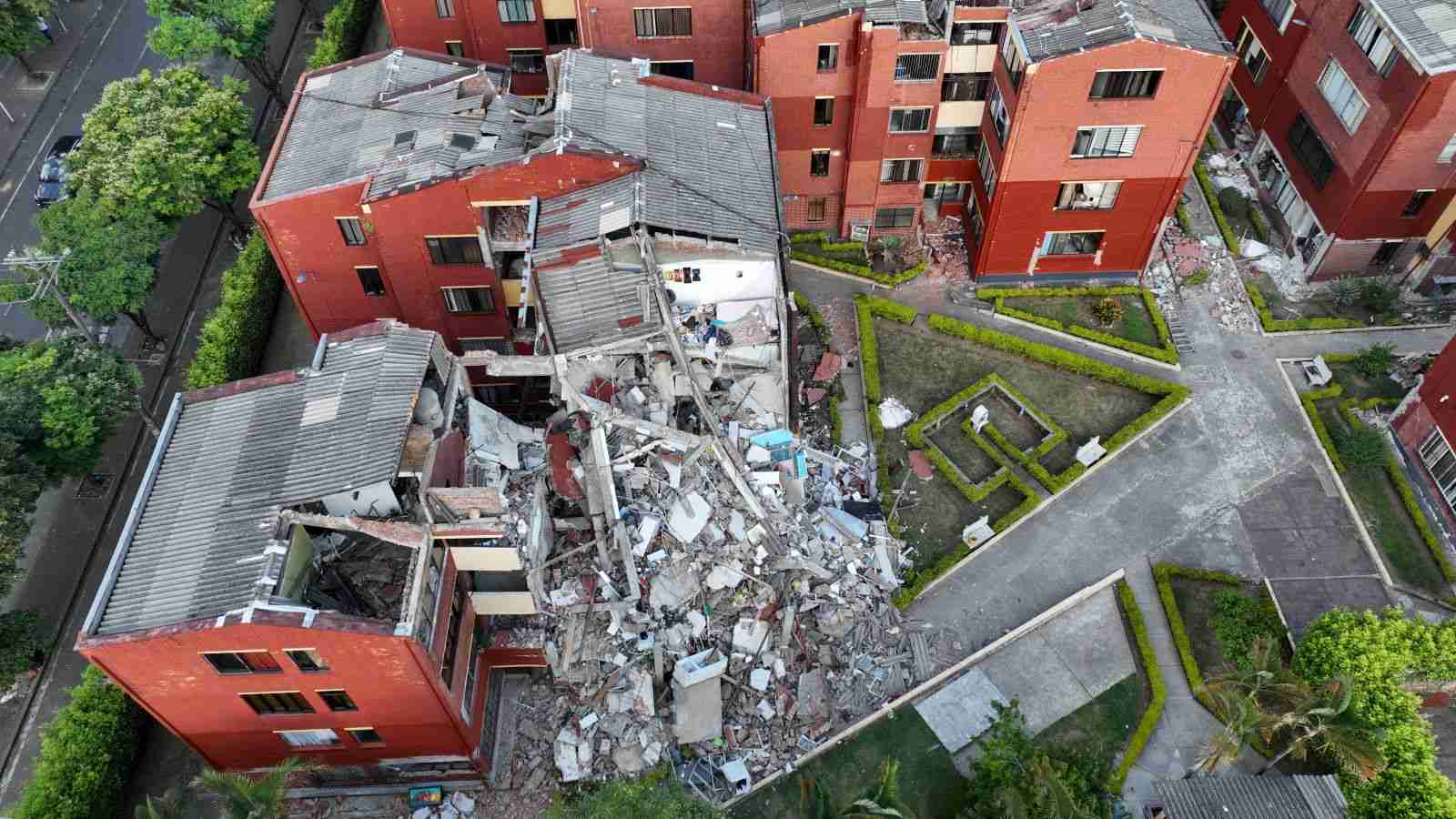
In Cali, the country’s third-largest city, crews shifted from a search-and-rescue effort to debris removal at most sites, a sign the disaster response was entering a grimmer phase after the crucial first 72 hours
International News via Reuters:
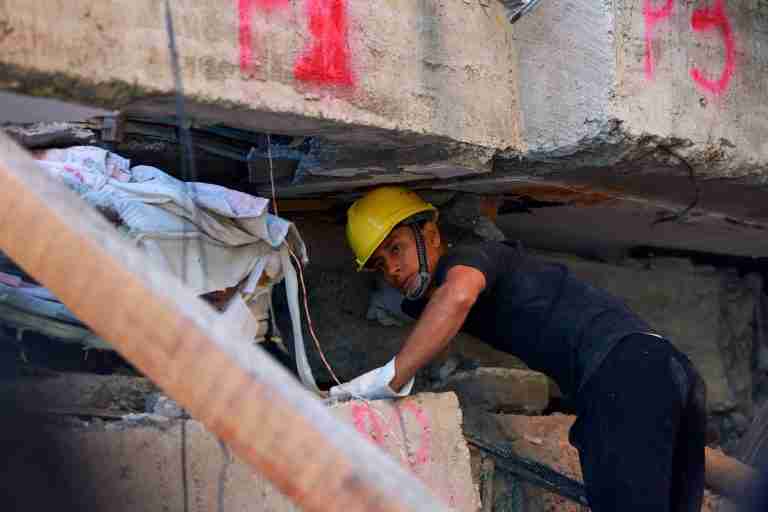
Hopes of finding more survivors of the powerful earthquake that rocked Colombia early this week were fading on Thursday as rescue workers narrowed their searches, while families in the worst-hit areas waited for news of missing relatives.
In Cali, the country’s third-largest city, crews shifted from a search-and-rescue effort to debris removal at most sites, a sign the disaster response was entering a grimmer phase after the crucial first 72 hours.
“Unfortunately, we are reaching a point where the likelihood of finding survivors is dwindling, but our mission is to keep searching and find all those people who are reported missing,” David Tamayo, head of Colombia’s National Unit for Disaster Risk Management, said on Thursday evening.
The 7.4-magnitude quake struck shortly after 7:30 a.m. on Monday, toppling apartment blocks, damaging homes, schools and hospitals, sending residents into the streets across western Colombia, home to the country’s coffee farms.
At least 281 people were killed — many in Cali and Pereira, a city in the coffee region — and more than 3,900 injured, according to government data on Thursday evening. The data indicated 379 people were still reported to be missing.
In Pereira, Enrique Marin said he drove more than 10 hours from Bogota after getting a call from a friend who told him Marin’s mother was trapped underneath the rubble of her home.
“My mother was rescued six hours after the earthquake. They pulled her out with vital signs, but she died on the way to the hospital,” Marin said as he stood in front of the debris clutching a bicycle from his childhood, the only item he said he was able to recover from the house.
He said his mother was found in her pajamas with the house keys still in her hand.
At the Torres del Limonar residential complex in southern Cali, work became frenzied for volunteers in bucket brigades, as a coordinator with a megaphone reminded them of the limited time and scolded two volunteers who approached without helmets.
Elsewhere in the rubble, crews carefully handed down gas tanks removed from the debris as workers called for silence for the more delicate rescue operations.
Monica Mina, a 38-year-old restaurant owner, said she and other chefs in the city were working almost around the clock to distribute about 1,000 meals a day — including scrambled eggs and pork — for rescuers, medics and volunteers.
Some 133 km (83 miles) north in Roldanillo Cemetery, Colombia’s disappeared persons unit said it was investigating camouflage-clad human remains exposed by the earthquake.
FIRST MAJOR TEST FOR NEW COLOMBIAN GOVERNMENT
Outside major cities, rescue groups said smaller towns and communities were still struggling with little or no response from the Colombian government.
Nazly Lozano, the International Rescue Committee’s program assistant at the port city of Buenaventura northwest of Cali, said rescue workers had not reached some stricken areas until Wednesday night, leaving locals to dig through the rubble with their bare hands in a desperate search for survivors.
IRC workers said some neighborhoods in Buenaventura remained inaccessible due to armed groups, some of which seized food donations, vowing to distribute these items themselves.
Residents still lack basic services such as water, gas and electricity, the IRC workers said.
More than 150 aftershocks have been recorded since Monday, adding to the risks for rescue workers combing through the debris as well as people made homeless by the initial quake, which was one of the strongest felt in Colombia in several decades.
The government has estimated the quake destroyed more than 10,500 homes.
President Abelardo De La Espriella, who took office just days before the disaster, said on Wednesday he would declare an economic emergency and create a reconstruction fund to channel domestic and international aid toward rebuilding hospitals, schools, homes and infrastructure.
The disaster is shaping up as the first major test for the conservative president, who campaigned on cutting public spending and now faces the task of financing relief and reconstruction while showing his government can manage a national crisis.
Colombian officials have also pushed back against criticism over the handling of foreign assistance, saying the government has not rejected any country’s offer but will only accept international search-and-rescue teams that meet recognized certification standards.
Reporting by Nelson Bocanegra in Pereira, Julia Symmes Cobb in Cali and Luis Jaime Acosta in Bogota; Additional reporting by Sarah Morland; Writing by Kylie Madry and Sarah Morland; Editing by Paul Simao and Rod Nickel
Brent futures were up $1.43, or 1.64%, to $88.50 a barrel at 0810 GMT, while U.S. West Texas Intermediate crude futures were up $1.56, or 1.92%, to $82.81 a barrel
International News via Reuters:
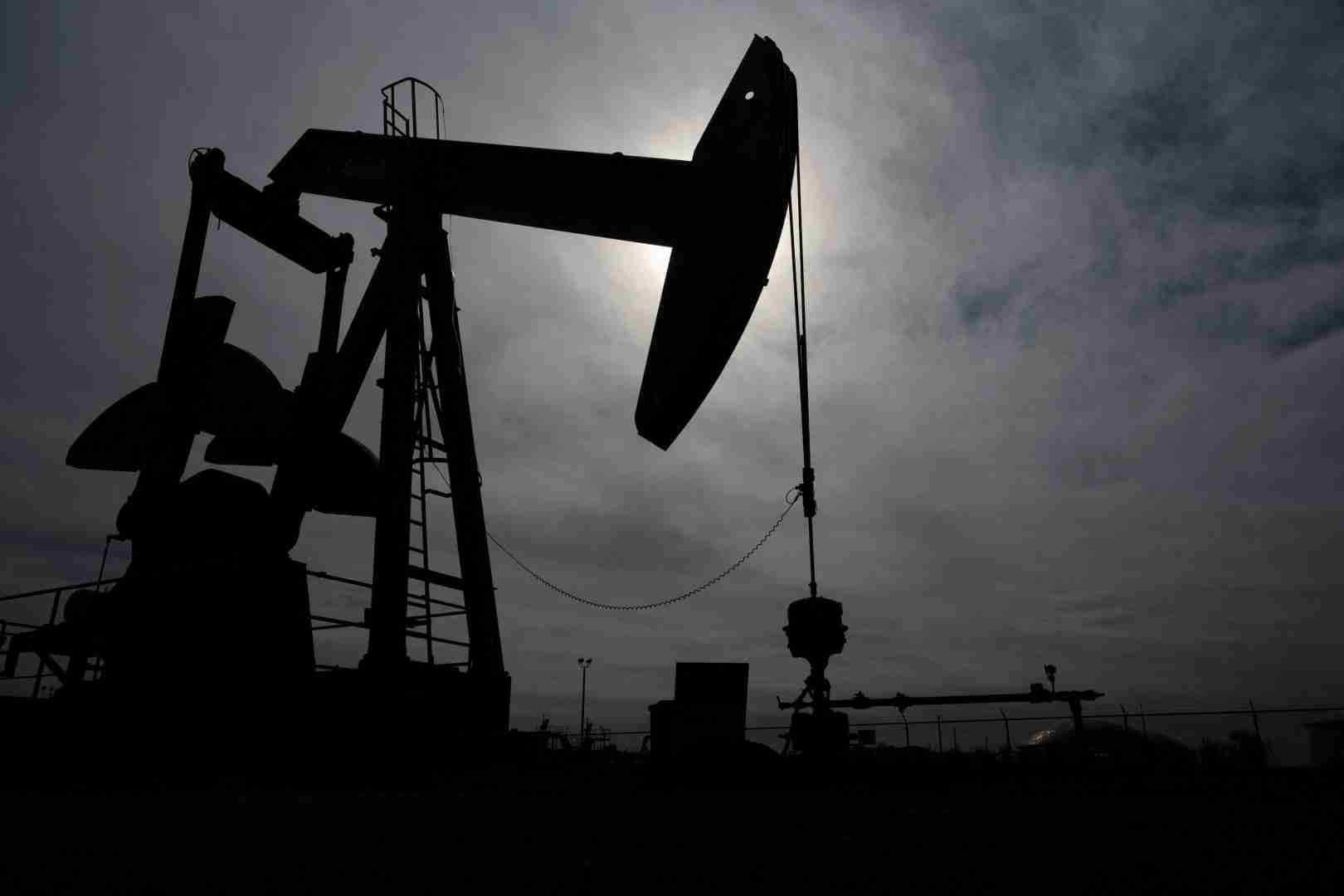
Oil prices rose on Friday and were on track for weekly gains after the United States threatened an indefinite naval blockade of Iran, raising concerns about disruptions to crude supplies from the Middle East.
Brent futures were up $1.43, or 1.64%, to $88.50 a barrel at 0810 GMT, while U.S. West Texas Intermediate crude futures were up $1.56, or 1.92%, to $82.81 a barrel.
Higher oil prices are a natural result of the latest approach by the U.S., which implies a substantial extension of the trouble in the Middle East with little hope of a near-term resolution, said Bjarne Schieldrop at SEB Research.
On Thursday, the U.S. warned it could maintain a naval blockade of Iran indefinitely and ramp up economic pressure on Tehran as ceasefire talks have stalled.
“Watch this space for more announcements coming next week because we are going to apply measures like have never been seen in the history of economic isolation of a country,” Treasury Secretary Scott Bessent told Newsmax’s “Rob Schmitt Tonight” programme in an interview.
“A return to normal flows out of the Strait of Hormuz is now suddenly without any near-term hopes,” Schieldrop said.
The latest U.S. threats come as Iran curbs flows through the Strait of Hormuz, which handled about one-fifth of global daily oil and liquefied natural gas supplies before the conflict began in late February.
Shipping traffic in the strait fell below the month’s average towards the end of the week, with both countries making competing claims over control of the waterway.
Two vessels from the state-owned Abu Dhabi National Oil Company were attacked transiting the strait on Thursday, UAE state news agency WAM said, an incident the UAE government condemned as an Iranian attack.
Meanwhile, forecasts from OPEC and the International Energy Agency pointed to weaker demand growth, while U.S. crude inventories posted their largest weekly increase in more than 3-1/2 years.
“This week’s reports by the IEA and EIA were quite revealing. Storage is holding up much better than feared, which should pull oil prices lower,” said Norbert Rucker, head of economics and next generation research at Julius Baer.
Reporting by Mohi Narayan in New Delhi and Helen Clark in Perth. Editing by Clarence Fernandez and Mark Potter
The blue-chip FTSE 100 dipped 0.1% to 10,765.30 points by 1009 GMT, on track for its first weekly decline since early July
International News via Reuters:
London’s FTSE 100 was on track for its first weekly setback in five on Friday, as miners retreated alongside a dip in copper prices, though software and data companies rebounded after the report of a large deal in the sector.
The blue-chip FTSE 100 dipped 0.1% to 10,765.30 points by 1009 GMT, on track for its first weekly decline since early July. The midcap FTSE 250 edged up 0.1% to 24,860.50 points, set to end the week largely flat.
• Shares of miner Antofagasta dropped almost 5%, down sharply for the second consecutive day after its production outlook disappointed on Thursday and copper prices fell after a recent rally. [MET/L]
• The FTSE 350 industrial metal and mining index was set for a 4.7% weekly drop, in what could be the weakest weekly performance since mid-March.
• Among gainers, shares of Sage Group, Experian and RELX climbed in 3.5% to 5.7% after Reuters reported private equity firm Silver Lake was in talks to acquire U.S. software firm Workday, lifting the sector.
• Global stocks traded just below record highs as benign U.S. inflation data this week tempered expectations of Federal Reserve interest rate hikes this year.
• Still, a lack of progress towards a lasting peace deal between the United States and Iran has weighed on sentiment and kept crude prices on track for weekly gains. [O/R]
• The United States said on Thursday it could maintain a naval blockade of Iran indefinitely and would ratchet up economic pressure on Tehran as ceasefire talks have floundered, global oil supply is dropping and regional tensions are rising.
• Bank of England Chief Economist Huw Pill told the Wall Street Journal that stronger-than-expected British economic growth figures reinforced the case for higher borrowing costs to bring inflation back to target, after data showed a surprise 0.3% rise in the UK’s gross domestic product in June.
• Traders expect at least one 25-basis-point rate hike from the BoE by the end of this year, according to LSEG-compiled data.
• Ladbrokes owner Entain rose 3.6% as it beat first-half profit expectations, while identity technology company GB Group sank 27%, its steepest fall in over nine years, after cutting its annual revenue growth forecast.
Reporting by Anand Gopal and Sruthi Shankar in Bengaluru; Editing by Joyjeet Das
The British currency was last at $1.3521, up 0.25% on the day and a similar amount on the week
International News via Reuters:
Sterling was set for a weekly rise against both the dollar and the euro on Friday, helped by this week’s better than expected GDP data as well as calm across currency markets that is pushing traders to buy currencies where bond yields are relatively high, like Britain.
The British currency was last at $1.3521, up 0.25% on the day and a similar amount on the week. It was trading at 85.44 pence per euro, a whisker firmer on the day and also around 0.25% stronger on the week.
“The pound has been supported by further evidence yesterday that the UK economy is proving more resilient than expected to the negative energy price shock triggered by the U.S.-Iran conflict,” said Lee Hardman, senior currency analyst at MUFG.
Thursday’s data showed the British economy grew by 0.3% during June, putting Britain on course for the strongest growth among the Group of Seven rich economies in the first half of 2026.
Hardman also said that “favourable carry conditions” had boosted the pound, something particularly relevant when compared to the euro.
In currency carry trades, investors borrow in a low yielding currency like the yen or the Swiss franc, and use those borrowed funds to buy a higher yielding currency, profiting from the interest rate differentials.
British short-dated borrowing costs are among the highest in developed markets, and are well above those in the euro zone.
Carry trades are particularly popular when volatility in currency markets is low, the current situation, and this is helping sterling appreciate on the European common currency.
The next important domestic data points for the pound are next week’s inflation and labour market data.
Brent and U.S. crude futures contracts pared losses after being down over 3.5% earlier in the session after reports that Yemen’s Houthis had targeted a Saudi Aramco refinery with drones
International News via Reuters:
Oil settled down more than 2% on Thursday, reversing course after a week of gains, as investors focused on signs of weaker global demand and a sharp build in U.S. crude inventories.
Brent and U.S. crude futures contracts pared losses after being down over 3.5% earlier in the session after reports that Yemen’s Houthis had targeted a Saudi Aramco refinery with drones, renewing concerns over supply disruptions in an already tight global market.
Brent futures finished $1.91, or 2.15%, lower at $87.07 a barrel following a six-session rally, while U.S. West Texas Intermediate (WTI) crude closed down $2.02, or 2.4%, at $81.25 a barrel after advancing for five sessions.
Investors weighed data from the U.S. Energy Information Administration on Wednesday that showed U.S. commercial crude oil inventories made their largest weekly gain since January 2023 as exports slumped. Crude inventories rose by 17.4 million barrels to 424.4 million in the week ended August 7, their highest since June 5, the EIA said.
OPEC lowered its world oil demand growth forecast for 2026 to 580,000 barrels per day in its monthly oil market report.
The International Energy Agency also said it expected a contraction of 1.6 million bpd in consumption this year, versus a drop of 1 million bpd forecast last month, with demand curtailed by higher prices and restricted supply due to the U.S.-Israeli war with Iran.
Prices, however, were pressured after a report from Yemen’s Houthi-run Saba news agency said the militant group attacked an Aramco refinery in Saudi Arabia’s Jazan with two drones on Thursday.
News of the attacks sent diesel cracks to an all-time high. According to Saudi Aramco’s website, the Jazan refinery has the capacity to produce 250,000 bpd of ultra-low sulfur diesel.
A Houthi military source said the attack was in response to what the group described as Saudi violations of Yemeni airspace and sovereignty in Saada and Hajjah provinces. Saudi Arabia did not immediately comment on the report.
COMPETING CLAIMS OVER HORMUZ
Supply disruptions in the Middle East and the Black Sea region continued to support oil prices, with the U.S. and Iran making competing claims over the Strait of Hormuz, through which about 20% of global oil supply passed before the start of the Iran war.
The strait is “under Iran’s control and management”, the recently appointed head of Iran’s Basij paramilitary unit said on Thursday, a day after U.S. President Donald Trump said the United States had “total control” of the waterway.
Iran and the United States remain at loggerheads over efforts to agree a permanent end to the war in the Gulf, according to a senior Iranian source, who said there had been no progress in talks to revive the interim deal agreed in June and define a time frame to implement it.
U.S. Defense Secretary Pete Hegseth said on Thursday that the United States military could keep a blockade on Iranian ports for as long as needed.
Traders continued to assess the scale of disruption after U.S. Energy Secretary Chris Wright said about 9 million bpd was moving through the strait weekly, while shipping data showed vessel crossings excluding container ships dropped to five on Wednesday, their lowest in three weeks.
Before the war, 125 to 140 vessels passed through the crucial waterway each day.
“Conflicting stories continue to drive the narrative as to who controls the Strait of Hormuz and just how many ships are making passage,” said Tim Snyder, chief economist at Matador Economics.
Adding to market tightness, Russia’s seaborne oil product exports fell sharply in July after Ukrainian drone attacks led to unplanned maintenance at key domestic refineries, industry sources said and Reuters’ calculations showed.
In the Russian city of Orsk, an oil refinery that was hit by a Ukrainian drone strike two days ago has been forced to shut down, and repairs could take up to six months, the regional governor said on Thursday.
Reporting by Siddharth Cavale in New York, Sam Li in Beijing and Siyi Liu in SingaporeEditing by Mark Potter, David Goodman, Keith Weir and Nia Williams
At least 273 people were killed — many in Cali and Pereira, a city in the coffee region — and more than 3,800 injured, according to government data on Thursday morning
International News via Reuters:
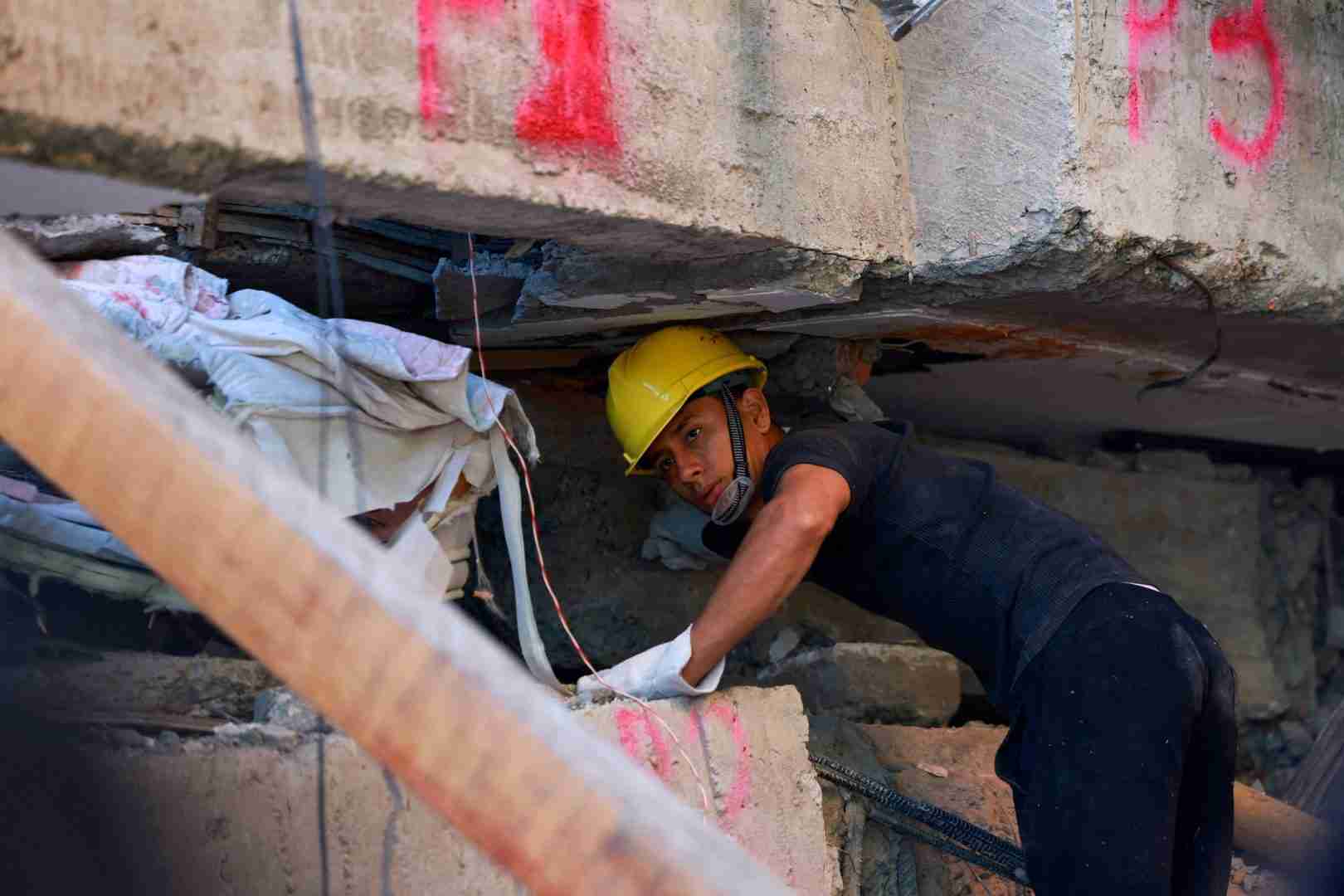
Hopes of finding more survivors from the powerful earthquake that rocked Colombia early this week were fading on Thursday as rescue workers narrowed their searches, while families in the worst-hit areas waited for news of missing relatives.
In Cali, the country’s third-largest city, crews have turned their attention from a search-and-rescue effort to debris removal at most sites, a sign the disaster response was entering a grimmer phase after the crucial first 72 hours.
The 7.4-magnitude quake struck shortly after 7:30 a.m. local time on Monday, toppling apartment blocks, damaging homes, schools and hospitals and sending residents into the streets across western Colombia, home to the country’s coffee farms.
At least 273 people were killed — many in Cali and Pereira, a city in the coffee region — and more than 3,800 injured, according to government data on Thursday morning. It also said 377 people were still reported to be missing.
In Pereira, Enrique Marin said he drove more than 10 hours from Bogota after getting a call from a friend who told him Marin’s mother was trapped underneath the rubble of her home.
“My mother was rescued six hours after the earthquake. They pulled her out with vital signs, but she died on the way to the hospital,” Marin told Reuters as he stood in front of the debris clutching a bicycle from his childhood, the only item he said he was able to recover from the house.
He said his mother was found in her pajamas with the house keys still in her hand.
At the Torres del Limonar residential complex in southern Cali, rescue brigades with buckets and cranes continued to search for 15 people still missing. Rescuers have found seven survivors and 13 corpses at the site.
Monica Mina, a 38-year-old restaurant owner, told Reuters she and other chefs in the city were working almost around the clock to distribute about 1,000 meals a day — including scrambled eggs and bits of pork — for rescuers, medics and volunteers.
FIRST MAJOR TEST FOR NEW COLOMBIAN GOVERNMENT
Outside major cities, rescue groups said smaller towns and communities were still struggling with little or no response from the Colombian government.
Nazly Lozano, the International Rescue Committee’s program assistant at the port city of Buenaventura northwest of Cali, said rescue workers had not reached some stricken areas until Wednesday night, leaving locals to dig through the rubble with their bare hands in a desperate search for survivors.
IRC workers said some neighborhoods in Buenaventura remained inaccessible due to armed groups, some of which seized food donations, vowing to distribute these items themselves. Residents still lack basic services such as water and electricity and were using logs to cook their meals, the IRC workers said.
More than 150 aftershocks have been recorded since Monday, adding to the risks for rescue workers combing through the debris as well as people made homeless by the initial quake, which was one of the strongest felt in Colombia in several decades.
The government has estimated the quake destroyed more than 12,500 homes.
President Abelardo De La Espriella, who took office just days before the disaster, said on Wednesday he would declare an economic emergency and create a reconstruction fund to channel domestic and international aid toward rebuilding hospitals, schools, homes and infrastructure.
The disaster is shaping up as the first major test for the conservative president, who campaigned on cutting public spending and now faces the task of financing relief and reconstruction while showing his government can manage a national crisis.
Colombian officials have also pushed back against criticism over the handling of foreign assistance, saying the government has not rejected any country’s offer but will only accept international search-and-rescue teams that meet recognized certification standards.
Reporting by Nelson Bocanegra in Pereira, Julia Symmes Cobb in Cali and Luis Jaime Acosta in Bogota; Additional reporting by Sarah Morland; Writing by Kylie Madry and Sarah Morland; Editing by Paul Simao
To provide the best experiences, we use technologies like cookies to store and/or access device information. Consenting to these technologies will allow us to process data such as browsing behavior or unique IDs on this site. Not consenting or withdrawing consent, may adversely affect certain features and functions.
Functional
Always active
The technical storage or access is strictly necessary for the legitimate purpose of enabling the use of a specific service explicitly requested by the subscriber or user, or for the sole purpose of carrying out the transmission of a communication over an electronic communications network.
Preferences
The technical storage or access is necessary for the legitimate purpose of storing preferences that are not requested by the subscriber or user.
Statistics
The technical storage or access that is used exclusively for statistical purposes.The technical storage or access that is used exclusively for anonymous statistical purposes. Without a subpoena, voluntary compliance on the part of your Internet Service Provider, or additional records from a third party, information stored or retrieved for this purpose alone cannot usually be used to identify you.
Marketing
The technical storage or access is required to create user profiles to send advertising, or to track the user on a website or across several websites for similar marketing purposes.