
At a press conference today, senior government figures shared eye-opening statistics about domestic violence. Already this year, police have recorded 567 domestic incidents
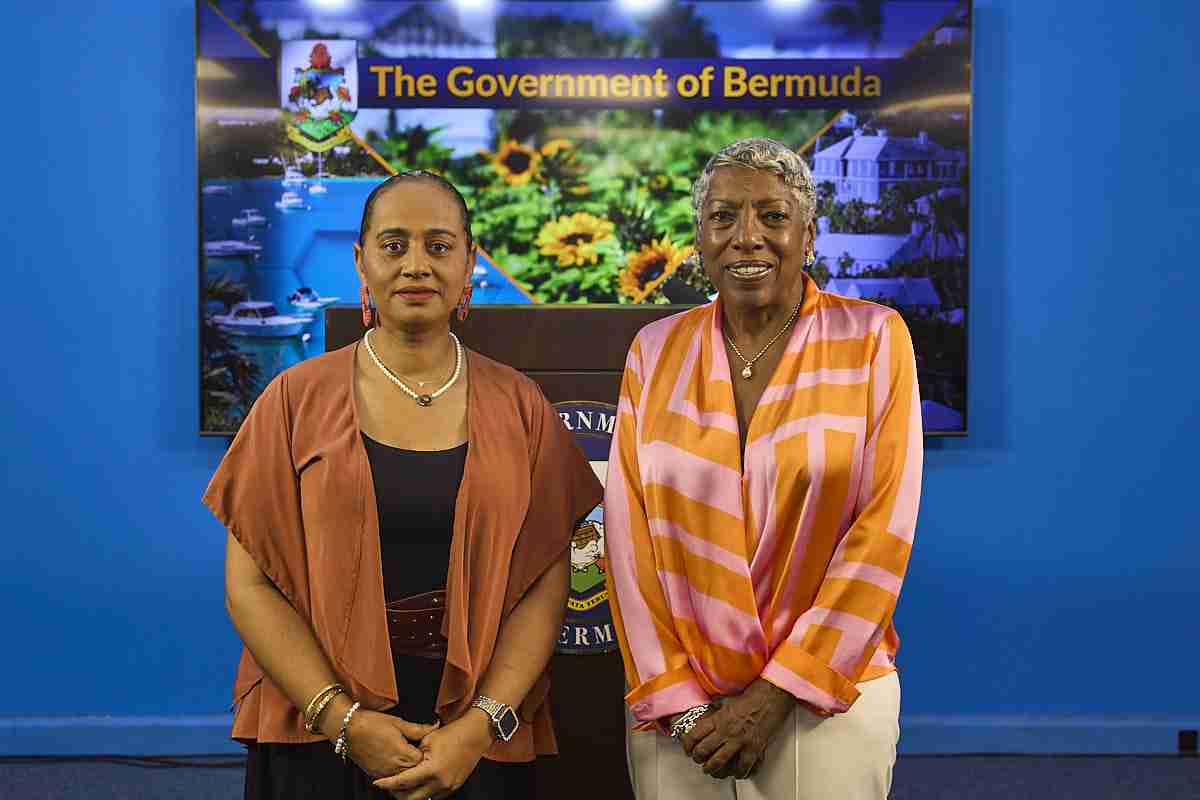
Remarks from The Hon. Tinee Furbert, JP, MP, Minister of Youth, Social Development and Seniors
Joint Press Conference with the Attorney-General and Minister of Justice, Sen. the Hon. Kim Wilkerson, JP
International Day for the Elimination of Violence Against Women
A National Domestic Abuse Prevention and Response Strategy 2026-2031
Good morning.
I am pleased to stand alongside my colleague, the Attorney-General and Minister of Justice, Senator the Hon. Kim Wilkerson, as we mark the International Day for the Elimination of Violence Against Women and Girls.
Our presence here together sends a clear message: this Government is united in its resolve to end violence against women and girls in Bermuda.
Today I am reminded of the children who have to pray themselves to sleep at night because they have witnessed domestic violence. Those children who tremble because they have witnessed rage. Those children who have witnessed shouting, fighting, kicking, choking, pulling of hair, punching or hitting and are left with horrible memories and heavy burdens.
November 25th marks the start of the 16 Days of Activism against Gender-Based Violence, which concludes on Human Rights Day, 10 December. This year’s global theme, “UNITE to End Violence Against Women and Girls: Ensure justice, protect survivors, end impunity,” speaks directly to this Government’s work. Strong laws matter, but laws alone will not end this violence. Survivors deserve safe ways to report abuse, support they can access when they need it most, and systems that respond effectively and hold those who cause harm to
account.
The available estimates of domestic violence paint a sobering picture, and every figure represents a real person in our community:
- In 2022, the Government commissioned SafeLives, an independent UK domestic abuse charity, to undertake a whole-system review of Bermuda’s response to domestic abuse. Its Bermuda: Public Health Approach Report (November 2022) estimated that around 27% of Bermuda’s female population, more than 7,000 women based on 2016 population data, have experienced intimate partner violence (IPV) in their lifetime.
- The report further estimated that more than 3,000 women had experienced intimate partner violence over a 12-month period.
- A 2026 community survey commissioned by SCARS Bermuda and conducted by KPMG found that 29% of its 1,010 adult respondents, close to one in three, disclosed experiencing sexual abuse before their 18th birthday, including nearly one in three females and nearly one in six males. 94% of survivors were abused by someone they knew. These findings are consistent with earlier research by SCARS, in partnership with the Bermuda Health Council, in 2017
- The Bermuda Police Service (BPS) recorded 704 domestic-related incidents in 2025 and has recorded 567 so far in 2026.
- In relation to enforcement of Domestic Violence Protection Orders (DVPOs), the BPS recorded 19 arrests in 2025 and 22 arrests in 2026.
Domestic abuse is not limited to women; in 2025/26, the Centre Against Abuse served 10 males, representing 5% of its caseload.
Domestic abuse also extends beyond physical or sexual violence to include psychological and financial abuse, coercive control, stalking and digital abuse, all of which can have devastating and long-lasting consequences.
- Children are also affected: in 2026, Child and Family Services received 119 new referrals to date for children exposed to domestic abuse.
- Of the 116 senior abuse reports received by Ageing and Disability Services this fiscal year, 53% are domestic-abuse-related, and nearly 80% of these involve abuse by non-intimate family members against an older person, often linked to mental health.
Let me be clear: domestic violence is not someone else’s problem, and it is not a distant one. It is happening here in Bermuda, in our homes, in our relationships, in our workplaces and, increasingly, online. Behind every case is a woman or a girl, a man, a boy, a family.
Today, I am pleased to share the Government’s strategy to Build Safer Communities Together: A National Domestic Abuse Prevention and Response Strategy 2026–2031. This Strategy builds on partnerships that are already making a difference in Bermuda; they are:
- The Multi-Agency Risk Assessment Conference, or MARAC, which brings agencies together to safeguard victims at high risk of serious harm.
- The Sexual Assault Response Team, or SART, coordinates the response to survivors of sexual assault, and work is advancing on an improved SART facility within the Department of Child and Family Services (DCFS).
- Domestic Abuse Perpetrator Services, delivered in partnership with Arius Solutions, challenge and support individuals who have used violence or control in intimate relationships to change their behaviour and aid in breaking the cycle of violence.
The Response Strategy outlines six commitments to the people of Bermuda:
- We will prevent abuse before it starts.
- We will spot the danger early and step in.
- We will offer survivors access to the help they need.
- We will hold abusers to account and challenge them to change.
- We will strengthen our laws and access to justice.
- We will encourage every agency to effectively collaborate.
Through this Strategy, and the government’s sustained investment in services to help survivors of domestic abuse, we will build a Bermuda where survivors are heard, protected and supported.
I am asking every resident to play their part: believe survivors when they come forward; speak up when you see controlling, abusive or disrespectful behaviour, whether online or offline; teach our young people what healthy and respectful relationships look like.
To the survivor of domestic abuse, don’t be embarrassed any more. Help is available and you are not alone. The Centre Against Abuse has a 24-hour helpline, 297-8278, and if it is an emergency, call 911.
It is now my pleasure to invite my colleague, the Attorney-General and Minister of Justice, Senator the Hon. Kim Wilkerson, to speak on the justice and legislative reform measures that form a key part of this work.
Remarks by Senator the Hon. Kim Wilkerson, JP, Attorney-General & Minister of Justice
International Day for the Elimination of Violence against Women
I am pleased to join my colleague, Minister Tinee Furbert, as Bermuda prepares to join the international community in recognising the International Day for the Elimination of Violence against Women tomorrow.
This occasion calls for us to examine how we ensure justice, protect survivors and end impunity.
As Minister of Justice, I am particularly concerned with the legal protections available to victims, the accountability of perpetrators and the ability of our justice system to respond effectively.
Violence against women takes many forms. It includes sexual assault, harassment, intimidation, threats and other forms of abuse that can
restrict the freedom, safety and dignity of women and girls.
One setting that deserves particular attention is the home, where domestic abuse continues to affect far too many families.
Domestic abuse is not exclusively experienced by women. Men can also be victims, and our laws must protect every individual who experiences abuse.
However, violence against women within intimate and family relationships remains a significant concern, making domestic abuse an important part of today’s wider discussion.
Within the Ministry of Justice, we are pursuing several initiatives to improve how our laws and courts respond to these circumstances.
An important development is the Domestic Violence Court Programme, which is now operating within our Magistrates’ Court.
The objective is to ensure that domestic abuse matters receive focused attention, urgent cases are prioritised and victims can access legal protection without unnecessary delays.
While some supporting systems remain under development, this programme represents meaningful progress.
Another major priority is the development of a comprehensive Domestic Abuse Act.
This proposed legislation is intended to address gaps in our existing laws and provide clearer, more comprehensive protection for victims.
For example, we are examining how the law can better recognise coercive control and financial abuse, where an individual may be subjected to intimidation, isolation or financial restrictions without necessarily experiencing physical violence.
Most importantly, we are pursuing legislative changes to recognise children who witness domestic abuse as victims in their own right.
A child who repeatedly witnesses a parent being threatened or assaulted can experience serious emotional and psychological harm, even without being physically assaulted themselves.
We are also reviewing sentencing guidelines to ensure that courts have clear and consistent approaches which reflect the seriousness of
the offending, the risks to victims and the need for accountability.
Another initiative involves the testing and procurement of electronic monitoring devices specifically for domestic abuse cases, alongside a review of the laws and policies governing their use.
These measures are being examined as additional safeguards, particularly where there is a risk of further harm.
Access to justice is another important priority.
The Ministry is reviewing barriers involving legal costs, delays and evidentiary requirements that can make it difficult for survivors to seek
protection or participate in court proceedings.
This work will inform policy proposals aimed at making our justice processes more accessible, timely and sensitive to the experiences of victims.
I should emphasise that several of these reforms remain under development. There is further policy work, consultation and legislative
drafting to be undertaken.
Nevertheless, the direction is clear. We are working towards a justice system that recognises abuse in all its forms, provides meaningful
protection for victims and holds perpetrators accountable.
Ultimately, as Bermuda approaches this International Day, our progress must be measured by whether women and girls are safer,
whether those experiencing violence can access justice and whether our institutions are responding as they should.
This is the work that we are committed to advancing.
Thank you.