An estimated 4.4 million people face crisis-level food insecurity, with nearly one million of them experiencing severe hunger, due to the impact of failed rainy seasons, conflict and declining humanitarian funding
International News via Reuters:
The U.N. World Food Programme said on Friday its life-saving food and nutrition assistance in Somalia could grind to a halt by April unless new funding is secured, putting millions of people at risk of worsening hunger.
An estimated 4.4 million people face crisis-level food insecurity, with nearly one million of them experiencing severe hunger, due to the impact of failed rainy seasons, conflict and declining humanitarian funding, the WFP said.
“The situation is deteriorating at an alarming rate,” Ross Smith, WFP director of emergency preparedness and response, said in a statement.
“Families have lost everything, and many are already being pushed to the brink. Without immediate emergency food support, conditions will worsen quickly,” Smith said.
Somalia declared a national drought emergency in November after recurrent seasons of poor rainfall, and other countries in the region have also been hit.
The WFP, the largest humanitarian agency in Somalia, said it has already scaled back assistance from 2.2 million people earlier this year to just over 600,000 due to funding shortages. Nutrition programmes for pregnant and breastfeeding women and young children have also been sharply reduced.
The agency said it faces a critical moment similar to a crisis in 2022, when famine was narrowly averted following large-scale international support. It is seeking $95 million to sustain operations between March and August.
“If our already reduced assistance ends, the humanitarian, security, and economic consequences will be devastating, with the effects felt far beyond Somalia’s borders,” Smith said.
Reporting by Olivia Le Poidevinand Kirsti Knolle;Editing by Linda Pasquini and Helen Popper
Lagarde’s status as leader of Europe’s most important financial institution was plunged into doubt this week after the Financial Times reported she planned to leave her job ahead of next spring’s French presidential election
International News via Reuters:
European Central Bank President Christine Lagarde has attempted to calm speculation about her stepping down early that has called into question the central bank’s separation from politics, telling the Wall Street Journal she expects to complete her term.
Lagarde’s status as leader of Europe’s most important financial institution was plunged into doubt this week after the Financial Times reported she planned to leave her job ahead of next spring’s French presidential election, giving outgoing leader Emmanuel Macron a say in picking her successor.
In an interview with the WSJ on Thursday, Lagarde dampened speculation about an imminent exit but still left the door slightly ajar to the possibility that she might leave before the end of her contract in October 2027.
“When I look back at all these years, I think that we have accomplished a lot, that I have accomplished a lot,” she told the paper. “We need to consolidate and make sure that this is really solid and reliable. So my baseline is that it will take until the end of my term.”
CENTRAL BANKS EMBROILED IN “HIGH POLITICS”
Reuters exclusively reported that Lagarde had sent a private message to fellow policymakers reassuring them that she was still concentrating on her job and that they would hear it from her, rather than the press, if she wanted to step down.
The ECB has said that Lagarde has not made a decision about the end of her term, but stopped short of denying the FT report.
Some analysts thought an early exit risked tangling the ECB up in European politics as it could give the impression of trying to make sure France’s eurosceptic far right, which could win next year’s presidential vote, had no say in her succession.
Lagarde said last year she intended to complete her term, a commitment she has conspicuously failed to repeat this week.
Bank of France Governor Francois Villeroy de Galhau announced plans to step down from his job last week, in a move that gives President Macron a chance to pick the next French central bank chief, drawing sharp criticism from the far-right who called the move anti-democratic.
Villeroy’s early departure and the confusion about Lagarde’s future come just as U.S. President Donald Trump is attacking the Federal Reserve, further stoking debates about central bank independence from politics.
“After the recent events in the U.S., this is another reminder that although central banks are nominally independent, who leads them and their worldview is a matter for high politics,” economists at Oxford Economics wrote on Friday.
As the head of the euro zone’s second largest economy, the French president plays an important role in wider negotiations to select the head of the ECB.
Polls show either far-right National Rally leader Marine Le Pen, or her protege Jordan Bardella, could win the French presidency.
While the party has long dropped a call for France to leave the euro, it is still seen as something of an unknown quantity in central banking circles.
Lagarde told the WSJ that she viewed her mission as price and financial stability, as well as “protecting the euro, making sure that it is solid and strong and fit for the future of Europe.”
She also said that the World Economic Forum was “one of the many options” she was considering once she left the central bank.
When Lagarde’s name first emerged as a possible candidate for ECB president in 2019, she said she had no interest in the job and would not leave the International Monetary Fund, where she was the managing director.
Reporting by Abu Sultan in Bengaluru and Francesco Canepa in Frankfurt; Editing by Kim Coghill, Kate Mayberry and Toby Chopra
Air Liquide, which supplies gases including oxygen, nitrogen and hydrogen to factories and hospitals, confirmed its 2026 target of a 100-basis-point increase in operating profit margin
International News via Reuters:
French industrial gases group Air Liquide said on Friday it sees a gradual improvement in Europe and said U.S. President Donald Trump’s move to cancel billions in federal clean‑energy funding will not affect its mid‑term activity.
“There are probably a few more reasons to be optimistic than a year ago, because we’re seeing some early stirrings in certain industries,” CEO François Jackow told reporters.
Air Liquide, which supplies gases including oxygen, nitrogen and hydrogen to factories and hospitals, confirmed its 2026 target of a 100-basis-point increase in operating profit margin and said it expects a similar rise in 2027, bringing the cumulative improvement to 560 basis points over 2022–2027 after previously providing targets only through 2026.
Industrial gases continue to look relatively resilient compared with the broader European chemicals sector, as the European Union’s chemical competitiveness remains under pressure from weak demand and high energy costs.
“There is no impact on our medium-term activity, but overall these projects are on pause, with a few exceptions we’re still working on,” CEO François Jackow said on the U.S. clean-energy grant cancellations.
Air Liquide reported slightly higher than expected recurring operating income of 5.58 billion euros ($6.56 billion) for 2025, while analysts polled by Vara Research were expecting 5.56 billion euros on average. That translated to an operating margin of 20.7%.
Shares in the company rose 3.5% by 1101 GMT, as J.P. Morgan analysts called the update reassuring and Jefferies highlighted a higher than expected annual dividend.
Rival Linde’s annual results still reflected soft volumes in the EMEA region, underscoring the European weakness.
Air Liquide said it would propose a dividend of 3.70 euros per share, up 12.1% from a year ago.
($1 = 0.8508 euros)
Reporting by Olivier Cherfan, editing by Milla Nissi-Prussak and Matt Scuffham
The HCOB Flash Eurozone Composite PMI, compiled by S&P Global and released on Friday, rose to 51.9 in February from 51.3 in January
International News via Reuters:
Euro zone business activity accelerated faster than forecast this month as manufacturing swung back to growth for the first time since October, though the dominant services sector marginally underperformed expectations, a survey showed.
The HCOB Flash Eurozone Composite PMI, compiled by S&P Global and released on Friday, rose to 51.9 in February from 51.3 in January, marking the 14th consecutive month of expansion and exceeding expectations in a Reuters poll of a more modest rise to 51.5.
PMI readings above 50.0 indicate growth in activity with those below reflecting contraction.
The headline manufacturing PMI jumped to 50.8 from 49.5 while the output index, which feeds into the composite reading, bounced to a six-month high of 52.1 from 50.5.
February’s rebound was driven by a resurgence in demand with the factory new orders index climbing to 50.9 from 49.2.
GERMANY LEADS EURO ZONE GROWTH, UK REBOUNDING
In Germany, Europe’s largest economy, business activity hit a four-month high, although in France the private sector showed little sign of growth amid weak demand, their PMIs showed.
“February’s flash PMIs support the view that activity in the euro zone economy is growing at a reasonable pace, led by a pick-up in Germany,” said Andrew Kenningham at Capital Economics.
“While the relationship between the Composite PMI and GDP growth in the euro zone has been weak over the past three years, this suggests at face value that the economy is continuing to expand at a moderate pace,” he added.
Services activity in the common currency area showed a modest improvement with the PMI nudging up to 51.8 from 51.6. The Reuters poll had predicted a slightly bigger uptick to 51.9.
Overall pricing pressures nudged up. But firms increased charges at a more modest pace, giving scant reason to revise expectations that the European Central Bank will hold interest rates steady for at least the rest of this year.
Meanwhile, Britain, outside the euro zone and the European Union, saw businesses extend their early 2026 rebound into a second month, its PMI showed.
British retail sales volumes rose in January at the fastest annual pace in nearly four years, according to official data, suggesting consumers are now happier to spend after a weak end to 2025 for the economy.
Reporting by Jonathan Cable; Editing by Joe Bavier
The former prince was released under investigation after being held by police for more than 10 hours
International News via Reuters:
British police were searching the former mansion of King Charles’ younger brother Andrew Mountbatten-Windsor on Friday after a photograph of the royal emerging from a police station was splashed on newspapers around the world.
Mountbatten-Windsor was arrested on Thursday, his 66th birthday, on suspicion of misconduct in public office over allegations he sent confidential government documents to disgraced financier Jeffrey Epstein when he was a trade envoy.
The former prince was released under investigation after being held by police for more than 10 hours. He has not been charged with any offence but looked haunted in a Reuters photograph after his release, slumped in the back of a Range Rover, eyes red and with a look of disbelief on his face.
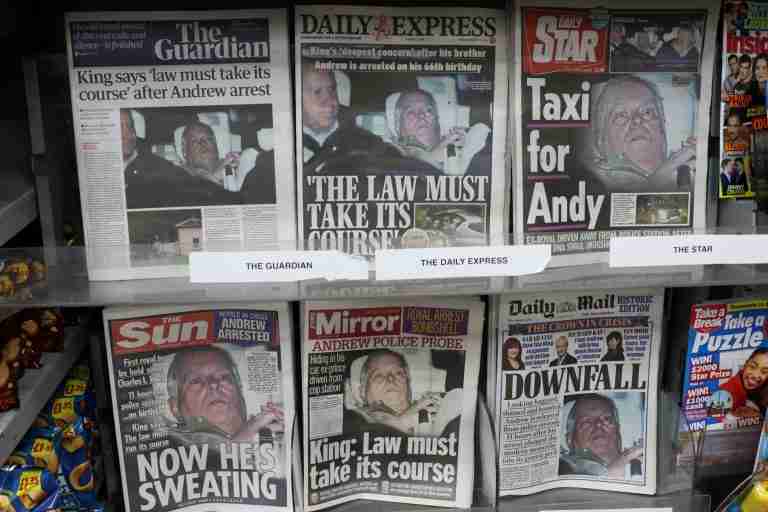
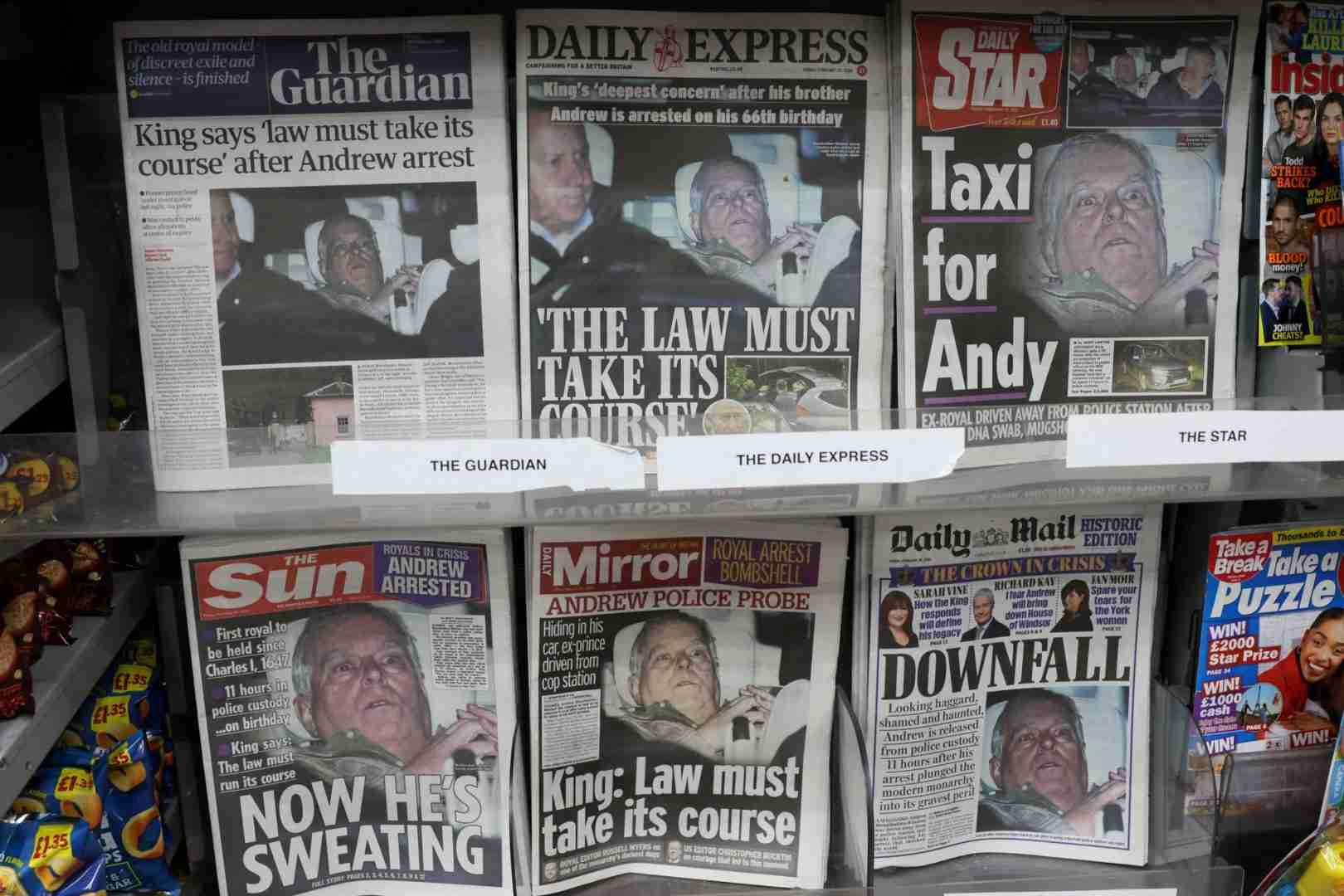
The photograph of a man who was once a dashing naval officer and reputed favourite son of the late Queen Elizabeth was carried on the front page of newspapers in Britain and around the world, accompanied by headlines such as “Downfall”.
Mountbatten-Windsor has always denied any wrongdoing in relation to Epstein, a convicted sex offender who took his own life in 2019, and said he regrets their friendship. But the release of millions of documents by the U.S. government showed he had remained friends with Epstein long after the financier was convicted of soliciting prostitution from a minor in 2008.
Those files suggested Mountbatten-Windsor had forwarded to Epstein British government reports about investment opportunities in Afghanistan and assessments of Vietnam, Singapore and other places he had visited as the government’s Special Representative for Trade and Investment.
KING SAYS THE LAW MUST TAKE ITS COURSE
The arrest of the senior royal, eighth in line to the throne, is unprecedented in modern times. The last member of the royal family to be arrested in Britain was Charles I, who was beheaded in 1649 after being found guilty of treason.
King Charles, who stripped his brother of his title of prince and forced him out of his Windsor home last year, said on Thursday he had learned about the arrest with “deepest concern”.
“Let me state clearly: the law must take its course,” the king said. “What now follows is the full, fair and proper process by which this issue is investigated in the appropriate manner and by the appropriate authorities.”
The news broke early on Thursday morning that six unmarked police cars and around eight plain-clothed officers had arrived at Wood Farm on the king’s Sandringham estate in Norfolk, eastern England, where Mountbatten-Windsor now resides.
Thames Valley Police officers also searched the mansion on the king’s Windsor estate west of London where Mountbatten-Windsor had lived before being forced out amid anger at the Epstein revelations.
Officers said late on Thursday that the royal had been released under investigation. They said the searches at Sandringham had concluded but the searches in Windsor were continuing.
While being arrested means that police have reasonable suspicion that a crime has been committed and that the royal is suspected of involvement in an offence, it does not imply guilt.
A conviction for misconduct in a public office carries a maximum sentence of life imprisonment, and cases must be dealt with in a Crown Court, which handle the most serious criminal offences.
Reporting by Phil Noble in Sandringham and Kate Holton and Michael Holden in London Editing by Gareth Jones
The war in Ukraine has shown how autonomous interceptor drones can provide an effective alternative to costly air-defence missiles, and Kyiv’s European allies are keen to learn from its experience
International News via Reuters:
Europe’s five biggest defence powers are set to announce a plan to invest in military drones, as part of wider efforts to boost the defence industry in the face of Russia’s invasion of Ukraine and concerns about the U.S. commitment to NATO.
According to a document seen by Reuters, and a Polish defence ministry source, the five aim to cooperate in developing autonomous drones.
The war in Ukraine has shown how autonomous interceptor drones can provide an effective alternative to costly air-defence missiles, and Kyiv’s European allies are keen to learn from its experience.
The European Group of Five Defence Ministers, which meets in Krakow, Poland on Friday, brings together the continent’s biggest military spenders – France, Germany, Italy, Poland and Britain.
They are meeting as European leaders work to boost defence capabilities amid increased European doubts about Washington’s commitment to protect the continent through the NATO alliance.
The statement seen by Reuters – still subject to change – said ministers “support a real increase in the production capacity of the European defence industrial base” and “welcome the EU’s commitment to providing Member states with increased fiscal flexibility for defence spending and to create lending instruments”.
However, it says that the EU’s role is to support defence capabilities which remain at the national level.
The ministers also pledge to work together within NATO and the EU to counter Russian hybrid threats, and to continue supporting Ukraine and efforts to find peace, the statement said.
“We agree to launch the Low-Cost Effectors and Autonomous Platforms (LEAP) initiative,” the statement seen by Reuters said. It said the aim was “to increase our cooperation on the development and procurement of low-cost effectors and autonomous platforms to deliver military effect.”
In military terminology, “effectors” are the components of a system which produce a physical effect, while “autonomous platforms” are unmanned systems capable of independent decision-making.
Reporting by Barbara Erling in Krakow and Lili Bayer in Brussels: Writing by Alan Charlish; Editing by David Holmes
The S&P Global UK Composite Purchasing Managers’ Index rose to 53.9 in a preliminary report for February from 53.7 in January
International News via Reuters:
British businesses have extended their early 2026 rebound into a second month, but jobs are still being sharply cut among services firms partly as a result of higher taxes imposed on them by the Labour government, a survey showed on Friday.
The S&P Global UK Composite Purchasing Managers’ Index rose to 53.9 in a preliminary report for February from 53.7 in January, the highest level since April 2024, before Prime Minister Keir Starmer’s government took office.
“The early PMI data for February bring further signs of an encouraging start to the year for the UK economy,” said Chris Williamson, S&P Global chief business economist.
PMI readings above 50.0 indicate growth in activity, while those below that level point to a contraction.
The surveys for January and February – which echoed other signs of a pickup among businesses and consumers after uncertainty in the run-up to finance minister Rachel Reeves’ budget in late November – were consistent with economic growth of about 0.3% in the first quarter of 2026, Williamson said.
That would be stronger than an expansion of just 0.1% in the last quarter of 2025.
“Bank of England policymakers will be encouraged by the indications of stronger economic growth,” Williamson said. “But the relatively modest price pressures being signalled and ongoing worrying labour market weakness will likely result in a growing call for further rate cuts.”
Investors are largely expecting the BoE to resume its cuts to borrowing costs in March as the central bank takes comfort from signs of slowing inflation and shifts its focus towards weakness in the jobs market.
Prices charged by businesses rose at the fastest pace since last April but their cost burdens, while still high, increased at the slowest pace in three months.
Staffing levels fell particularly sharply among services firms with some companies reporting redundancies or hiring freezes as employers faced higher social security payments which were introduced by Reeves in April 2025.
Some firms said they were investing in technology to grow without additional recruitment.
The PMI for the services sector edged down to 53.9 from 54.0 in January, while the survey for the smaller manufacturing sector hit an 18-month high of 52.0, up from 51.8.
Total new work increased at the strongest pace since September 2024 with the rise in new work for manufacturers from abroad at its fastest pace in four-and-a-half years.
Writing by William Schomberg; Editing by Joe Bavier
The dollar index, which measures the greenback against a basket of currencies, nudged slightly higher on Friday and was last set for a weekly rise of about 1.1%
International News via Reuters:
The dollar was on track for its largest weekly gain since October on Friday, buoyed by a run of better-than-expected economic data and a more hawkish Federal Reserve outlook, as tensions rose between the U.S. and Iran.
The dollar index, which measures the greenback against a basket of currencies, nudged slightly higher on Friday and was last set for a weekly rise of about 1.1% .
Jobs data lifted the dollar in the previous session, with the number of Americans filing new applications for unemployment benefits falling more than expected last week – underscoring labour market stability.
Earlier in the week, minutes from the Fed’s most recent meeting showed policymakers were divided on the outlook for rates, given the persistence of inflation.
“(Between) relatively solid data and a slightly less dovish Fed in terms of the minutes, some of this tension in the Middle East and … a little bit of a positioning lining up, you can sort of see why the dollar’s managed to bounce,” said Dominic Bunning, head of G10 FX strategy at Nomura.
Investors often buy dollars when geopolitical tensions escalate.
MARKETS ‘POSITIONING FOR RISK’
U.S. President Donald Trump warned Iran on Thursday it must make a deal over its nuclear programme or “really bad things” would happen, and set Tehran a deadline of 10 to 15 days to cooperate. Iran said it would retaliate against U.S. bases in the region if attacked.
“Given the build-up of military presence in the Middle East and the comments from Trump, I think markets will certainly be positioning for the risk of something happening over the weekend,” said Derek Halpenny, MUFG’s head of research – global markets EMEA.
A jump in crude oil prices could leave various currencies, including the euro, Japanese yen and British pound vulnerable, Halpenny said.
“Those are the currencies where you could get some bigger moves,” he added.
Sterling last languished near a one-month low at $1.3455 and was heading for a weekly drop of 1.4%, its biggest since January 2025.
The euro was down 0.1% at $1.1760 and set to lose nearly 0.9% for the week, with the common currency also weighed down by uncertainty over European Central Bank President Christine Lagarde’s tenure.
RATES, RATES, RATES
Markets on Friday also awaited the release of the U.S. core PCE price index and advance fourth quarter GDP figures later in the day, which could drive the next move in currencies.
Investors continue to price in roughly two Fed rate cuts this year, though expectations for such a move in June have dipped to a roughly 58% chance from 62% a week ago, according to the CME FedWatch tool.
“The big argument within the Fed is whether or not to proactively lower rates to support the job market, or to keep rates higher for longer in order to fight inflation,” said Chris Zaccarelli, chief investment officer for Northlight Asset Management.
Friday’s PCE report will “add to the debate”, Zaccarelli added.
In Japan, data on Friday showed the country’s annual core consumer inflation hit 2.0% in January, the slowest pace in two years.
“Today’s data won’t exactly instil a sense of urgency in the (Bank of Japan) to resume its tightening cycle, especially given the lacklustre rebound in activity last quarter,” said Abhijit Surya, senior APAC economist at Capital Economics.
The yen fell more than 0.4% and was last at 155.53 per dollar.
The currency hardly reacted to a speech on Friday by Japanese Prime Minister Sanae Takaichi, who underlined her administration’s commitment to revitalising the economy.
Elsewhere, the New Zealand dollar headed for a weekly fall of 1.3%, affected by a dovish outlook on rates from the Reserve Bank of New Zealand.
Reporting by Sophie Kiderlin and Rae Wee;Editing by Shri Navaratnam, Kate Mayberry and Helen Popper
Pickleball: The open elite team national squad has been announced for next month’s Championships at the W.E.R. Joell Tennis Stadium
The countdown is on for the 2026 Caribbean Pickleball Championships — and this time, Bermuda will defend its crown on home soil.
After lifting the inaugural title in Cayman last year, the pressure is now on the hosts to repeat. With a familiar core, some key changes, and regional rivals closing in, expectations are high.
The 2026 Caribbean Pickleball Championships will be held March 16th-21st at the W.E.R. Joell Tennis Stadium.
At the Fairmont Southampton construction site, material covered in plastic sheeting and asbestos warning labels has become a source of concern
Concerns have been raised over asbestos storage at the Fairmont Southampton Construction site.
Mounds of material sit covered in plastic sheeting at the lot just below the Boundary sports bar and grille, and can be seen through the trees by anyone heading up Harbour View Drive en route to the golf course.
A warning label for asbestos can be seen on the plastic sheeting, and a sign at the entrance to the lot also has ‘Asbestos! Beware’ scribbled in marker pen.
Whether the concerns that reached out newsroom have any validity depends on how the asbestos has been removed and stored.
We understand that material has been stored at the site since at least mid-December.
Images shared with Bermuda Broadcasting (included in the report above) indicate that there are bags under the plastic sheets that have asbestos warning labels, and that they have been uncovered at times.
In an effort to assuage the concerns of nearby residents or sports club users, we have reached out to both Fairmont Southampton and Environmental Health to find out if inspections have been performed at the site – and if all passed.
An M.O.U. should ensure Bermudians claim 50% of Fairmont Southampton jobs upon reopening – but it could cause turbulence for hospitality employers
Half of the Fairmont Southampton Hotel’s staff must be Bermudian when it’s doors reopen…that’s the agreement Government is set to sign with the iconic resort.
…but the total impact on the local jobs market could exceed, or possibly fail to reach, any thresholds set by Government.
It is also likely to create some disturbance among employers.
As already reported, the hotel’s reopening comes at a time when our unemployment rate is low, potentially creating competition between hospitality employers to secure local talent… or even to lure Bermudians back home from overseas.
Furthermore, Fairmont Southampton is already looking to outsource certain services and – outside of statutory Immigration requirements – those external partners will not be subject to the hotel owners’ obligations regarding the proportion of Bermudian staff.
This is also the case regarding a future tax rebate promised to this and another hotel, in exchange for employing Bermudians.
This week, Gary Foster Skelton spoke this week with Labour and Economy Minister Jason Hayward about the opportunities at the Fairmont Southampton.
To provide the best experiences, we use technologies like cookies to store and/or access device information. Consenting to these technologies will allow us to process data such as browsing behavior or unique IDs on this site. Not consenting or withdrawing consent, may adversely affect certain features and functions.
Functional
Always active
The technical storage or access is strictly necessary for the legitimate purpose of enabling the use of a specific service explicitly requested by the subscriber or user, or for the sole purpose of carrying out the transmission of a communication over an electronic communications network.
Preferences
The technical storage or access is necessary for the legitimate purpose of storing preferences that are not requested by the subscriber or user.
Statistics
The technical storage or access that is used exclusively for statistical purposes.The technical storage or access that is used exclusively for anonymous statistical purposes. Without a subpoena, voluntary compliance on the part of your Internet Service Provider, or additional records from a third party, information stored or retrieved for this purpose alone cannot usually be used to identify you.
Marketing
The technical storage or access is required to create user profiles to send advertising, or to track the user on a website or across several websites for similar marketing purposes.