Young runner Naomi MacGuinness stormed to victory in the 2025 MAAC Partner Re Women’s 5k, securing the championship title with a decisive finish in 19 minutes and 23 seconds.
MacGuinness finished 20 seconds clear of the competition in the highly anticipated all-female race, signalling her arrival as a major force in senior distance running.
The competition for the podium spots was fierce among the island’s best:
Teresa Ruiz secured second place overall, clocking a time of 19:43.
Veteran runner Christine Dailey rounded out the podium, finishing third in 20:50.
Just outside the medal positions, perennial contender Rose-Anna Hoey crossed the line fourth, recording 20:53, followed by Stepanka Sprincova in fifth place at 20:58.
MacGuinness’s sub-20 minute time and commanding victory over an experienced field mark a significant step in her running career.
Statement by Senator Mischa Fubler, PLP candidate for Constituency #30, Southampton East Central
The One Bermuda Alliance has once again proven that what they say and what they do are often at odds with one another.
As is my custom, I listen to the House of Assembly in preparation for our debate in the Senate and welcomed the Shadow Minister of Tourism & Transport, Culture & Sport, Dwayne Robinson’s, explicit support of the Loren (Pink Beach and Elbow Beach) 2025 bill:
“…how important [the passing of the bill] will be to our tourism product and is certainly in the national interest to see this property supported and to see the jobs and the growth of our industry to be supported in this bill.”
The opposition leader in the senate, Victoria Cunningham, then also voiced their support as we opened debate on Monday afternoon:
“The OBA strongly believes that we need a vibrant tourism sector and that it’s central to our long-term economic success….ultimately it’s not just about visitors, it’s about jobs for Bermudians…We welcome any legislative measures that enable us to move things forward.”
So imagine my bemusement when they waited until the 3rd and final reading of the bill to vote “nay” down the line. No objection to the 2nd reading, no objection to skipping committee, (which would have provided the opportunity to debate the finer details of the bill.) and still, all three elected to demonstrate by their actions that while they may say they believe that getting the Elbow Beach hotel up and running again is in the national interest, they are willing to jeopardize that progress in favour of political shenanigans.
Let’s be clear.
This legislation is about bringing jobs, investment, and life back to a hotel that’s been closed for half a decade. It’s about attracting investment, boosting tourism, and creating opportunities for Bermudians. Simply put, and in the OBA’s own words, the passing of this bill is in Bermuda’s economic interest and while it is disappointing, it is unfortunately unsurprising that OBA Senators Cunningham, D. Smith, and T. Smith have yet again chosen political games over progress for Bermuda.
Where does the newly appointed OBA Leader, Robert King, and the Shadow Tourism Minister, Dwayne Robinson stand on this difference of opinion within their caucus?
While the OBA plays political games, the Progressive Labour Party remains focused on delivering real results for Bermudians, attracting investment, creating jobs, and building a stronger, fairer Bermuda for all of us. The PLP Senate team proudly joined the President of the Senate in voting to advance Bermuda’s Tourism Recovery. Hopefully the OBA Senators pause for some introspection over the Fall legislative break and adopt a new approach to holding us to account when we return…. One that puts aside petty politics and centres the best interests of Bermudians.
Bermudian coaches and players had a highly successful week across England and the United States, marked by crucial league victories and FA Cup progress.
WSL and USL coaching wins
Shaun Goater, Assistant Coach for Aston Villa Women, celebrated a key 2-0 WSL victory over West Ham at the Emirates Stadium. After a goalless first half, Villa broke the deadlock with a spectacular strike from Kirsty Hanson, securing the win.
Across the Atlantic, Manager Khano Smith guided Rhode Island FC to a convincing 3-1 win over Las Vegas Lights FC in the USL Championship.
Women’s cup dominance
K’Shaela Burch-Waldron starred for Sutton United Women in the Adobe Women’s FA Cup, scoring two goals—including the winner—in a 5-2 victory.
Camryn Lines’s Bridgwater United Women FC advanced with a dominant 8-1 win, while Jahni Simmons’s Coventry Sphinx Ladies also progressed with a 5-1 victory.
Aaliyah Nolan and her Bradford City Women’s team maintained their unbeaten run, winning 3-0.
NWSL and cup heartbreak
NWSL: Leilanni Nesbeth’s Chicago Stars FC staged a spirited 2-2 comeback draw, while Mia Fishel’s Seattle Reign FC drew 0-0 to stay fifth.
Cup Exit: Goalkeeper coach Dashun Cooper’s QPR Women bowed out of the FA Cup, losing 4-1 on penalties after a 1-1 draw.
Fire Safety Awareness Week puts focus on the hazards of lithium-ion batteries
Government press release”
The Bermuda Fire & Rescue Service (BFRS) will observe Fire Safety Awareness Week from 6–11 October 2025, highlighting the growing risks of lithium-ion battery fires and providing the community with practical fire prevention advice.
Minister of National Security, the Hon. Michael Weeks, JP, MP, said: “Fire prevention starts at home.
“Every household should make safety a daily habit, whether it is checking your smoke alarms, charging devices responsibly, or simply talking with family about what to do in an emergency. A few moments of preparation can save lives.”
Minister Weeks continued: “This year we are particularly mindful of the risks that lithium-ion batteries bring. They are part of our everyday lives, but when handled incorrectly, they can be dangerous.
“I encourage the public to take advantage of the advice being shared this week to protect themselves and their loved ones.”
Details relating to the safe disposal of lithium-ion batteries at the Tynes Bay public drop-off will be released to the public at a later date.
The public is encouraged to show their support for Fire Safety Awareness Week by lining the streets of Hamilton at 11:45 a.m. on Monday.
A convoy of fire vehicles will depart the Hamilton Fire Station and make its way through the city, travelling along Reid Street, then Queen Street, before heading down Church Street and returning to the station.
The BFRS is working in coordination with the National Fire Protection Association®️ (NFPA®️), which has launched a new campaign, “Charge into Fire Safety”, in response to the increasing number of fires caused by lithium-ion batteries.
These batteries are found in micromobility devices such as e-bikes and e-scooters, smaller electronics such as cell phones and laptops, and electric vehicles. As the use of these items has increased in recent years, so too has the number of related fires.
“The BFRS encourages residents to learn more about the hazards of lithium-ion batteries,” said Jamal Albuoy, Divisional Officer of Fire Prevention Division at the BFRS.
“By better understanding how lithium-ion battery fires start, people can take the necessary steps to minimise associated risks and safely use their electronics and other devices powered by these batteries.”
Lorraine Carli, vice president of Outreach and Advocacy at NFPA, commented: “Lithium-ion batteries are increasingly found in the many devices and systems we use every day.
“With this greater use, however, we are seeing an uptick in related fires, prompting people to contact us frequently with questions about battery safety.
“In response, NFPA created the ‘Charge into Fire Safety’ campaign with information that helps answer these questions clearly and thoroughly, in one easy-to-find location.”
The NFPA and BFRS recommend these tips when buying, charging, storing, and using lithium-ion batteries to help prevent fires:
Only purchase and use devices, batteries, and charging equipment listed by a nationally recognised testing lab and labelled accordingly.
Use charging equipment that is only compatible with your device. To be safe, use only the charging equipment supplied with your device.
Do not keep charging the device or battery after fully charging.
Do not put lithium-ion batteries in the trash. Recycling is always the best option. Take the batteries to a battery recycling location or contact your local waste department for disposal instructions.
Stop using your device if the battery shows signs of damage, such as an unusual odour, excessive heat, popping sounds, swelling, or a change in colour.
Only have device repairs performed by a qualified professional.
The blue-chip index briefly crossed 9,500 for the first time on Monday, its fifth consecutive session of record highs, before reversing course
International News via Reuters:
London’s benchmark FTSE 100 slipped on Monday as investors took a breather after last week’s rally that pushed the index to record highs, while declines in shares of packaging company Mondi after its quarterly results also weighed.
The blue-chip index briefly crossed 9,500 for the first time on Monday, its fifth consecutive session of record highs, before reversing course. It was last down 0.1% at 9,482.86 points.
The industrials sector fell 3.9%. Mondi slumped 15.4%, hitting a 12-year low, after the packaging company said growth in its core profit slowed for the third-quarter on weak demand and lower prices.
Investors across the UK and European Union were also spooked by the unexpected resignation of France’s new prime minister Sebastian Lecornu and his government on Monday, hours after he announced his cabinet line-up. This made the government the shortest-lived in modern French history.
British banks lost 0.6%.
“The fact that the French Prime Minister has resigned adds to concerns around political and fiscal stability and more broadly in the UK and Europe,” said Fiona Cincotta, senior market analyst at City Index.
“We often see the nerves surrounding the fiscal outlook reflected in banking stocks.”
Meanwhile, Citigroup double downgraded UK equities to “underweight” from “overweight. It said that the market’s exposure to defensive sectors such as consumer staples and utilities made it less attractive in an environment increasingly favouring cyclical and growth-oriented plays.
On the flip side, energy stocks gained 1.4%, tracking a rise in crude prices.
Healthcare stocks were up 0.1%. The sector had boosted the FTSE 100 last week, logging their best weekly showing since October 2008. The beaten-down sector saw investor interest after a deal between U.S. administration and drug giant Pfizer reduced some uncertainty around the sector.
Among other stocks, Aston Martin declined 6.5% after the luxury carmaker warned of a deepening annual loss due to weaker-than-expected demand in North America and Asia Pacific and the impact of U.S. tariffs.
It weighed heavily on the mid-cap index that shed 0.4% on Monday after logging its biggest weekly gain in two months on Friday.
Reporting by Purvi Agarwal in Bengaluru; Editing by Leroy Leo
The swift, unexpected resignation came after allies and foes alike threatened to topple the new government
International News via Reuters:
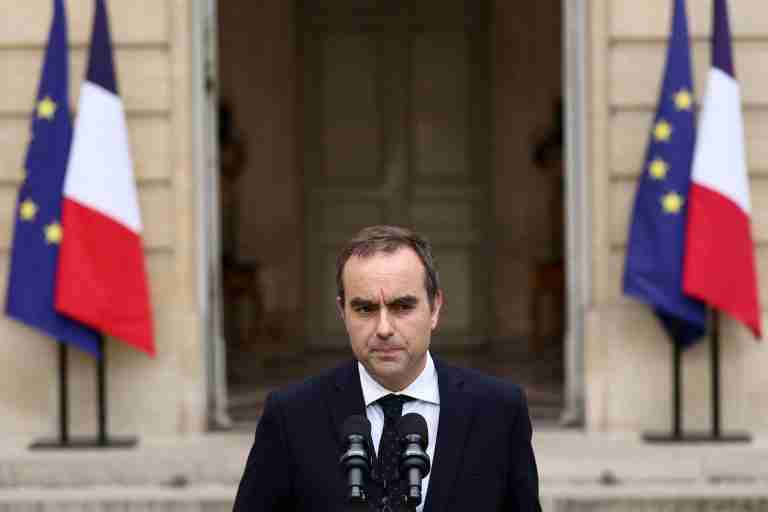
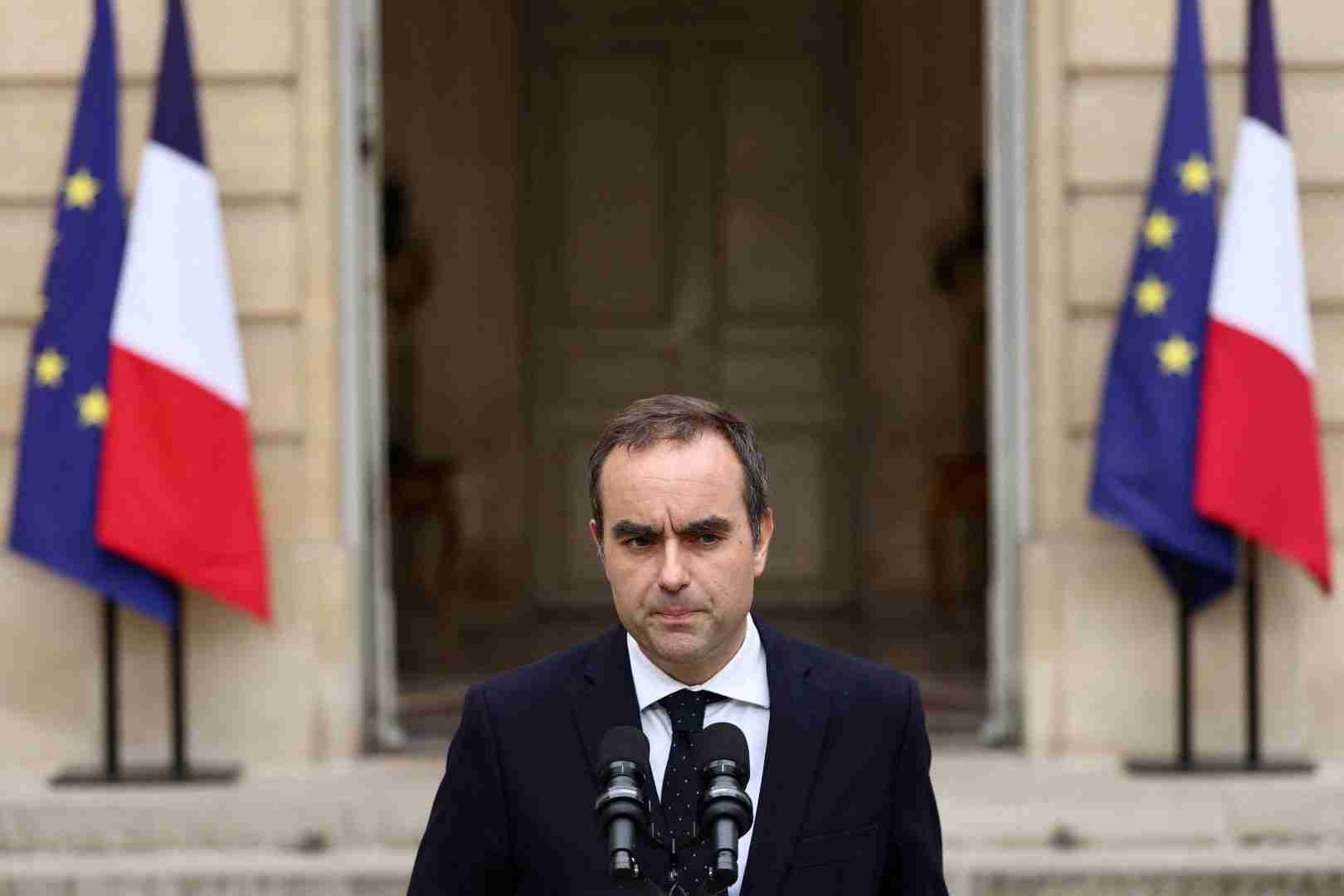
France’s new Prime Minister Sebastien Lecornu and his government resigned on Monday, hours after Lecornu announced his cabinet line-up, in a major deepening of France’s political crisis that drove stocks and the euro sharply lower.
The swift, unexpected resignation came after allies and foes alike threatened to topple the new government, with Lecornu saying that meant he could not do his job.
Opposition parties immediately urged President Emmanuel Macron to resign, or call a snap parliamentary election, saying there was no other way out of the crisis.
Lecornu, who was Macron’s fifth prime minister in two years, stayed in the job for only 27 days. His government lasted 14 hours, making it the shortest-lived in modern French history at a time when parliament is deeply divided and the euro zone’s second-largest economy is struggling to put its finances in order.
WHAT’S NEXT?
French politics has become increasingly unstable since Macron’s re-election in 2022 for want of any party or grouping holding a parliamentary majority. Macron’s decision to call a snap parliamentary election last year deepened the crisis by producing an even more fragmented parliament.
The centrist president could now call new snap elections, resign or try to appoint yet another prime minister. In past months, Macron, whose mandate runs until May 2027, has repeatedly ruled out the first two options. He is yet to react publicly to Lecornu’s resignation.
BFM TV showed footage of Macron walking by the Seine, cutting a lonely figure.
OPPOSITION WANTS SNAP ELECTIONS
In the opposition, many rushed to ask for Macron to call new snap parliamentary elections or resign.
“Macron must now choose: dissolution or resignation, and fast!” the far-right National Rally (RN) said on X.
“This joke has gone on long enough, the farce must end,” RN leader Marine Le Pen said.
Mathilde Panot, of the hard left France Unbowed, said: “Lecornu resigns. 3 Prime Ministers defeated in less than a year. The countdown has begun. Macron must go.”
David Lisnard, of the conservative Republicans, was also among those who called on Macron to leave.
To explain why he could not go forward and strike compromises with rival parties, Lecornu blamed the “egos” of opposition politicians who rigidly stuck to their manifestos, while those inside his minority coalition were focusing on their own presidential ambitions.
“You should always prefer your country to your party,” he said in a short speech after his resignation.
NEW CABINET LINE-UP ANGERED OPPONENTS
After weeks of consultations with political parties across the board, Lecornu, a close ally of Macron, had appointed his ministers on Sunday and they had been set to hold their first meeting on Monday afternoon.
But the new cabinet line-up had angered opponents and allies alike, who either found it too right-wing or not sufficiently so, raising questions on how long it could last.
Lecornu handed his resignation to Macron, who accepted it.
FRENCH STOCKS AND EURO FALL
Paris’ $3 trillion CAC 40 dropped more than 1.5%, making it the worst-performing index in Europe, as banking shares came under heavy fire.
The euro slid 0.7% on the day to $1.1665.
Lecornu’s two predecessors, Francois Bayrou and Michel Barnier, were brought down by parliament over efforts to rein in France’s public spending at a time when ratings agencies and investors are watching closely.
France’s debt has risen to 113.9% of gross domestic product, while the deficit was nearly double the European Union’s 3% limit last year.
“It’s just one government after another… this is the major problem for French assets, but it has a spillover effect for the rest of Europe,” said Chris Beauchamp, chief market analyst at IG Group.
DEEP INSTABILITY
France has rarely suffered a political crisis so deep since the creation in 1958 of the Fifth Republic, the current system of government.
The 1958 constitution was designed to ensure stable governance by creating a powerful and highly centralised president endowed with a strong majority in parliament, and to avoid the instability of the periods immediately before and after World War Two.
Instead, Macron – who in his ascent to power in 2017 reshaped the political landscape – has found himself struggling with a fragmented parliament where the centre no longer holds the balance and the far-right and hard-left hold sway.
France is not used to building coalitions and finding consensus.
Reporting by Elizabeth Pineau, Benoit Van Overstraeten, Michel Rose, Sudip Kar-Gupta, Inti Landauro, Alessandro Parodi; Writing by Ingrid Melander; Editing by Gareth Jones, Sharon Singleton
Akermark, most recently Barclays’ country CEO for Sweden and head of Nordic banking, would be based in Stockholm and join later this year
International News via Reuters:
Citigroup has hired Tobias Akermark from Barclays and Kasper Dichow from Nordea to jointly lead its Nordic investment banking franchise, the U.S. bank said on Monday, as it expands its European operations.
Akermark, most recently Barclays’ country CEO for Sweden and head of Nordic banking, would be based in Stockholm and join later this year.
Dichow, who led Finland-based lender Nordea’s Nordic corporate finance and equity capital markets team, would work from Copenhagen, starting early 2026.
The bankers each have nearly two decades of investment banking experience. Prior to Barclays, Akermark had worked for 15 years at Morgan Stanley, including as the head of Nordic M&A. Dichow was leading Credit Suisse’s Nordic investment banking business before joining Nordea in 2015.
Citigroup, which has been undergoing a major turnaround, including selling businesses and simplifying its structure, expects investment banking fees and markets revenue to grow in mid-single digits in the third quarter compared to a year earlier.
Reporting by Raechel Thankam Job in Bengaluru; Editing by Shilpi Majumdar
Cooper sold 11 million copies of her books in Britain alone
International News via Reuters:
Jilly Cooper, the British author of novels such as “Rivals” and “Riders” whose 1980s best-sellers were a blend of sex, satire and British snobbery, has died aged 88, her agent Curtis Brown said in a statement on Monday.
Cooper sold 11 million copies of her books in Britain alone. From the mid-1980s, her raunchy novels depicting the romantic adventures of an upper-class set of characters in the fictional county of Rutshire gained increasing commercial success.
Born in Essex in 1937, Cooper was a newspaper columnist for the Sunday Times in the 1960s, writing about marriage, sex and housework.
She started writing novels in the 1970s, but it wasn’t until Riders in 1985 that she had her breakthrough.
At the centre of that book was her character Rupert Campbell-Black, a handsome showjumper and womaniser, and it was her blend of wealthy rural aristocrats bed-hopping alongside sharp observations of Britain’s class system which helped make the books so popular.
Rivals found a new generation of fans when it was made into a series for Disney+ in 2024.
A dog-lover, she was married to Leo Cooper in 1961 and they had two children. He died in 2013.
Reporting by Sarah Young and Sam Tabahriti; Editing by Kate Holton, Alexandra Hudson
The motions are set to be proposed on Monday by France’s far right and hard left
International News via Reuters:
European Commission President Ursula von der Leyen will face bids to remove her for the second time in three months when hard-right and left groups in the European Parliament present no-confidence motions this week.
Although the motions of censure have almost no chance of reaching the two-thirds majority of votes required to unseat von der Leyen, they could expose more general disquiet over her leadership and destabilise the EU assembly, whose backing is required to pass legislation.
The motions are set to be proposed on Monday by France’s far right and hard left – Jordan Bardella, president of the National Rally, and Manon Aubry of France Unbowed – followed by von der Leyen’s defence, and spots for leaders of all party groups.
The votes take place on Thursday.
For von der Leyen this is not a new experience. She also faced a no-confidence motion in July from mainly far-right lawmakers, which she comfortably survived.
However, parties outside the mainstream have realised that triggering previously seldom-used censure motions is easy to achieve after the 2024 elections swelled the far right to more than 100 lawmakers, with only 72 required to back one.
In the case of the left, it has also co-opted one lawmaker from the centre-left Socialist and Democrats group and several Greens.
The two censure motions differ, the right’s complaining about “misguided” green policies and a failure to address illegal migration, while the left’s highlights the EU’s inaction over Gaza.
However, both sides agree that von der Leyen accepted an unbalanced tariff deal with the United States and that the Commission’s proposed EU-Mercosur trade deal is a threat to farmers and the environment.
Both will be put to votes in the parliament in the coming months, with the outcomes unclear.
Reporting by Philip Blenkinsop; Editing by Sharon Singleton
While outgoing chief Audrey Azoulay has worked to diversify funding sources, the U.N. culture and education agency still receives about 8% of its budget from Washington
International News via Reuters:
UNESCO will choose its next chief on Monday to lead the organisation after President Donald Trump withdrew the United States from it for a second time.
While outgoing chief Audrey Azoulay has worked to diversify funding sources, the U.N. culture and education agency still receives about 8% of its budget from Washington. Once the withdrawal takes effect at the end of 2026, that funding will be cut.
The White House described UNESCO as supporting “woke, divisive cultural and social causes” when Trump decided to pull the U.S. out in July, repeating a move he took in his first term that was reversed by Joe Biden.
The agency, founded after World War Two to promote peace through international cooperation in education, science, and culture, is best known for designating and protecting archaeological and heritage sites, from the Galapagos Islands to the tombs of Timbuktu.
Former Egyptian tourism and antiquities minister Khaled El-Enany, 54, is up against Édouard Firmin Matoko, 69, of Republic of Congo, who has spent much of his career working for the agency.
El-Enany is the favourite to win the secret ballot for a four-year term, having launched his campaign early in April 2023, and he has since built strong regional backing and international alliances.
“How come a country like Egypt, with its long history, with layers of Pharaonic, Greek, Roman, Coptic, Arab, Islamic civilisation, has not led this important organisation? This is not acceptable at all,” Egyptian Foreign Minister Badr Abdelatty said in Paris last week.
UNESCO’s board, which represents 58 of the agency’s 194 member states, will vote on Monday before its general assembly in November formalises the appointment.
Azoulay, from France, has completed the maximum two four-year terms.
Reporting by John Irish;Editing by Alison Williams
New French prime minister Sebastien Lecornu resigned on Monday, barely 14 hours after appointing his cabinet.
International News via Reuters:
European stocks, bonds and the euro fell on Monday, dragged down by tumbling French assets after the surprise collapse of the government, while political stories in Japan and the U.S. lifted Japanese equities and gold.
New French prime minister Sebastien Lecornu resigned on Monday, barely 14 hours after appointing his cabinet.
At 0850 GMT, the pan-European benchmark STOXX 600 was down 0.4%, while France’s CAC 40 sunk 2%.
Shares in French banks were hard hit, with BNP Paribas, Societe Generale and Credit Agricole falling between 4.7-6%.
“The bigger concern for the market is really what comes next, because if Macron decides to appoint another prime minister that’s going to be the sixth PM in two years,” said Michael Brown, senior research strategist at Pepperstone.
Any newcomer would face the same challenging parliamentary arithmetic and problems when trying to pass the budget, said Brown.
POLITICAL INSTABILITY IN FRANCE
French political instability has ramped up since Emmanuel Macron’s re-election in 2022, with no party or grouping holding a parliamentary majority.
The euro slipped 0.7% to $1.1667, and sterling was off 0.35% to $1.3423.
At 0856 GMT, however, U.S. S&P 500 futures still pointed to gains of about 0.3%, with the cash index having risen to a record high on Friday.
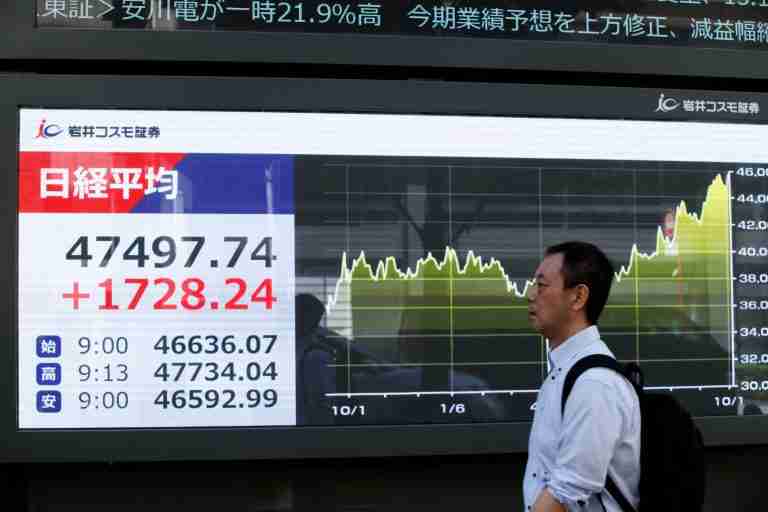
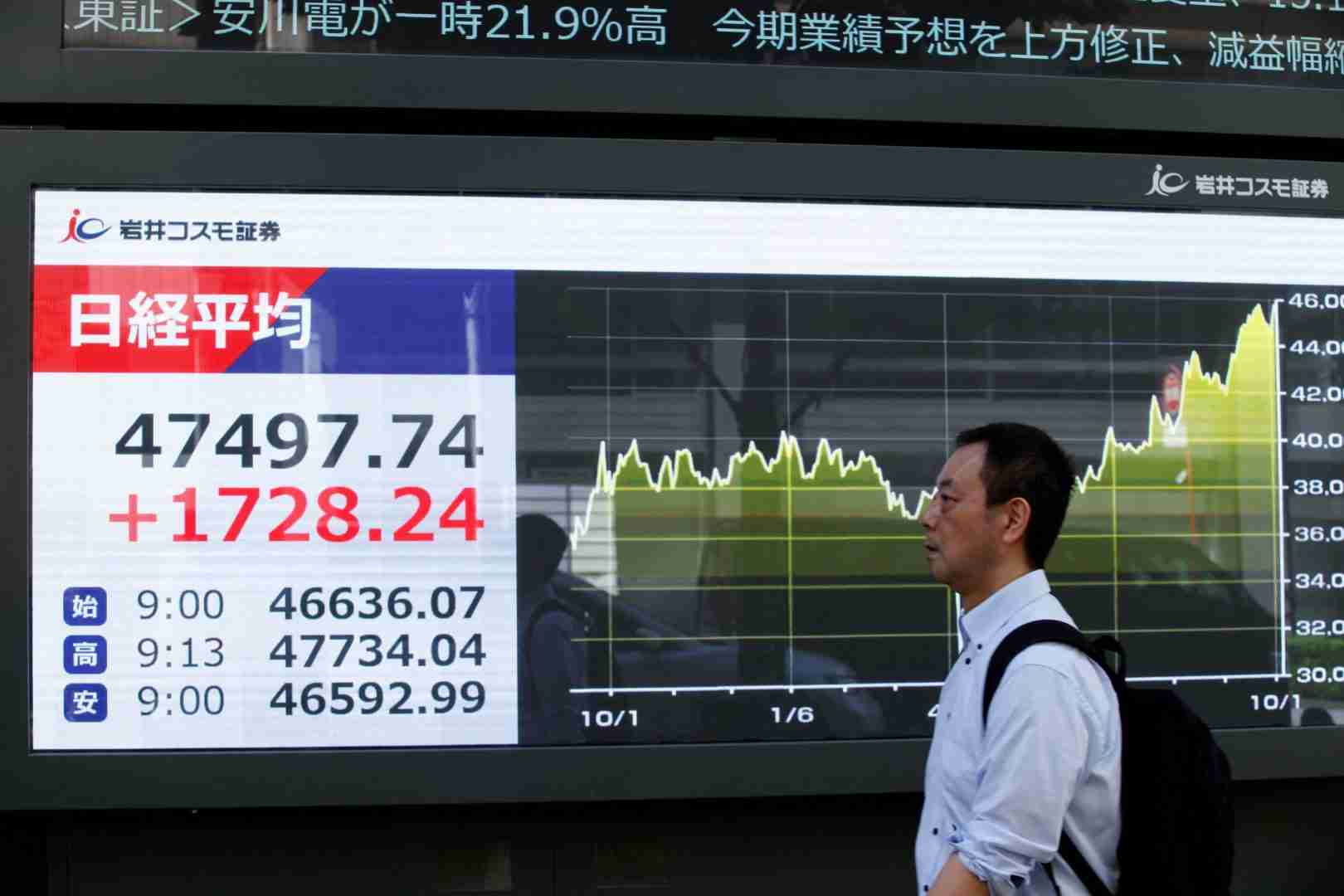
In Japan, stocks surged more than 5% to an all-time high while the yen skidded on Monday after fiscal and monetary dove Sanae Takaichi was elected as leader of the ruling party, putting her on course to become the nation’s first female prime minister.
Meanwhile, gold climbed to a record peak close to $4,000, while leading cryptocurrency bitcoin rallied to a lifetime high on Sunday, with investors increasingly turning to alternative assets as a store of value as the U.S. government shutdown frayed nerves.
Japan’s Nikkei soared above 48,000 for the first time ever after Takaichi beat the more moderate Shinjiro Koizumi in the Liberal Democratic Party’s leadership vote on Saturday, stoking expectations for fiscal stimulus.
The yen slumped as much as 2% to beyond 150 per U.S. dollar for the first time since August 1, and slid as much as 1.8% to an all-time low versus the euro at 176.25.
Worries about Japan’s finances sent the yield on 30-year government bonds to an all-time high.
SHORT-DATED JAPANESE GOVERNMENT BOND YIELDS SLIDE
At the same time, short-dated Japanese government bond yields slid to a two-week low as traders pared bets on when the Bank of Japan will resume raising interest rates.
Market-implied odds of a BOJ hike by year-end fell to 41% from 68% on Friday.
A year ago, Takaichi criticised the BOJ’s decision to raise rates as “stupid”, although her recent rhetoric has been more restrained, saying only that central bank policy should be aligned with the government.
“We believe concerns among some investors that the next administration might pursue extreme fiscal expansion or exert political pressure on the BOJ are overblown,” Morgan Stanley MUFG Securities economists wrote in a research report, noting that Takaichi’s stance appears closely aligned with BOJ Governor Kazuo Ueda’s cautious approach to policy normalisation.
Most other major share markets around the region were closed for holidays, including mainland China, South Korea and Taiwan.
Gold last changed hands around $3,942 after advancing as much as 1.5% earlier to a record just above $3,944.
Bitcoin traded around $123,988 following its jump to $125,653.32 on Sunday.
Oil prices rose after OPEC+ announced on Sunday it would increase production by 137,000 barrels per day (bpd) from November, the same modest monthly increase as in October, amid persistent concerns over a looming supply glut.
In the run-up to the meeting, sources said Russia was advocating an output increase of 137,000 bpd to avoid pressuring prices, but Saudi Arabia would have preferred double, triple or even quadruple that figure to regain market share more quickly.
Brent crude futures gained 1.6% to $65.54 a barrel.
Reporting by Kevin Buckland; Editing by Sam Holmes and Ed Osmond
To provide the best experiences, we use technologies like cookies to store and/or access device information. Consenting to these technologies will allow us to process data such as browsing behavior or unique IDs on this site. Not consenting or withdrawing consent, may adversely affect certain features and functions.
Functional
Always active
The technical storage or access is strictly necessary for the legitimate purpose of enabling the use of a specific service explicitly requested by the subscriber or user, or for the sole purpose of carrying out the transmission of a communication over an electronic communications network.
Preferences
The technical storage or access is necessary for the legitimate purpose of storing preferences that are not requested by the subscriber or user.
Statistics
The technical storage or access that is used exclusively for statistical purposes.The technical storage or access that is used exclusively for anonymous statistical purposes. Without a subpoena, voluntary compliance on the part of your Internet Service Provider, or additional records from a third party, information stored or retrieved for this purpose alone cannot usually be used to identify you.
Marketing
The technical storage or access is required to create user profiles to send advertising, or to track the user on a website or across several websites for similar marketing purposes.