Monday, November 9, 2026
Home Blog Page 744

Spain moves to criminalise gender-based abuse against victims’ loved ones

A draft bill seeks to codify so-called “vicarious”, or indirect, gender-based violence committed to intimidate, control, punish or extract revenge

International News via Reuters:

Spain’s government on Tuesday proposed a new law on gender-based violence making it a separate crime when an abuser hurts someone close to their victim — like a child, parent or pet — in order to cause the victim more pain.

A draft bill seeks to codify so-called “vicarious”, or indirect, gender-based violence committed to intimidate, control, punish or extract revenge. Mexico passed similar legislation at the federal level in late 2023.

Spain’s centre-left government has made women’s rights a priority, tightening laws on sexual consent and gender violence, expanding protections and funding for victims and pressing businesses to close pay gaps and boost female leadership.

“These measures aim to … once again put Spain at the forefront of policies promoting real equality,” Equality Minister Ana Redondo told reporters.

The legislation’s goal is to protect victims but also to raise awareness within Spanish society of “such radical, savage, inconceivable violence”, she added.

Government data identifies 65 minors as killed in cases of vicarious violence since 2013, when authorities started recording the phenomenon.

The draft bill is still subject to public consultation and advisory reports before final cabinet approval. It will then be sent to parliament, where it requires an absolute majority to become law.

The proposed changes to the criminal code would carry a prison sentence of up to three years.

They also include a new penalty for “publishing information or documents produced directly or indirectly by the perpetrator to continue causing pain and damage to the victim’s moral integrity”, according to Redondo.

This appeared to be a reaction to the unpublished book “Hatred”, which recounts the testimony of a man who killed both his children in 2011 after his wife filed for divorce.

Public outcry over the book led its publisher to cancel the planned release earlier this year.

Reporting by David Latona; Editing by Aislinn Laing, William Maclean

Explainer-Why is Britain talking about ID cards again?

The plan has revived a national debate, last played out two decades ago, in which fears about privacy and security run up against a government drive for greater control and efficiency

International News via Reuters:

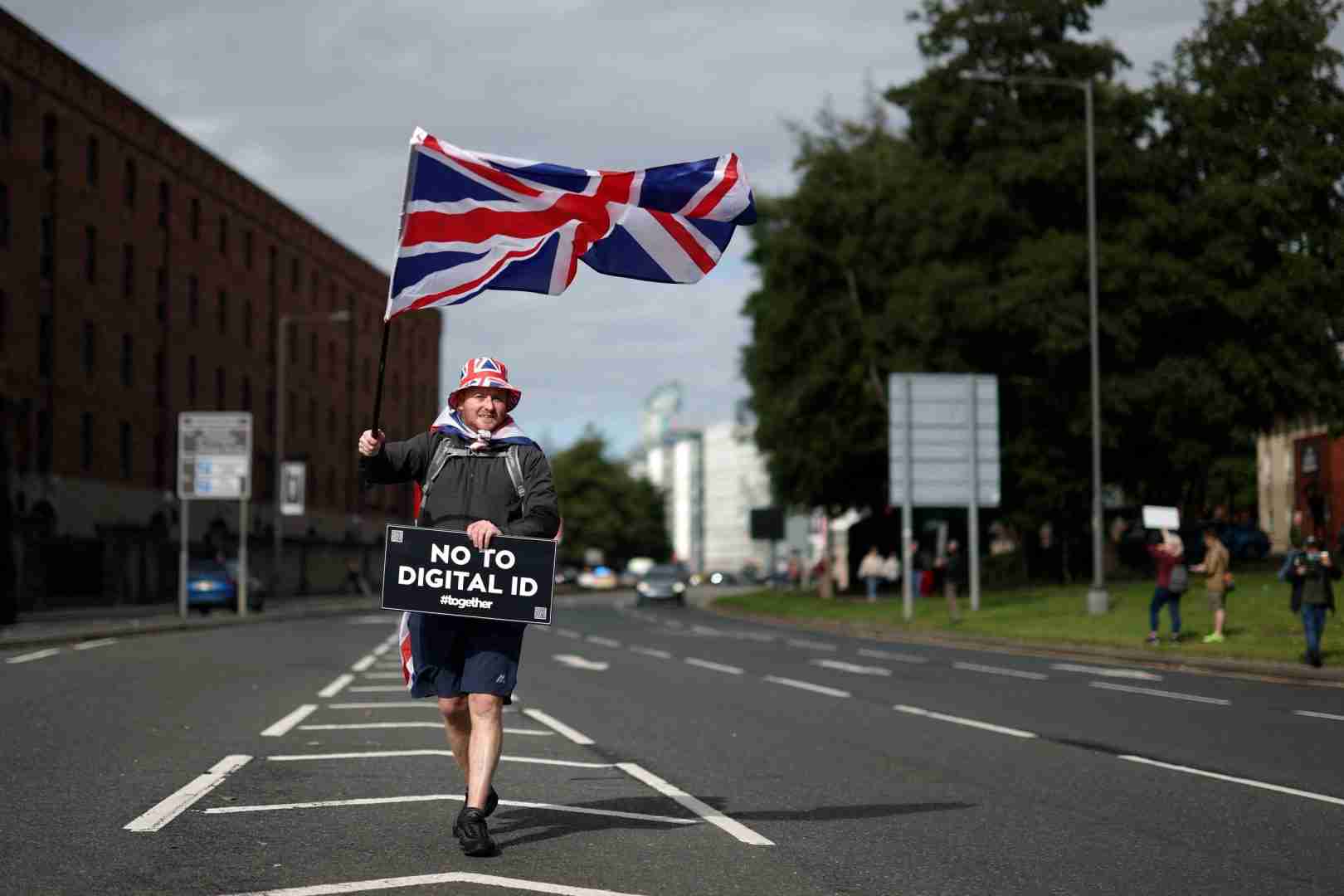
British Prime Minister Keir Starmer last week announced plans to require workers to hold a compulsory digital identity card to tackle illegal immigration.

The plan has revived a national debate, last played out two decades ago, in which fears about privacy and security run up against a government drive for greater control and efficiency.

WHY IS BRITAIN DOING THIS?

Starmer’s centre-left Labour Party is trailing in opinion polls behind Nigel Farage’s populist Reform UK party. High immigration is top of many voters’ concerns, and so far Labour’s attempts to control it have not had a big impact.

The government says digital IDs will limit access to jobs and thereby remove one of the factors drawing migrants to Britain.

Labour is trying to differentiate itself from Reform by demonstrating it is serious about immigration but with more moderate policies, said Andrew Blick, co-director of the centre for British democracy at King’s College London.

Reform has called for the mass deportation of asylum seekers and proposed scrapping the “Indefinite Leave to Remain” status which migrants can claim after five years, replacing it with a five-year renewable work visa.

WHAT WOULD A DIGITAL ID LOOK LIKE?

A free mobile app to prove a person’s identity, age and immigration status, with data protected using biometric security and encryption similar to banking apps.

It would be mandatory for employers checking right-to-work status and would replace document checks which the government says are easier to fake or circumvent. The scheme is expected to be in place before the next election, due in 2029.

It could also eventually be used to simplify access to public services.

WHY DOESN’T BRITAIN HAVE IDS ALREADY?

Britain is a relative laggard when it comes to ID cards, which were abolished after World War Two.

In the early 2000s Labour tried to introduce a compulsory ID scheme, framed as a way to bolster national security after the 9/11 attacks in the United States.

Although initially popular with the public, the projected cost of introducing the cards combined with opposition from civil liberties campaigners, who saw them as a threat to freedom and were concerned about data security, meant opinion soured.

The scheme was watered down to become voluntary, before it was scrapped when Labour lost power in 2010.

HOW DOES PUBLIC OPINION COMPARE?

In 2004, an Ipsos poll showed 80% overall support for the physical ID card proposal.

This time round public opinion is divided.

A YouGov survey on Friday showed 42% supported Starmer’s plan while 45% opposed it. Reform voters were by far the strongest opponents of the scheme.

An Ipsos poll, conducted in July before the government announcement, showed 57% of Britons support ID cards and that support for a specifically digital scheme was lower at 38%.

More than 2.5 million people have signed a petition against a digital ID.

The proposal was not included in Labour’s 2024 election manifesto.

WHAT’S DIFFERENT THIS TIME ROUND?

Now millions of Britons use phone apps to process personal data, including for payments and access to health records. During the COVID-19 pandemic apps warned of exposure to the virus and allowed people to prove their vaccination status.

The Ipsos polling showed 3 in 10 people said concerns about how their personal data might be used or sold on and the potential for misuse were reasons to oppose ID cards.

Other concerns were comparable to those raised last time.

Confidence in the government to hold information securely had fallen to 39% in July’s online survey, compared to 57% in a 2004 telephone survey. Confidence that the government could roll out an ID card scheme had fallen from 39% to 28%.

Reporting by Yoruk Bahceli and Sam Tabahriti, additional reporting by William Schomberg; Editing by William James and Janet Lawrence

Four Individual Awards for Bermuda in ECVA Final Four

The Bermuda Women’s National Volleyball team returned from the 2025 ECVA Women’s Final Four tournament with the silver medal, but their success was underlined by an outstanding haul of four individual awards, showcasing the technical quality of the Bermudian squad.

Despite falling to a 3-1 defeat against Saint Lucia in the final, the team’s strong pool play and overall performance earned significant recognition across key disciplines:

Best Blocker: Amber Simons was recognized as the tournament’s best defensive presence at the net, winning the Best Blocker award.

Best Setter: Kaylee Trott was named the Best Setter, highlighting the high standard of Bermuda’s court distribution and offensive organisation.

Best Server: Megan Hands was awarded the Best Server trophy, acknowledging her effectiveness and consistency from the service line throughout the competition.

Second Best Spiker: Natalie Gazzard was honored as the Second Best Spiker of the tournament, recognizing her powerful and efficient hitting on the attack.

The four individual awards are a testament to the comprehensive development of the Bermuda National Team, providing a major boost to the program even as they narrowly missed out on the ultimate prize of qualification for the 2026 NORCECA Panamerican Cup.

Grasberg mine accident tightens global copper supply estimates

Freeport’s Grasberg operation located in Indonesia suspended operations on September 8 after a deadly mud slide

International News via Reuters:

Metals analysts are cutting their estimates of global copper supplies for this year and next after an accident at the giant Grasberg mine dramatically tightened the outlook for the market.

Copper prices hit 15-month highs of $10,485 a metric ton last week after Freeport-McMoRan declared force majeure at its Grasberg mine and cut sales forecast from the Indonesian unit for this year and 2026.

Freeport’s Grasberg operation located in Indonesia suspended operations on September 8 after a deadly mud slide.

The world’s second-largest copper mine behind Chile’s Escondida faces a lengthy damage assessment process and a clear-up while the search for missing workers continues.

“The scale of this disruption is very big,” said Albert Mackenzie, a copper analyst at Benchmark Mineral Intelligence.

Benchmark’s analysis suggests the disruption will amount to 591,000 tons of lost copper output between September 2025 and the end of 2026.    

This amounts to 2.6% of the 2024 global mine production estimated at around 23 million tons by analysts. 

Supply losses from Grasberg mean the global copper market is facing a significantly wider deficit of around 400,000 tons in 2025, according to Benchmark Minerals.

The disruption has shifted Goldman Sachs’ 2025 copper market balance from a projected surplus of 105,000 tons to a deficit of 55,500 tons. It expects a small surplus in 2026.

With the losses in Grasberg’s September-December production, the copper market faces the largest deficit since 2004, Societe Generale said on Monday.

The suspension at Grasberg follows other large disruptions this year including Kamoa-Kakula in the Democratic Republic of Congo and El Teniente mine in Chile.

This year’s mine supply was already expected to come in below every forecast over the past 15 years and this is now exacerbated by unexpected supply disruptions, Bank of America analyst Michael Widmer said in a note.

BofA raised its estimate of the 2026 copper market deficit to 350,000 tons from a previous 162,000 tons and upgraded its 2026 and 2027 copper price forecast by 11% and 12.5% to $11,313 a ton and $13,500 respectively.

Copper’s record high was in May 2024, when it hit $11,104.50 a ton.

Reporting by Polina Devitt; editing by Tomasz Janowski

Jordan-Whitter’s UNE Tennis Rolls to 7-0 Sweep

The University of New England (UNE) women’s tennis team, guided by Bermudian Head Coach Jovan Jordan-Whitter, continues to impress in its inaugural season, delivering a dominant 7-0 sweep over the University of Hartford in a Conference of New England (CNE) match.

The victory improves the Nor’easters’ overall record to 6-1 and their CNE standing to 2-1.

The team set the tone early by clinching the doubles point, led by Madeline Frank and Nora Hill’s spirited 6-4 comeback at the No. 1 spot.

The singles matches saw relentless dominance:

  • Alyssa Fritschka (No. 5) and team captain Sydney Pelletier (No. 6) both delivered flawless 6-0, 6-0 victories.
  • Madeline Frank (No. 1) sealed the overall team win 6-0, 6-1.
  • The shutout was completed by Nora Hill (No. 2), who was pushed to a thrilling tie-breaker in the second set before securing the 6-4, 7-6 victory.

The result is a major statement for Jordan-Whitter’s squad, who are performing well above expectations in their first varsity season.

Bank of England’s Mann says high UK inflation has become persistent

In August, the BoE set out a potential scenario where a combination of weak productivity growth and fast-rising wages led to more lasting inflationary pressure than in its main forecast

International News via Reuters:

Bank of England interest rate-setter Catherine Mann said on Tuesday she thought Britain’s inflation rate had become persistently high – although that did not mean further interest rate cuts were completely off the table.

“For those of you who might have read the August Monetary Policy Report … there was an inflation persistence scenario in that,” Mann told a seminar organised by the Financial Times and S&P Global Market Intelligence.

“I believe that that inflation persistence scenario is playing out,” she added.

In August, the BoE set out a potential scenario where a combination of weak productivity growth and fast-rising wages led to more lasting inflationary pressure than in its main forecast, which sees inflation returning to target by mid-2027.

But uncertainty over the economic outlook means that further reductions in borrowing costs cannot be ruled out, she said.

Mann voted with a majority of the Monetary Policy Committee members this month to keep the BoE’s benchmark Bank Rate unchanged. In August she was in the minority who opposed a cut to 4%.

The BoE expects inflation to hit 4% in September but it is also worried about a slowdown in economic growth.

Earlier on Tuesday, BoE Deputy Governor Clare Lombardelli said central banks should be careful about assuming that inflation shocks are temporary.

Another MPC member Megan Greene last week called for a cautious approach on cutting rates while Governor Andrew Bailey said he thought borrowing costs would fall but it was not clear when or by how much. On Monday, Deputy Governor Dave Ramsden said he was confident rates could be cut further.

At the MPC’s September meeting, Mann voted for the BoE to reduce its government bond holdings at a more gradual pace than that chosen by the majority of the committee’s members.

A slower pace of quantitative tightening would avoid having to sell too many medium-dated gilts and allow a more cautious approach as Britain’s financial system adjusts to a less ample central bank reserves framework.

“I think we’re closer than other people think to a more upward sloping, steeper sloping part of the reserves demand curve,” she said, adding that she disagreed with the BoE’s decision this month to skew sales away from long-dated gilts.

Writing by William SchombergEditing by David Milliken and Gareth Jones

Storm update: Conditions deteriorating as Humberto nears the island

A weakened Humberto will come closest in the early hours of tomorrow; Imelda will be a direct hit and closest to Bermuda tomorrow night

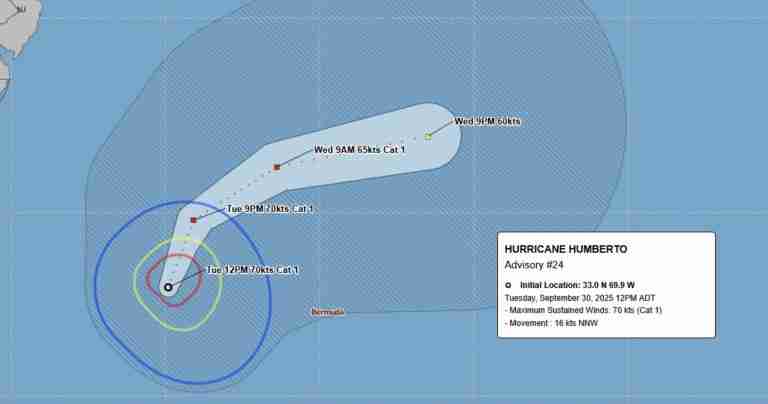
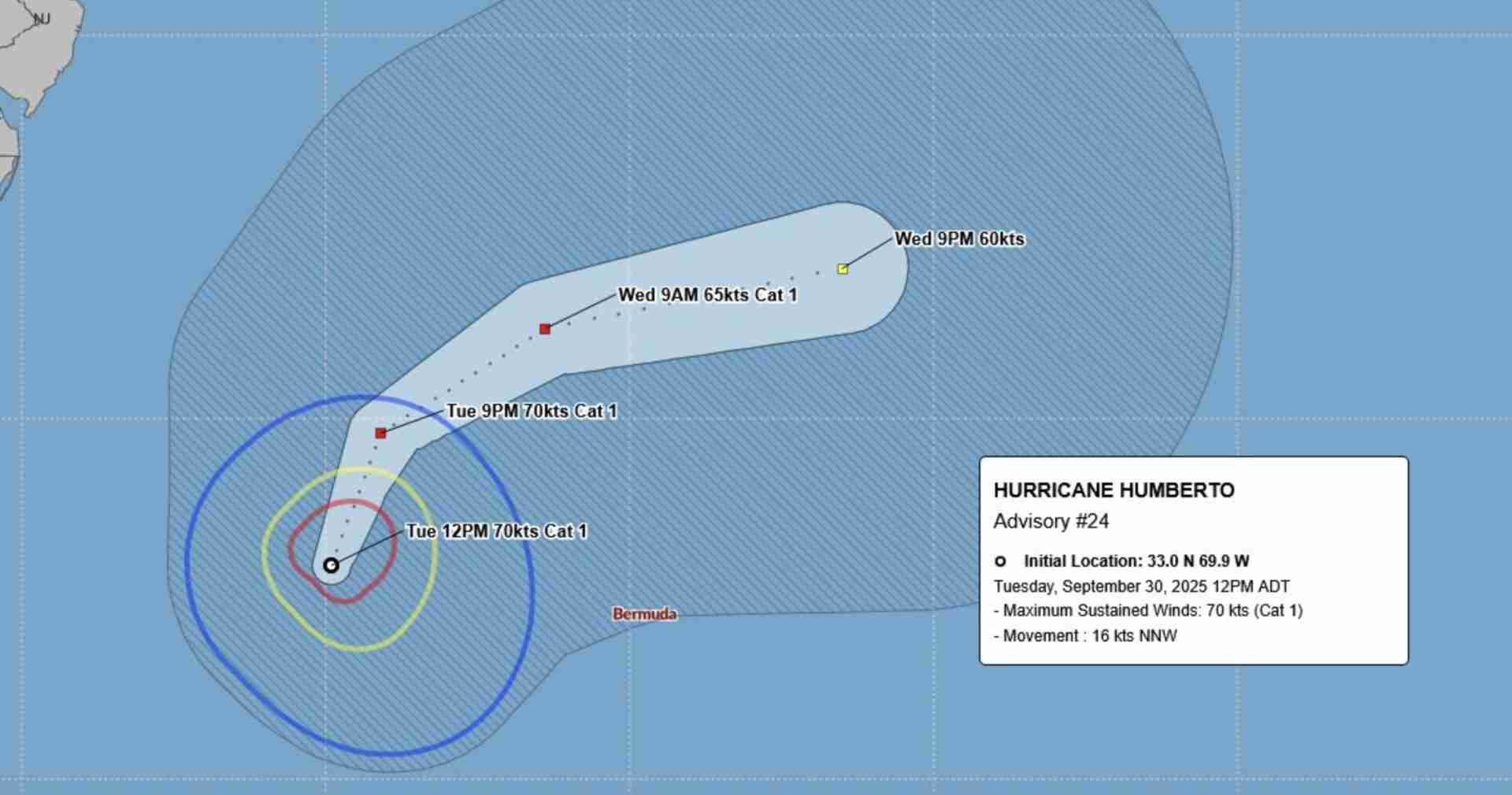
The latest forecast from the Bermuda Weather Service has Hurricane Humberto coming closest to Bermuda at 4am tomorrow, when it will be 241 nautical miles to our north-west.

Humberto has weakened to a Category 1 system but is packing winds of 70 knots with gusts up to 85 knots. Hurricane force winds extend outwards up to 70 miles from the centre and tropical storm force winds extend outwards up to 205 miles.

Humberto, which is moving north-north-west at 18 mph, is expected to bring rainfall of up to two inches.

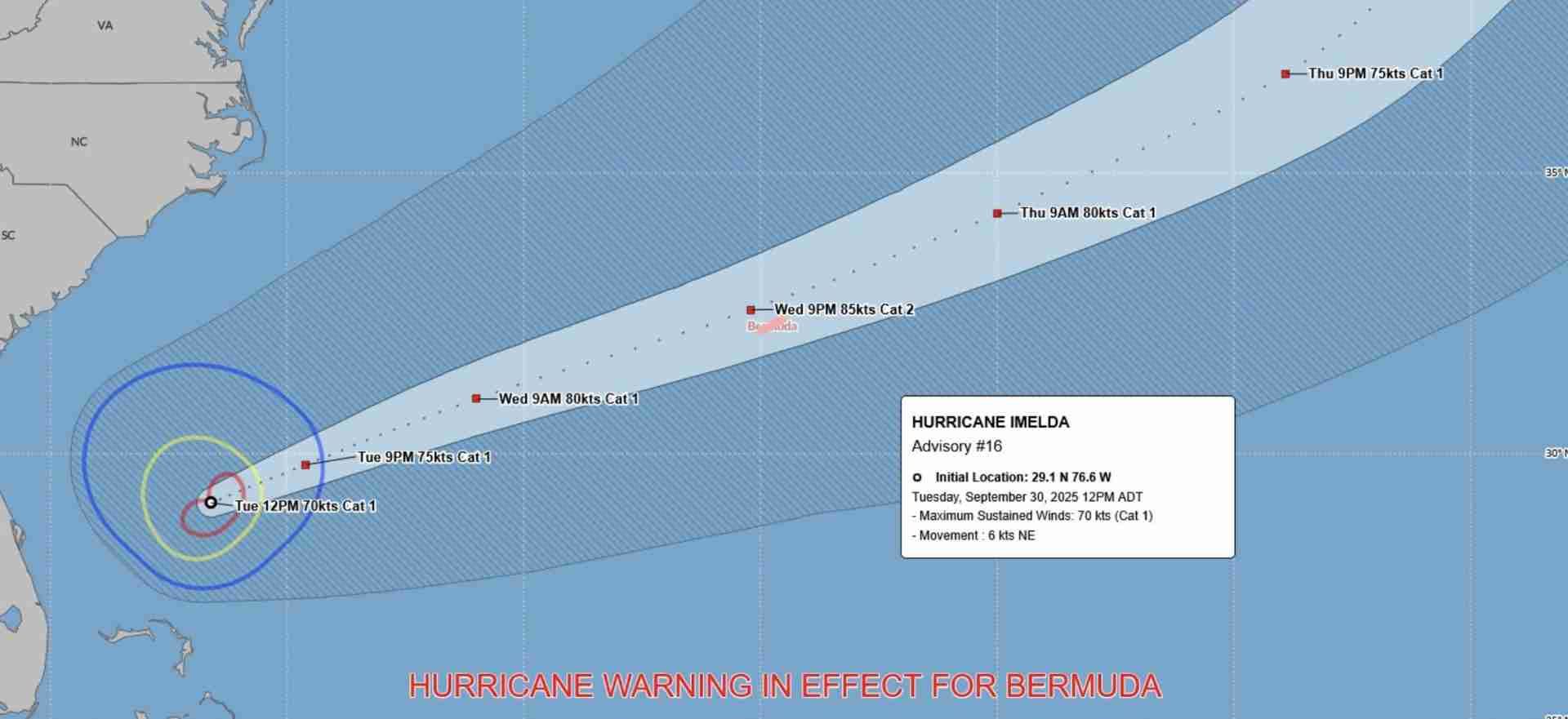
Meanwhile, Hurricane Imelda is expected to pass within 25 nautical miles of Bermuda – or even make a direct hit – at 9pm tomorrow. At that point Imelda is expected to be a Category 2 hurricane.
Imelda is currently packing winds of 70 knots, gusting to 85 knots.
Hurricane force winds extend outwards up to 45 miles from the centre and tropical storm force winds extend outwards up to 185 miles. Imelda is moving north-east at 7 mph.

Causeway to close 6pm tomorrow; Schools out Wed & Thur

The Ministry of National Security provide the latest on Bermuda’s response to Hurricanes Humberto and Imelda

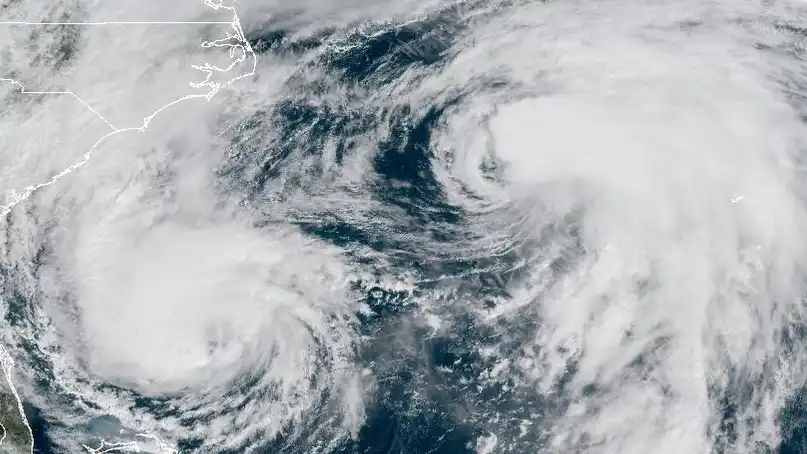
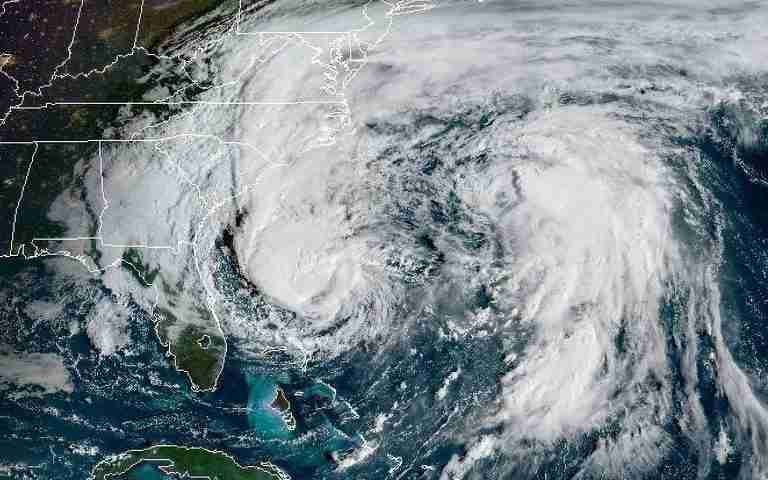
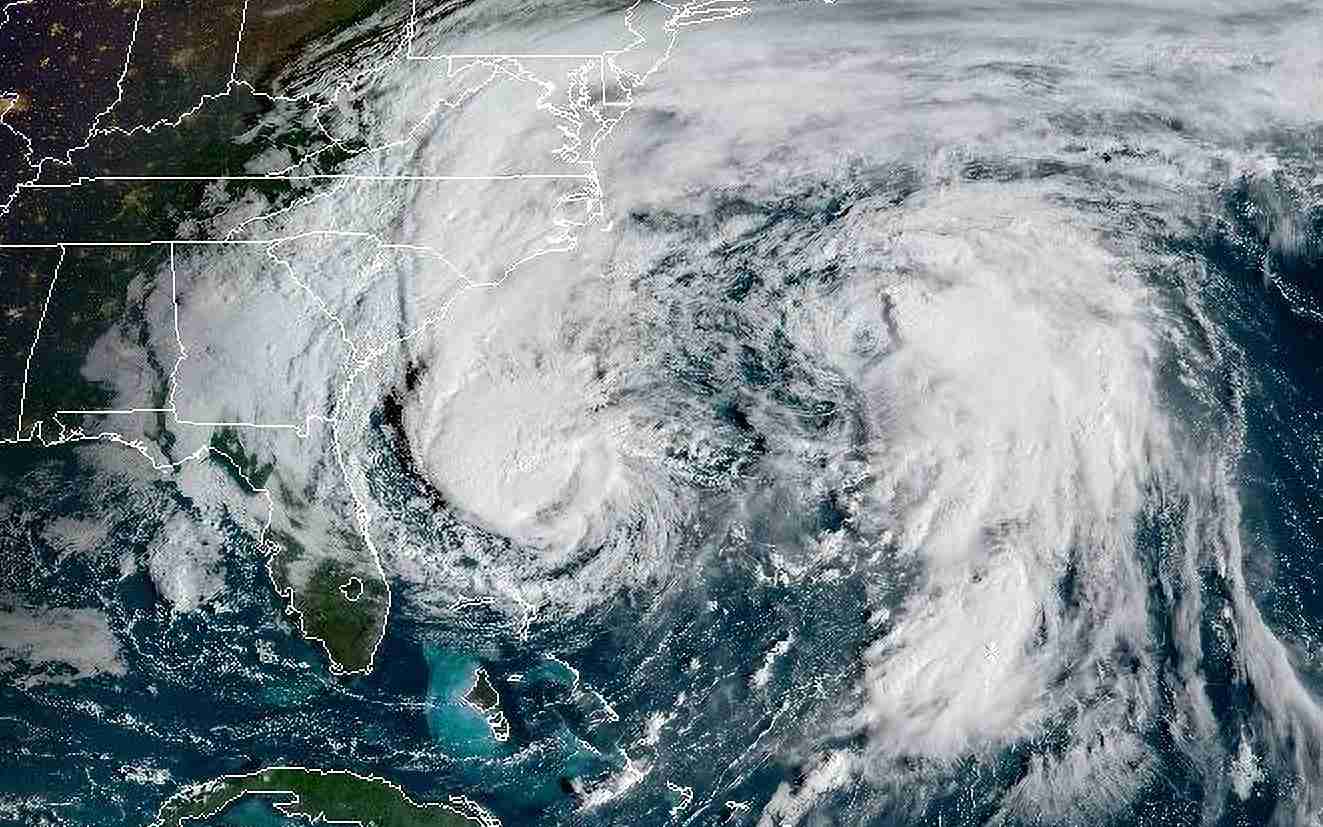
Hurricanes Imelda and Humberto in the Atlantic on Tuesday 30th September. Bermuda can be seen on the far right. Photo via NOAA.

Minister of National Security Michael Weeks hosts a briefing on September 30th to provide an Emergency Measures Organisation update regarding Hurricane Humberto and Tropical Storm Imelda. (REFRESH for latest)


Humberto is set to impact us today and this evening, but Imelda is the storm of primary concern.

This from National Security Minister Michael Weeks.

Imelda has just been upgraded to a hurricane, and Bermuda is under a Hurricane Warning.

50kt wind will start impacting Bermuda Wednesday evening, and rise to hurricane force by 10pm.

Up to 60-80kt winds, with gusts up to 100kt, for a period of up to 6 hours into early Thursday.

Minister Weeks reiterated the seriousness of the situation, as Imelda is expected to bring hurricane force winds for 4-6 hours.

Now is the time to act, he said, and all preparations for Imelda must be complete by noon on Wednesday. Conditions will begin to deteriorate after that time.

Closures

The EMO has determined that the Causeway will close at 6pm on Wednesday.

All public schools will be closed Wednesday and Thursday, and will reopen after an assessment.

Bus service stop at 4pm on Wednesday, ferry service is suspended from 8pm Tuesday.

The airport will close on Wednesday, and will reopen following an assessment on Thursday.

All Government offices will close by 1pm on Wednesday,

The Emergency Shelter will be located at CedarBridge Academy, opening 4pm Wednesday.

Everyone should plan to be off the roads by 2pm on Wednesday.

Firefighter Williams Conquers 153-Mile Spartathlon

Bermudian firefighter Jason Williams has achieved a monumental feat of human endurance, successfully completing the Spartathlon 2025 ultramarathon. The race, often cited as the world’s most grueling foot race, covers a punishing 153-mile (246km) course from Athens to Sparta.

Williams tackled the challenging course—which includes rough tracks, muddy paths, and the 1,200-metre ascent and descent of Mount Parthenio in the dead of night—with immense fortitude.

The full-time Bermuda firefighter crossed the finish line in a time of 35 hours, 16 minutes, and 05 seconds.

His success in finishing the multi-day event, which began at the foot of the Acropolis on the last Friday of September, is a testament to his mental toughness and rigorous training, securing him a place among the elite few who conquer this historic distance.

Bermuda under Hurricane Watch for Imelda

Potential upgrade to Hurricane Warning as the storm strengthens

National Hurricane Center satellite view of Hurricanes Humberto and Imelda

Rainbands from Hurricane Humberto swept across the Island overnight, bringing moderate to heavy showers and occasional lightning. Conditions are expected to remain unsettled today, with additional bands producing showers and isolated thunderstorms as Humberto passes to the distant west.

Winds, which reached 18–24 knots overnight, are forecast to strengthen to 20–30 knots this afternoon, with gusts up to 40 knots. By evening, winds will veer southerly at 25–35 knots, with gusts potentially reaching 50–55 knots in squally showers. Offshore seas of 10–15 feet are forecast to build to 18 feet later today.

Meanwhile, a Hurricane Watch is in effect for Bermuda due to developing Tropical Storm Imelda, which is expected to intensify. Officials anticipate upgrading the watch to a Hurricane Warning later today.

Residents are urged to monitor official updates and prepare for rapidly changing conditions.

Pandora CEO to retire in 2026, replaced by marketing chief

Pandora’s share price fell 2% by 0931 GMT following the announcement and are down 37% year-to-date as the Danish company struggles with weak European sales

International News via Reuters:

Jewellery maker Pandora’s CEO Alexander Lacik will retire next March after nearly seven years in charge and be succeeded by marketing chief Berta de Pablos-Barbier, the company said on Tuesday in an earlier than expected move.

Pandora’s share price fell 2% by 0931 GMT following the announcement and are down 37% year-to-date as the Danish company struggles with weak European sales, rising commodity prices and U.S. import tariffs.

De Pablos-Barbier, formerly CEO of LVMH’s champagne brand Moet & Chandon, was hired in November last year as a potential future leader of the group, and was the strongest candidate for CEO, Pandora said in a statement.

Investors had not expected her to take the helm so soon.

De Pablos-Barbier said she would continue Lacik’s long-term strategy of building the company beyond its traditional focus on bracelets to make it a full jewellery brand.

“We have to stay true to what Pandora is. Pandora is an accessible luxury brand,” de Pablos-Barbier told Reuters.

WEAK EUROPEAN DEMAND

Lacik’s departure is the latest in a series of CEO exits this year at European retail and consumer brands, which included Francois-Henri Pinault at Gucci owner Kering, Laurent Freixe at Nestle and Debra Crew at Diageo.

De Pablos-Barbier has enjoyed a 30-year career in luxury and consumer goods. Other companies she has worked at include Mars Wrigley, Lacoste and jeweller Boucheron.

“She is the right person to lead our continued growth, and I am pleased that we can maintain strategic focus and momentum during this smooth and orderly leadership transition,” Pandora Chair Peter Ruzicka said.

Pandora’s share price tripled during Lacik’s tenure as CEO, which began in 2019. After a dip in sales during the pandemic, the group’s revenue recovered sharply but growth has been hit this year by weak demand in Europe and the impact on costs of new U.S. tariffs.

The group announced in 2021 that it would stop selling mined diamonds, opting instead for lab-made versions to attract younger shoppers with less expensive stones guaranteed not to have come from conflict zones.

Reporting by Elviira Luoma and Louise Breusch Rasmussen; Editing by Terje Solsvik, Kate Mayberry and Susan Fenton